Grow Forget Me Not – All USDA Zones | 7–14 Days to Sprout, Grow Instantly
You’ve seen them before — those tiny, sky-blue flowers that turn an ordinary garden into something out of a storybook. Forget-me-nots.
They bloom in early spring when most gardens still look bare. They fill gaps between tulips, soften rose beds, and spill beautifully over the edges of pots. And the best part? They’re incredibly easy to grow — even for complete beginners.
Whether you want to grow forget-me-nots from seed, fill a shady corner, or just keep them coming back every year, this guide has everything you need. Let’s get into it.
What Is a Forget-Me-Not Plant?
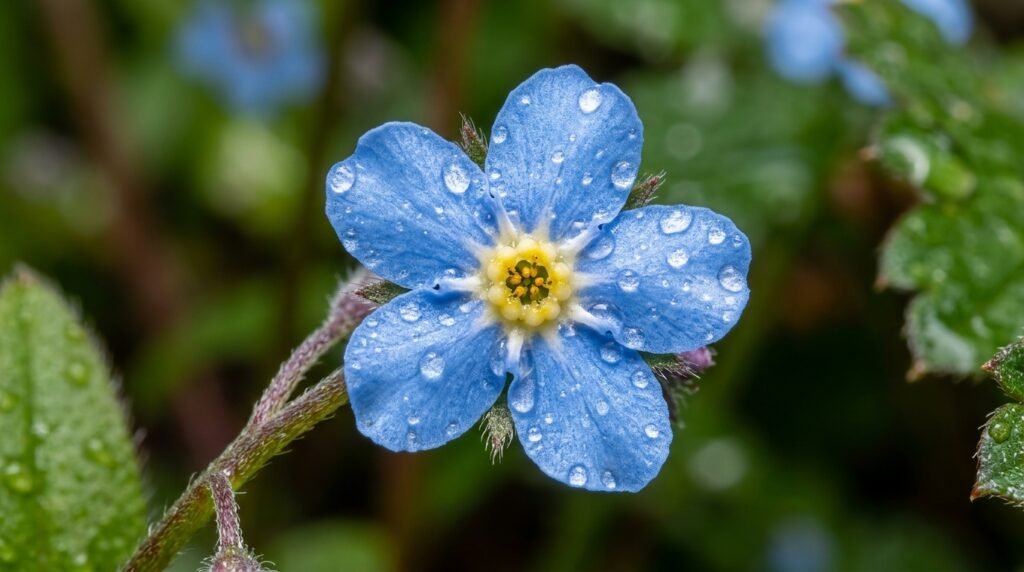
The forget-me-not plant (Myosotis sylvatica) is a small, delicate flowering plant that belongs to the Boraginaceae — the borage family. It’s native to Europe and parts of Asia, and has naturalised across much of the world wherever cool, moist conditions exist.
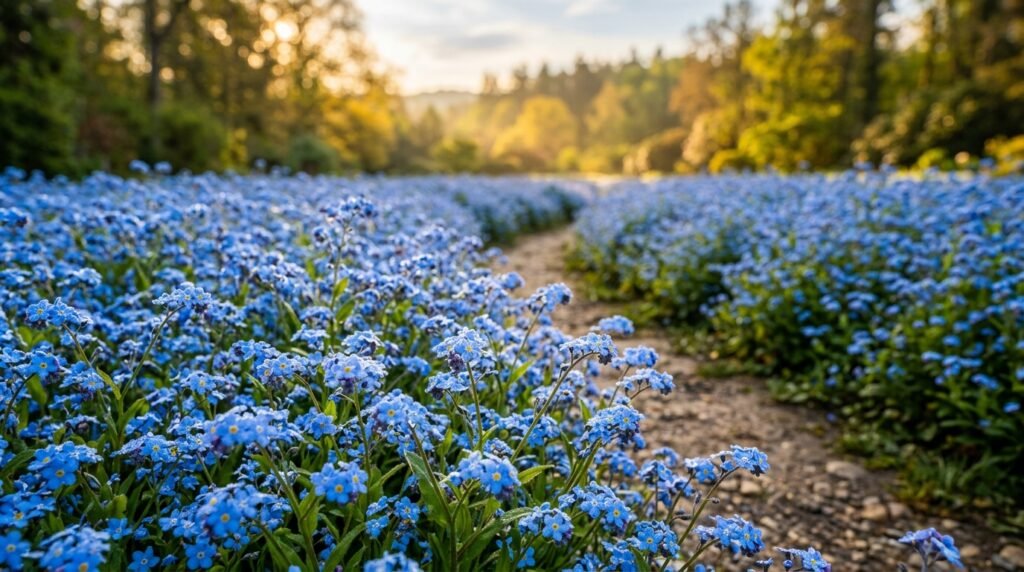
The plant produces clusters of tiny five-petalled flowers, most commonly in shades of blue, but also available in pink and white. Each bloom has a distinctive yellow or white eye at the centre — a small detail that makes the flower instantly recognisable.
Most forget-me-not plants grow 6 to 12 inches tall and form loose, bushy mounds. They’re cool-season plants — thriving in spring, fading in the heat of summer — and they self-seed so freely that once you plant them, they tend to come back every year without any help from you.
The name itself comes from a German legend. A knight picking forget-me-not flowers from a riverbank for his lady fell into the fast current. As he was swept away, he threw the flowers toward her and cried out “Vergiss mein nicht!” — “Forget me not!” The story spread across Europe, and the name became inseparable from the flower.
Today, forget-me-nots are grown in gardens, pots, woodland borders, and wildflower meadows all over the world. And for good reason — they’re genuinely easy to grow, stunningly beautiful, and full of meaning.

Types and Varieties of Forget-Me-Not — Which One Should You Grow?
Not every plant labelled ‘forget-me-not’ is the same species. Here’s what you’re actually dealing with when you see that familiar name:
1. Myosotis sylvatica — Classic Wood Forget-Me-Not
This is the one everyone pictures. Myosotis sylvatica — often called the wood forget-me-not or garden forget-me-not — produces masses of small blue flowers with a yellow centre from early spring through early summer. It grows 6–12 inches tall, thrives in partial shade, and self-seeds prolifically. Hardy in USDA zones 3–8. This is the forget-me-not most commonly sold as seeds or transplants at garden centres.
2. Chinese Forget-Me-Not (Cynoglossum amabile)
Despite the similar common name, Chinese forget-me-not is a completely different genus — Cynoglossum rather than Myosotis. It grows taller (up to 24 inches), prefers full sun, and blooms in summer rather than spring. Chinese forget-me-not sprouts emerge within 7–14 days of sowing and the plants are more heat-tolerant than their Myosotis cousins. Chinese forget-me-nots are true annuals.
3. Cape Forget-Me-Not (Anchusa capensis)
Native to South Africa, the cape forget-me-not produces vivid cobalt-blue flowers and handles drier, warmer conditions than Myosotis. Grown as an annual in most climates. A brilliant choice if your garden gets hotter summers.
4. Creeping Forget-Me-Not (Myosotis scorpioides)
Also called water forget-me-not, this species loves wet ground and pond margins. It spreads by creeping stems and produces soft blue flowers in spring and early summer. Perfect for bog gardens or beside water features.
5. Armenian Forget-Me-Not
A compact, vivid variety suited to rock gardens and low borders. The Armenian forget-me-not has a long blooming period and produces jewel-bright blue flowers. Excellent for edging paths.
6. Jack Frost Forget-Me-Not
The jack frost forget-me-not is known for its silvery-white marbled foliage as much as its flowers. Often used as a ground cover under trees or as a companion to shade plants. The variegated leaves look decorative even when not in bloom.
7. Chatham Island Forget-Me-Not (Myosotidium hortensia)
The dramatic showstopper of the family. The Chatham Island forget-me-not produces enormous clusters of blue flowers — clusters can reach 60 centimetres wide — on bold, glossy foliage. It needs a sheltered spot with coastal conditions and is not widely hardy, but if you can grow it, it’s breathtaking.
8. Forget-Me-Not Rose Varieties
Some rose varieties have been named after forget-me-nots due to their small, clustered blooms or blue-tinted colouration. The forget-me-not rose pairing in the garden is a classic cottage combination — not a rose variety itself, but the traditional companion planting of roses and forget-me-nots grown together.
9. Hydrangea Forget-Me-Not
Hydrangea forget-me-not is a companion planting term used when blue Myosotis is planted at the feet of blue hydrangeas to extend the blue colour palette throughout the growing season. It’s not a plant variety — it’s a design idea, and a very good one.
Not sure which long-lasting plants suit your garden best? Our Long-Life Plants Selector helps you choose plants that stay beautiful season after season — perfect for combining with forget-me-nots.
Forget-Me-Not Flower Colours — Blue, Pink, White and Beyond
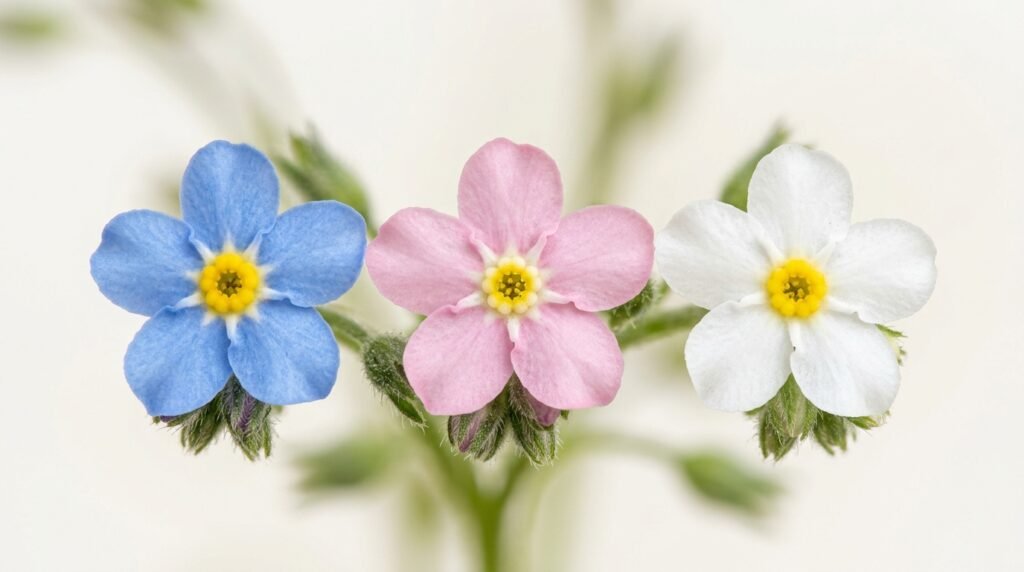
💡 Quick Answer: Forget-me-not flower colours include classic blue, forget-me-not flower pink, and white forget-me-not. Unlike hydrangeas, forget-me-not flower colours do not change with soil pH — the colour you plant is the colour you get.
Most people think forget-me-not means blue. And yes — the classic forget-me-not blue is iconic. That particular shade of soft cornflower blue with a tiny yellow centre is one of the most distinctive flower colours in all of gardening. But the colour range is broader than most people realise.
- Blue forget-me-not — The classic. Ranges from soft sky blue and powder blue to deeper cobalt and ultramarine tones. The most common and most widely sold variety.
- Forget-me-not flower pink — Soft, romantic, and beautiful. Pink-flowered varieties like ‘Rosylva’ and ‘Victoria Rose’ are increasingly popular in cottage gardens. They blend beautifully with white tulips and pale roses.
- White forget-me-not — Clean, elegant, and versatile. White varieties create a crisp look and brighten shaded spots. They pair particularly well with blue or purple spring bulbs.
- Purple forget-me-not — Less common, but deeply beautiful. Some varieties shift toward lavender or soft violet, particularly as they age.
- Bicolour forget-me-not — Certain cultivars produce flowers that start pink and fade to blue as they mature, creating a multi-toned effect across a single plant.
Forget-me-not flower colours don’t require any special soil treatment to achieve. Choose your colour when you buy your seeds or transplants, and that’s exactly what will bloom. Simple.
When Do Forget-Me-Not Flowers Bloom — And How Long Does It Last?
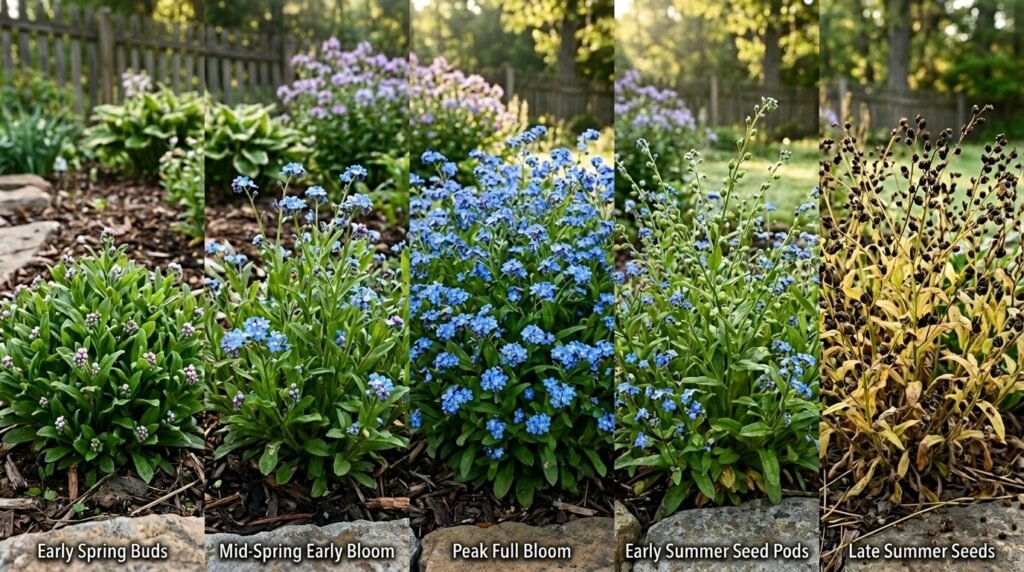
💡 Quick Answer: Myosotis sylvatica typically blooms from early spring to early summer — March to June in most temperate climates. Chinese forget-me-nots bloom in summer. Forget-me-nots do not bloom all summer in most climates.
When do forget-me-not flowers bloom? The answer depends on which species you’re growing and where you live.
Myosotis sylvatica — the standard garden forget-me-not — is a true spring flower. Bloom period typically runs from early spring through early summer. In mild UK winters and temperate US zones, expect flowers from March through May or into June. In warmer climates (USDA zone 7 and above), flowering may begin as early as February.
Do forget-me-nots bloom all summer? Not usually. Classic Myosotis is a cool-season annual that starts to fade when temperatures consistently rise above 70°F (21°C). As heat builds, the plant redirects its energy into setting seed and begins to decline. This is completely normal — it’s not dying from disease, it’s completing its lifecycle.
Can you extend the bloom period? Yes, with a few tricks:
- Deadhead regularly — removing spent flowers pushes the plant to produce more blooms.
- Water consistently — dry conditions accelerate decline.
- Provide afternoon shade in warm climates to keep temperatures lower around the plant.
- Grow Chinese forget-me-nots alongside Myosotis to continue the blue-flower display into summer.
The short-lived perennial nature of forget-me-nots is actually part of their charm. They arrive, bloom abundantly, drop their seeds, and fade — leaving the garden to the next season’s players. But their seeds are already in the soil, ready to start the cycle again.
Planning your full garden calendar around these spring flowers? Our Bush Trimming Calendar helps you schedule all your seasonal garden tasks alongside your forget-me-not bloom period.

How to Grow Forget-Me-Nots from Seed — The Complete Step-by-Step Guide
Growing forget-me-not from seed is one of the most satisfying things you can do in the garden. These are genuinely easy-to-grow plants — the kind that reward a beginner’s first attempt and a seasoned gardener’s thousandth planting equally well.
When to Sow Forget-Me-Not Seeds
Timing is everything with forget-me-nots. For a spring flower display, sow seeds in late summer or early autumn — August through September in the Northern Hemisphere. Seeds sown at this time will germinate, establish through autumn, overwinter as young plants, and burst into bloom in early spring.
If you miss the autumn window, you can also direct sow forget-me-not seeds in early spring (as soon as the soil can be worked) for a slightly later display. In USDA zones 7 and above, spring sowing works particularly well.
How to Plant Forget-Me-Not Seeds Indoors
Starting seeds indoors gives you more control and is ideal for gardeners who want to get a jump on spring:
- Fill small pots or seed trays with fine, moist potting mix. Don’t use heavy compost — a light, well-drained mix works best.
- Scatter forget-me-not seeds thinly across the surface. These are tiny seeds — don’t overdo it.
- Do not bury the seeds deeply. They need light to germinate — a light pressing into the surface is all that’s needed.
- Mist gently with a spray bottle and cover with a clear propagator lid or plastic wrap.
- Place in a cool location — ideal temperature is 55–65°F (13–18°C). A cool windowsill, unheated greenhouse, or cold frame works well.
- Forget-me-not seeds germinate in 7–14 days under these conditions.
- Once seedlings appear, remove the cover and ensure good air circulation to prevent damping off.
- When seedlings have two true leaves (beyond the initial seed leaves), thin or transplant to 6–9 inches apart.
Getting your potting mix right matters. Our Orchid Potting Mix Calculator gives you a feel for how mix components affect drainage and moisture retention — the same principles apply to your forget-me-not seed trays.
How to Plant Forget-Me-Not Seeds in a Pot
Forget-me-not seeds germinate well in containers. Choose a pot at least 8–10 inches deep with drainage holes in the base. Fill with moist, well-drained potting mix — not garden soil, which compacts in containers. Sow seeds as described above, mist gently, and place in a cool, partially shaded spot. Water regularly and thin seedlings once they’re 2–3 inches tall.
Use our Soil Calculator for Pots to calculate exactly how much potting mix you need for any container size — no guessing, no wasted compost.
How to Direct Sow Forget-Me-Not Seeds Outdoors
Direct sowing forget-me-not seeds in the garden is the simplest method — and it works beautifully. Prepare the soil by removing weeds and raking to a fine tilth. Scatter seeds thinly across the prepared area and rake very lightly to ensure soil contact. Water gently with a fine rose watering can. Once seedlings are 2–3 inches tall, thin to 6–9 inches apart to allow good air circulation.
In warmer zones, you can sow forget-me-not seeds directly into raised beds or borders in autumn for a spectacular early spring display. The cool winter temperatures actually help vernalise the seeds and improve germination rates.
Planning a raised bed? Our Build a Raised Bed Yourself guide walks you through the full process, and our Soil Calculator for Raised Garden Beds tells you exactly how much soil you’ll need to fill it.

Forget-Me-Not Seedling Identification — What Do Young Plants Look Like?
Forget-me-not seedling identification is straightforward once you know the signs. Young Myosotis plants follow a predictable pattern:
- First stage — Two rounded, smooth cotyledon (seed) leaves appear. These are oval and mid-green, about 5–8mm long.
- Second stage — True leaves emerge between the cotyledons. These are elongated, slightly textured, and covered in fine soft hairs — a distinctive Boraginaceae family trait.
- Third stage — The plant forms a low rosette of hairy, mid-green leaves, staying flat to the ground through winter before sending up flowering stems in spring.
The soft, fuzzy texture of forget-me-not leaves is the key identification feature. Run your finger along a leaf — if it feels like very fine velvet, you’ve got a forget-me-not seedling. Chinese forget-me-not sprouts look similar but are slightly larger and more upright from an early stage.
Don’t confuse forget-me-not seedlings with common weeds. Chickweed has smooth, shiny leaves. Hairy bittercress has pinnate (divided) leaves. Forget-me-not true leaves are always simple (undivided) and softly hairy.
The Perfect Growing Conditions for Forget-Me-Not Plants
Sun or Partial Shade?
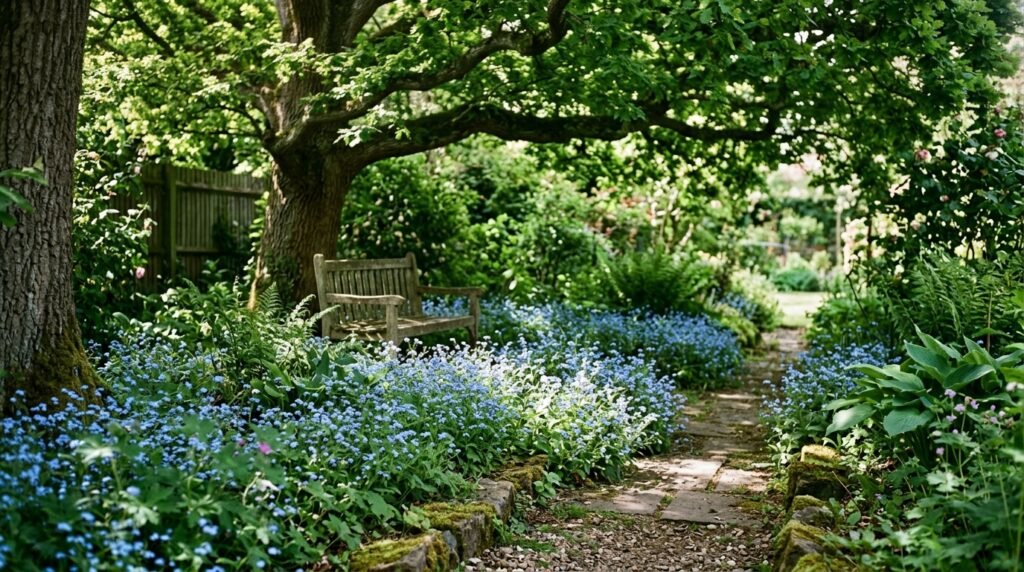
Forget-me-nots are most at home in partial shade or in a spot that receives morning sun with afternoon shade. They can tolerate full sun in cooler northern climates (USDA zones 3–5), but in zones 6 and above, afternoon shade is strongly recommended — it keeps the soil cooler and significantly extends the bloom period.
A shady spot with bright indirect light is often ideal. Think: the north side of a fence, beneath deciduous trees before they fully leaf out, or in the dappled shade of an established border. Forget-me-nots thrive in spots where many other flowering plants struggle — making them genuinely valuable for partially shaded gardens.
Soil — Moist, Well-Drained, and Fertile
The forget-me-not plant prefers moist, well-drained soil that’s rich in organic matter. ‘Moist well-drained soil’ is the sweet spot — consistently damp but never waterlogged. Heavy clay that holds water around the roots will cause the plant to rot; dry, sandy soil will stress it quickly.
If your soil is heavy clay, improve drainage by digging in grit and compost before planting. If your soil is very sandy and struggles to retain moisture, adding compost will help it hold water better.
Not sure what type of soil you’re working with? Our Soil Type Guide breaks down the characteristics of every soil type and explains exactly how to improve each one for better plant growth.
Watering — Consistent Moisture, Base-Level Delivery
Keep soil consistently moist, especially during spring growth and flowering. The key rule: avoid overhead watering where possible. Wet foliage — particularly in cool, humid conditions — creates the perfect environment for powdery mildew and other fungal diseases. Always water at the base of the plant.
A layer of mulch around the base of plants helps retain moisture between waterings and regulates soil temperature. This is particularly useful in USDA zones 7 and above where spring can transition quickly to summer heat.
Temperature and USDA Zones
Forget-me-nots are cool-season plants. They thrive between 40–70°F (5–21°C) and are hardy in USDA zones 3–8 for most Myosotis varieties. In zones 9–11, they can be grown as winter annuals — sown in autumn, enjoyed in late winter and early spring, then allowed to set seed before summer heat arrives.
Chinese forget-me-nots are slightly more heat-tolerant and can succeed in zones up to 10 in sheltered spots with afternoon shade.
Spacing and Air Circulation
One of the most overlooked aspects of growing forget-me-nots is spacing. Good air circulation between plants is essential for preventing powdery mildew and other fungal diseases. Space plants 6–9 inches apart when transplanting, and thin seedlings promptly if they self-seed too densely.
Young plants may look small and sparse when first planted, but forget-me-nots fill in quickly. Resist the temptation to overcrowd them — the open spacing pays dividends in plant health and flowering performance.
Forget-Me-Not Plant Care — Feeding, Deadheading, and Seasonal Maintenance
Feeding Forget-Me-Nots
Forget-me-nots are not heavy feeders. In soil that’s been improved with compost, they often need no supplementary feeding at all. If your soil is poor, a light application of balanced slow-release fertiliser in early spring will support growth. Avoid high-nitrogen feeds — they push leafy growth at the expense of flowers.
For timing advice on spring garden feeding, our guide on the Best Time of Year to Fertilize Grass covers seasonal feeding principles that apply across your whole garden.
Deadheading to Extend Bloom Period
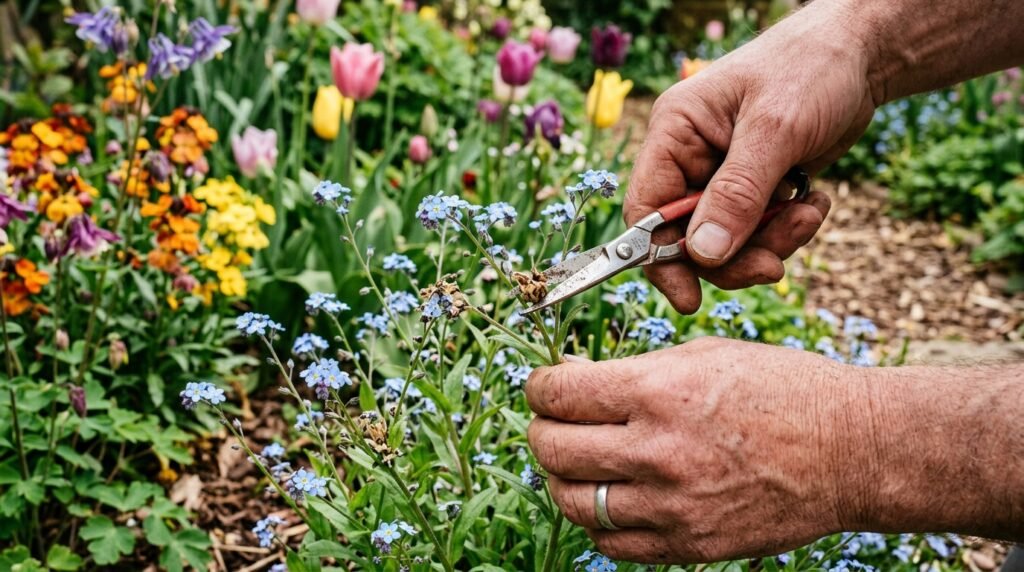
Regular deadheading — removing spent flowers as soon as they fade — keeps forget-me-not plants looking tidy and encourages the production of new blooms. Use small scissors or pinch spent flowers off between your fingers. This simple step can extend the bloom period by several weeks.
Once you’re happy with the season and want plants to self-seed for next year, stop deadheading and let seed pods form naturally. The plant will do the rest.
End-of-Season Care
When forget-me-not plants finish blooming and begin to look straggly, you have two options:
- Leave them to self-seed — Allow plants to set seed and scatter naturally. Pull the spent plants once seeds have had time to drop (usually 2–3 weeks after bloom ends).
- Collect seeds for deliberate sowing — Collect the small brown seed pods (nutlets) in a paper bag. Store in a cool, dry place and sow in late summer for next year’s display.
Potted Forget-Me-Nots — Extra Attention Needed
Forget-me-not potted plants need more frequent watering than those in the ground because containers dry out faster. Check soil moisture daily in warm weather. Feed potted plants every two to three weeks with a diluted liquid fertiliser during the growing season.
For potted plants, getting watering and feeding right is crucial. Our Indoor Plant Care Calculator helps you dial in schedules for container plants — the same principles apply to outdoor potted forget-me-nots.

Pests and Diseases — What to Watch For
Powdery Mildew
Powdery mildew is the most common problem with forget-me-not plants. It appears as white, chalky patches on leaves and stems, usually in late spring when temperatures begin to rise and air humidity is high. Poor air circulation and overhead watering are the main triggers.
Prevention is much easier than cure: space plants well, always water at the base, and remove affected foliage promptly. If powdery mildew takes hold, a diluted solution of neem oil or potassium bicarbonate applied to the leaves can help.
Fungal Diseases — Botrytis and Downy Mildew
Botrytis (grey mould) can affect forget-me-not plants in cool, damp conditions. It causes brown, fuzzy patches on leaves and stems. Remove infected material immediately and improve airflow around plants. Avoid overhead watering, which creates ideal conditions for fungal diseases to spread.
Slugs and Snails
Young forget-me-not plants — especially freshly transplanted seedlings — are vulnerable to slugs and snails in wet spring conditions. Protect young plants with copper tape around pot rims, crushed eggshells scattered around plants, or organic iron phosphate slug pellets. Once plants are established with several sets of leaves, they become more resilient.
For natural pest control in your garden, explore our guide to 10 Plants That Stop Mosquitoes — many of these pest-deterring plants work beautifully as companion plants alongside forget-me-nots. Also check our Garden Helper Animals Finder to discover which beneficial creatures you can encourage into your garden to keep pests in check naturally.
Leaf Spot and Other Fungal Issues
Occasional leaf spotting can occur on forget-me-not plants, especially in humid conditions. This is usually a minor fungal infection and rarely causes serious harm. For detailed information on identifying and treating plant leaf problems, our Leaf Spot Disease Guide is an excellent reference.

Are Forget-Me-Nots Perennials or Annuals? The Honest Answer
💡 Quick Answer: Forget-me-nots are technically short-lived perennials or biennials, but they self-seed so freely they effectively return every year. Chinese forget-me-nots are true annuals. Neither is invasive in the serious sense, though they do spread freely.
This question causes a lot of confusion — and understandably so. Here’s the clear answer:
Are Forget-Me-Nots Perennials?
Myosotis sylvatica is technically a biennial or short-lived perennial. In its first year, it grows as a leafy rosette. In its second year, it flowers, sets seed, and dies. However — and this is the important bit — it self-seeds so abundantly that new plants appear every year. To most gardeners, forget-me-nots are effectively perennial because the garden always has them.
Are Chinese Forget-Me-Nots Perennials?
No. Cynoglossum amabile — the Chinese forget-me-not — is a true annual. It completes its entire lifecycle in one growing season: germinating, flowering, setting seed, and dying within 12 months. You’ll need to resow Chinese forget-me-not seeds each year.
Do Forget-Me-Nots Come Back Every Year?
Yes — in most gardens, forget-me-nots come back every year through self-seeding. The parent plant dies, but its seeds are already in the soil. By the following spring, a new generation of forget-me-not plants is ready to bloom. It’s one of the things that makes them so beloved — they replenish themselves.
Are Forget-Me-Nots Weeds? Are They Invasive?
Forget-me-nots self-seed freely, which can make them feel invasive in a tidy, formal garden. They’re listed as naturalised plants in parts of North America and Australia. But are forget-me-nots weeds in any serious ecological sense? Generally no — they’re easy to control, they don’t crowd out established plants aggressively, and they can simply be pulled by hand wherever they’re not wanted. Invasive forget-me-not concerns are usually about aesthetics rather than ecology.
The simple management approach: let them grow where you want them, pull the seedlings where you don’t, and deadhead before seed sets if you want to limit spread.
For help identifying and managing different plant types in your garden, our Poisonous Plants Finder is useful, and our Garden Organizer helps you plan and track what’s growing where across your whole garden.

Forget-Me-Not Companion Plants — The Best Pairings for Your Garden
One of the most practical things about forget-me-not plants is how brilliantly they work as companion plants. They fill exactly the right amount of space at exactly the right time of year — early spring — when most other plants haven’t yet arrived.
Roses and Forget-Me-Nots
This is the most celebrated of all forget-me-not companion plant combinations. Forget-me-nots bloom in early spring just as roses are coming into leaf — before the roses are bushy enough to fill the base of the bed. The blue forget-me-not carpet at the feet of the roses is visually stunning and fills otherwise bare soil.
By the time the roses are in full summer bloom, the forget-me-nots have set seed and faded back — leaving the space cleanly for the roses to take centre stage. It’s near-perfect garden timing.
Forget-Me-Not and Tulips
Another iconic spring pairing. Plant tulip bulbs in autumn and scatter forget-me-not seeds or transplants between them. When spring arrives, the blue forget-me-nots create a living tapestry that makes upright tulip stems look more dramatic and elegant. The contrast of blue flowers at ground level with tall, bold tulip blooms above is a classic of spring garden design.
Other Excellent Companion Plants
- Primroses — Share forget-me-not’s love of cool, moist, partially shaded conditions. Bloom at the same time for a tapestry effect.
- Wallflowers — Warm-coloured spring flowers that contrast beautifully with blue forget-me-not flowers in mixed borders.
- Bleeding heart (Dicentra) — A perfect woodland combination. Both love partial shade and moist soil.
- Hostas — Forget-me-nots bloom and fade just as hostas are unfurling their leaves, making them ideal gap-fillers in hosta borders.
- Hardy geraniums — Natural companions in partially shaded spots. Their extended flowering bridges the gap after forget-me-nots fade.
- Alliums — The blue-purple combinations of forget-me-nots and alliums create beautiful spring colour in sunny borders.
- Foxgloves — In a mixed cottage border, forget-me-nots at the front with foxgloves at the back create a classic two-level planting.
Planning your garden layout and spacing? Our Plant Spacing Calculator helps you work out exactly how many plants you need and how far apart to space them for the best results. Also, if you’re choosing between different companion plants, our Animal Resistant Plants Finder can help you select pairings that are naturally protected from garden wildlife.

Forget-Me-Not Safety Guide — Toxicity, Edibility, and Pets
Are Forget-Me-Nots Toxic to Cats?
Yes — forget-me-nots are considered mildly toxic to cats. Myosotis plants contain pyrrolizidine alkaloids (PAs), compounds that can affect the liver with repeated or large ingestion. If a cat eats small amounts of forget-me-not plant material, mild symptoms such as skin irritation, drooling, vomiting, or digestive upset may occur.
Forget-me-nots are not severely toxic to cats — they’re not in the same category as lilies or foxgloves, which are seriously dangerous. However, it’s wise to monitor cats in gardens where forget-me-nots grow freely, especially as the plants spread and become harder to avoid.
Are Forget-Me-Nots Toxic to Dogs?
Similarly, forget-me-nots toxic to dogs can be a concern for the same reasons — pyrrolizidine alkaloids. In dogs, ingestion typically causes mild gastrointestinal symptoms: nausea, vomiting, and loose stools. Are forget-me-nots poisonous to dogs in a life-threatening way? No — they’re not classified as severely toxic to dogs. But if your dog is a habitual plant-eater, it’s worth being aware.
If you’re concerned your pet has eaten a significant quantity of forget-me-not plant material, contact your vet for advice.
Can Forget-Me-Nots Have Adverse Effects on Humans?
Yes, potentially. Forget-me-nots can have adverse effects on humans primarily through repeated consumption. The pyrrolizidine alkaloids present in Myosotis plants are hepatotoxic — meaning they can damage the liver with repeated or large-scale ingestion. Some people also experience skin irritation (contact dermatitis) from handling forget-me-not plants, particularly from the fine hairs on the leaves and stems.
Are Forget-Me-Nots Edible?
Small quantities of forget-me-not flowers are occasionally used as decorative garnishes on salads or desserts. But are forget-me-nots truly edible in a culinary sense? Not really — or at least not regularly. The alkaloid content means they shouldn’t be eaten in quantity. They’re technically edible in tiny amounts but not worth the risk as a regular food item. Many other edible flowers are safer and more flavourful choices.
Can you eat forget-me-nots? Technically yes, in tiny quantities. Should you? No. Treat them as ornamental plants and enjoy them with your eyes, not your fork.
Are Forget-Me-Nots Deer Resistant?
Yes — forget-me-nots are reasonably deer resistant. Deer tend to avoid Myosotis plants, likely because of the rough, hairy texture of the leaves and stems, which is unappealing to browse. While no plant is entirely deer-proof in a hungry garden, forget-me-nots are a safer choice than many alternatives in deer-prone areas.

The Meaning of Forget-Me-Not Flowers — Symbolism, Spirituality, and Stories
Few flowers carry as much meaning as the forget-me-not. Its very name is a promise — and that promise has made it one of the most symbolically powerful flowers in history.
Forget-Me-Not Flower Meaning
The primary meaning of forget-me-not flowers is remembrance and true love. They’ve been exchanged between people who are parting — whether through distance, time, war, or death — as a physical token of the vow: I will not forget you.
In medieval Germany, knights wore forget-me-nots as tokens of undying loyalty to their ladies. In the Victorian language of flowers (floriography), forget-me-nots meant faithful memory and enduring love. The meaning has remained essentially unchanged for centuries.
Blue Forget-Me-Not Flower Meaning
Blue forget-me-not flower meaning carries specific associations: constancy, faithfulness, and truth. The blue colour reinforces connections to sky, water, and depth — all symbols of things that endure beyond the immediate moment. A blue forget-me-not given to someone is saying: I am faithful. I will not forget.
Forget-Me-Not Flower Meaning Death and Grief
Forget-me-not flower meaning in the context of death is one of eternal memory. They’re commonly used at memorial services, planted at gravesides, and incorporated into funeral wreaths and grief jewellery. The message they carry: those we’ve lost are never truly forgotten. They live on in our memory as surely as these flowers return to bloom each spring.
Many bereaved families plant forget-me-nots in memory gardens. The fact that they self-seed and return every year makes them particularly poignant memorial plants — a living reminder that renews itself.
Forget-Me-Nots Symbolism and Spiritual Meaning
Forget-me-nots spiritual meaning centres on the connection between the earthly and the eternal. In various traditions, they represent the soul’s journey, the continuity of love beyond physical life, and the power of memory to bridge the gap between worlds. In Freemasonry, forget-me-nots have been used as a symbol of remembrance for those who have suffered persecution.
Forget-Me-Not Tattoo Meaning
As a tattoo, forget-me-nots are among the most meaningful choices for memorial ink. They’re most commonly chosen to honour a loved one who has passed — a parent, partner, child, or friend. The tattoo carries the same message as the flower: you are remembered, always. Some people choose forget-me-not tattoos to mark bonds of friendship or love that have endured distance or difficulty.
The Forget-Me-Not Story
The forget-me-not story that gave the flower its name is the German legend already mentioned — the knight swept into the river, throwing the flowers to his lady. But the story’s power runs deeper than one romantic tragedy. Forget-me-not stories appear across cultures and centuries, always centred on the same themes: love, loss, loyalty, and the fear of being forgotten. The flower became the embodiment of that universal human longing.

Growing Forget-Me-Nots in Pots — Everything You Need to Know
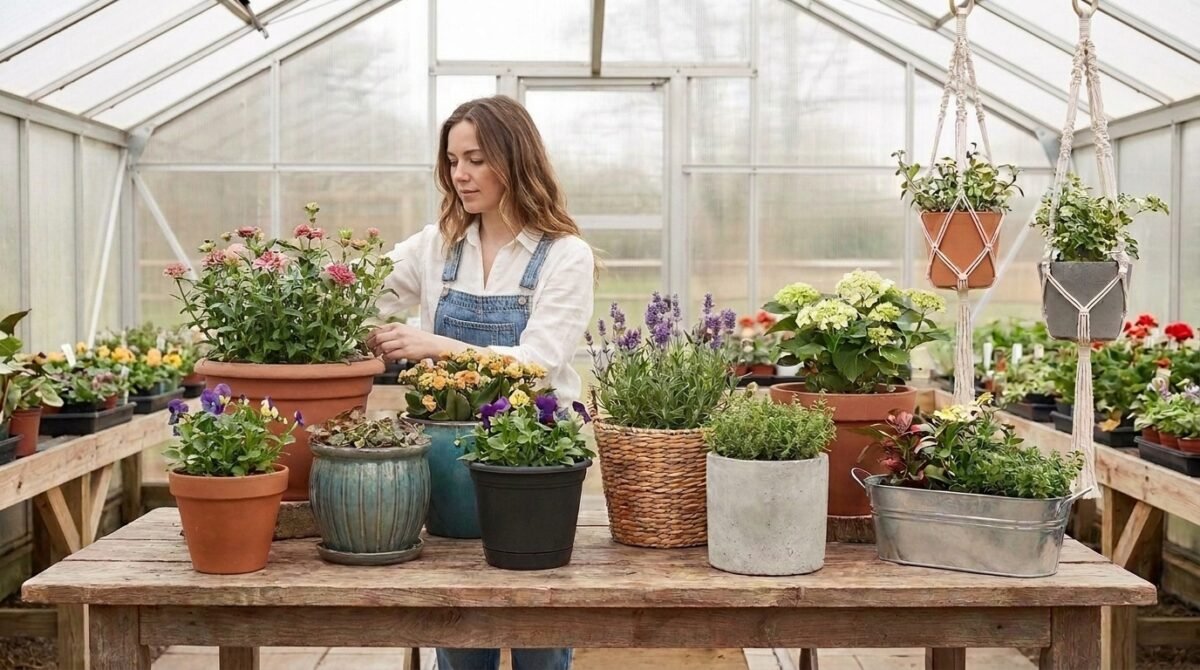
Forget-me-not potted plants are a brilliant choice for balconies, patios, doorstep displays, and small-space gardens. They’re compact enough for containers but generous enough in bloom to make a real impact.
Choose a pot at least 8 inches deep with drainage holes in the base. Fill with a good quality, moisture-retentive potting mix — not garden soil, which compacts and drains poorly in containers.
Position forget-me-not potted plants in partial shade, especially in warmer climates. Afternoon shade is particularly important in summer-transition months. Water regularly — containers dry out faster than beds, and forget-me-nots need consistent moisture.
Feed potted plants every 2–3 weeks with a balanced liquid fertiliser during the growing season. Deadhead regularly to extend flowering. Once plants finish blooming, either allow them to self-seed into the pot for next year, or collect seeds and refresh the potting mix for a fresh autumn sowing.
Getting the right pot and soil volume is important. Use our Pot Size Calculator and Planter Volume Calculator to find the perfect container setup, and our Soil Volume for Pots to calculate exactly how much mix you’ll need.
Forget-Me-Not Quick Reference — Key Growing Facts
- Botanical name: Myosotis sylvatica (wood forget-me-not)
- Plant type: Cool-season biennial / short-lived perennial; self-seeds freely
- USDA hardiness zones: 3–8 (Myosotis); Chinese forget-me-not (Cynoglossum) up to zone 10
- Height: 6–12 inches (Myosotis); up to 24 inches (Chinese forget-me-not)
- Spread: 6–12 inches
- Sunlight: Partial shade preferred; tolerates full sun in cooler climates
- Soil: Moist, well-drained, fertile — avoid waterlogged or very dry conditions
- Watering: Consistent; avoid overhead watering to prevent powdery mildew
- Bloom time: Early spring to early summer (Myosotis); Summer (Chinese forget-me-not)
- Germination time: 7–14 days at 55–65°F (13–18°C)
- Self-seeding: Yes, prolifically — effectively returns every year
- Deer resistance: Moderate — deer generally avoid hairy-leaved plants
- Toxicity: Mildly toxic to cats and dogs; avoid regular human consumption
- Companion plants: Roses, tulips, primroses, hostas, bleeding heart, alliums
Troubleshooting Common Forget-Me-Not Problems
Leaves Turning Yellow
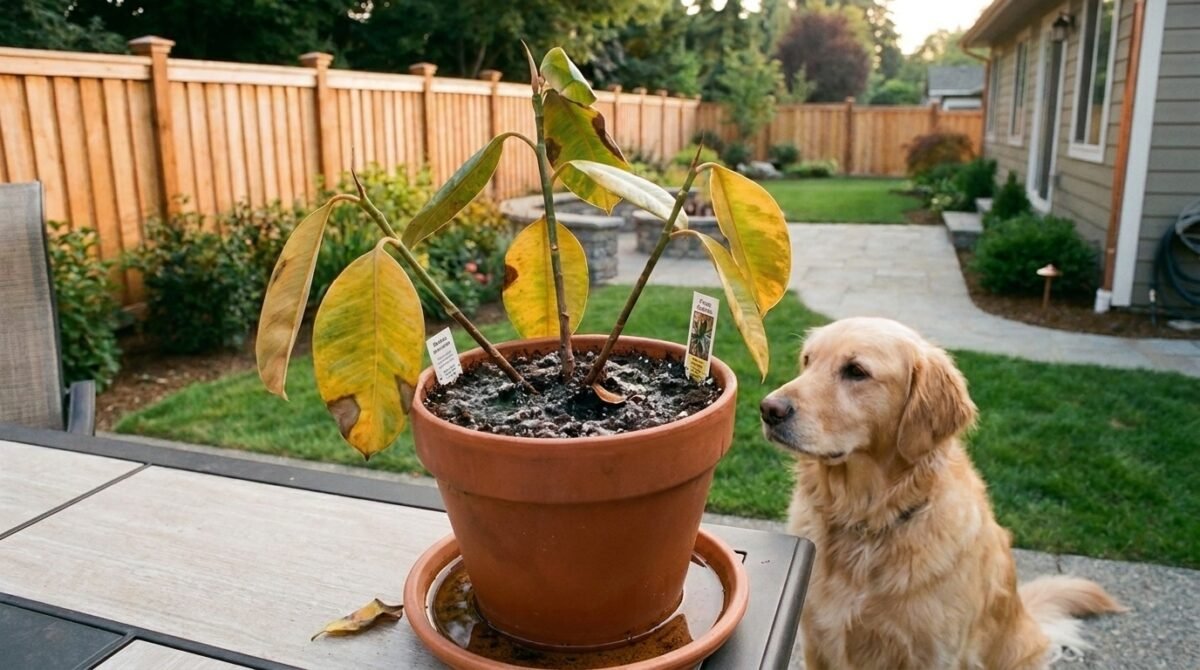
Yellow leaves on forget-me-not plants are usually caused by overwatering, waterlogged soil, or nitrogen deficiency. Check drainage first. If the problem persists, reduce watering frequency and ensure the pot or bed drains freely. For a broader guide on diagnosing yellowing plants, read our article: Why Are My Plant Leaves Turning Yellowish?
No Flowers — Just Leaves
Too much nitrogen fertiliser is the usual culprit, pushing the plant to produce leaves rather than blooms. Excess shade can also reduce flowering. Stop feeding with high-nitrogen products and, if possible, move plants to a brighter position.
Plants Dying After Flowering
This is entirely normal and not a problem. Forget-me-nots are short-lived perennials — after flowering and setting seed, the parent plant dies. This is its natural lifecycle. Let seeds drop naturally for next year’s plants, or collect seeds to sow in late summer.
Leggy, Floppy Growth
Leggy forget-me-not plants that flop over rather than growing upright are usually responding to too much shade or overcrowding. Thin seedlings to improve air circulation. In very shaded spots, consider moving containers to a slightly brighter location.
Powdery White Coating on Leaves
This is powdery mildew — the most common forget-me-not disease. Remove affected leaves promptly, improve airflow by thinning plants or spacing them further apart, and switch to base watering only. In severe cases, apply a fungicide labelled for powdery mildew.
Frequently Asked Questions About Forget-Me-Nots
What colour is a forget-me-not?
💡 Quick Answer: The classic forget-me-not colour is soft cornflower blue with a tiny yellow or white centre. Pink and white varieties also exist, as do some purple-toned cultivars.
Do forget-me-nots come back every year?
Yes — in most gardens, forget-me-nots come back every year through self-seeding. The parent plant dies after setting seed, but its offspring return reliably each spring. In managed gardens, some gardeners collect seeds and sow deliberately in late summer for controlled displays.
How long does it take forget-me-not seeds to germinate?
Forget-me-not seeds typically germinate in 7–14 days when kept at a cool temperature of 55–65°F (13–18°C). They need light to germinate — do not bury them deeply. Surface sowing or very light covering with fine grit works best.
Are forget-me-nots easy to grow?
Yes — genuinely one of the easiest spring flowers you can grow. They require minimal intervention, tolerate a range of soil conditions, self-seed reliably, and look beautiful almost everywhere they’re planted. They’re an excellent choice for beginner gardeners.
What is the meaning of the forget-me-not flower?
Forget-me-not flowers mean remembrance, true love, loyalty, and faithfulness. They’re used as memorial flowers (symbolising those we’ve lost), as love tokens (symbolising eternal bonds), and as spiritual symbols (representing the connection between the living and those who have passed).
Are forget-me-nots perennials or annuals?
Myosotis sylvatica is a short-lived perennial or biennial — it lives 2 years and then dies. But because it self-seeds so freely, it effectively returns every year. Chinese forget-me-not (Cynoglossum amabile) is a true annual.
Can I grow forget-me-nots in all USDA zones?
Myosotis varieties are hardy in USDA zones 3–8 as standard biennials. In zones 7–9, they work beautifully as cool-season winter annuals. In zones 10–11, they’re very challenging due to summer heat but can succeed in shaded, cool microclimates.
Are forget-me-nots toxic to cats and dogs?
Yes, mildly. Forget-me-nots contain pyrrolizidine alkaloids that can cause mild gastrointestinal symptoms in cats and dogs if ingested. They’re not severely toxic, but large or repeated ingestion warrants a vet consultation.
Are forget-me-nots edible for humans?
Small amounts of forget-me-not flowers can be used as garnishes, but regular consumption is not recommended due to pyrrolizidine alkaloid content. Choose safer edible flowers (such as nasturtiums or violets) for culinary use.
What is the forget-me-not tattoo meaning?
Forget-me-not tattoos most commonly represent remembrance of a loved one who has passed. They’re also chosen to symbolise enduring love, loyalty between friends, or the bond between people separated by distance. A deeply personal and meaningful tattoo choice.
Is forget-me-not a weed?
Forget-me-nots self-seed freely and can spread into unexpected areas of the garden, which leads some gardeners to treat them as weeds. But they’re easily pulled by hand and don’t aggressively crowd out established plants. Most gardeners welcome their spread rather than fight it.
What is the forget-me-not book about?
‘Forget Me Not’ is a title shared by several books — in children’s literature, it often explores themes of memory, family, and connection. In adult fiction and non-fiction, forget-me-not titles typically explore grief, love, and remembrance — themes perfectly aligned with the flower’s meaning.

Conclusion — Plant Forget-Me-Nots and They Will Never Let You Down
There’s a reason forget-me-nots have been grown in gardens for centuries. They’re effortless, they’re beautiful, and they carry meaning that no other spring flower quite matches.
Whether you’re growing forget-me-not flowers for the first time — scattering seeds in a sunny corner and waiting 7–14 days for those first sprouts to appear — or you’re an experienced gardener pairing myosotis sylvatica with roses and tulips in a cottage border, the experience is reliably rewarding.
They self-seed. They return. They fill gaps, soften hard edges, and remind us that the most beautiful things in a garden are often the simplest. And they carry with them, every single spring, a message older than any garden trend: I have not forgotten.
Plant forget-me-nots this season. Give them moist, well-drained soil, a shady spot, and a bit of water. Then step back and let them do what they do best.
You won’t regret it.
Ready to plan your whole spring garden? Explore our complete collection of tools and guides at PrimeHomeAndGarden Home & Garden Hub. For more plant growing guides like this one, visit our full Forget-Me-Not Guide and our Dramatic Thirsty Plants Guide for companion planting inspiration.
Lorem ipsum dolor sit amet, consectetur adipiscing elit. Ut elit tellus, luctus nec ullamcorper mattis, pulvinar dapibus leo.