Animal Resistant Plants: Natural Pest Control That Really Works
You spend weeks planning your garden. You plant, water, and nurture every little seedling. Then one morning you walk outside and find your hostas chewed to stumps and your tulips snapped at the base. Sound familiar?
Deer and rabbits are beautiful — but they can destroy a garden overnight. And honestly? Fencing everything, spraying repellents every few days, and replanting the same spots gets exhausting fast.
Here is the good news: nature already solved this problem. Certain plants are so bitter, so prickly, so strongly scented, or so toxic that deer, rabbits, and other garden wildlife simply walk on by. These are your animal resistant plants — and building your garden around them is the smartest, most low-maintenance form of natural pest control available.
In this guide you will learn exactly which plants to choose, why they work, how to arrange them, and how to protect the plants animals do love. Let’s dig in.
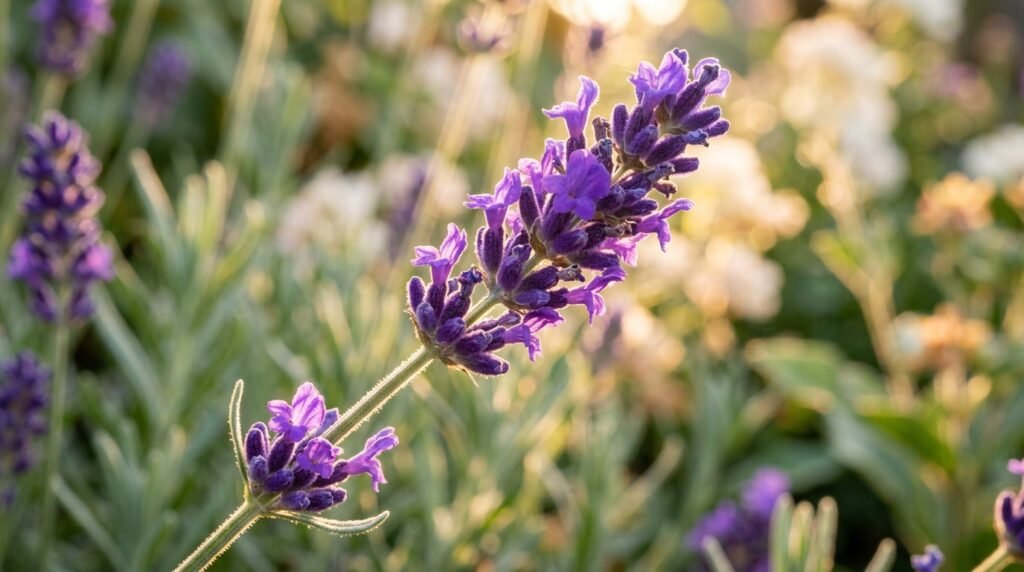
Why Do Animals Avoid Certain Plants?
Before we get into the plant lists, it helps to understand the defense mechanisms at play. Animals are not random in what they eat — they are selective. They learn very quickly what tastes bad, hurts their mouth, or makes them sick.
Plants have evolved over millions of years to fight back. Here is a quick breakdown of the main defenses:
| Defense | How It Works | Example Plants |
|---|---|---|
| Aromatic & Fragrant Leaves | Strong oils overwhelm and repel herbivores | Lavender, Rosemary, Catmint, Bee Balm |
| Fuzzy or Hairy Leaves | Rough texture is unpleasant to eat | Lamb's Ear, Foxglove, Woolly Thyme |
| Spines & Serrated Edges | Sharp points deter chewing and browsing | Barberry, Holly, Hellebore, Yarrow |
| Waxy & Leathery Leaves | Tough coating is hard to digest | Lilac, Boxwood, Daphne |
| Toxic Compounds | Chemicals cause illness or death | Daffodils, Foxglove, Delphinium |
| Bitter Taste | Unpalatable flavors stop browsing cold | Turtlehead, Prairie Sage, Rudbeckia |
| Milky Sap | Sticky, irritating latex repels foragers | Euphorbia, Common Milkweed |
Keep this table in mind as we go through each plant. Once you understand why a plant is resistant, you will start making much smarter garden decisions.
Deer & Rabbit Resistant Perennials: Your Garden Backbone
Perennials come back year after year — which means once you plant them, your work is mostly done. Choosing deer resistant perennials is the single most effective long-term strategy for a critter-proof garden.
Want to know if a plant will survive your local climate before you buy? Use the Indoor Plant Care Calculator to check care requirements against your conditions.
| Plant | Key Defense | USDA Zones | Sun | Pollinators? |
|---|---|---|---|---|
| Hardy Geranium (Cranesbill) | Spicy scent, hairy/leathery foliage | 5–8 | Full sun to part shade | Yes |
| Lavender (Lavandula) | Intense aromatic oils | 5–9 | Full sun | Yes |
| Catmint (Nepeta) | Mint-family scent | 3–8 | Full sun to part shade | Yes |
| Yarrow (Achillea) | Strong scent + hairy leaves | 3–9 | Full sun | Yes |
| Foxglove (Digitalis) | Toxic compounds + fuzzy leaves | 4–9 | Part shade | Yes |
| Hellebore (Lenten Rose) | Toxic; evergreen | 4–9 | Shade to part shade | Yes |
| Turtlehead (Chelone) | Extremely bitter taste | 3–8 | Part shade | Yes |
| Echinacea (Coneflower) | Prickly texture | 3–9 | Full sun | Yes |
| Rudbeckia (Black-Eyed Susan) | Hairy foliage; bitter | 3–9 | Full sun | Yes |
| Bleeding Heart (Dicentra) | Toxic compounds | 3–9 | Part shade | Yes |
| Bee Balm (Monarda) | Aromatic mint-family foliage | 4–9 | Full sun to part shade | Yes |
| Sedum (Stonecrop) | Succulent; drought tolerant; unpalatable | 3–9 | Full sun | No |
Top Picks for Critter-Proof Gardens
Lavender — The Fragrant Force Field
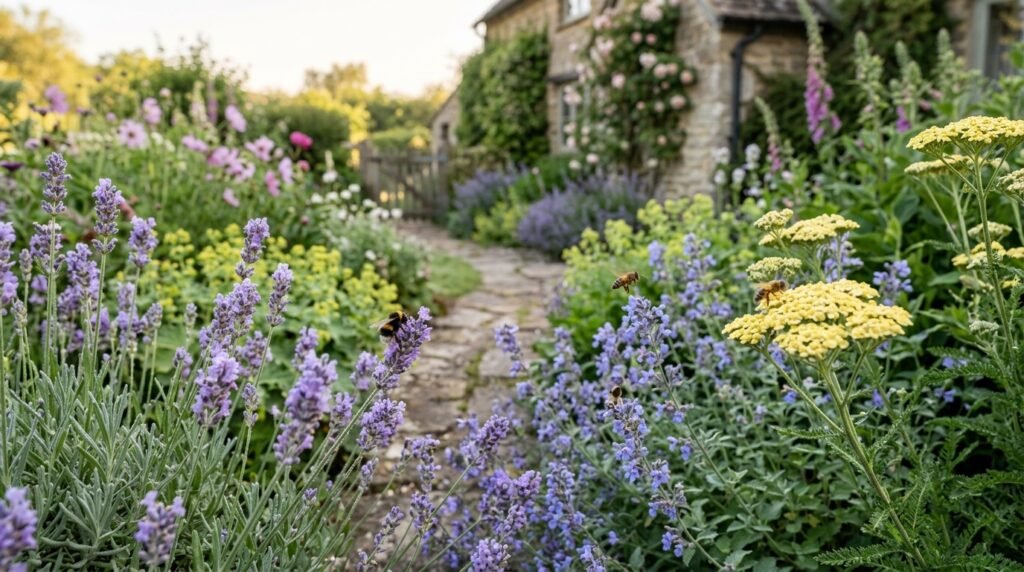
Lavender is one of the most reliable deer resistant plants you can grow. The strong essential oils that we find so pleasant are exactly what deer and rabbits cannot stand. Plant it along borders, pathways, or as low hedges and it pulls double duty — it looks stunning and creates a scent barrier animals do not want to cross.
It is also one of the most drought tolerant options available, making it perfect if you garden in a dry climate. Zones 5–9, full sun, and well-drained soil. That is it. Hard to go wrong here.
Catmint — Easy, Beautiful, and Truly Deer Proof
Catmint (Nepeta) is underrated. It produces clouds of purple-blue flowers from late spring right through summer, and its mint-family scent makes it one of the most deer and rabbit resistant plants you will find. It is also easy to grow, tolerates part shade, and rebounds quickly if you cut it back mid-season for a second flush of blooms.
Once established, catmint is practically self-sufficient. It is a superstar for deer resistant landscaping because it edges beds beautifully and blooms for months.
Hellebore — Shade-Lover That Animals Leave Alone
Most shade plants get hammered by deer. Hellebore is the happy exception. Every part of this plant is toxic, so deer and rabbits avoid it completely. It blooms in late winter to early spring — often while snow is still on the ground — making it one of the most dramatic additions to a shaded corner.
If you are struggling with what to plant under trees or in dim corners, hellebore is your answer. Pair it with other deer resistant ground covers like ajuga and sweet woodruff for a fully protected shade bed.
Check out the Long Life Plants Selector to find more shade-tolerant, critter-resistant species that will outlast almost everything else in your garden.
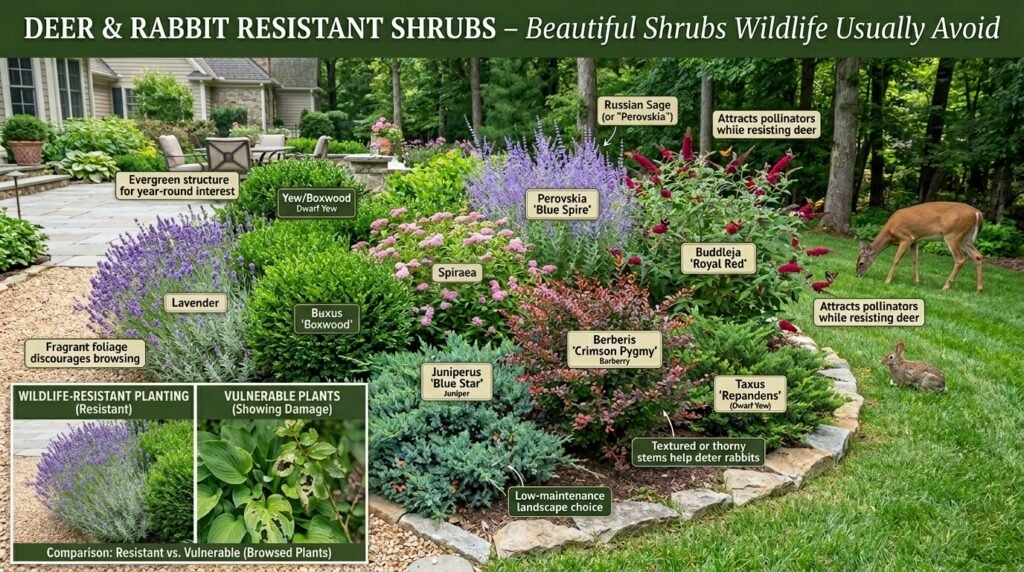
Deer & Rabbit Resistant Shrubs: Structure That Protects Itself
Shrubs give your garden its bones — the permanent structure everything else grows around. Choosing deer resistant shrubs means your framework stays intact even when wildlife pressure is high.
| Shrub | Key Defense | USDA Zones | Notes |
|---|---|---|---|
| Boxwood (Buxus) | Dense, bitter, alkaloid-rich foliage | 5–9 | Excellent hedge plant; critter resistant |
| Barberry (Berberis) | Sharp spines; deer and rabbit proof | 4–8 | Colorful foliage; check invasive status by region |
| Lilac (Syringa) | Waxy, glossy, tough leaves | 3–7 | Fragrant blooms deer rarely touch |
| Butterfly Bush (Buddleja) | Strong fragrance; deer resistant | 5–9 | Attracts pollinators; trim back hard in spring |
| Daphne | Waxy leaves; toxic if ingested | 4–8 | Incredibly fragrant; part shade |
| Holly (Ilex) | Prickly leaf margins | 5–9 | Evergreen; birds love the berries |
| Spirea | Bitter foliage; dense growth | 3–8 | Easy to grow; low maintenance |
| Weigela | Deer resistant; tough stems | 4–8 | Great spring color; part shade tolerant |
| Smokebush (Cotinus) | Aromatic when bruised | 4–8 | Stunning fall color |
| Rose of Sharon (Hibiscus syriacus) | Deer resistant; thick bark | 5–9 | Late summer blooms |
Smart Framework Selection
Barberry deserves a special mention. Those vicious spines make it deer and rabbit proof in the truest sense — animals do not even try. Just check before you plant because it is listed as invasive in some US states. Your local cooperative extension office will have the most current guidance.
Planning how your shrubs, borders, and beds fit together? The Landscape Timbers guide walks you through using edging and structure to define garden zones — which also helps channel wildlife away from vulnerable spots.
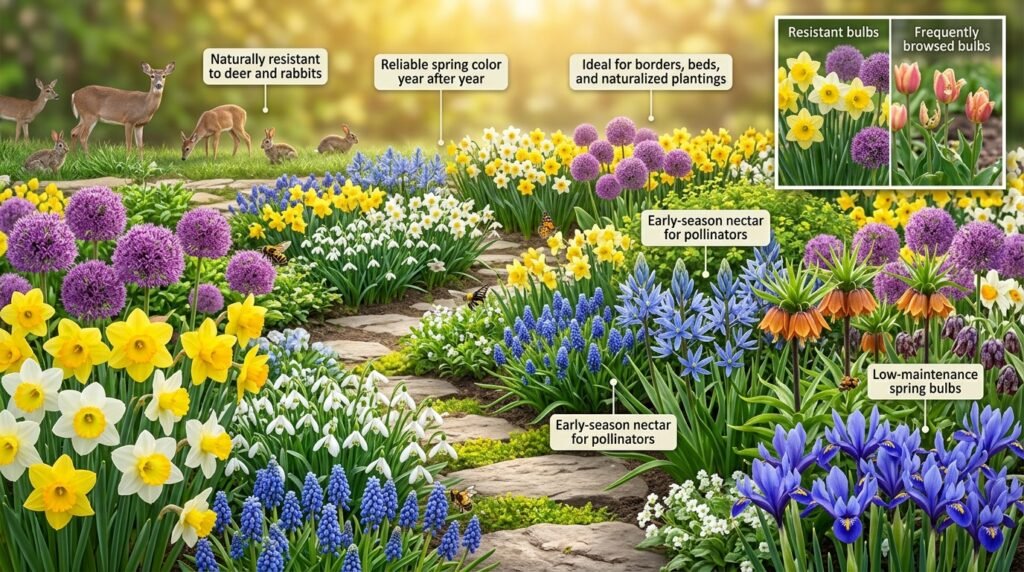
Deer & Rabbit Resistant Bulbs: Spring Beauty Without the Heartbreak
Nothing is more frustrating than planting 200 tulip bulbs in autumn and finding them all gone by spring. Deer and squirrels absolutely love them. But swap in deer resistant bulbs and you get all the color with none of the heartbreak.
| Bulb | Key Defense | Bloom Time | Sun |
|---|---|---|---|
| Daffodils (Narcissus) | Highly toxic to most mammals; lycorine alkaloid | Early spring | Full sun to part shade |
| Alliums (Ornamental Onions) | Pungent sulfur compounds repel deer and rabbits | Early summer | Full sun |
| Hyacinths | Toxic oxalic acid compounds; strong scent | Early spring | Full sun |
| Camassia | Saponins; unpalatable to deer | Late spring | Full sun to part shade |
| Scilla (Squill) | Toxic compounds; bitter | Early spring | Full sun to part shade |
Strategic Spring Planning
Daffodils are the gold standard. They are completely ignored by deer, rabbits, and squirrels because every part of the plant contains toxic alkaloids. Plant them in drifts and you get a spectacular, zero-stress spring display. You can even use them as a companion planting strategy — ring your tulip beds with daffodils and the scent alone helps confuse and deter browsers.
Alliums are another game-changer. Their pungent onion smell makes them one of the best plants that repel deer in the bulb category. They also attract pollinators, look architectural in the border, and come in sizes from tiny 6-inch pom-poms to 4-foot-tall drumstick alliums.
Deer Resistant Herbs & Vegetables: Protect Your Edible Garden Too
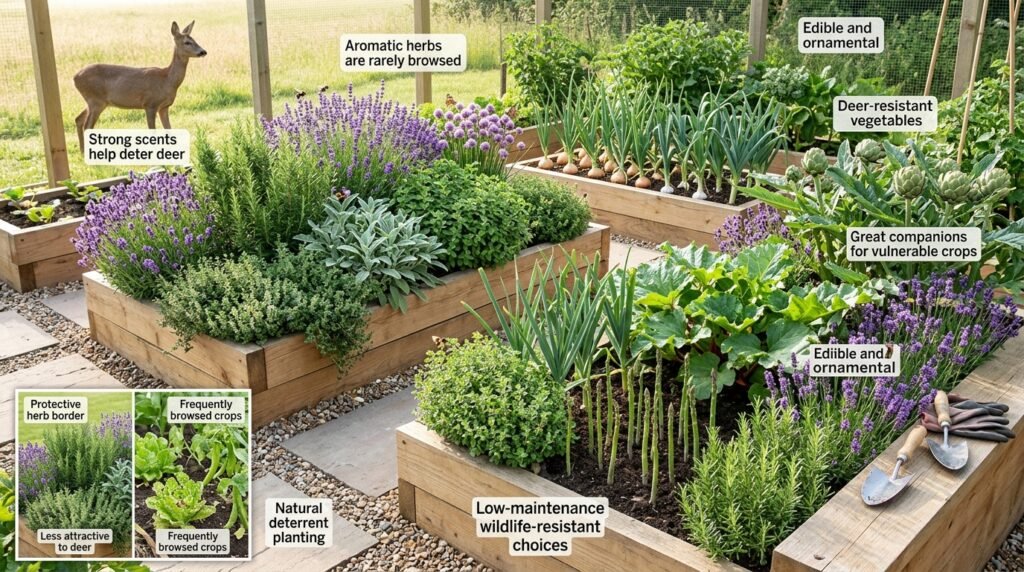
Yes, you can grow food in a deer-prone garden. The secret is leaning into plants that have natural chemical defenses — which, conveniently, are also some of the most useful culinary and medicinal herbs around.
| Plant | Defense | Sun | Notes |
|---|---|---|---|
| Garlic | Intense sulfur odor repels rabbits and deer | Full sun | Easy to grow; harvest in summer |
| Onions & Chives | Pungent aroma; sulfur compounds | Full sun | Great border plant for veggie beds |
| Rhubarb | Leaves are toxic (oxalic acid) | Full sun to part shade | Easy to grow; harvest stems only |
| Rosemary | Strongly aromatic; camphor notes | Full sun | Drought tolerant; zones 7–11 (or containers) |
| Sage | Aromatic; slightly fuzzy leaves | Full sun | Drought tolerant; very deer resistant |
| Thyme | Aromatic oils; low ground cover | Full sun | Drought tolerant; great edging plant |
| Oregano | Fragrant foliage; deer and rabbit proof | Full sun | Drought tolerant; spreads readily |
| Mint | Intense menthol scent repels most animals | Full sun to part shade | Keep contained — it spreads aggressively |
Aromatic Interplanting Strategies
A really smart strategy is to interplant these aromatic herbs throughout your vegetable garden. Tuck rosemary or sage between your lettuce rows. Ring your tomatoes with chives. The scent plume from these plants confuses browsers and makes the whole area less appealing.
Speaking of protecting your veggie garden — if you are planning raised beds, the Raised Bed Soil Calculator will help you get the right soil volume, and you can easily combine that with a Silt Fence around the perimeter for extra rabbit protection.
Native Plants That Resist Deer and Rabbits
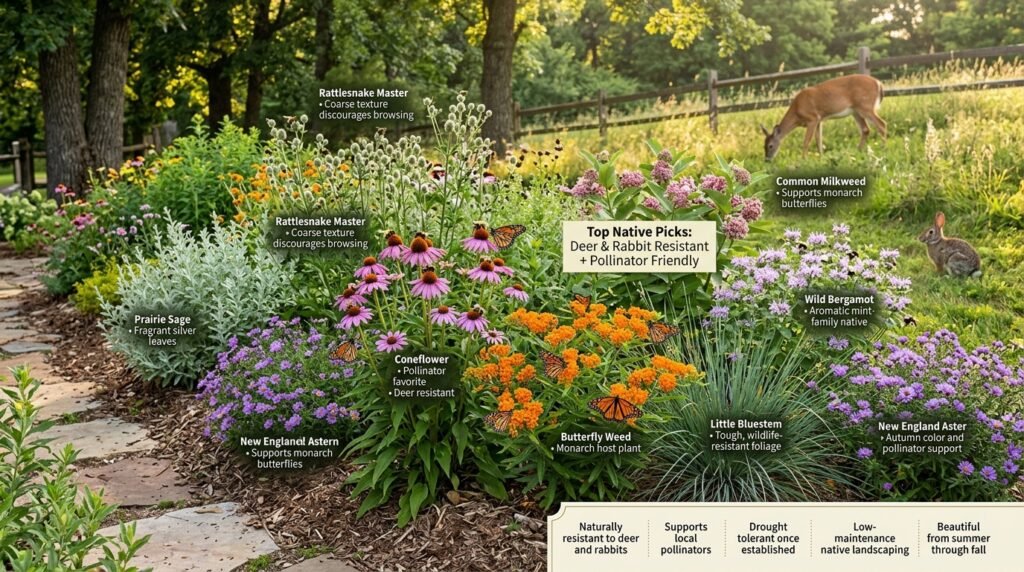
Native plants have co-evolved with local wildlife, which means local deer and rabbits already know to avoid them. This makes native species some of the most reliably animal resistant plants you can add to your landscape.
They also tend to be drought tolerant once established, support local pollinators, and require almost no maintenance. Triple win.
| Native Plant | Key Feature | Sun | Pollinators |
|---|---|---|---|
| Prairie Sage (Artemisia ludoviciana) | Intensely aromatic silver foliage | Full sun | Yes |
| Rattlesnake Master (Eryngium yuccifolium) | Coarse, spiny foliage; deer resistant | Full sun | Yes |
| Coneflower (Echinacea) | Prickly texture; very deer resistant | Full sun | Yes |
| Butterfly Weed (Asclepias tuberosa) | Milky sap; deer resistant | Full sun | Yes – monarch host |
| Little Bluestem (grass) | Tough, fibrous foliage; critter resistant | Full sun | Birds |
| Common Milkweed | Latex milky sap repels all browsers | Full sun | Yes – monarch host |
| New England Aster | Resistant once established; late-season color | Full sun | Yes |
| Wild Bergamot (Monarda fistulosa) | Aromatic; mint family | Full sun | Yes |
Co-Evolved Protection
Coneflower (Echinacea) and Butterfly Weed are particularly valuable. They are deer and rabbit resistant, they support monarch butterflies and native bees, and they look stunning from midsummer through autumn. If you can only add a handful of native plants this year, start with these two.
Want help choosing the right plants for your garden zone and sun conditions? The Animal Resistant Plants Finder tool on PrimeHomeAndGarden is built exactly for this — just enter your zone and conditions to get a personalised list.
Deer Resistant Plants by USDA Zone
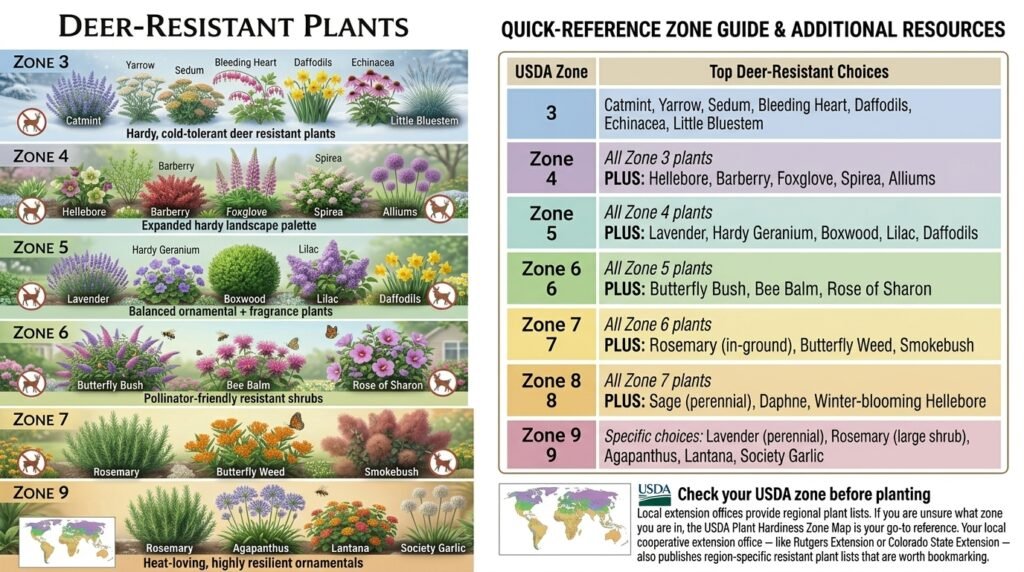
Not every resistant plant grows in every climate. Here is a quick zone-by-zone guide to the most reliable choices:
| Zone | Top Deer Resistant Choices |
|---|---|
| Zone 3 | Catmint, Yarrow, Sedum, Bleeding Heart, Daffodils, Echinacea, Little Bluestem |
| Zone 4 | All Zone 3 plants + Hellebore, Barberry, Foxglove, Spirea, Alliums |
| Zone 5 | All Zone 4 plants + Lavender, Hardy Geranium, Boxwood, Lilac, Daffodils |
| Zone 6 | All Zone 5 plants + Butterfly Bush, Bee Balm, Rose of Sharon |
| Zone 7 | All Zone 6 plants + Rosemary (in-ground), Butterfly Weed, Smokebush |
| Zone 8 | All Zone 7 plants + Sage (perennial), Daphne, Winter-blooming Hellebore |
| Zone 9 | Lavender (perennial), Rosemary (large shrub), Agapanthus, Lantana, Society Garlic |
If you are unsure what zone you are in, the USDA Plant Hardiness Zone Map is your go-to reference. Your local cooperative extension office — like Rutgers Extension or Colorado State Extension — also publishes region-specific resistant plant lists that are worth bookmarking.
How to Design an Animal Resistant Garden (Strategy Matters)
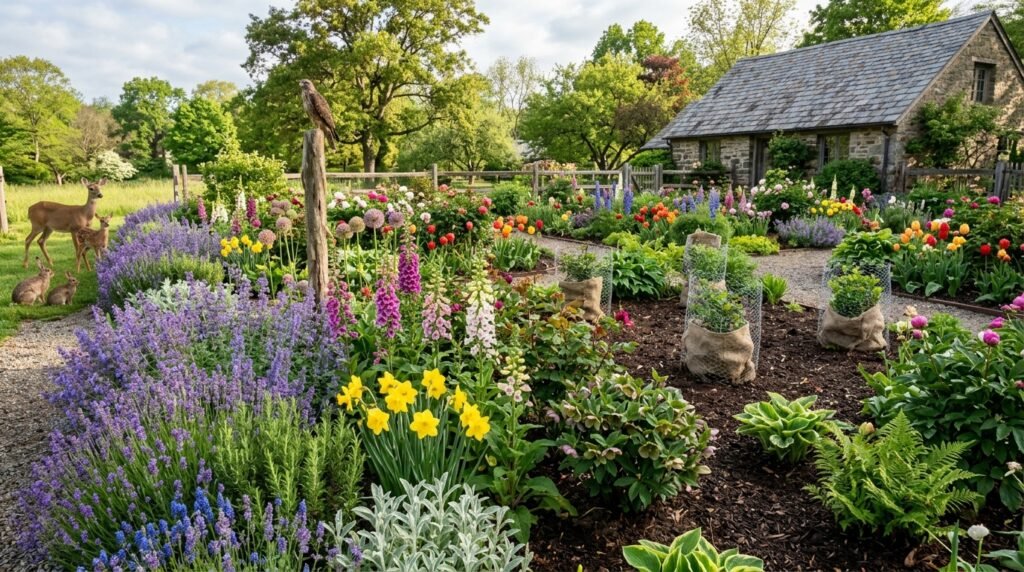
Choosing the right plants is step one. But how you arrange them matters just as much. Here is a layered strategy that really works:
1. Create a Scent Border
Plant strongly aromatic species — lavender, rosemary, catmint, or sage — along the outer edges of your beds. Deer and rabbits approach gardens from the perimeter, so hitting them with a wall of scent right away makes them think twice before venturing further in. It is like a natural fragrance fence.
2. Use Toxic Plants as Anchors
Position daffodils, foxglove, and hellebore as anchor plants near your most vulnerable specimens. Animals are smart enough to recognize these plants and tend to avoid entire areas where they appear. They act as warning flags to browsing wildlife.
For more on plants that can be toxic to pets and children too — not just wildlife — check out the Poisonous Plants Finder to make sure your garden is safe for everyone in your household.
3. Protect New Plantings Extra Carefully
Here is something most gardeners learn the hard way: even deer resistant plants are vulnerable when they are newly transplanted. They have not developed their full aromatic oils or toxic load yet, and animals will sample them before they know better.
Use chicken wire cages, tree tubes, or burlap wraps for the first one to two growing seasons. Once established, most resistant plants take care of themselves. The Silt Fence guide also covers simple barrier strategies that can protect young plantings at low cost.
4. Companion Plant Strategically
Interplant resistant species directly among vulnerable ones. Mix daffodil bulbs in with your tulips. Thread catmint through your rose bed. Plant alliums between your prized perennials. This scatter-planting technique means animals cannot simply eat around the resistant plants — they have to brush past them constantly, which deters continued browsing.
The Plant Spacing Calculator can help you work out optimal interplanting distances to maximize both aesthetics and protection.
5. Make the Habitat Less Welcoming
Remove brush piles where rabbits like to hide. Install bird-of-prey perches (hawks and owls control rabbit populations naturally). If you have fruit trees or a veggie patch, keep the ground clear of fallen fruit that attracts deer at night. A tidy, open garden with good sight lines is less attractive to wildlife in general.
If you are working on your broader garden organisation, the Garden Organizer guide has practical ideas for keeping everything tidy, tool-ready, and less likely to harbor pests.
When Fencing Is the Right Answer
Sometimes resistant planting is not enough — especially if you are in a high deer pressure area or growing vegetables that simply cannot be made resistant (lettuce, anyone?). In those cases, fencing is your best friend.
- Rabbit fencing: 2 feet high, buried 4–6 inches underground to stop tunnelling. Hardware cloth or chicken wire works well.
- Deer fencing: at least 8 feet high — deer are powerful jumpers. A double fence with just a few feet between layers is surprisingly effective even at lower heights, because deer cannot judge the depth.
- Invisible deer netting: stretched tightly around beds, this near-invisible black netting is great for protecting specific areas without ruining your garden aesthetics.
If you are putting up permanent fencing, do the math on Fence Panels and Fence Picket Spacing first — it will save you a lot of wasted material and unnecessary trips to the hardware store.
Plants That Repel Deer and Other Garden Pests Too
Many of the best plants that repel deer and rabbits also do double duty against other garden pests. Here is a look at the overlap:
- Lavender, Catmint, and Bee Balm also repel aphids and certain beetles thanks to their aromatic oils. They’re featured in our deep-dive on the 10 Plants That Stop Mosquitoes too.
- Alliums (including chives and garlic) repel aphids, Japanese beetles, and even some fungal diseases when planted near roses and fruit trees.
- Yarrow attracts beneficial predatory insects — lacewings, ladybugs, hoverflies — that naturally control aphid and caterpillar populations.
- Rosemary and Sage confuse the chemical receptors of spider mites and whiteflies when planted densely.
Think of these plants not just as natural pest control against large animals, but as ecosystem engineers that make your whole garden healthier.
Caring for Your Animal Resistant Plants
One of the best things about this plant group is that most of them are genuinely low-maintenance once established. But there are a few things worth knowing:
Soil & Drainage
Most aromatic, drought-tolerant species — lavender, rosemary, thyme, sedum — hate wet feet. Make sure your beds have excellent drainage. If your soil is heavy clay, consider amending it or building raised beds. The Soil Type Guide walks you through identifying your soil and the best ways to improve it for different plant types.
Watering
Many animal resistant plants are drought tolerant by design — their thick, waxy, hairy, or aromatic foliage is an adaptation to dry conditions as much as a defense against animals. Once established, lavender, catmint, yarrow, and sedum need very little supplemental watering. Overwatering actually weakens them and can reduce their pest resistance by diluting their essential oils.
If you need help managing watering schedules across different plant types, the Thirsty Plants Guide has excellent advice on matching water needs to plant types — especially useful if you are mixing resistant and non-resistant species in the same border.
Pruning & Maintenance
Most deer resistant shrubs and perennials benefit from annual cutting back. Cut catmint back by half after its first flush of flowers in early summer and it will rebloom. Trim lavender lightly after flowering to keep it bushy rather than woody. Cut bee balm to the ground in autumn and it will emerge vigorously in spring. Check the Bush Trimming Calendar for month-by-month guidance tailored to your hemisphere.
Fertilising
Less is more for most aromatic resistant plants. Overfertilising encourages lush, soft growth that is actually MORE attractive to deer and rabbits. Use a balanced, slow-release fertiliser at half the recommended rate, or rely on compost. The Fertilizer Selector helps you pick the right product for each plant type without overdoing it.
Common Mistakes When Planting for Animal Resistance
Even experienced gardeners make these mistakes. Avoid them and you will see far better results:
- Planting only one type of resistant plant. Diversity is key. A mix of scent, texture, and toxic deterrents is far more effective than a monoculture of a single species.
- Ignoring newly transplanted plants. All plants are vulnerable until established. Use physical protection for the first season, no exceptions.
- Not accounting for seasonal hunger. In late winter, deer and rabbits are starving. They will eat plants they normally ignore. Stock up on repellent sprays as a backup for late February through March.
- Assuming any plant is 100% animal proof. No plant is. These are plants that animals strongly prefer not to eat. In extreme hunger or stress, any plant can be browsed. Resistance is a tendency, not a guarantee.
- Overwatering aromatic plants. This dilutes their essential oils and reduces their natural deterrent power. Err on the dry side with lavender, rosemary, sage, and thyme.
- Planting resistant species in wrong conditions. A lavender in clay soil and full shade will not thrive — and a struggling plant is more vulnerable to browsing anyway. Match the plant to the site.
Frequently Asked Questions
What are the best deer resistant plants for full sun?
Lavender, catmint, yarrow, echinacea, rudbeckia, alliums, and sedum are all excellent choices for full-sun positions. They are also drought tolerant once established, which makes them ideal for hot, sunny borders.
What plants are both deer and rabbit resistant?
Most of the plants in this guide are resistant to both. The most reliable dual-resistant species include lavender, catmint, yarrow, daffodils, alliums, foxglove, hellebore, boxwood, barberry, and echinacea.
Are deer resistant plants safe for pets and children?
Not necessarily. Many deer resistant plants — including foxglove, hellebore, daffodils, and delphinium — are toxic to pets and people if ingested. Always check plant toxicity before adding new species, especially if you have curious dogs, cats, or young children. Use the Poisonous Plants Finder to check any plant before you buy.
Why do deer eat my ‘deer resistant’ plants?
A few things can cause this. First, newly planted specimens are more vulnerable before they are fully established. Second, extreme hunger (late winter, drought conditions) makes deer less discriminating. Third, regional deer populations can develop tolerance for certain plants over time. Finally, unhealthy or over-watered aromatic plants lose some of their deterrent potency.
What are the most deer resistant flowers?
Daffodils, alliums, foxglove, lavender, catmint, yarrow, echinacea, and rudbeckia are all highly deer resistant flowering plants. They also happen to be some of the most beautiful choices for a summer border.
Do deer eat lavender?
Rarely. Lavender is one of the most reliably deer proof plants available. Its intense essential oil content — the same thing that makes it smell wonderful to us — is highly repellent to deer and rabbits. In 20+ years of widespread gardening experience, deer browsing on established lavender is genuinely uncommon.
What is the most rabbit proof plant?
Daffodils are arguably the most rabbit proof bulb — the toxic alkaloids make them completely unattractive to rabbits. For perennials, lavender, catmint, and yarrow are among the most reliably rabbit proof plants. For shrubs, barberry (with its vicious spines) is close to rabbit proof in the truest sense.
Can I grow vegetables in a deer-prone area?
Yes — with the right approach. Focus on aromatic or pungent vegetables like garlic, onions, chives, and herbs. Use physical barriers (fencing, netting, cages) for vulnerable crops like lettuce, beans, and brassicas. Surround your veggie plot with strongly aromatic resistant plants as a deterrent perimeter.
Do resistant plants need special soil?
Most prefer well-draining soil. Aromatic Mediterranean herbs like lavender, rosemary, and thyme actively dislike heavy, wet clay. If drainage is an issue, build raised beds or amend your soil. The Raised Bed Soil Calculator makes it easy to get the right soil blend and volume for any bed size.
What are the best deer resistant plants for shade?
Hellebore is the undisputed king of shade-tolerant deer resistance. Other excellent options include bleeding heart (Dicentra), foxglove (in partial shade), astilbe, ferns (most are deer resistant), and sweet woodruff. Turtlehead (Chelone) also does well in part shade and is extremely bitter — deer dislike it strongly.
Final Thoughts: Build a Garden Animals Walk Past
Here is the truth: you cannot garden in deer and rabbit territory and expect zero losses. But you can absolutely tip the odds heavily in your favor.
The gardeners who succeed in high-pressure wildlife areas are the ones who plan smart from the start. They build their garden’s backbone from reliably animal resistant plants — the lavenders, the daffodils, the catmints, the yarrows, the hellebores. They use those resistant species as shields for the things they really love. And they accept that a little physical protection goes a long way for new plantings.
Most importantly: they enjoy the flowers. Because the list of beautiful, fragrant, pollinator-friendly, spectacular plants that deer and rabbits avoid is genuinely long. You are not settling. You are making smarter choices.
Whether you are working on a raised bed build, planning your modern patio planting scheme, or just trying to stop a deer from eating your garden for the hundredth time — starting with the right plants is always step one.
Go plant something beautiful. Make it resistant. And enjoy it all season long.