Don't Let Your Garden Wash Away: 7 Tips to Prevent Soil Erosion
7 Ways to Control Soil Erosion
Soil Erosion is a natural process, but human activities like construction and farming can speed it up, leading to land degradation and water pollution. Fortunately, there are many effective methods to control soil erosion and protect our landscapes. Here are seven of the best ways to keep soil in place.
1. Plant Trees and Vegetation
Planting vegetation is one of the simplest and most effective ways to stop soil erosion. The roots of plants, especially trees and shrubs, act like a natural net, holding soil particles together. This makes the soil more resistant to being washed away by rain or blown away by wind.
- How it works: Plant roots anchor the soil, while leaves and branches (the canopy) intercept raindrops, reducing their impact on the ground.
- Best plants for erosion control: For best results, use native plants that are adapted to your local climate. Deep-rooted grasses, ground cover plants, wildflowers, shrubs, and trees are all excellent choices for stabilizing soil on hillsides, slopes, and riverbanks.
2. Apply Mulch to Bare Soil
Covering bare soil with a layer of mulch is a quick and easy way to prevent erosion. Mulch acts as a protective blanket, shielding the soil from wind and rain. It’s especially useful in gardens and on newly seeded areas.
Mulch also offers several other benefits:
- Retains moisture: A layer of mulch helps the soil stay moist, reducing the need for watering.
- Suppresses weeds: It blocks sunlight, preventing unwanted weeds from growing.
- Improves soil health: Organic mulches like wood chips, straw, or compost break down over time, adding valuable nutrients to the soil.
3. Reforestation and Afforestation
Reforestation (replanting trees in a cleared forest) and afforestation (planting trees where there were none before) are powerful, large-scale solutions for erosion. Forests are one of nature’s best defenses against soil loss.
There are two main reasons why clearing forests increases erosion:
- Loss of the canopy: The tree canopy acts as a natural umbrella, softening the impact of heavy rain on the soil.
- Loss of the root system: The extensive network of tree roots binds the soil, creating a stable foundation. Without them, soil becomes loose and vulnerable.
By replanting trees, we can stabilize eroding land and even prevent small landslides and gullies from forming.
4. Use Erosion Control Blankets
For steep slopes or construction sites where vegetation needs time to grow, erosion control blankets are an excellent solution. These blankets are typically made from biodegradable materials like straw, coconut fiber, or jute.
They are rolled out over bare soil and secured with stakes or staples. The blanket holds the soil in place, prevents seeds from washing away, and slows down water runoff, giving new plants a chance to establish themselves. Once the vegetation grows, the blanket naturally breaks down.
5. Install Silt Fences
You’ve likely seen silt fences around construction sites. These temporary barriers are made of a special geotextile fabric stretched between posts. Their job is to control sediment in runoff water.
A silt fence acts as a filter, trapping soil and sediment while allowing water to pass through. This prevents loose soil from construction sites from polluting nearby streams, rivers, and storm drains. For them to work effectively, they must be installed correctly along the contour of the land and maintained regularly.
6. Construction Seeding
Disturbed soil on construction sites is highly susceptible to erosion. Construction seeding involves planting grasses to provide quick ground cover and stabilize the soil.
- Temporary Seeding: This uses fast-growing annual grasses to cover the soil for a short period. A common method is hydroseeding, where a mixture of seed, mulch, and fertilizer is sprayed onto the soil for rapid growth.
- Permanent Seeding: Once construction is finished, a permanent mix of native perennial grasses and other plants is sown to create a long-term, stable ground cover that prevents future erosion.
7. Build Check Dams and Other Structures
In areas with concentrated or high-velocity water flow, like ditches or channels, you may need to build structures to slow the water down. These are often called “energy dissipaters” because they reduce the water’s erosive power.
Common examples include:
- Check dams: Small, temporary dams made of rock or logs built across a channel.
- Riprap: A layer of large, angular rocks placed along riverbanks or channel bottoms.
- Gabions: Wire mesh baskets filled with rocks, often used to build retaining walls.
These structures absorb the force of the flowing water, slowing it down and allowing sediment to settle instead of being washed away.

What Is a Silt Fence?
A silt fence is a temporary barrier installed on construction sites to control sediment and prevent erosion. It consists of a strong filter fabric, known as a geotextile, which is stretched between wooden or metal stakes.
The main job of a silt fence is to manage soil erosion and sediment runoff. It works by letting water pass through the fabric while catching and holding back silt, dirt, and other sediment. This process is crucial for preventing loose soil from washing off a construction site and polluting nearby streams, rivers, storm drains, and other sensitive environments.
Installing silt fences is a key best practice for any effective erosion and sediment control plan. Proper installation and maintenance not only protect the local ecosystem but also help contractors meet federal, state, and local environmental regulations, preventing costly fines and work stoppages.

Silt Fences 101: Your Ultimate Guide
Silt Fence Installation: A Step-by-Step Guide
Silt fences are temporary barriers used to control sediment on construction sites, in erosion-control projects, and in restoration areas. Choosing the right type of silt fence is crucial for project success and meeting regulatory standards.
This guide provides a complete overview of the seven main types of silt fences:
- Standard Silt Fence
- Reinforced Wire-Backed Silt Fence
- Pre-Assembled Silt Fence
- Super Silt Fence
- Floating Turbidity Barrier
- Compost Filter Sock
- High-Visibility Orange Silt Fence
We will cover everything you need to know, from specifications and installation methods (like manual and power trenching) to costs, equipment, and regulatory compliance. Learn how to plan your site and troubleshoot common issues to ensure your silt fence is effective at controlling sediment.
🚧 Silt Installation & Selector Tool
Explore our User friendly calculator of over 15 product variations to find the perfect match for your needs. Easily compare technical specifications to see which option best fits your requirements. Once you've selected a product, use our material calculator to estimate the exact quantity you'll need. Find the right fit for your project and budget today.
| Category | Features | Recommended Use |
|---|---|---|
| 1. Standard | Woven fabric, wood/steel stakes | General perimeter control |
| 2. Reinforced | Wire-backed, handles high pressure | Heavy runoff areas |
| 3. Super Silt | Chain-link or industrial backing | Major construction sites |
| 4. Turbidity | Floating systems, aquatic filter | Shorelines, ponds, lakes |
| 5. Compost Sock | Bio-degradable straw/coir | Sustainable/Green sites |
| 6. High-Visibility | Bright orange, safety alert | Roadwork & Public zones |
| 7. Pre-Assembled | Labor-saving preset stakes | Quick-response projects |
📋 Installation Requirements
*Estimates are based on standard trench-method installation.
Standard height options: 24", 36", 42". Geotextile strength varies by site flow requirements.
Always entrench the bottom 6-12 inches. Stake support should be on the downstream side.
🚀 Quick and Easy Setup
Choosing the right silt fence for your construction project involves several key steps. Here’s what you need to know to make the best choice:
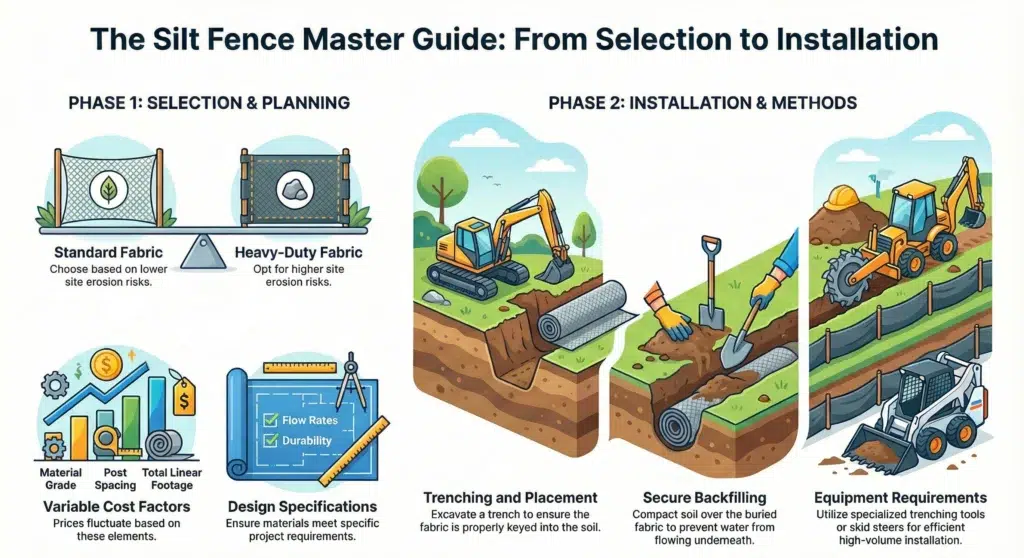
- Assess Your Site: First, evaluate your job site’s specific conditions. Do you need a standard silt fence for simple sediment control, a wire-backed or reinforced fence for heavy flows, or a floating silt curtain for work in water? Understanding the terrain, soil type, and water flow is crucial.
- Consider Project Scale: The size of your project will influence the installation method. For smaller areas, manual installation might be sufficient. For larger construction sites, machine installation is more efficient and ensures proper placement.
- Balance Your Budget: Silt fence costs can vary. The price depends on the type of fence you choose (e.g., standard vs. reinforced) and the installation method. Factor these costs into your overall project budget.
- Check Regulations: Always verify local, state, and federal erosion and sediment control regulations. Compliance with environmental laws is essential to avoid penalties and ensure your project meets all legal requirements.
A Contractor’s Guide to Silt Fences
Silt fences are a key tool for controlling sediment and preventing erosion on construction sites. Choosing the right one is crucial for protecting your site, managing runoff, and staying compliant with environmental regulations. This guide will walk you through the different types of silt fences and their best uses.
We’ll cover everything from standard and wire-backed silt fences to heavy-duty and pre-assembled systems. Understanding these options will help you select the best solution for your project. We’ll also explore alternatives for unique site conditions, like turbidity barriers (silt curtains) and compost filter socks.
For each type of silt fence, we’ll break down:
- Materials and specifications
- Proper installation techniques
- Typical costs and pricing
This guide also covers key environmental regulations, best practices for inspection and maintenance, and tips for troubleshooting common problems. Learn how to select, install, and maintain the right erosion control fence to keep your job site compliant and protected.
Silt Fence Installation and Maintenance
Installing a silt fence is crucial for controlling erosion on construction sites. For a standard installation, bury the fence 6-8 inches deep with stakes 4-6 feet apart. It’s a physically demanding DIY project, and renting equipment like a power trencher or a skid steer can save significant time on larger jobs.
Key considerations include:
- Permits: Most projects disturbing over 5,000 sq ft require a permit and a Stormwater Pollution Prevention Plan (SWPPP), with heavy fines for non-compliance.
- Inspection: Check the fence weekly and after rain, removing sediment when it reaches 12 inches high.
- Types: Use standard fences for flat areas, reinforced fences for slopes, and super-duty fences for steep inclines.
- Removal: Once the site is stable, remove the fence and dispose of the sediment and materials according to local regulations.
Resources
Erosion Control Standards & Specifications
- https://www.epa.gov – EPA construction storm water regulations and requirements
Installation & Equipment Information
- https://www.youtube.com – Installation videos and equipment demonstrations
Materials & Supplies
- https://www.lowes.com – Silt fence materials, stakes, and supplies
Regulatory Compliance & Guidelines
- https://www.houzz.com – Professional erosion control contractor directory
DISCLAIMER
This guide offers general advice on silt fence installation. However, it’s crucial to consult local environmental regulations, stormwater permits, and professional engineers, as requirements vary and penalties for non-compliance can be high. This information does not replace professional consultation, especially for complex projects.