
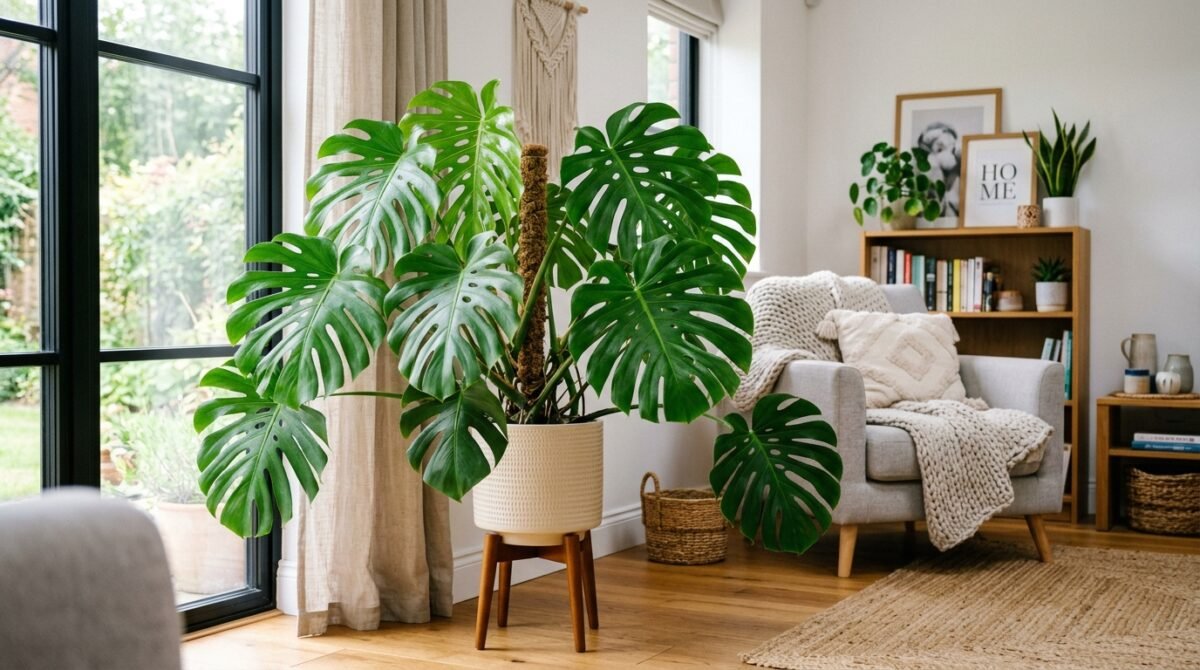
Monstera Care: The Complete Guide to a Thriving Swiss Cheese Plant
Few houseplants have won over as many homes as the Monstera. With huge, glossy, hole-filled leaves, the Swiss cheese plant (Monstera deliciosa) looks dramatic, yet it is one of the easiest big-impact indoor plants you can grow.
The good news: it is far less fussy than it looks. Get light and watering right and it rewards you with strong growth for years. This guide covers light, watering (with a free calculator below), humidity, soil, support, feeding, propagation, common problems and pet safety.
What Is a Monstera Plant?
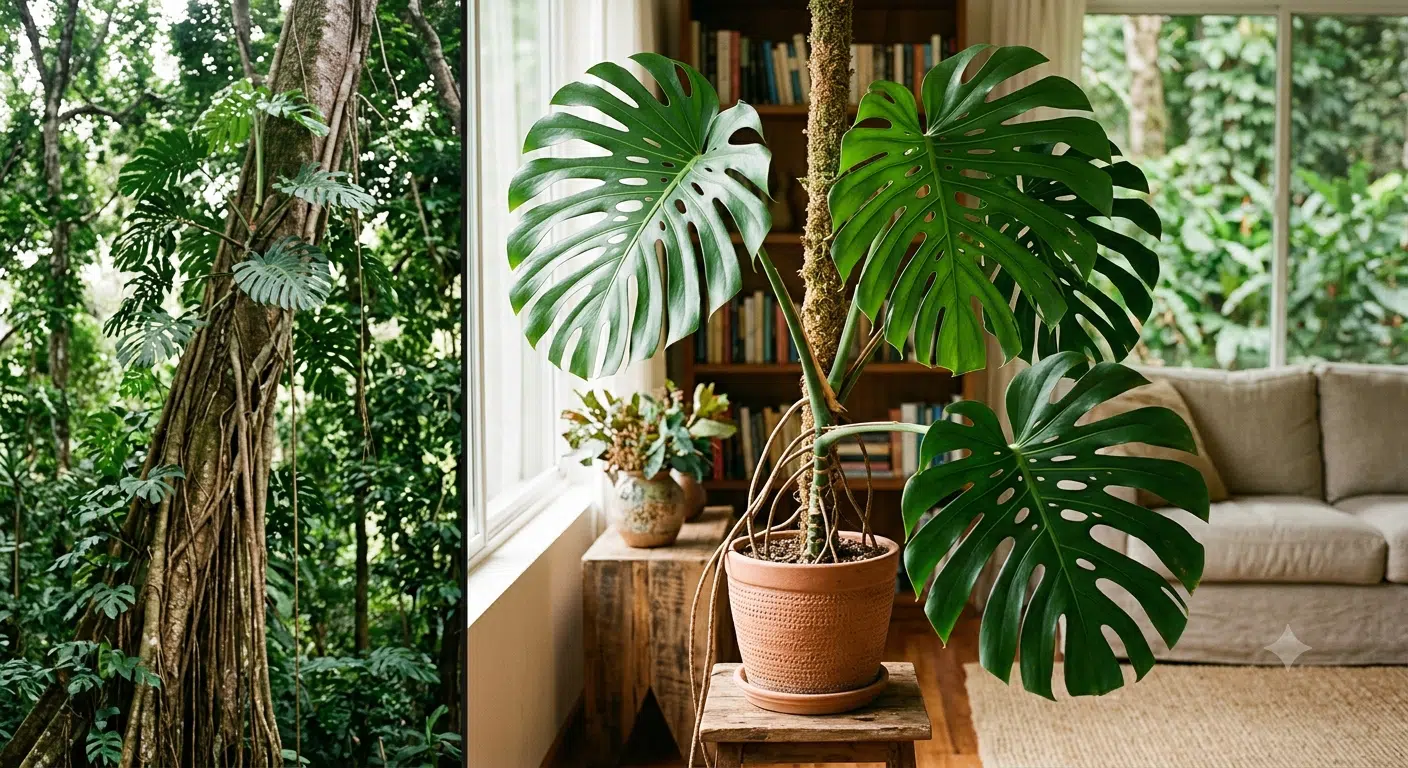
Monstera is a genus of tropical climbing plants. The best-known species, Monstera deliciosa, comes from the rainforests of southern Mexico and Central America, where it climbs trees using its aerial roots. The holes and splits in mature leaves are called fenestrations. You can read more about its natural history on Wikipedia.
The name comes from the Latin for “monstrous,” a nod to the giant leaves. “Deliciosa” refers to its fruit, which is edible only when fully ripe and is often described as tasting like a mix of pineapple and banana. Unripe fruit irritates the mouth, so do not taste it unless you know what you are doing.

What Are the Different Types of Monstera?
There are dozens of Monstera species and cultivars, from easy classics to rare collector plants. These are the ones you are most likely to see for sale:
- Monstera deliciosa – the classic, large-leaved Swiss cheese plant.
- Monstera adansonii – the Swiss cheese vine, with smaller leaves and more holes.
- Monstera siltepecana – silvery leaves and a trailing habit; lovely in a hanging basket.
- Monstera ‘Peru’ (M. karstenianum) – thick, deeply textured leaves.
- Monstera ‘Esqueleto’ – leaves that are almost more hole than leaf.
- Variegated forms – such as ‘Albo Variegata’, ‘Thai Constellation’ and ‘Aurea’. They grow more slowly and are usually expensive. See our guide to plants with variegated leaves for care tips.
Two names cause confusion. Plants sold as “Monstera borsigiana” are a smaller, faster-growing form that botanists now group under M. deliciosa. The “mini Monstera” is actually Rhaphidophora tetrasperma, a related plant from a different genus that looks similar and suits small spaces.

Do Monstera Plants Need a Lot of Light?
Yes. Monsteras need bright, indirect light to grow well and develop their signature holes. Gentle morning sun is fine, but strong midday sun through glass can scorch the leaves.
If your Monstera has no holes, low light is the most common reason (young plants also have solid leaves, which is normal). A spot near an east- or west-facing window, or a few feet back from a south-facing one with a sheer curtain, works well.
In a dark room, a full-spectrum LED grow light helps a lot. If your space is dim overall, these low-light indoor plants may suit you better.
Quick Diagnosis: Common Monstera Problems
The video shows a mature Monstera deliciosa with fully split leaves. If yours looks different, find the symptom below to narrow down the cause before changing your routine.
| Symptom | Likely cause | What to do |
|---|---|---|
| Yellow lower leaves, soil stays wet | Overwatering or poor drainage | Let the top 2–5 cm dry; check drainage holes |
| Crispy brown edges or tips | Dry air or underwatering | Water more consistently; raise humidity |
| Brown or black patches with a yellow halo | Overwatering, root rot or cold damage | Check roots; trim mushy ones and repot |
| Drooping, soil bone dry | Thirst | Water thoroughly until it drains |
| Drooping, soil wet | Root rot | Unpot, trim rotten roots, use fresh airy mix |
| New leaves without holes, long gaps between leaves | Too little light (or a young plant) | Move to brighter, indirect light |
| Fine webbing, speckled leaves | Spider mites | Wipe leaves; treat with insecticidal soap |

How Often Should You Water a Monstera?
Water a Monstera when the top 2–5 cm (1–2 inches) of soil feel dry. In a typical home that is roughly once a week in spring and summer, and less often in autumn and winter. Aim for soil that is moist but never soggy.
Overwatering is the biggest danger because it leads to root rot. A drooping plant can mean thirst or rot, so always feel the soil before reaching for the watering can. Use the calculator below for a starting schedule, and see our indoor plant care calculator for your other houseplants.
Monstera Watering Schedule Calculator
Estimate how often to check your Monstera’s soil and roughly how much water a thorough watering takes.
What Temperature and Humidity Does a Monstera Like?
Monsteras are happiest between 18 and 27°C (64–80°F). Growth stalls below about 15°C (59°F), and temperatures under 10°C (50°F) can damage the leaves.
They tolerate average household humidity (around 40–60%) but grow best when it is higher. Keep the plant away from cold drafts and heating vents, and raise humidity with a humidifier or by grouping plants together. Very dry air is a common cause of crispy brown edges.

What Soil and Pot Size Does a Monstera Need?
Use a light, well-draining mix: peat-free houseplant compost blended with perlite and orchid bark works well. It keeps the roots airy and stops water from pooling around them.
Choose a pot with drainage holes, only 2–5 cm (1–2 inches) wider than the current root ball. Oversized pots hold extra wet soil that dries slowly. Repot every one to two years in spring, or when roots circle the pot or poke out of the drainage holes. Our pot size calculator helps you pick the next size up.


Does a Monstera Need Support?
Yes. Monstera deliciosa is a natural climber; in the wild it grips tree trunks with its aerial roots.
Indoors, give it a moss pole, coir pole or sturdy stake and loosely tie the main stem to it. Support stops the plant from flopping over, and climbing plants tend to produce larger, more split leaves.
How Do You Fertilize a Monstera?
Feed a Monstera with a balanced liquid houseplant fertilizer about once a month in spring and summer, diluted to half the label strength. Stop feeding in autumn and winter when growth slows.
Do not overdo it: excess fertilizer builds up as salts that can burn the roots. Flush the pot with plain water every few months. Not sure what to buy? Our fertilizer selector points you to the right type for leafy tropicals.


How Do You Propagate a Monstera?
Monsteras are easy to propagate from stem cuttings, as long as each cutting includes a node: the small bump on the stem where leaves and aerial roots grow. A leaf without a node will not grow into a new plant.
To propagate in water:
- Cut a stem section with one or two leaves and at least one node, using clean, sharp shears.
- Place the cutting in a jar of water with the node submerged and the leaves above water.
- Keep it in bright, indirect light and change the water weekly.
- When roots are 5–10 cm (2–4 inches) long, usually after a few weeks, pot it into a well-draining mix.

Why Is My Monstera Turning Yellow?
Overwatering is the most common reason Monstera leaves turn yellow, especially lower leaves. Check that the pot drains freely and let the top of the soil dry before watering again. An occasional old leaf yellowing at the base is normal.
For a deeper look at the causes, read our guide on why plant leaves turn yellow. Other common issues:
- Brown edges or spots – usually dry air or irregular watering. Raise humidity and water consistently.
- Black spots or blackened leaves – often root rot or cold damage. Check the roots and move the plant somewhere warmer.
- Curling leaves – a sign of thirst or low humidity.
- Leggy growth or leaning sideways – not enough light. Move it somewhere brighter and rotate it occasionally.
Most struggling Monsteras recover once watering and light are corrected. Trim badly damaged leaves at the base so the plant can focus on new growth.

Are Monstera Plants Toxic to Cats and Dogs?
Yes. Monstera is toxic to cats and dogs because its leaves and stems contain insoluble calcium oxalate crystals. The ASPCA lists the Swiss cheese plant as toxic to both, with signs such as mouth irritation, drooling, vomiting and difficulty swallowing. It can also irritate people’s mouths and skin, so keep it away from small children.
To keep a pet from chewing it, place the plant out of reach, cover the soil with large stones, and offer cat grass as a safer alternative. If your pet has chewed a Monstera and seems unwell, contact your vet. You can check other houseplants with our poisonous plants finder.

Can You Plant a Monstera Outside?
Only in warm, frost-free climates, roughly USDA zones 10–12. There it can grow outdoors year-round in a shaded or dappled spot.
In cooler regions, keep it indoors and, if you like, move it to a sheltered, shady spot outside for summer. Bring it back in before night temperatures fall below about 10°C (50°F); frost will kill it.

Is a Monstera the Same as a Philodendron?
No. Monstera and Philodendron are separate genera in the same plant family (Araceae).
The mix-up happens because Monstera deliciosa is sometimes sold as a “split-leaf philodendron.” Our guide to split-leaf philodendron types and sizes explains the differences.

What Are the Benefits of a Monstera Plant?
The main benefits are practical and visual: it adds bold greenery, grows quickly, and is forgiving enough for beginners. With good care, a single plant can live for many years and become a living centerpiece.
You may read that houseplants purify indoor air. Research suggests the effect of a few plants in a normal home is very small, so think of a Monstera as a mood and décor boost rather than an air filter.
Frequently Asked Questions
How do I get my Monstera to grow holes?
Give it bright, indirect light, something to climb and time. Young plants naturally have solid leaves; fenestrations appear as the plant matures, usually after it is a couple of years old and in good light.
How big does a Monstera get indoors?
Indoors, Monstera deliciosa commonly reaches 1–3 metres (3–10 feet) tall with support. In the wild it can climb as high as around 20 metres, so give yours room and a sturdy pole.
Why are my Monstera leaves turning brown?
Brown edges usually mean dry air or irregular watering. Raise the humidity, water consistently and keep the plant away from radiators and heating vents.
How do I save a dying Monstera?
Start with the roots. Trim any mushy, dark roots, repot in fresh airy soil, then give it bright, indirect light and careful watering while it recovers.
Can a Monstera live in water permanently?
It can survive in water for a long time, but it grows larger and stronger once moved to soil. Water is best for rooting cuttings and for display.
Should I wipe Monstera leaves?
Yes. Dust blocks light. Wipe the leaves gently with a soft, damp cloth every few weeks; this also lets you spot pests early.

Final Thoughts
A Monstera asks for little and gives back a lot. Bright, indirect light, watering only when the top of the soil is dry, something to climb and a monthly feed in summer are all it needs to thrive.
Keep it warm, keep it away from curious pets and be patient with those holes, and your Swiss cheese plant will grow into the dramatic centerpiece you pictured when you brought it home.
Sources: Monstera deliciosa – Wikipedia; ASPCA – Swiss Cheese Plant.
Last updated: October 6, 2026.
