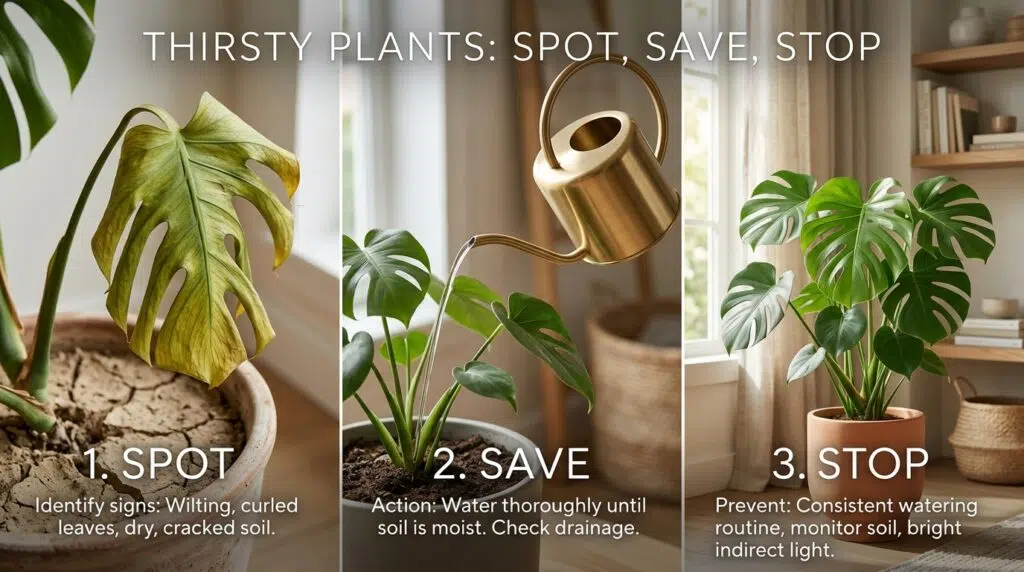
Thirsty Plants: How to Spot, Save, and Stop Underwatering
Your plant is drooping. The leaves look crispy at the edges. The soil feels like dust. And you are standing there with a watering can wondering one thing: did I forget to water it, or did I drown it?
That worry is normal. Thirsty plants and overwatered plants can look almost the same, so it is easy to guess wrong. The good news is that plants are not silent. They send clear signals, and once you learn to read them, watering stops feeling like a guessing game.
This guide walks you through every sign of a thirsty plant, simple tests anyone can do, how to rescue a plant that has dried out, and how to stop it happening again.
What does a thirsty plant actually look like?
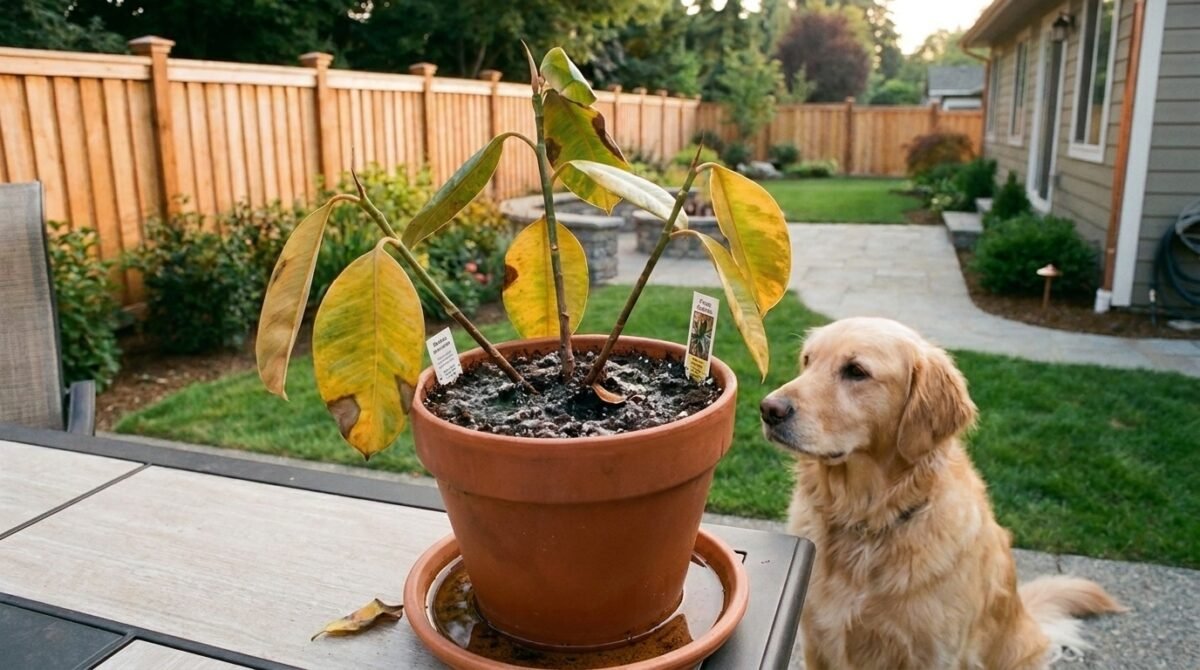
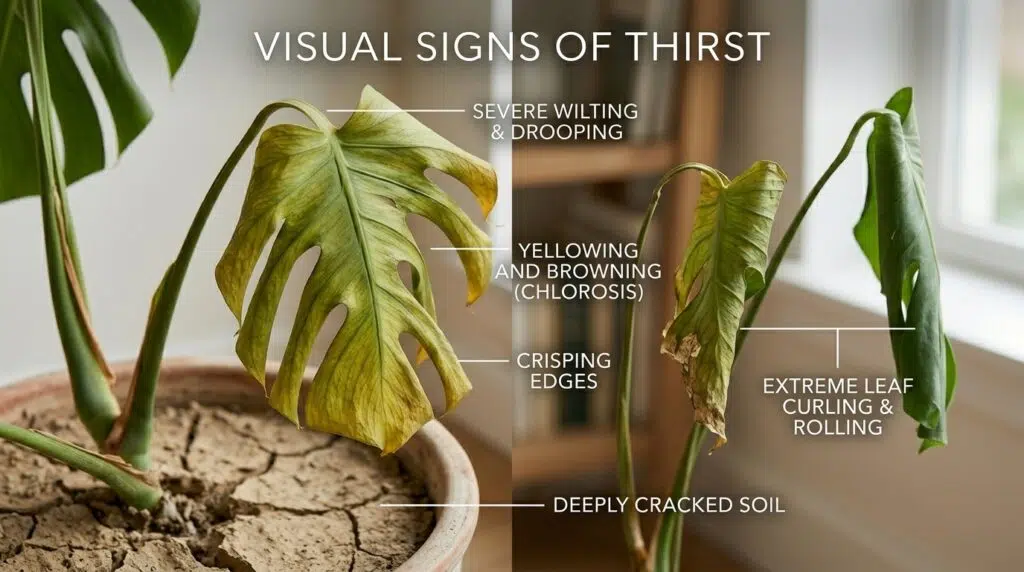
A thirsty plant usually wilts from the top down, with dry crispy leaves and soil that pulls away from the side of the pot.
When a plant runs short of water, its cells lose their firmness. That firmness, called turgor pressure, is what keeps leaves and stems standing upright. Lose the water, lose the structure, and the plant flops.
Underwater plants feel dry and brittle, not soft and soggy. The soil is the biggest clue. Dry soil cracks, turns dusty, and shrinks away from the container edge. If you see that gap, your plant has been thirsty for a while.

How much water does your plant actually need?
Stop guessing and stop underwatering. Tell us about your pot and plant, and get a clear amount to pour plus how often to do it.
Your plant & pot
Your watering guide
This is a smart starting estimate, not an exact prescription. Soil moisture is always the final word — check it before every watering.
How the watering amount is worked out
The tool estimates your pot's soil volume, then pours a deep-soak fraction of that volume and adjusts the timing for your plant, light, season, soil and pot.
Watering well is about two numbers: how much and how often. They are not the same. The amount mostly depends on the size of the pot, because you are trying to wet the whole root zone. The frequency depends on how fast that water disappears.
The amount is based on your pot's soil volume, with a thorough-soak fraction of roughly 20–25%. Fast-draining mixes and porous pots get a little more, because more runs through.
The frequency starts from the plant's thirst level, then shifts with light and warmth, the season, your soil mix, and whether the pot is porous. Hot sunny spots and growing season speed things up; winter dormancy and plastic pots slow them down.
Why a deep soak beats a daily splash
Watering deeply but less often grows stronger, deeper roots and makes plants far more drought-proof.
A small daily splash only wets the top of the soil. Roots then crowd near the surface where they dry out fastest. A proper soak that reaches the bottom of the pot trains roots to grow down, so the plant can ride out a missed watering without drama.
For trusted, science-backed habits, the Royal Horticultural Society has a clear guide to watering plants wisely and a practical walkthrough on how to water containers. The University of Maryland Extension also explains watering indoor plants in plain terms.
Watering questions, answered
How much water does my plant need per watering?
Give a deep soak of roughly 20–25% of the soil volume, pouring until water just drains from the bottom. This tool turns that rule into a clear figure in millilitres or cups for your exact pot.
How often should I water my plant?
There is no fixed number. Water when the top 1–2 inches of soil feels dry. The day range here is a guide — warm, bright rooms dry faster, and dormant winter plants need far less.
Why does pot material change the schedule?
Terracotta and fabric pots are porous and lose moisture through their walls, so they dry out faster than plastic or glazed pots. The calculator shortens the interval for porous pots.
My plant is wilting — should I water right now?
Check the soil first. Dramatic plants like hydrangeas wilt in afternoon heat even when the soil is moist, and recover by evening. If the soil is genuinely dry, water it; if it is moist, wait.
Does this replace checking the soil?
No. The calculator gives a reliable starting point, but soil moisture is the final word. Use the finger test before every watering.
Keep your plants happy
What are the warning signs your plant is thirsty?
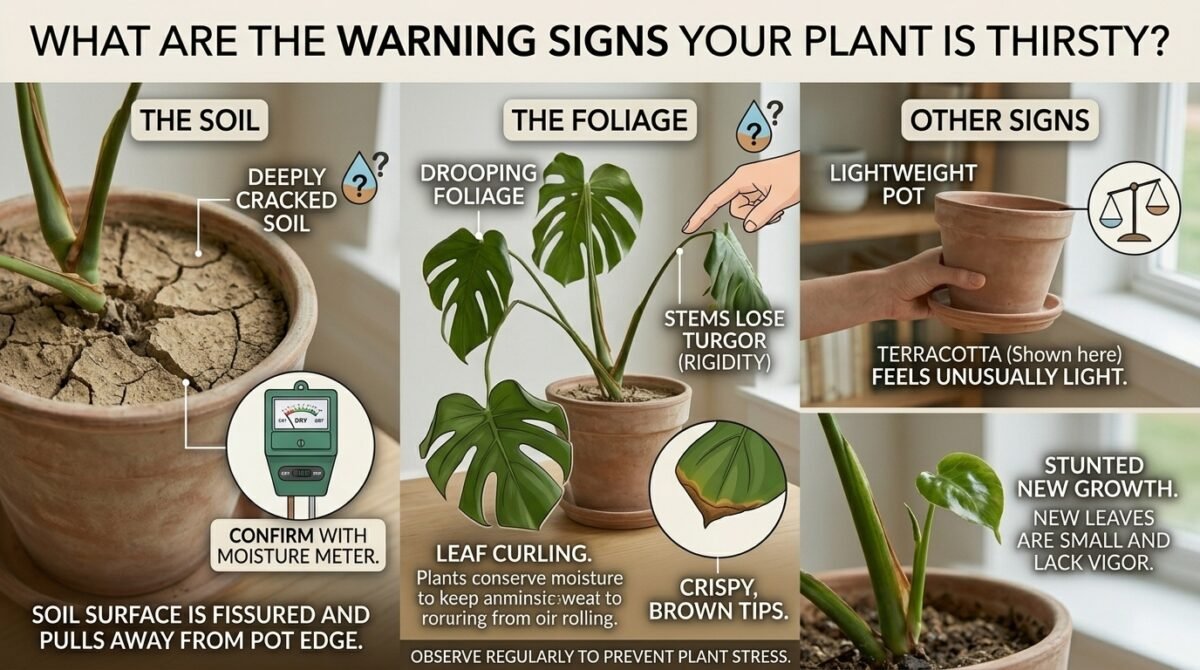
The most reliable signs of a thirsty plant are wilting, dry cracked soil, crispy leaf edges, leaf drop, and slow growth.
Here are the eleven signals to watch for, roughly in the order they appear:
- Wilting leaves. This is the first and most common sign. The top leaves usually droop before the lower ones.
- Dry, cracked soil. Push a finger in. If it feels dry and dusty around the roots, the plant needs a drink.
- Yellow leaves with brown edges. Without enough water, the plant struggles to move nutrients, so leaves yellow and the tips crisp.
- Curling, crispy leaf margins. Curling inward is the plant shrinking its surface area to save moisture.
- Leaf drop. In a real shortage, a plant sheds leaves to survive on less.
- Slow or stunted growth. No water means no fuel for new leaves, so growth stalls.
- Brittle, dry roots. Healthy roots bend. Severely dried roots snap.
- Soil pulling away from the pot. Shrinking soil leaves a visible gap around the rim.
- Sudden pests. Stressed, thirsty plants are easy targets for aphids, spider mites, and mealybugs.
- Dropped flower buds. A drought-stressed plant sacrifices its buds first.
- Dull, gray-green color. The leaves lose their healthy shine and look faded.
Seeing yellow leaves can be confusing because both too little and too much water cause it. That is why the next step matters: always check the soil before you reach for the watering can.

How can you tell if a plant is thirsty?
The simplest test is the finger test: push a finger one to two inches into the soil, and if it feels dry at that depth, the plant needs water.
You do not need fancy gear to read your plant. Try these quick checks:
- The finger test. Dig in one to two inches. Dry at that depth means water now.
- The pot-weight test. Lift small pots. A surprisingly light pot is a dry pot.
- The soil-feel test for beds. Dig down six to eight inches and squeeze a handful. Sandy loam should hold together loosely and leave your hand damp.
- The scratch test. Lightly scratch a stem. Green underneath means the plant is still alive and worth saving.
- The stem-bend test. Bend a small stem. If it snaps, it is bone dry. If it springs back, you are fine.
If you want to take the guesswork out completely, a cheap soil moisture meter works well, and you can find one with the rest of your home and garden tools. For a routine that adjusts to each plant, our indoor plant care calculator is a handy companion.

Underwatering vs overwatering: how do you tell them apart?
Underwatered plants feel dry, crispy, and bounce back fast after watering, while overwatered plants feel soft, soggy, and keep declining.
Both problems share symptoms like wilting, yellowing, and leaf drop. The differences are in the details:
Clue | Underwatering | Overwatering |
Wilting pattern | Top leaves wilt first | Bottom leaves wilt first |
Leaf feel | Crispy, dry, brittle | Limp, soggy, soft |
Soil | Dry, cracked, pulling from pot | Wet, heavy, maybe mouldy |
Roots | Brittle and shrivelled | Brown, mushy, smelly |
Recovery | Perks up soon after watering | Keeps getting worse |
Quick rule: soft and soggy means stop watering; dry and crispy means water now. Check the soil first, every time.

How do you rehydrate a thirsty plant?
To revive a thirsty plant, water it slowly and thoroughly, let it soak, and repeat the next day if the soil was very dry.
For everyday dry potted plants
- Water deeply. Pour slowly until water runs out the drainage holes, then let it sit and soak in.
- Bottom water. Set the pot in a shallow dish of water so the roots pull moisture up from below.
- Repeat tomorrow. Very dry soil often needs a second watering to fully recover.
For severely dried-out plants
- Lift the plant gently out of its pot.
- Soak the roots in water for 12 to 24 hours.
- Trim away any roots that are brittle and dead, using clean scissors.
- Repot into fresh, moist soil with a little compost mixed in.
For soil that won’t absorb water
When peat or coco coir dries out fully, it turns water-repellent, so the water just runs straight through. Loosen the surface gently with a fork, push the soil back toward the edges, then soak the whole pot slowly so the mix can finally drink. Picking the right soil type from the start makes this far less likely.
Go gently. A sudden flood can shock the roots. Start by simply moistening the soil, remove the crispy dead leaves, then return to a steady watering rhythm.

Which plants are the most dramatic when thirsty?
Peace lilies, hydrangeas, ferns, calatheas, and fiddle leaf figs are the biggest drama queens, drooping fast when dry and perking up within hours of a drink.
The peace lily is the classic show-off, collapsing dramatically and then standing tall again soon after watering. The hydrangea is so thirsty it earned its name from the Greek for “water vessel,” and it wilts on hot afternoons even when the soil is fine.
These plants are actually helpful, because they tell you loudly when they are thirsty. If you enjoy expressive plants like these, our dramatic thirsty plants guide goes deeper, and you will find plenty of company among indoor plants that wear their feelings on their leaves.

Which plants barely get thirsty at all?
Succulents, cacti, snake plants, lavender, and agave need very little water because they store moisture and lose it slowly.
If you forget to water, these plants forgive you. Their secrets:
- Thick, waxy leaves that lock moisture in.
- Small or narrow leaves with less surface to lose water from.
- Deep roots that reach moisture far below the surface.
- The ability to drop leaves in a drought and regrow later.
Agave can survive on as little as three inches of water a year. If a low-water garden appeals to you, plan it out with our drought-resistant garden calculator.

How much water does a thirsty plant actually need?
Most plants want a deep soak until water drains from the bottom, rather than a small daily splash.
The right amount depends on the pot size, the plant type, the light, and the season. A small succulent on a shady shelf needs a fraction of what a big fern in a sunny window drinks.
Watering deeply but less often is the golden rule. It pushes roots to grow downward and makes plants tougher. To get a starting amount and a watering rhythm tailored to your exact pot and plant, try the Watering Amount Calculator that pairs with this guide. Matching the right pot size also helps, since an oversized pot holds soggy soil while a tiny pot dries out in hours.

How do you stop your plants getting thirsty in the first place?
Prevent thirsty plants by watering deeply but less often, mulching the soil, and checking moisture before you water instead of following a fixed schedule.
Build these habits and underwatering mostly disappears:
- Water deeply and infrequently to encourage strong, deep roots.
- Water in the morning so less is lost to midday evaporation.
- Add a layer of mulch to hold moisture and keep roots cool.
- Check the soil first, not the calendar. Plants do not read schedules.
- Use the right mix and pot that drains well but still holds some moisture.
For trusted, science-backed watering habits, the Royal Horticultural Society has a clear guide to watering plants wisely and a practical walkthrough on how to water containers. The University of Maryland Extension also explains watering indoor plants in plain terms.
Frequently asked questions about thirsty plants
Do plants recover after being underwatered?
Yes, most do. Underwatered plants are far easier to save than overwatered ones. As long as the roots and stem are still alive, a thorough soak usually brings them back within a day or two.
Should I water a wilting plant in the heat of the day?
Check the soil first. Some plants, like hydrangeas, wilt in afternoon heat even when the soil is moist, and they recover on their own by evening. If the soil is genuinely dry, water it. If it is moist, wait.
How often should I water indoor plants?
There is no fixed number. Water when the top one to two inches of soil feels dry. Bright, warm rooms dry out faster, so plants there drink more often, while plants in cooler, low-light spots need water far less often.
Why are my plant’s leaves turning yellow, too much or too little water?
Both can cause yellow leaves. Crispy, dry yellow leaves point to thirst, while soft, soggy yellow leaves point to overwatering. The soil tells the real story, so always feel it before deciding.
Can a thirsty plant be too far gone to save?
Sometimes, but check before giving up. Do the scratch test on a stem. If there is green tissue underneath, the plant is alive and may recover with patient watering, even if the leaves look hopeless.

The takeaway: thirsty plants are easy to read
Thirsty plants are not a mystery once you know the signs. Wilting from the top, crispy edges, and soil shrinking from the pot all point to one simple fix: a slow, deep drink.
Always check the soil before you water, lean toward deep and infrequent watering, and let dramatic plants like the peace lily tell you when they are ready. Do that, and you will spend far less time worrying and far more time enjoying healthy, happy plants.
Your next step: open the Watering Amount Calculator and get a tailored amount for your own pot and plant in seconds.