Vapor Barrier Basement And; Crawl Space Selector
Pick your area and plan, enter the size, and get the right vapor barrier type, mil thickness, and placement, plus a material and installed cost estimate. Built on current building-science guidance so you control moisture without trapping it and causing mold.
Last updated June 2026 · Guidance reflects U.S. Department of Energy building-science recommendations and 2026 cost data.
Key Takeaways
- A basement floor and a crawl space dirt floor need a vapor barrier because concrete and soil let water vapor pass through.
- Do not put a plastic poly vapor barrier on a framed basement wall — it traps moisture and causes mold. Use rigid foam board against the concrete instead.
- Use 6 mil for basic jobs, 10–12 mil for durable floors and crawl space encapsulation, and 20 mil for heavy traffic.
- Never sandwich fiberglass insulation between two vapor barriers (a "double" or diaper wall) — that is the classic condensation mistake.
- A basement ceiling between two conditioned floors usually needs no vapor barrier; any insulation there should be unfaced.
Find Your Vapor Barrier
Choose your area and plan, add the size, then tap Show My Vapor Barrier.
Your vapor barrier
Estimates are general 2026 US figures for planning, not a quote or an engineered spec. Moisture and code rules vary by climate and region — confirm with local building code and a qualified contractor before you buy.
Do I Need a Vapor Barrier in My Basement?
Quick answer: Usually yes for the floor and a crawl space dirt floor, because concrete and soil let water vapor through. On finished basement walls you generally do not use a plastic vapor barrier — you use rigid foam board against the concrete. A basement ceiling between two conditioned floors normally needs none.
Concrete looks solid, but it is porous, so ground moisture moves up through a slab or block wall as water vapor even when there is no visible leak. Left alone, that vapor makes a basement musty, sweats on cold surfaces, ruins flooring, and feeds mold. A vapor barrier is the layer that slows it down. The catch is that where and how you place it matters as much as whether you use one — the right barrier in the wrong spot can trap moisture and make things worse.
Moisture barrier vs vapor barrier — what is the difference?
People use these terms loosely, and the keywords "basement moisture barrier vs vapor barrier" and "water vapor barrier basement" all point at the same confusion. A vapor barrier (more correctly a vapor retarder) slows water vapor from diffusing through a surface and is rated in perms. A moisture or water barrier usually means stopping bulk liquid water. In a basement you generally want both jobs handled: keep liquid water out on the outside with grading, drainage, and damp-proofing, and control vapor on the inside with poly on the floor or rigid foam on the walls.
Where the Vapor Barrier Goes
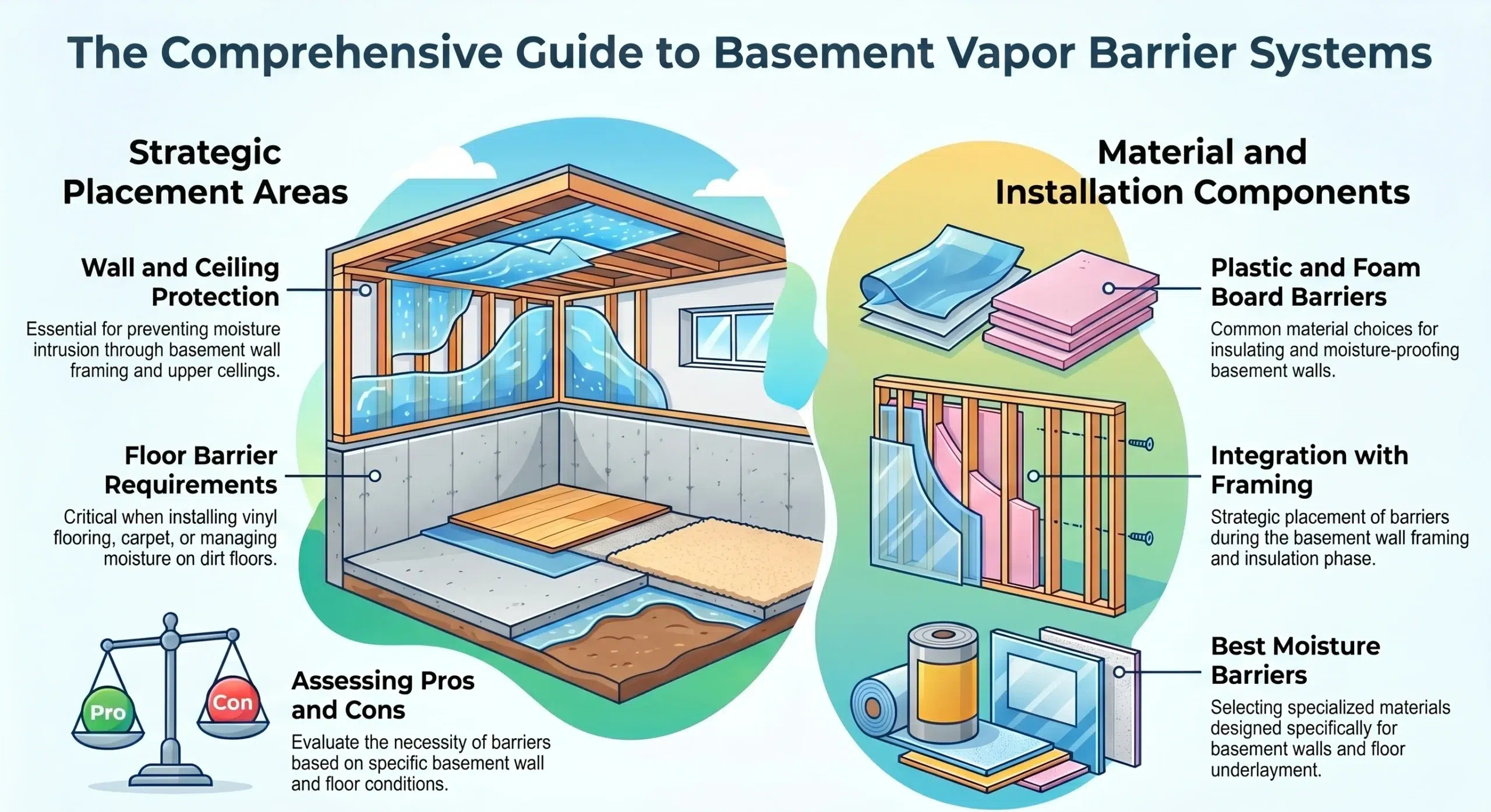
Placement is the whole game. These cross-sections show the right approach for each part of a basement and crawl space.
Basement Floor (Slab)
Lay 6–10 mil poly over the slab, then a subfloor, carpet, or vinyl on top. Concrete needs the barrier even when it looks dry.
6–10 mil over the slabBasement Walls (Concrete / Block)
Rigid foam board against the concrete is the moisture control. Then studs, optional unfaced insulation, and painted drywall — no plastic.
Rigid foam, not polyCrawl Space (Dirt Floor)
Cover the ground and run the liner up the walls. Use 6–10 mil for a ground cover, 12–20 mil for a sealed encapsulation.
12–20 mil to encapsulateBasement Ceiling
Between two conditioned floors, no vapor barrier is needed. Add unfaced insulation only if you want sound control.
Usually none neededVapor Barrier Thickness Guide (Mil)
"Mil" is thousandths of an inch. Thicker plastic resists punctures and lasts longer. Here is what each grade suits.
| Thickness | Best for | Lifespan / notes |
|---|---|---|
| 6 mil | Basic floor cover, crawl space ground cover, under-slab | Code-minimum in many areas; tears more easily |
| 10 mil | Durable basement floors, standard crawl space encapsulation | Residential standard; ~15–20 years |
| 12 mil | Full encapsulation, better puncture resistance | Recommended minimum for encapsulation |
| 20 mil | Heavy traffic, service-heavy crawl spaces | Reinforced with woven fibers; most durable |
A 6 mil or 10 mil vapor barrier over a basement floor is common; thicker liners are worth it where the surface gets walked on or stores heavy items.
Basement Vapor Barrier Questions, Answered
Basement wall vapor barrier — or not? Should you put one on?
Quick answer: Not a plastic poly vapor barrier on a framed wall. Building science from the U.S. Department of Energy says interior poly on a framed basement wall traps moisture and causes mold. Use rigid foam board or closed-cell spray foam against the concrete, then framing and painted drywall.
This is the most-searched and most-misunderstood basement question: "basement wall vapor barrier or not." The old approach — fiberglass against the block with a plastic vapor barrier and drywall over it — is exactly what building scientists warn against. Basement walls need to dry toward the inside, and a sheet of poly stops that drying, so warm humid air condenses behind it and grows mold. Some call it a "diaper wall."
So the best moisture barrier for basement walls is foam, not film. This is also why "plastic vapor barrier basement walls" is a phrase that needs a warning, not a how-to. Concrete and block themselves are fine sealed between layers — the mold danger only appears when you trap permeable fiberglass between two barriers.
How to install a vapor barrier in a basement (floor and crawl space)
Quick answer: Fix active water first. On a floor, lay poly over the slab; in a crawl space, lay it over the dirt and up the walls. Overlap seams 6–12 inches and tape them. On framed walls, use rigid foam against the concrete, not poly, and never sandwich fiberglass between two barriers.
Vapor barrier installation in a basement is straightforward once placement is right. Start by solving any bulk water — grading, gutters, downspout extensions, and a sump pump if needed — because no barrier fixes a leak. For a basement floor, roll the poly over the clean slab, lap each sheet over the next, and tape the seams before you lay a subfloor or flooring. For a crawl space or a dirt basement floor, cover the ground fully, run the liner several inches up the foundation walls, and seal it to the walls and at every seam. For framed walls, glue rigid foam board tight to the concrete and seal the edges — that replaces any plastic. Always check your local code, since some regions and Canadian provinces have specific placement rules.
Vapor barrier under a basement floor for carpet, vinyl, and flooring
Quick answer: Yes — protect any basement flooring from slab moisture. Use a 10 mil poly vapor barrier over the slab under a subfloor, or choose a carpet pad or carpet tiles with a built-in vapor barrier so the floor does not turn damp and musty.
Basement flooring fails when slab moisture reaches it. For carpet, either lay a 10 mil barrier over the slab first, or use a carpet pad or basement carpet tiles with a built-in vapor barrier designed for concrete. For vinyl plank, laminate, or engineered wood, follow the maker's instructions — many call for a 6 mil sheet or their own underlayment with a vapor barrier built in. For a basement bathroom, the same rule applies under tile or vinyl. Putting flooring straight on bare concrete with no barrier ("basement floor no vapor barrier") is the most common cause of musty carpet and cupped wood downstairs.
Vapor barrier for a dirt basement floor or crawl space
Quick answer: Cover a dirt floor with 6–10 mil poly for a basic ground cover, or 12–20 mil reinforced poly for a full encapsulation. Run it up the walls, overlap seams 6–12 inches, and seal all edges with tape.
A bare dirt basement floor or vented crawl space pumps a surprising amount of moisture into the house. Covering the ground with a vapor barrier is the single biggest fix. A simple ground cover uses 6–10 mil poly held down and lapped at the seams. A full crawl space encapsulation uses a 12–20 mil reinforced liner across the floor and up the walls, sealed vents, and often a dehumidifier, turning the space into a clean, dry, conditioned zone.
Basement insulation and vapor barrier (framing, furring, foam board)
Quick answer: Insulate with rigid foam against the concrete, then frame. Skip any interior poly on the walls. Painted drywall is your vapor retarder. The "with or without vapor barrier" debate comes down to this: foam yes, plastic no.
When you combine basement insulation and a vapor barrier, the order is what protects you. Whether you build a furring wall or a 2x4 stud wall, put the rigid foam board directly on the concrete first as the vapor and capillary break. You can add unfaced fiberglass or mineral wool in the stud cavities for extra R-value, but do not add a plastic vapor barrier on the warm side over it — that recreates the double-barrier mold trap. This is the answer to "basement insulation no vapor barrier," "basement insulation without vapor barrier," and "basement furring wall rigid insulation vapor barrier": the foam handles vapor so you do not need the poly.
Condensation behind a vapor barrier, and the double (back-to-back) barrier mistake
Quick answer: Condensation behind a vapor barrier means it is on the wrong side or trapping moisture. On basement walls this is the classic poly error. Remove interior poly, switch to rigid foam against the concrete, and let the wall dry inward.
If you see water or mildew behind a wall vapor barrier, the assembly is trapping moist air against a cold surface. A back-to-back vapor barrier — poly on both faces of a fiberglass wall — is the worst case, because the cavity can never dry. Fix it by removing the interior plastic and rebuilding with foam against the concrete and breathable drywall inside.
How much does a basement vapor barrier cost?
Quick answer: Material runs about $0.10–$2.00 per square foot depending on thickness, and installed it runs about $1.50–$4.50 per square foot. A full crawl space encapsulation averages around $5,500 and ranges from about $3,000 to $15,000.
Vapor barrier basement cost depends on thickness, square footage, and whether you DIY. The poly itself is cheap — a few cents to about a dollar a square foot for 6 to 12 mil, more for 20 mil reinforced. Installed by a pro, a basement or crawl space barrier typically runs $1.50–$4.50 per square foot. A whole crawl space encapsulation with sealed vents and a dehumidifier is a bigger project, averaging roughly $5,500. DIY can cut material-plus-labor by half or more if you are comfortable working in tight spaces. Use the calculator above to estimate your own square footage and cost.
Codes and climate (Canada, Alberta, and local rules)
Quick answer: Vapor barrier rules vary by climate zone and local code. In cold climates such as much of Canada, code often requires a vapor retarder on the warm side of above-grade walls — but below-grade basement walls still follow the rigid-foam approach. Always check your local code.
Building codes treat vapor control differently by region. In cold Canadian climates, the building code (for example the Alberta building code and the National Building Code) generally calls for a vapor retarder on the warm, interior side of above-grade framed walls and ceilings, which is why "basement insulation vapor barrier Canada" and "alberta building code basement vapor barrier" come up so often. Below grade, the foam-against-concrete method still applies. In humid US climates, a reader searching "vapor barrier basement Knoxville TN," for instance, is dealing with the opposite problem — summer humidity — where sealing the floor and using foam on walls, plus a dehumidifier, matters most. The safe rule everywhere: confirm placement with your local building department before you build.
Vapor Barrier by Area — Quick Reference
A side-by-side of the right barrier, thickness, and placement for each part of a basement.
| Area | Use | Thickness / type | Placement |
|---|---|---|---|
| Basement floor (slab) | Yes | 6–10 mil poly | Over the slab, under subfloor/flooring |
| Basement walls (framed) | No poly | 1–2" rigid foam board | Foam against concrete; painted drywall inside |
| Crawl space / dirt floor | Yes | 6–20 mil poly | Over the ground and up the walls, sealed |
| Under carpet / vinyl | Yes | 10 mil or built-in | Over slab, or pad/tiles with built-in barrier |
| Basement ceiling | Usually no | Unfaced insulation only | Warm side only over unconditioned space |
Quick Answers by Surface & Material
Short, direct answers to the most common basement vapor barrier searches, grouped by where you are working.
Floors
Vapor barrier basement floor / basement floor vapor barrier: yes — a basement floor vapor barrier goes over the slab. Use 6 mil for basic protection or a 10 mil vapor barrier over basement floor slabs for durability. Vapor barrier basement floor vinyl, vapor barrier basement floor carpet, or basement hardwood floor vapor barrier: put the barrier (or a flooring product with a built-in barrier) between the concrete and the finish; "basement floor no vapor barrier" is the top cause of musty carpet and cupped hardwood. Basement concrete floor vapor barrier: concrete is porous, so it always needs one, even sealed. Basement floor vapor barrier paint / basement paint vapor barrier: vapor-barrier paint is a cheap option but far weaker than poly or foam and is not a substitute under flooring. Basement carpet pad vapor barrier and basement carpet tiles with a built-in vapor barrier are easy ways to protect carpet on a slab.
Walls
Vapor barrier basement walls / on basement walls / basement wall vapor barrier: do not use plastic poly on a framed wall — a basement plastic vapor barrier on framing traps moisture. The best way to vapor barrier basement walls, and the right answer to insulating basement walls vapor barrier questions, is a foam board vapor barrier basement assembly: rigid foam sealed to the concrete. That settles "how to insulate and vapor barrier basement walls," "should you put vapor barrier basement walls," and "basement wall vapor barrier or not" in one move — foam yes, poly no. Basement block wall vapor barrier and basement cinder block vapor barrier: same rule, foam board sealed to the block. Basement framing vapor barrier and basement drywall vapor barrier: the foam handles vapor and painted drywall is the only retarder. For how to install vapor barrier basement walls, glue and seal the foam, frame over it, and finish — that is the basement wall vapor barrier installation method. Basement above grade vapor barrier: on the above-grade portion of framed walls in cold climates, code may call for a warm-side vapor retarder — check locally.
Crawl space & dirt floors
Basement crawl space vapor barrier / vapor barrier basement dirt floor / vapor barrier for dirt basement floor / basement dirt floor vapor barrier: cover the ground with 6–10 mil poly for a ground cover, or 12–20 mil for a sealed crawl space. 6 mil vapor barrier basement is fine for dry, low-traffic ground cover; step up to 10–20 mil where it gets walked on. Overlap seams and tape them.
Ceiling, insulation & the double-barrier trap
Vapor barrier basement ceiling / basement ceiling vapor barrier / basement ceiling insulation vapor barrier: usually none between two conditioned floors; use unfaced insulation for sound. Vapor barrier basement insulation, with the right basement insulation vapor barrier placement: insulate with foam board against the concrete and skip interior poly — that covers "basement insulation no vapor barrier," "basement insulation without vapor barrier," and "basement insulation with vapor barrier" alike. Back to back vapor barrier basement / basement condensation behind vapor barrier: avoid trapping fiberglass between two barriers; that double layer is what causes the condensation and mold.
Do I need one, cost, and how to install
Do I need a vapor barrier in my basement / basement remodel do I need a vapor barrier: yes for floors and crawl spaces, foam for walls, usually none for the ceiling. Pros and cons of vapor barrier in basement: pros are drier air, protected flooring, less mold, and energy savings; the only real con is trapping moisture if it is placed wrong. How to install vapor barrier basement, and how to put vapor barrier in basement: the steps for vapor barrier basement installation are the same whether you search "installing vapor barrier in basement," "how to install vapor barrier in basement," or "vapor barrier installation basement" — fix water first, lay poly over floors and dirt, foam on walls, then overlap and tape seams. Best vapor barrier basement options: 10–12 mil poly for floors and crawl spaces, rigid foam for walls — the best vapor barrier for basement floor use is a 10 mil sheet, and the best for walls is foam board.
Terms You Will See
A quick glossary of vapor-barrier words from spec sheets and code books.
FAQs: Vapor Barrier Basement Crawl Space
Do I need a vapor barrier in my basement?
Should you put a vapor barrier on basement walls or not?
What is the best vapor barrier for basement walls?
What thickness for a basement floor?
What about a dirt floor or crawl space?
How much does a basement vapor barrier cost?
Can I put a vapor barrier under basement carpet?
Moisture barrier vs vapor barrier — difference?
Why is there condensation behind my vapor barrier?
Do I need a vapor barrier on a basement ceiling?
What are the pros and cons of a vapor barrier in a basement?
Sources & References
Placement guidance follows U.S. Department of Energy building-science recommendations; thickness and cost figures are drawn from 2026 cost data and cross-checked across multiple sources. Vapor control depends on your climate zone, moisture conditions, and local code — always confirm with your building department and a qualified contractor.