Construction Loans Guide: Types, Rates & Process (2026)
Building a house from the ground up sounds simple until you realize a regular mortgage won’t touch a property that doesn’t exist yet. That’s the exact gap a construction loan fills, and it’s also where a lot of first-time builders get stuck, staring at draw schedules, inspection requirements, and loan terms that don’t look anything like the mortgage they had on their last house.
This guide walks through every major piece: loan types, how draws actually work, what things cost beyond the interest rate, and the government-backed programs that can make building far more affordable than most people assume. If you’d rather start with the numbers, our mortgage and home loan calculator is a useful companion once you have a rough construction budget in mind.

Mortgage & Home Loan Calculator
Estimate your monthly payments, principal breakdown, and total interest cost easily.
| Year | Principal Paid | Interest Paid | Remaining Balance |
|---|

What Is a Construction Loan, and How Is It Different From a Mortgage?
A traditional mortgage hands you the full loan amount at closing because the home already exists and can secure the loan. A construction loan works completely differently, since there’s no finished house to use as collateral yet.
- Funds are released in stages, called draws, as the build hits specific milestones
- Most construction loans are interest-only during the building phase, so you’re not paying principal on money you haven’t fully used yet
- Loan terms are typically 12 to 18 months, matched to a realistic build timeline
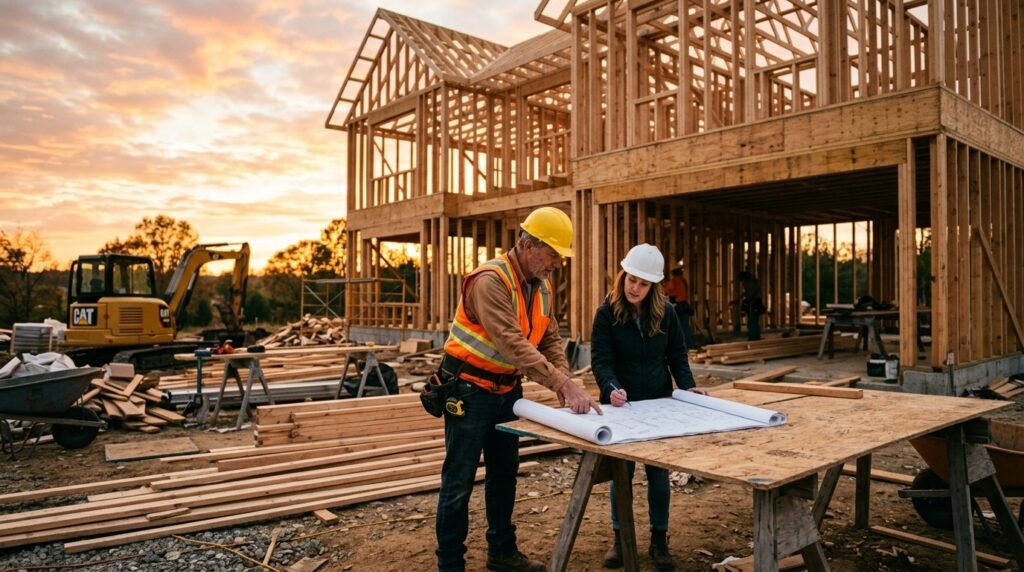
- Lenders require an approved builder, detailed plans, and a firm budget before they’ll fund anything
Once the home is complete, you either convert into a permanent mortgage automatically or apply for one separately, depending on which loan structure you chose.

Types of Construction Loans
Construction-to-Permanent Loans
This is the most common structure for homeowners, and it’s easy to see why: one application, one closing, and one set of closing costs. The loan automatically rolls into a permanent mortgage once construction wraps up, and many lenders let you lock your permanent rate at the very start of the process.
Stand-Alone Construction Loans
Also called a two-time close loan, this splits the process into two separate loans: one for construction, and a completely new mortgage application once the home is finished. It gives you flexibility to shop for the best permanent rate later, but you’ll pay two sets of closing costs and take on the risk that your financial situation or rates could shift between the two closings.
Owner-Builder Construction Loans
If you’re qualified to act as your own general contractor, this loan type skips the requirement for a licensed builder. Fewer lenders offer it, and the ones that do usually ask for more documentation and construction experience upfront.
Hard Money and Private Construction Loans
Private construction lenders move faster than traditional banks, sometimes closing in under two weeks instead of a month or more, which matters for investors competing for land or a fast build timeline. The tradeoff is a meaningfully higher interest rate and shorter loan term.
Renovation-Specific Options
If you’re not building new but taking on a major renovation or addition, an FHA 203k streamline loan or a VA renovation loan can roll the cost of the work into your mortgage rather than requiring a separate construction loan. Our home renovation guide covers planning a project like this from the ground up.

FHA, VA, and USDA Construction Loans: Government-Backed Options
Government-backed one-time close loans combine the construction loan and the permanent mortgage into a single closing, which saves you a second round of closing costs and paperwork.
🎖️ VA Loans: VA construction loans require using a VA-registered builder and meeting VA property standards; you can confirm eligibility directly through VA.gov's home loan program page.
🌾 USDA Loans: USDA construction loans cover a surprisingly large share of the country, including many areas just outside major metro suburbs, though the home must be modest in size and serve as your primary residence; check address eligibility via the USDA Rural Development single-family housing program.
🏛️ FHA Loans: FHA construction-to-permanent loans are generally the most flexible on credit score, though they come with upfront and ongoing mortgage insurance under official FHA guidelines.

How Construction Loan Draws Actually Work
This is the part that surprises most first-time builders: you don't get a lump sum. Instead, funds are released through a series of scheduled draws tied to construction progress[cite: 1].
💡 System Benefit: This system protects both you and the lender: the bank isn't handing over money for work that hasn't happened, and you're not paying interest on funds still sitting untouched in an account[cite: 1].

Construction Loan Rates in 2026: What to Actually Expect
Construction loan rates run higher than a standard mortgage, typically by roughly 1 to 2 percentage points, since the lender is financing a property that doesn’t exist yet and carries more short-term risk. As of mid-2026, residential construction-to-permanent loans have generally landed somewhere in the high-6% to low-9% range, with government-backed programs like VA and USDA often coming in on the lower end of that band.
Rates move constantly and vary by lender, credit score, down payment, and project type. Treat any specific number, including the ranges above, as a starting point for comparison shopping rather than a guarantee. The Consumer Financial Protection Bureau’s construction loan resources are a good neutral place to check current guidance before you commit to a lender.
A few factors that consistently move your rate:
- Credit score, higher scores generally unlock meaningfully better pricing
- Loan-to-cost (LTC) and loan-to-value (LTV) ratios, lower ratios usually mean lower risk and better rates
- Whether you choose a fixed or floating rate during the construction phase
- Builder experience and project type, spec and investor builds often price higher than owner-occupied custom homes

Costs and Fees Beyond the Interest Rate
Key non-interest costs associated with processing, securing, and maintaining a construction loan.
💡 Insurance Note: Builder's risk insurance is worth paying special attention to, since it's easy to assume your homeowner's policy already covers a half-finished structure (it doesn't). Our specialty insurance guide and home insurance tips both cover coverage gaps worth closing before a project breaks ground.

How to Qualify for a Construction Loan
- Credit score: most conventional construction lenders look for scores in the high 600s or better, though government-backed programs can be more flexible
- Down payment: conventional construction loans commonly require 20% down, while VA and USDA programs can require none for eligible borrowers
- Detailed construction plans and specifications from a licensed architect or designer
- A signed contract with a lender-approved, licensed general contractor
- Proof of income, assets, and existing debt, similar to a standard mortgage application
Bad credit doesn’t automatically disqualify you, but it usually means a higher rate, a larger down payment, or a private/hard money lender rather than a traditional bank.

The Construction Loan Application Process, Step by Step
- Get pre-approved so you know your realistic budget before finalizing plans with an architect or builder
- Choose a licensed, lender-approved general contractor and finalize detailed building plans
- Submit your application along with plans, contractor agreement, and financial documents
- Go through underwriting, where the lender reviews the appraisal, your finances, and the project scope
- Close on the loan and begin the draw schedule as construction starts
Timelines vary widely, but expect several weeks from application to closing for a traditional lender, and sometimes just one to two weeks with a private construction lender prioritizing speed over the lowest possible rate.

Land Equity, No Money Down, and Building Without Selling Your Current Home
If you already own your land free and clear, or have significant equity in it, many lenders let you apply that value toward your down payment or loan-to-value calculation, sometimes eliminating a cash down payment entirely. This is a common path for buyers who don’t qualify for a USDA or VA loan’s zero-down structure but still want to avoid a large out-of-pocket payment.
If you’re still living in your current home while building, a home equity loan or HELOC against that property is another common way to fund a build without a dedicated construction loan, though both come with their own rate and repayment structure worth comparing carefully.

What Happens If Construction Goes Over Budget
Cost overruns are common enough that most experienced builders plan for a 15 to 20% contingency above the initial estimate. If your project does run over:
- A contingency reserve built into the original loan can absorb smaller overages automatically
- Larger overruns may require a loan modification or extension, which usually involves additional underwriting
- In some cases, you may need to cover the difference out of pocket or adjust the project scope with your builder
- Government-backed loans like USDA are generally stricter here, since the loan amount is fixed at closing based on submitted plans
Our building materials calculator can help you sanity-check material estimates before they turn into a mid-project surprise.

Converting a Construction Loan to Permanent Financing
With a construction-to-permanent loan, this step happens automatically once the home passes final inspection and receives its certificate of occupancy, no second application or closing needed. With a stand-alone construction loan, you’ll need to apply for a brand new mortgage, meaning your credit, income, and the market rate at that moment all get re-evaluated from scratch.
Refinancing a construction loan before the project is fully complete is generally difficult, since most permanent lenders want to see a finished, appraised home before they’ll take over the debt.

Commercial and Multifamily Construction Financing
The same core mechanics, draws, inspections, interest reserves, apply at a larger scale for commercial and multifamily projects, but the details shift:
- Multifamily and apartment construction loans often use a mini-perm structure, a short-term loan that bridges into permanent financing once the property is stabilized with tenants
- Lenders evaluate commercial deals heavily on loan-to-cost (LTC) and projected debt service coverage ratio (DSCR) rather than personal income alone
- Build-to-suit and spec building loans carry different risk profiles depending on whether a tenant or buyer is already lined up before construction starts
If you’re building a duplex, triplex, or fourplex rather than a single detached home, ask lenders directly whether they treat it as residential or commercial financing, since the answer changes both your rate and your documentation requirements.

One More Thing to Plan For Before You Move In
New construction gives you a rare chance to get fire safety right from day one instead of retrofitting it later. According to NFPA research, a working smoke alarm cuts your risk of dying in a home fire by roughly 60%, yet nearly three out of five home fire deaths still happen in homes with no working alarm.
Most building codes already require hardwired smoke detectors in new construction, but it’s worth double-checking placement and count before drywall goes up, since it’s far cheaper to wire it in now than retrofit later. Our smoke detector calculator can help you plan coverage room by room.
FAQs: Construction Loan Guide
Essential answers about application steps, credit qualifications, draw schedules, and financing rules
Fact-Check & Editorial Note
Construction loan rate figures vary enormously across current sources (some single-source blogs cite ranges as wide as 6% to 15%, and several appear to be auto-generated content with internally inconsistent numbers)[cite: 1]. Rather than citing one source's specific percentage as fact, this article presents a general 1-2 percentage-point premium over standard mortgage rates and a broad high-6%-to-low-9% range as of mid-2026, framed explicitly as a starting point for comparison shopping, with a direct pointer to CFPB and lender resources for current figures[cite: 1].
FHA/VA/USDA program mechanics (one-time close structure, down payment requirements, mortgage insurance) were corroborated across multiple independent sources before inclusion[cite: 1].
The Bottom Line
Construction loans aren’t harder than a regular mortgage, they’re just structured around a different reality: the home doesn’t exist yet, so the money shows up in stages instead of all at once. Once you understand draws, the fee structure, and which government-backed programs you might qualify for, the whole process gets a lot less intimidating.
Before you commit to a lender or a build timeline, run your numbers through our mortgage and home loan calculator and manufactured home loan calculator if that fits your project, and talk to more than one lender. A half-percent difference in rate is worth the extra phone calls on a loan this size.
Reminder: this guide is educational, not financial or lending advice. Confirm current rates, terms, and eligibility with a licensed loan officer before making any decisions.