How to Save Money on Fire-Rated Demising Walls
Are you spending too much on your construction projects? In commercial buildings, safely separating tenant spaces is mandatory, but balancing building codes with your budget can be challenging. High labor rates and expensive materials often lead property owners to overpay for demising walls, sometimes due to unclear assembly details or overspecified materials.
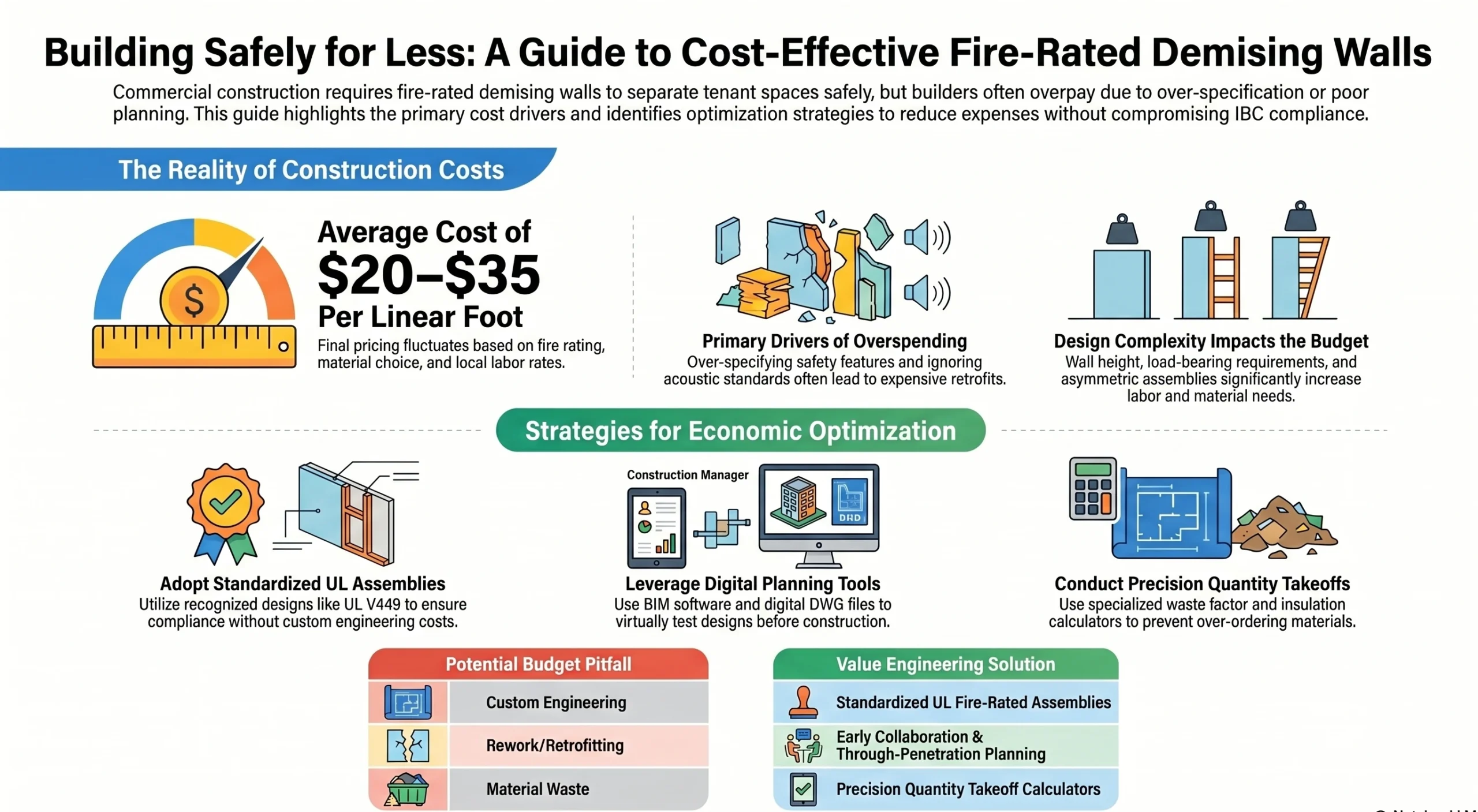
The average cost of a demising wall ranges from $20 to $35 per linear foot, depending on the required fire rating, materials, and local labor rates. To avoid overpaying, it’s crucial to understand how to meet safety standards cost-effectively. One way to optimize your design is to follow the International Building Code (IBC) Chapter 7 minimums rather than using unnecessarily expensive assemblies.
This guide will explore fire rating requirements for demising walls and how to plan your budget accurately. By learning about material options and efficient installation practices, you can save money on your next project without compromising safety.

What Are the Basics of Demising Walls and Fire Ratings?
A demising wall separates two distinct tenant spaces within the same building. You might also hear it called a party wall. Whether you are building office spaces or residential units, these walls must meet strict safety guidelines. They act as a fire partition to prevent flames and smoke from spreading between units.
Building codes dictate specific fire ratings for these structures. Typically, you will need a 1-hour or 2-hour rating ASTM E119. The exact requirement depends on the building’s use and size.
Understanding the rules laid out in IBC Chapter 7 is crucial. This chapter of the International Building Code outlines the legal minimums for an occupancy separation. By following these codes closely, you ensure safety without paying for unnecessary upgrades.

What Factors Influence the Cost of a Demising Wall?
Several elements determine your final budget. Understanding these variables helps you make smarter financial choices.
First, your materials cost will take up a large portion of the budget. Essential items include metal stud framing, Type X gypsum board, and mineral wool insulation. Prices fluctuate based on your location, so checking the national average by your specific zip code is highly recommended.
Labor is the next major factor. The framing cost varies depending on whether you hire union or non-union workers. Contractors usually price the job based on the square foot or linear foot.
Design choices also change the price. The wall height and stud spacing dictate how much material you need. If you are building load-bearing walls, you will need stronger, more expensive materials than you would for standard interior walls. Similarly, a specialized asymmetric wall assembly will require more complex labor, driving up the average cost.
What Are Common Mistakes That Lead to Overspending?
Many builders lose money during the planning phase. One frequent error is over-specifying safety features. For example, building a heavy-duty fire barrier when a standard partition meets the code wastes money.
Choosing unnecessarily expensive materials is another pitfall. Sometimes, builders forget to plan for a through-penetration fire stop. When plumbers or electricians cut holes in the wall later, fixing the fire rating becomes a costly emergency.
Ignoring acoustics also leads to expensive retrofits. A good wall blocks noise as well as fire. Failing to meet the required sound transmission class (STC) standards outlined in ASTM E90 means you will have to tear open walls to add soundproofing later.

How Can You Optimize Your Demising Wall Costs?
You can keep your budget in check through value engineering. This means choosing cost-effective materials that still meet safety codes.
Start by standardizing your designs. Using a recognized UL fire-rated assembly ensures compliance without the need for custom engineering. For example, using the popular demising wall UL assembly V449 is a proven way to meet 2-hour rating requirements efficiently.
Next, embrace smart material procurement. Run a detailed demising wall material quantity takeoff before ordering. Use a demising wall waste factor calculator to ensure you only buy what you actually need.
Efficient installation also saves money. Train your team to properly install a resilient channel to prevent flanking noise between units. To speed up your planning, utilize a reliable demising walls cost calculator. You can also use a demising wall thickness calculator and a demising wall insulation calculator to map out your exact material needs before construction begins.

How Do Real Projects Save Money on Wall Construction?
Consider a recent multi-family housing project. The original plan called for heavy, custom-engineered walls between every unit. By switching to standard, pre-approved assemblies, the developer cut material costs by 15%.
Conversely, a commercial office build ignored early planning. They failed to coordinate plumbing and electrical work. The team had to break open finished walls to install pipes, doubling their labor costs. Early design collaboration is always the cheaper route.

How Are Technology and Innovation Changing Wall Construction?
Modern technology makes planning much easier. Building Information Modeling (BIM) software allows architects to test designs virtually. You can download a precise demising wall detail DWG. file to drop directly into your digital blueprints.
New materials also offer better performance. Advanced drywall and lightweight steel allow builders to meet safety codes faster and cheaper than traditional methods.

Ready to Build Smarter Fire-Rated Walls?
Managing the cost of a tenant separation wall requires careful planning. By understanding building codes, avoiding common mistakes, and using standard assemblies, you can protect your budget. Always remember that safety and compliance do not have to break the bank. Consult with local fire protection experts today to find the most cost-effective solutions for your next project.
How to Use Our Smart Wall Partition Calculator
This powerful tool helps you design and plan wall partitions for your construction project. It simplifies cost estimation, ensures you meet building code requirements, and automatically generates detailed material lists.
To get started, set your project preferences, such as measurement units (imperial or metric) and currency. Then, explore the five specialized modes:
- Cost Estimator: Get a quick financial overview. Enter your wall dimensions, desired fire rating, and STC (Sound Transmission Class) rating to estimate the total cost.
- Fire Rating Finder: Easily determine the necessary fire separation for your wall partitions according to International Building Code (IBC) standards, ensuring your project is compliant and safe.
- STC Calculator: Predict a wall’s acoustic performance. This mode calculates how effectively a partition will block sound based on its materials and construction, helping you achieve the desired soundproofing.
- UL Assembly Selector: Find the correct UL design numbers required for your permits and submittals. This feature simplifies the process of specifying code-compliant wall assemblies.
- Quantity Takeoff: Create a precise and accurate list of all materials needed for your project. This tool helps you budget effectively and streamlines purchasing by calculating quantities, including standard waste factors.
🛠️ Smart Demising Walls System Analyzer
Unified engineering suite for compliance, acoustic profiling, estimating, and takeoff generation.
Wall System Geometry & Targets
System Cost Breakdown Summary
| Component Element | Cost Estimate |
|---|---|
| Framing Members (Structural Track/Studs) | $0.00 |
| Type X Gypsum Board Sheathing | $0.00 |
| Acoustic Mineral Fiber Insulation | $0.00 |
| Intumescent Firestopping Joint Compounds | $0.00 |
| Specialized Trade Field Assembly Labor | $0.00 |
IBC Separation Evaluation
IBC Code Requirements
Calculations derive from IBC Chapter 5 separation matrices. Local jurisdictions may mandate variations based on active automatic sprinkler protection design.
Assembly Component Matrix Configuration
Acoustic Rating Verification
Baseline Target Minimum: STC 45 (Standard IBC Demising Threshold)
Acoustic behavior estimations represent lab assembly baselines. Field results (FSTC) typically drop 3 to 5 points without sound caulk parameters at top/bottom plates.
Design Path Filters
Matched Certified Design Standard
Dimensional Scope Constraints
Calculated Material Takeoff Results (Includes Waste Factors)
| Material Component Description | Required Units |
|---|---|
| Structural Framing Studs (Standard Profile Lengths) | 0 pcs |
| Top & Bottom Base Runner Track Plates | 0 lf |
| Type X 4′ × 8′ Finished Face Gypsum Sheets | 0 sheets |
| Sound Core Internal Insulation Blanket Area | 0 sq ft |
| Type-S Bugle Head High Performance Fasteners | 0 units |
| Pre-Mixed Ready Taping Compound Mud Paste | 0 kg/lbs |
| Intumescent Acoustic Compound Fire Sealant Caulk | 0 tubes |
Frequently Asked Questions About Demising Walls
How do I calculate the sound rating of my wall?
You can use a demising wall STC calculator to estimate how well your design blocks noise. This tool considers your drywall, insulation, and framing choices to predict the final acoustic performance.
What is the difference between an interior and exterior partition?
Exterior walls must withstand weather, wind, and temperature changes, requiring different insulation and moisture barriers. Standard interior walls only need to manage privacy, fire safety, and sound between indoor rooms.
Can I use wood framing for a fire-rated wall?
Yes, a wood frame can be used to build a frame wall, provided you use the correct fire-resistant drywall and insulation. However, many commercial codes require steel studs for higher fire ratings.
What insulation is best for commercial walls?
The required demising wall insulation R value depends on your local energy codes. Mineral wool is highly recommended because it provides excellent thermal resistance and natural fireproofing.
How do I estimate the cost of sealing wall penetrations?
Use a demising wall penetration firestop calculator. This helps you estimate the cost of the specialized caulks and collars needed to safely seal pipes and wires that pass through the wall.
Does adding soundproofing drastically increase the budget?
Your total demising wall soundproofing cost depends on the methods used. Adding simple acoustic insulation is relatively cheap, but adding mass-loaded vinyl or specialized clips will increase your total expenses.