
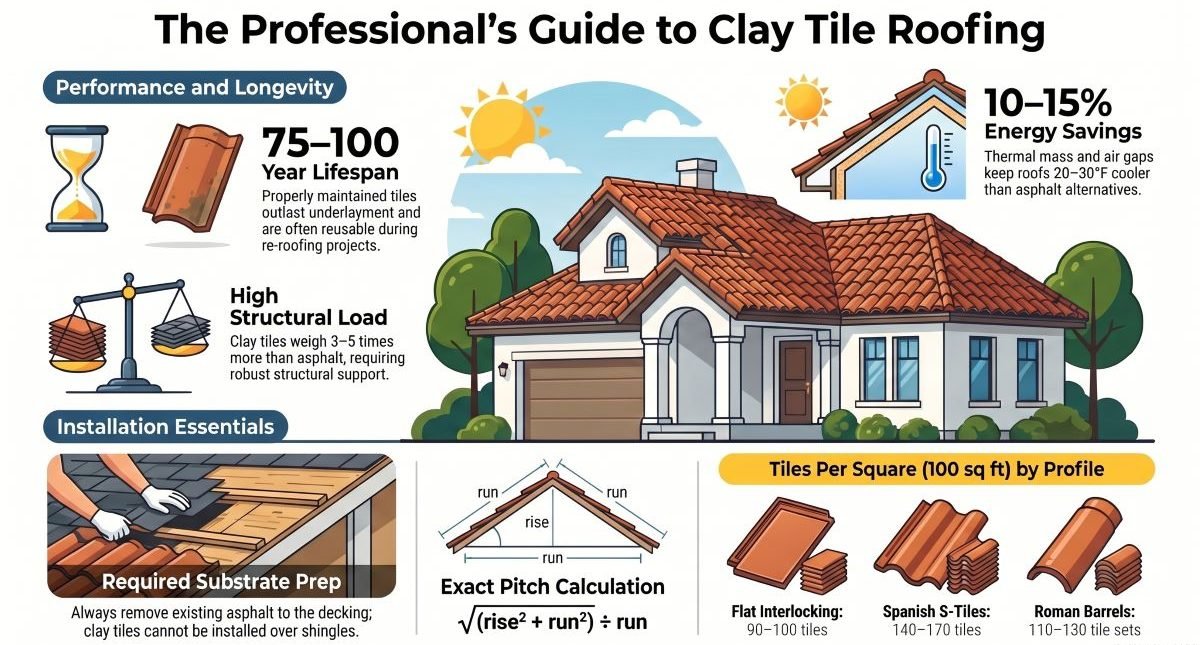
The Only Clay Roof Tiles Roof Calculator You’ll Ever Need
Let me tell you something I learned the hard way: guessing on Clay Roof Tiles is like betting your paycheck on a coin flip. I once watched a buddy order 400 extra Spanish S-tiles, because he “felt better safe than sorry.” That was $2,800 worth of terracotta sitting in his driveway for six months. Another time, a homeowner two towns over ran out of Roman barrels two days before a rainstorm. The supplier was back-ordered for three weeks. They had to tarp a half-finished roof in February.
Clay tiles are not asphalt shingles. You can’t just walk into a big-box store and grab another bundle. Every profile—the swooping curves of a mission tile, the chunky rolls of a Roman barrel, the clean lines of a flat clay tile—has its own coverage, overlap, and weight personality.
That’s why a clay tile roof calculator isn’t just a nice online tool. It’s your sanity check. Below, I’ll walk you through the exact formulas I’ve used on jobs from Santa Fe to Savannah. No fluff. No textbook nonsense. Just what works.

Why Generic Roofing Calculators Lie to You
You’ve seen them. Those one-size-fits-all estimators where you punch in your square footage, and it spits out a number. They work fine for three-tab asphalt. For clay? They’re useless.
Step 1: Measure Your Roof’s Flat Footprint (The Easy Part)
Grab a tape measure or a laser distance tool. Break your roof into rectangles and triangles. Length times width for each rectangle. For a triangle, its base times height is divided by two. Add them all up.
That’s your plan area—what the roof would measure if it were perfectly horizontal.
Example: A simple gable roof, 40 feet long, 25 feet wide from eave to ridge. Plan area = 40 × 25 = 1,000 square feet.
Got a hip roof or dormers? No problem. Just measure each plane separately. My rule: if you have to change direction with your tape, it’s a new rectangle.
Step 2: The Pitch Factor – Where Most People Mess Up
A roof that measures 1,000 square feet flat is not a 1,000-square-foot roof once you tilt it. That’s the whole point of a roof tile pitch factor calculator.
Here’s the cheat sheet I keep taped inside my tool box:
Roof Pitch (rise per 12″) | Angle | Pitch Factor (multiply plan area by this) |
4:12 (low, walkable) | 18.4° | 1.054 |
6:12 (very common) | 26.6° | 1.118 |
8:12 (steep, needs jacks) | 33.7° | 1.202 |
10:12 (scary steep) | 39.8° | 1.302 |
12:12 (45°, call a pro) | 45.0° | 1.414 |
Formula: Actual tile area = Plan area × Pitch factor
Back to our 1,000 sq ft gable roof. Say it’s a 6:12 pitch.
1,000 × 1.118 = 1,118 square feet of surface to cover.
See why generic calculators fail? That extra 118 sq ft might not sound like much, but at 0.8 sq ft per tile, that’s 147 extra tiles you would have forgotten.
For a full technical breakdown of pitch factors, check the National Roofing Contractors Association (NRCA) pitch factor tables – they publish the most reliable multipliers for oddball pitches like 7:12 or 9:12.
Step 3: Coverage Per Tile – The Profile Tells the Truth
Now you need to know how much of that surface one tile actually covers when installed correctly. This is not the tile’s total length. It’s the exposure – total length minus the headlap (the part tucked under the tile above).
I’ve measured dozens of clay profiles. Here’s real-world data:
- Spanish S-tile (Mission profile): Each tile covers roughly 0.6 to 0.7 square feet. Those deep waves look amazing, but they overlap a lot.
- Roman barrel tile (two-piece pan & cover): Each set (one pan + one barrel) covers about 0.8 to 0.9 square feet.
- Flat interlocking clay tile: Most efficient – up to 1.1 square feet per tile because of side locks.
- French/Mediterranean flat pan: Usually 0.75 to 0.85 square feet.
Formula: Tiles needed (before waste) = Actual tile area ÷ Coverage per tile
Our 1,118 sq ft roof with Roman barrel at 0.85 sq ft per set:
1,118 ÷ 0.85 = 1,315 tile sets.
Always, always get the manufacturer’s published coverage for your specific tile. I learned that lesson after a supplier sent me a different “equivalent” profile that was off by 12%. The Tile Roofing Industry Alliance (TRIA) has a great library of coverage specs for most major brands – it’s worth bookmarking.
Step 4: Waste – The 5-10-15 Rule
Nobody likes admitting waste. But clay tiles break. You cut them at the hips and valleys. You drop one off a ladder (we’ve all done it). You need spares for future repairs.
Here’s my rule of thumb after 15 years:
- Simple gable roof, no valleys, no hips: Add 5% waste.
- Moderate: one or two valleys, a couple hips, maybe a dormer: Add 10%.
- Complex: multiple valleys, skylights, chimneys, crazy angles: Add 15%.
Our Roman barrel example on a moderate roof (say, one valley, two hips):
1,315 tiles × 1.10 = 1,447 tiles final order.
I once worked a 15% waste job on a historic church with 14 hips. The pastor wanted to argue about the waste factor. After we cut the 200th hip tile, he stopped arguing.
Step 5: Clay Tile Weight Calculator – Don’t Skip This
I cannot stress this enough: run the weight numbers before you buy a single tile.
Typical installed weights (tile + battens + underlayment):
- Lightweight flat clay: 9–11 lbs per square foot
- Standard Spanish S-tile: 12–14 lbs per sq ft
- Heavy Roman barrel: 14–16 lbs per sq ft
Multiply your actual tile area (not plan area) by that number.
Our 1,118 sq ft roof × 13 lbs (mid-range Spanish) = 14,534 lbs on your roof structure.
That’s over 7 tons. An asphalt roof on the same house would weigh about 3,000 lbs.
Structural reality check: If your house was built after 1980 with engineered trusses, you’re probably fine. But if you own a craftsman bungalow from 1925 with 2×4 rafters 24 inches in the center, you need a structural engineer. Look for ceiling cracks or doors that stick near the ridge line. For more details on load assessment, ASTM C1167 (the standard for clay roof tiles) explains the difference between Grade 1 and Grade 2 tiles – Grade 1 is for freeze-thaw climates, Grade 2 for warm regions only.
Step 6: Clay Roof Tile Cost Estimator – Real Numbers
Pricing changes by region and season, but here’s what I’m seeing across the Southeast and Southwest as of this year (materials only, no labor or underlayment):
Tile Type | Cost per Square (100 sq ft) | Cost per Tile (approx) |
Basic flat clay (Grade 2) | 400– 400–600 | 2.50– 2.50–4.00 |
Spanish S-tile (Grade 1) | 700– 700–1,200 | 5.00– 5.00–8.50 |
Roman barrel (authentic) | 1,000– 1,000–1,800 | 8.00– 8.00–14.00 |
Reclaimed / antique clay | $2,000+ | $15.00+ |
For our 1,118 sq ft roof (that’s 11.18 squares) using Grade 1 Spanish S-tile at
900persquare:11.18×
900persquare:11.18×900 = $10,062 in materials.
Don’t forget hip and ridge tiles (usually
4–
4–8 each) and birdstops at the eaves – those little clips or protruding pieces that keep wind from lifting your first row. If you’re in a high-wind zone, check the TRIA wind resistance guide for proper fastening schedules.
A fully installed clay roof – including tear-off, underlayment, battens, and labor – runs
1,200to
1,200to2,500 per square (
12–
12–25 per sq ft). Expensive? Yes. But a clay roof will outlive your mortgage. I’ve taken clay tiles off 1890s buildings and reinstalled them on new construction. You can’t do that with asphalt.
Here’s why:
- Exposure varies. A flat interlocking clay tile could expose 11 inches to the weather. A Roman barrel, with its deep headlap (that’s the overlap between rows), might only expose 7 inches. Same roof area, wildly different tile counts.
- Weight is a structural conversation. Asphalt weighs about 2.5–3.5 lbs per square foot installed. Clay starts at 9 lbs and climbs to 15 lbs. I’ve seen 1920s bungalows with sagging ridges, because someone fell in love with terracotta without checking the rafters.
- Pitch changes everything. A 6:12 roof has about 12% more surface area than its flat footprint. 12:12? That’s 41% more. Most generic calculators ignore pitch entirely.
A real clay roof tiles per square calculator has to handle all three. Let’s build yours

A Real Story: The Santa Barbara Spanish Revival
Last year, a homeowner called me about a 1940 Spanish Revival. She wanted authentic Mission S-tiles. The roof was 40×30 feet (1,200 sq ft plan) with a 20×20 garage (400 sq ft plan). Total plan = 1,600 sq ft.
Pitch: Main roof 8:12 (×1.202), garage 6:12 (×1.118).
Main: 1,200 × 1.202 = 1,442 sq ft. Garage: 400 × 1.118 = 447 sq ft.
Total surface = 1,889 sq ft.
Coverage: Spanish S-tile at 0.65 sq ft per tile. 1,889 ÷ 0.65 = 2,906 tiles theoretical.
Waste: Two valleys, three hips, one skylight → 12% waste. 2,906 × 1.12 = 3,255 tiles.
Weight: 1,889 sq ft × 13 lbs = 24,557 lbs. We had an engineer check the rafters (16″ centers, good shape). He signed off.
Cost: Grade 1 Spanish tile at
850persquare(1,889sqft=18.89squares).18.89×
850persquare(1,889sqft=18.89squares).18.89×850 =
16,056.Plus
16,056.Plus800 for ridge and hip,
1,200forbreathableunderlayment.Total materials:
1,200forbreathableunderlayment.Total materials: 18,056.
She almost ordered 2,500 tiles because a different “calculator” told her to. That would have been a disaster. Instead, we finished on time and under budget. Her roof should see 2080 without major work.

The Waste Factor: 5%, 10%, or 15%?
Waste is not incompetence—it’s physics. Clay tiles break, hips require half-cuts, valleys need angled pieces, and ridge lines eat into field tile counts.
Simple gable roof (no valleys, no hips): Add 5% waste.
Moderate complexity (one valley, two hips): Add 10% waste.
Complex (multiple valleys, dormers, skylights): Add 15% waste.
For our 2,828 Roman tiles on a moderate roof: 2,828 × 1.10 = 3,111 tiles final order.
This is why a clay tile roof calculator distinguishes between “theoretical” and “real-world” quantities. Theory is for textbooks; reality includes the tile your roofer drops from the ladder.

Structural Reality Check: Clay Tile Weight Calculator
Before you fall in love with that terracotta aesthetic, run a clay tile weight calculator. Most residential roofs are framed for 20 lbs per square foot (dead load + live load). Clay tiles alone can consume half that allowance.
Typical installed weights (tiles + underlayment + battens):
Lightweight flat clay tile: 9–11 lbs per sq ft
Standard Spanish S-tile: 12–14 lbs per sq ft
Heavy Roman or barrel tile: 14–16 lbs per sq ft
Multiply your total surface area by the per-sq-ft weight.
2,404 sq ft × 13 lbs (mid-range Spanish tile) = 31,252 lbs of clay on your roof structure.
That is nearly 16 tons. For context, a typical asphalt roof on the same house would weigh 6,000–8,000 lbs.
Structural action item: If your home was framed after 1980 with engineered trusses, you are likely fine. But if you own a 1920s bungalow with 2×4 rafters 24 inches on center, you need a structural engineer. Look for sagging ridge lines or ceiling cracks before ordering a single pallet.
Clay Roof Tile Cost Estimator: From Budget to Premium
Pricing fluctuates by region, supplier, and grade. Use this clay roof tile cost estimator as a baseline (materials only, excluding labor, underlayment, or battens):
| Tile Type | Cost per Square (100 sq ft) | Cost per Tile (approx) |
|---|---|---|
| Basic flat clay (Grade 2) | 400–400–600 | 2.50–2.50–4.00 |
| Spanish S-tile (Grade 1) | 700–700–1,200 | 5.00–5.00–8.50 |
| Roman barrel (authentic) | 1,000–1,000–1,800 | 8.00–8.00–14.00 |
| Reclaimed / antique clay | $2,000+ | $15.00+ |
Grade 1 vs Grade 2 tile matters more than aesthetics. Grade 1 tiles (ASTM C1167) undergo rigorous freeze-thaw testing—non-negotiable for northern climates with snow. Grade 2 tiles work fine for warm Southwest applications but will crack in a single Massachusetts winter.
For our 2,404 sq ft roof (24.04 squares) using Grade 1 Spanish S-tile at 900persquare:24.04×900persquare:24.04×900 = $21,636 in materials.
Add hip and ridge tiles (usually sold separately at 4–4–8 each), birdstops at the eaves, and a proper underlayment system. A complete installed clay roof often lands between 1,200and1,200and2,500 per square (12–12–25 per sq ft), making it a lifetime investment (75+ years) rather than a 20-year disposable roof.

🏺 Clay Roof Pro Calculator
Quantity · Structural Load · Cost · Pitch Converter · Reclaimed Batcher · Printable List