Benefits of Growing Your Own Food: Why Home Gardening Is Worth It
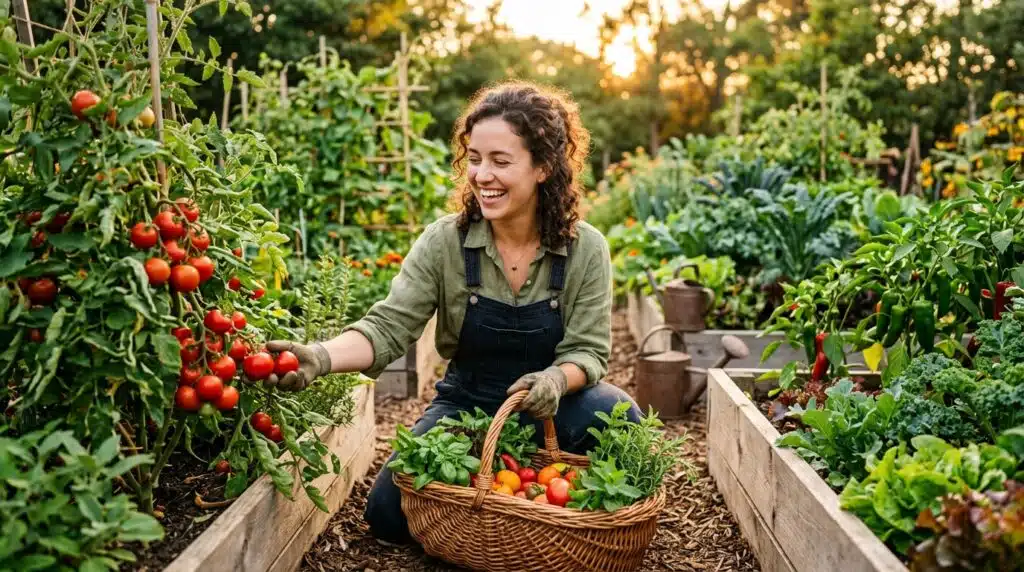
Picture this: it’s a Tuesday evening, dinner needs to happen, and instead of driving to the grocery store, you walk twenty feet to your raised garden bed. You pick a handful of Black Krim tomatoes still warm from the sun, a few sprigs of basil, and a zucchini that was a flower last week — all while your indoor plants soak up the last of the evening light through the kitchen window. That’s it. That’s dinner sorted.
So many people ask whether growing your own food is actually worth it. The honest answer is yes — though not always in the ways they expect, and not always for the reason they start (usually saving money).
A home garden, whether it’s a few herb pots or a full vegetable bed, touches nearly every part of your life: your grocery bill, your health, your stress levels, your kids’ relationship with food, and even your connection to the world around you. It isn’t just a trendy lifestyle choice — there is solid research behind several of these benefits, and we link to the key studies below so you can check them yourself.
In this guide, we’ll walk through the main benefits — financial, physical, mental, environmental, and practical — along with the honest trade-offs. By the end, you’ll know whether growing your own food is right for you and how to get started without overspending.

Does Growing Your Own Food Actually Save Money?
This is usually the first question people ask, and it deserves an honest answer: yes, but it depends on how you approach it.
A modest vegetable garden typically costs somewhere between $50 and $300 to set up in the first season — soil, seeds, basic tools, maybe a raised bed. That sounds like a lot until you compare it to what a single productive plant can give back.
A healthy, well-grown tomato plant can often yield 10 pounds or more of fruit in a season. Depending on local grocery prices, that can easily be worth more than the $4 seedling it started as. Multiply that across a small garden with tomatoes, peppers, lettuce, and herbs, and the math starts to work in your favor.
How Much Money Do You Save Growing Your Own Food?
Savings vary a lot with your climate, local prices, and how well the season goes, so treat these as general patterns rather than guarantees. Here’s how the most common crops tend to compare with buying from the store:
- Lettuce and salad greens: Cut-and-come-again lettuce can keep producing for weeks from one sowing, replacing repeated purchases of bagged salad.
- Tomatoes: One well-tended plant can produce many pounds of fruit — usually worth several times the price of the seedling.
- Herbs: A small basil plant costs about the same as one or two small store packs of fresh basil, yet keeps producing all summer if you pinch it back regularly.
- Raspberries: Store-bought berries are among the most expensive produce per pound. Established raspberry canes produce fruit every year and spread on their own.
The catch? Not every vegetable saves you money. Carrots, potatoes, and onions are so cheap at the grocery store that homegrown versions can cost more once you factor in soil, water, and space. The real savings come from crops that are expensive to buy but cheap to grow — tomatoes, herbs, leafy greens, and berries top that list.
💡 Quick Tip: Want the biggest financial return for your effort? Focus on high-value, high-yield crops: tomatoes, peppers, herbs, zucchini, and leafy greens. Skip low-cost staples like potatoes and onions unless you genuinely enjoy growing them.
Thinking about your first raised bed? Our guide to building a raised bed yourself and soil calculator for raised garden beds will help you plan the setup cost before you start — getting this part right is the key to gardening on a budget.
Is It Cheaper to Grow Your Own Vegetables Than Buy Them?
For most households, the answer is yes — especially after the first season, once the initial tool and soil investment is behind you. Seeds are inexpensive and many can be saved year after year. Compost reduces fertilizer costs. And once perennial herbs and berry bushes are established, they keep producing with very little ongoing cost.
The real financial win shows up over time. Year one might barely break even once you account for setup costs. By year two or three, when you’re reusing tools, saving seeds, and your perennial plants are established, the savings add up.

The Mental Health Benefits of Growing Your Own Vegetables
Here’s something that surprises a lot of new gardeners: the mental health benefits of gardening are not just anecdotal. A growing body of peer-reviewed research supports them.
In a 2011 study published in the Journal of Health Psychology, participants who spent 30 minutes gardening after a stressful task showed a greater drop in cortisol — the body’s main stress hormone — than those who spent the same time reading indoors. It was a small study, but it’s a good example of a measurable physical change from an activity many people already enjoy.
There’s also an interesting biological angle. In 2007, researchers at the University of Bristol reported that a harmless soil bacterium, Mycobacterium vaccae, activated serotonin-producing brain cells in mice. It was an animal study, so it doesn’t prove the same effect happens when people dig in the soil — but it’s one reason scientists are exploring the link between soil, nature, and mood.
Gardening and Mindfulness
Many people use gardening as a form of mindfulness alongside, not instead of, professional mental health care. The repetitive, hands-on tasks — weeding, watering, checking on seedlings — create a natural rhythm that pulls your attention into the present moment.
You can’t really worry about tomorrow’s deadline while you’re carefully separating root-bound seedlings. Your hands are busy, your mind has one job, and that singular focus is exactly what mindfulness practices try to teach. Gardening just happens to deliver it for free.
What the Research Says About Gardening and Mental Health
The strongest recent evidence comes from the CAPS trial, a randomized controlled trial of 291 adults in Colorado. Published in The Lancet Planetary Health in 2023, it found that people assigned to community gardening ate more fiber, were more physically active, and — as a follow-up analysis summarizes — reported greater reductions in perceived stress and anxiety than the control group. A 2022 meta-analysis of randomized controlled trials in the Journal of Psychiatric and Mental Health Nursing also found a positive effect of horticultural therapy on mental health outcomes.
In the UK, the NHS has explored “green social prescribing,” where health professionals refer people to nature-based activities such as community gardening as part of their support for mental wellbeing.
💡 Quick Tip: If stress relief is your main goal, focus on low-pressure tasks like weeding, deadheading flowers, or simply walking through your garden each morning with coffee. You don’t need a massive harvest to get the mental health benefit — the act itself is what matters. Gardening can support your wellbeing, but it isn’t a substitute for professional care if you’re struggling.
Curious which plants are most forgiving if you’re gardening mainly for the calming ritual rather than the harvest? Our long life plants selector and indoor plant care calculator can help you choose low-stress plants for any space.

Health Benefits of Gardening You Might Not Expect
The health benefits of gardening go well beyond the produce itself. Gardening doesn’t feel like exercise, which is exactly why it works so well as one. There’s no gym intimidation, no monotonous treadmill — just digging, lifting, bending, and walking, spread naturally across an hour or more.
Depending on your body weight and how hard you work, tasks like digging, raking, and pushing a wheelbarrow can burn roughly 200 to 400 calories per hour — comparable to a brisk walk. The U.S. Centers for Disease Control and Prevention lists general gardening as an example of moderate-intensity physical activity, alongside brisk walking.
Gardening for Seniors and Older Adults
For older adults, gardening offers low-impact movement that helps maintain strength, joint mobility, and balance — without the intensity of more vigorous exercise. Raised beds and container gardens make it even more accessible by reducing the need to bend or kneel.
Beyond the physical movement, gardening gives older adults a sense of purpose and daily routine, both of which are widely associated with healthy aging and wellbeing in retirement. If you have a health condition, check with your doctor about what level of activity is right for you.
Vitamin D, Sunlight, and Gardening
Spending time outdoors in the garden means regular daylight exposure, which helps your body make vitamin D — a nutrient many people run low on, especially in winter or at northern latitudes. A short spell outdoors is usually enough; you don’t need long hours in strong sun.
Balance this against sun safety: in hot climates and during summer, garden in the early morning or late afternoon, wear a hat, use sunscreen on exposed skin, and drink water regularly.
If you’re setting up a garden with accessibility in mind, our raised bed soil calculator helps you plan a taller bed that’s easier on your back and knees, and our garden room cost calculator can help if you’re considering a sheltered space to work from.

Benefits of Eating Homegrown Vegetables: Nutrition and Taste
Ask anyone who’s grown their own tomatoes why they bother, and flavor usually comes up in the first sentence. This isn’t just nostalgia talking — there are practical reasons homegrown produce often tastes better.
Vegetables begin losing some nutrients after harvest. Produce that travels from farm to distribution center to grocery store to your kitchen can spend days or even weeks in transit and storage. Vitamin C in particular breaks down fairly quickly after picking, so vegetables you eat within hours of harvesting can hold on to more of it.
There’s also the ripeness factor. Some commercial produce, such as tomatoes, is picked before it is fully ripe so it survives shipping. Homegrown produce can ripen fully on the plant, which is when flavor and sweetness develop best. That’s a big part of why a homegrown tomato can taste so different from a supermarket one.
Pesticide-Free Homegrown Food
When you grow your own vegetables, you decide exactly what touches them. If you garden organically, you know precisely what was — and wasn’t — sprayed on your harvest, without relying on a label. For many families, that control is one of the biggest reasons to grow their own.
Interested in growing organically from the start? Our fertilizer selector tool can help you compare organic and conventional options, and our organic lawn fertilizer guide explains how common organic inputs like compost and manure work.
Environmental Benefits of Growing Your Own Food
Much of the produce in a grocery store has traveled a long way to get there. An often-quoted estimate from Iowa State University’s Leopold Center put the typical distance for U.S. produce at around 1,500 miles. Transport is only one part of food’s total footprint, but it adds fuel, refrigeration, and packaging along the way.
Growing your own food cuts much of that out. Your tomato traveled twenty feet, not hundreds of miles. There’s no plastic clamshell, no shipping box, and no truck involved.
Supporting Pollinators and Local Ecosystems
A home garden — even a small one — creates habitat. Flowering vegetables, herbs, and companion plants attract bees, butterflies, and other pollinators that are under pressure from habitat loss. Every garden adds a small patch of biodiversity back into an increasingly paved-over landscape.
If you’d like to plan a garden border that works harder for you, our guide to plants that help deter mosquitoes includes several flowering herbs that also attract pollinators.
Composting Closes the Loop
Many home gardeners compost kitchen scraps back into their soil, keeping food waste out of landfills (where it produces methane) and turning it into free, nutrient-rich soil amendment instead. It’s one of the simplest closed-loop systems available to an everyday household.

Food Security and Self-Sufficiency Gardening
Interest in growing food at home rose sharply in recent years, and supply chain disruptions are a big reason why. When grocery store shelves were unpredictable, households with even a small backyard garden had something many others didn’t: a degree of control over part of their food supply.
This doesn’t mean every household needs to become fully self-sufficient. But can growing your own food help with food security? Even a modest garden reduces dependency on any single grocery trip or supply chain link. If lettuce prices spike or a particular crop becomes scarce, a home garden buffers you from that disruption, at least partially.
You’d be in good company, too. The National Gardening Association’s Garden to Table report found that about one in three U.S. households was growing food at home — the highest level it had recorded in more than a decade.

Teaching Kids to Garden: Benefits That Last a Lifetime
If you have kids who turn their nose up at vegetables, gardening might be the most effective approach you haven’t tried yet. Research from Saint Louis University and others has found that children who help grow vegetables are more likely to eat them.
There’s a logic to this that goes beyond stubbornness. A child who planted a pepper seed, watered it for weeks, and watched it grow has an emotional investment in that pepper that no amount of parental encouragement can replicate. Pride and curiosity do what nagging never could.
Beyond nutrition, gardening teaches kids patience, responsibility, basic biology, and the satisfaction of delayed gratification — a skill that’s increasingly rare in a world of instant everything. Watching a seed become food over weeks is a powerful, hands-on lesson that no classroom worksheet can fully replicate.
💡 Quick Tip: Start kids with fast, forgiving crops like radishes, cherry tomatoes, or sunflowers. Quick results keep young gardeners engaged — a carrot that takes 70 days to mature can lose a five-year-old’s interest fast.
Setting up a family-friendly garden space? Our mud kitchen guide is a popular companion project for kids who love getting hands-on outdoors.

Choosing Your Garden Type: Herbs, Containers, or Raised Beds
Not everyone has a backyard, and that’s fine. The benefits of a vegetable garden scale down well to apartments, balconies, and tiny patios. Whatever space you’re working with, the goal is the same: get the most out of every square foot, whether that’s a sprawling backyard or a single sunny windowsill.
Benefits of Growing Your Own Herbs at Home
If you’re nervous about starting, herbs are the lowest-risk way in. A small pot of basil, mint, or rosemary on a sunny windowsill costs a few dollars and can pay for itself within weeks compared with buying small packs of fresh herbs — which often wilt before you use them all.
Herbs are also very forgiving. Most thrive on minimal attention, which makes them perfect for first-time gardeners building confidence before tackling vegetables.
Benefits of Container Gardening for Small Spaces
Container gardening is ideal if you’re working with a balcony, patio, or small yard. Tomatoes, peppers, lettuce, and most herbs grow happily in pots, as long as the container size matches the plant’s root needs.
Use our planter volume calculator and pot volume calculator to make sure your containers are sized correctly — undersized pots are one of the most common reasons container vegetables underperform.
From our own garden in Karachi: where summer temperatures regularly climb past 45°C, containers dry out and heat up fast. Larger, lighter-colored pots, a layer of mulch, early-morning watering, and afternoon shade make a noticeable difference — and many leafy greens and herbs do far better when grown in the cooler months rather than at the height of summer.
Benefits of Raised Bed Gardening for Beginners
Raised beds offer better drainage, fewer weeds, and soil that warms up faster in spring, so you can often plant a little earlier. They’re an investment upfront, but they tend to be more productive and far easier on your back than ground-level gardening.
Planning your first raised bed? Our step-by-step guide to building a raised bed yourself walks through the entire process, paired with our soil calculator for raised garden beds to get the fill volume right.
Benefits of Growing Your Own Fruit
Growing fruit takes more patience than vegetables — berry bushes and fruit trees need a season or more before their first real harvest — but the long-term payoff is significant. Established raspberry canes, blueberry bushes, or a single apple tree keep producing for years with modest ongoing care, making them some of the best long-term value in any home garden.

Benefits of Community Gardening vs. Home Gardens
If you don’t have outdoor space at all, a community garden offers nearly all the same advantages — financial, nutritional, and mental health — with an added bonus: connection with other people.
Tending a plot alongside neighbors creates natural opportunities for conversation, shared knowledge, and the simple pleasure of swapping extra zucchini for someone else’s surplus basil. Studies have linked community gardening with stronger neighborhood ties and reduced feelings of isolation, which can matter most for older adults and people living alone.
So how do community gardens and home gardens compare? The trade-off is flexibility — you’re working within shared rules and a shared schedule. But for many people, especially renters and apartment dwellers, it’s the most realistic path to growing their own food.

Growing Your Own Food as a Beginner — Where to Start
If everything above has convinced you but you’re not sure where to begin, here’s an honest, no-overwhelm starting point.
- Start small. Three or four pots, or a single 4×8-foot raised bed, is plenty for your first season. Overplanting is one of the most common reasons beginners burn out.
- Grow what you actually eat. There’s no point growing eggplants if nobody in your house likes them. Match your garden to your kitchen habits.
- Pick high-value crops first. Tomatoes, herbs, peppers, and leafy greens deliver the best return for beginner effort and cost.
- Don’t fight your light conditions. Most fruiting vegetables need 6 or more hours of direct sun. If your space is shadier, lean toward leafy greens and herbs instead of tomatoes.
- Expect a learning season. Your first year won’t be perfect, and that’s completely normal. Treat it as information-gathering for next year.
Need help figuring out your garden’s growing potential before you start? Our garden harvest projection calculator and fruit garden grow calculator give you a realistic sense of what to expect from your space.
Safety Guidelines for Growing Your Own Food
Home gardening is low-risk, but a few simple precautions keep it that way — especially if children or pets share the space.
- Wear gloves and wash up. Soil can contain bacteria and animal waste. Wear gloves, cover cuts, wash your hands after gardening, and make sure your tetanus vaccination is up to date.
- Test urban or older soil. Soil near old buildings, busy roads, or former industrial sites can contain lead or other contaminants. Have it tested before growing food, or use raised beds filled with clean soil.
- Wash your harvest. Rinse homegrown produce under running water before eating, particularly leafy greens and root crops.
- Store garden products safely. Keep fertilizers, pesticides (including organic ones), and sharp tools out of reach of children and pets, and always follow label directions.
- Know your plants. Some garden plants and parts are toxic — for example, tomato and potato leaves and rhubarb leaves. Teach children to eat only what an adult has confirmed is safe.
- Beat the heat. In hot weather, work in the early morning or evening, take breaks in the shade, wear a hat and sunscreen, and drink water regularly.
- Lift carefully. Bend your knees when lifting soil bags and full pots, and use a wheelbarrow or trolley for heavy loads.
Frequently Asked Questions
The main benefits are savings on produce you would otherwise buy, better taste and freshness from food harvested at peak ripeness, mental health benefits from the activity itself, gentle physical exercise, a smaller environmental footprint, and a greater sense of food security and self-sufficiency.
Savings vary widely with your climate, local prices, and what you grow. A well-planned vegetable garden can save a household a meaningful amount each season once startup costs are covered. High-value crops like tomatoes, herbs, salad greens, and berries usually deliver the strongest savings, while cheap staples like potatoes and onions rarely do.
Yes, especially if you start small and focus on a few forgiving, high-reward crops like tomatoes, herbs, and lettuce. The first season is mostly a learning experience, and most beginners see better results and savings by their second or third season.
Research suggests it can. In one study, 30 minutes of gardening lowered levels of cortisol, the body's main stress hormone, more than 30 minutes of indoor reading. A 2023 randomized trial of community gardening also found greater reductions in perceived stress and anxiety among gardeners than in a control group. Gardening can support wellbeing, but it is not a substitute for professional care.
Often, yes. Homegrown vegetables can ripen fully on the plant and be eaten within hours of picking, while some store-bought produce is harvested early and spends days in transit and storage. Both factors affect flavor and freshness.
Gardening offers low-impact exercise that helps maintain joint mobility, balance, and muscle strength, all valuable for healthy aging. It also provides routine, purpose, and time outdoors. Raised beds and containers make it easier on the back and knees.
An herb garden is the easiest entry point. Herbs like basil, mint, and rosemary are forgiving, inexpensive, and give quick, usable results within weeks, making them ideal for building confidence before moving on to vegetables.
Yes, at least partially. A home garden reduces dependence on grocery supply chains and price swings for the specific crops you grow. It won't replace grocery shopping for most households, but it adds a useful buffer of self-sufficiency.
Home gardening reduces food transport and packaging waste and can support pollinators through flowering plants. Composting kitchen scraps back into garden soil also keeps organic waste out of landfills.
Community gardens offer the same nutritional, financial, and mental health benefits as home gardens, plus a social dimension: shared knowledge, neighborhood connection, and produce swapping. The trade-off is less flexibility and a shared schedule with other gardeners.

Your Garden Is Worth More Than the Vegetables It Grows
Here’s what nobody tells you when you start gardening: the tomatoes are just the beginning. What you actually get is lower stress after a hard day, a project that gives your kids something real to be proud of, a dent in your grocery bill, and food that tastes the way it’s supposed to.
You don’t need acres of land or a green thumb passed down through generations. A few pots on a balcony, one raised bed in a corner of the yard, or a shared plot in a community garden are all enough to start experiencing these benefits firsthand.
The research is encouraging, the money usually works in your favor over time, and the real cost of trying is a packet of seeds and a little patience. Start small, start with something you actually want to eat, and let the rest follow naturally.
Ready to plan your first garden bed? Our soil calculator for raised garden beds and home and garden calculator hub can help you map out your space, soil, and budget before you plant your first seed. Happy growing!
Helpful Tools & Related Guides
More resources from Prime Home & Garden to help you plan and grow.
📊 Garden Planning & Calculators
- 🔨Build a Raised Bed YourselfStep-by-step DIY raised bed construction
- 🌱Soil Calculator for Raised Garden BedsWork out soil volume for your bed size
- 🌾Garden Harvest Projection CalculatorEstimate your expected yield before planting
- 🍓Fruit Garden Grow CalculatorPlan fruit plantings with realistic timelines
- 🪴Pot Volume CalculatorSize containers correctly for vegetables
- 📐Plant Spacing CalculatorAvoid overcrowding for better yields
📖 Growing & Project Guides
- 🍅How to Grow Black Krim TomatoesA flavorful heirloom variety for beginners
- 🎃How to Grow Acorn SquashA rewarding fall harvest crop
- 🏡Organic Fertilizer for LawnHow organic feeding methods work
- 🧪Fertilizer Selector ToolCompare fertilizer options for your plants
- 🦟10 Plants That Stop MosquitoesUseful additions to your garden border
- 🪵Mud Kitchen GuideA fun outdoor project for involving kids
- ⏳Long Life Plants SelectorLow-maintenance plants for busy households