Pot Liter Calculator: Find Any Pot's Volume in Liters
Standing in the garden center, looking at compost bags marked in liters and wondering how many you need for a new pot? Enter your pot's inside measurements below and the calculator gives you its volume in liters (litres), milliliters, US gallons and cubic feet, plus how many bags of potting mix to buy. Below the tool you'll find the formulas, a size chart, and pot sizes for common plants.
How it works: the tool calculates cubic centimeters (or cubic inches) from your measurements using the formulas explained below, then converts: 1 L = 1,000 cm³, 1 in³ = 0.016387 L, 1 US gallon = 3.7854 L, 1 cu ft = 28.317 L.

The Simple Rule: 1 Liter = 1,000 cm³
Here is the whole idea in one line. A cube measuring 10 cm × 10 cm × 10 cm holds exactly 1 liter, because 10 × 10 × 10 = 1,000 cm³, and by definition 1 liter is 1 cubic decimeter, or 1,000 cm³ (NIST: SI units of volume).
Converting Pot Volume to Other Units
The method never changes: work out your pot's volume in cubic centimeters, then divide by 1,000 to get liters. From there, 1 liter is 1,000 milliliters, about 1.06 US quarts, and about 0.264 US gallons. So a small 0.5 L pot holds 500 mL of potting mix.
💡 Tip: Always measure the inside diameter and the soil fill height, not the outside or the full height of the pot. You fill to just below the rim, so measuring the fill line gives a realistic liter figure.

How to Calculate Pot Volume in Liters (Formulas)
Most pots fall into one of three shapes, and each has a simple formula. Whatever the shape, measure in centimeters and finish by dividing the cubic-centimeter result by 1,000 to get liters.
| Pot shape | Formula (in cm) | To liters |
|---|---|---|
| Round / cylindrical | π × radius² × height | cm³ ÷ 1,000 |
| Rectangular / square | length × width × height | cm³ ÷ 1,000 |
| Tapered (frustum) | (π × h ÷ 3) × (R² + R×r + r²) | cm³ ÷ 1,000 |
Formulas with Worked Examples
Halve the inside diameter to get the radius, square it, multiply by π (3.1416), then by the fill height. Example: a pot 30 cm wide and 25 cm deep gives π × 15² × 25 = 17,671 cm³, or about 17.7 liters.
Multiply length × width × height in centimeters, then divide by 1,000. A 40 × 20 × 20 cm trough holds 16,000 cm³, which is 16 liters.
Many decorative pots are narrower at the base. Use the frustum formula with the top radius (R) and the bottom radius (r). Example: a pot 30 cm across the top, 20 cm across the base and 25 cm deep gives (π × 25 ÷ 3) × (15² + 15×10 + 10²) = 12,436 cm³, or about 12.4 liters.
💡 Tip: In the tapered example above, treating the pot as a straight 30 cm cylinder would suggest 17.7 L, about 5 liters (roughly 40%) more mix than it actually holds. For tapered pots, always measure the base too.

How to Measure a Plant Pot (Diameter and Height)
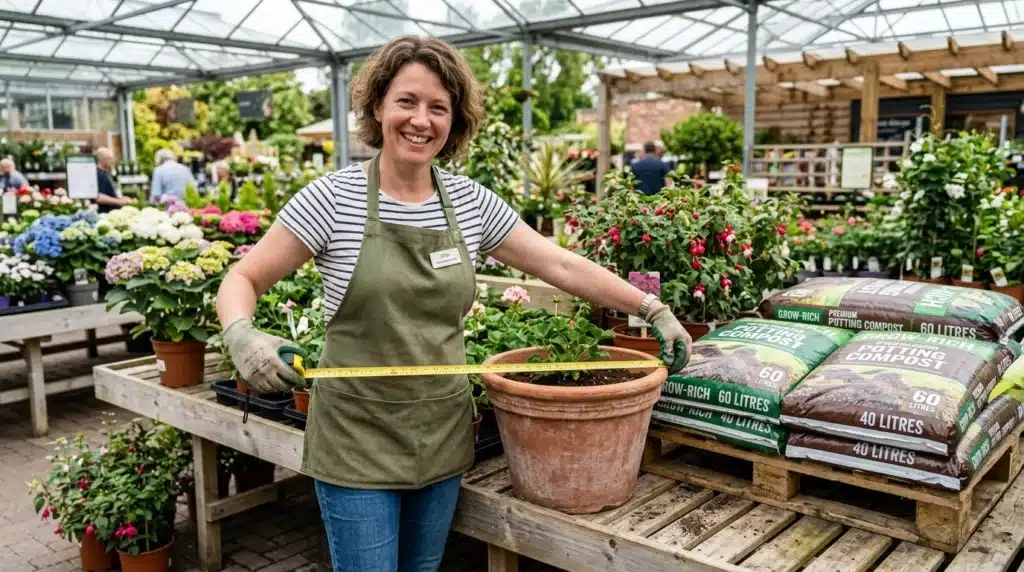
Accurate liters start with accurate measuring, and it takes less than a minute with a tape measure or ruler.
Step-by-Step Measuring Guide
- Measure the diameter across the top, from inside rim to inside rim. Pots are usually sold by this top width.
- Halve that diameter to get the radius. A 20 cm pot has a 10 cm radius.
- Measure the fill height on the inside, from the base up to where the soil will sit, just below the rim.
- For tapered pots, also measure the inside diameter across the base.
- For square or rectangular planters, measure the inside length and width instead of a diameter.
💡 Tip: With those measurements, the calculator at the top of this page turns your pot dimensions into liters in seconds. For long planters and troughs, you can also try our planter volume tool.

Common Pot Sizes: Diameter to Liters (Chart)
Prefer not to do the maths? This chart matches common pot diameters to their approximate capacity in liters. Treat the figures as a guide: real capacity depends on the pot's depth and taper, which vary between makers, so check the label or use the calculator above for an exact number.
| Diameter (cm) | Diameter (in) | Approx. liters |
|---|---|---|
| 9 cm | 3.5" | 0.33 L |
| 13 cm | 5" | 1 L |
| 15 cm | 6" | 1.5 L |
| 17 cm | 6.5" | 2 L |
| 18 cm | 7" | 3 L |
| 20 cm | 8" | 4 L |
| 22 cm | 8.5" | 5 L |
| 24 cm | 9.5" | 6 L |
| 25 cm | 10" | 7 L |
| 30 cm | 12" | ~15 L |
| 35 cm | 14" | ~22 L |
| 40 cm | 16" | ~30 L |
| 50 cm | 20" | ~55 L |
Reading the Chart
For example, a 20 cm pot typically holds about 4 liters and a 30 cm pot around 15 liters. A standard 14 cm nursery pot usually sits between 1 and 1.5 liters. Deep "long tom" pots and shallow bowls of the same width can differ a lot, so measure when it matters.
💡 Tip: For more pot sizing guidance, see our pot sizes guide and our plant pot volume calculator.

Liters to Gallons: Pot Size Conversions
Buying from US brands, or grow bags sized in gallons? One US gallon is 3.785 liters, and one cubic foot is 28.317 liters (about 7.48 US gallons). Bagged potting mix is often labelled in cubic feet, so the table shows all three units side by side.
| Pot / grow bag | Liters | Cubic feet |
|---|---|---|
| 1 gallon | 3.8 L | 0.13 cu ft |
| 2 gallon | 7.6 L | 0.27 cu ft |
| 3 gallon | 11.4 L | 0.40 cu ft |
| 5 gallon | 18.9 L | 0.67 cu ft |
| 7 gallon | 26.5 L | 0.94 cu ft |
| 10 gallon | 37.9 L | 1.34 cu ft |
| 15 gallon | 56.8 L | 2.01 cu ft |
| 20 gallon | 75.7 L | 2.67 cu ft |
| 25 gallon | 94.6 L | 3.34 cu ft |
| 30 gallon | 113.6 L | 4.01 cu ft |
Nursery "Gallon" Pots Hold Less
Nursery containers labelled "#1" or "1 gallon" are trade sizes, not exact measures, and they usually hold noticeably less than a true US gallon (3.8 L). If the exact amount matters, measure the pot and use the calculator above, or check the manufacturer's stated volume. To match gallon sizes to real pot dimensions, try our gallon pot size finder or the pot size calculator.
💡 Tip: Fresh potting mix settles after the first few waterings, so when you buy bags for several grow bags it is sensible to have a little extra on hand for topping up.

What Size Pot in Liters for Each Plant?
Volume is not just about buying soil, it is about healthy roots. The table below lists typical pot sizes in liters for popular plants. Use it as a starting point, then move plants up a size as their roots fill the pot.
| Plant type | Typical pot size |
|---|---|
| Seedlings, herbs, bedding plants | 1–2 L |
| Perennials, small shrubs | 2–3 L |
| Established perennials and shrubs | 3–5 L |
| Young roses (nursery size) | 4 L |
| Lettuce, chard, parsley, basil | 5 L |
| Specimen plants | 10 L |
| Chillies and peppers | 15–20 L |
| Cherry tomatoes | 20–30 L |
| Semi-mature shrubs, small trees | 50 L |
Don't Jump Too Many Sizes at Once
Bigger is not always better. The Royal Horticultural Society advises potting on into a slightly larger pot, usually 2.5–5 cm (1–2 in) wider than the previous one, because a large volume of unused compost stays wet for too long and can lead to root rot (RHS: Overpotting). Vigorous crops such as tomatoes are the usual exception: once past the seedling stage, they normally go straight into their final, large container. If you grow tomatoes, our guide to growing Black Krim tomatoes has more growing tips.
💡 Tip: Once you have chosen a container size, our soil calculator for pots works out how much potting mix to buy.

How Much Potting Soil (Liters) Do I Need?
Once you know a pot's volume in liters, buying mix is easy: the pot's liters are roughly the amount of mix it takes, minus a little for the plant's rootball. For several pots, add their liters together and divide by the bag size. The calculator above does this for you when you enter the number of pots and your bag size, and our potting soil calculator for pots can total different-sized containers.
Choosing the Right Mix
Containers do best with a light, free-draining mix rather than garden soil. See our guide to well-draining soil and the wider soil type guide, or the orchid potting mix calculator for plants that need a special blend. Filling raised beds instead? The soil calculator for raised garden beds works on the same volume principle.
💡 Tip: Bag sizes vary by brand and country (common sizes include 10, 20, 40, 50 and 70 liters). Check the liters printed on the bag and enter it in the calculator's "Bag size" box.

Safety Tips for Handling Pots and Potting Mix
Large containers filled with damp mix get heavy quickly. Where you can, place big pots in their final position before filling and watering them, lift with your legs rather than your back, and use a trolley or ask for help with anything awkward.
Potting Mix Hygiene
Bagged potting mix can carry Legionella longbeachae, a bacterium that can cause Legionnaires' disease if contaminated dust is breathed in. Most people who are exposed stay well, but health authorities recommend simple precautions (NSW Health):
- Wear gloves and a face mask when opening and handling bags.
- Open bags slowly, away from your face, and dampen the mix to keep dust down.
- Wash your hands with soap after gardening, even if you wore gloves.
- Follow the warnings printed on the bag.
💡 Tip: Using heat mats, grow lights or extension leads around the potting bench? Keep them away from water and damp compost, and switch them off when not in use.
Pot Liter Calculator FAQs
How do I calculate the volume of a pot in liters?
Measure the inside of the pot in centimeters, work out the volume in cubic centimeters with the formula for its shape (for a round pot, π × radius² × height), then divide by 1,000. The result is in liters, because 1 liter equals 1,000 cm³.
How many liters is a 20 cm pot?
A typical 20 cm (8 inch) pot holds roughly 4 liters, depending on its depth and taper. Measure the inside diameter and fill height and use the calculator for an exact figure.
How many liters does a 30 cm pot hold?
A typical tapered 30 cm (12 inch) pot holds around 15 liters. A straight-sided 30 cm pot filled to 25 cm deep holds about 17.7 liters.
How do I convert liters to gallons for pots?
Divide liters by 3.785 to get US gallons, or multiply gallons by 3.785 to get liters. A 10 liter pot is about 2.64 US gallons, and a 5 gallon pot is about 18.9 liters.
What size pot in liters do tomatoes need?
Cherry and standard tomatoes are commonly grown in large pots of about 20 to 30 liters, at least 30 cm wide. Larger pots hold more water, so they dry out less quickly in summer.
How many liters of soil do I need to fill a 10 gallon pot?
A 10 US gallon pot holds about 37.9 liters, so plan on roughly 38 liters of potting mix, a little less once the plant’s rootball takes up space. Nursery trade gallon pots often hold less than a true gallon, so measure if you want an exact amount.
How do I measure a pot to find its liters?
Measure the inside diameter across the top, halve it to get the radius, then measure the soil fill height. Put those into the round-pot formula (or the calculator on this page) and divide cubic centimeters by 1,000 for liters.
Is a liter the same as 1,000 cm³?
Yes. One liter is defined as one cubic decimeter, which is exactly 1,000 cubic centimeters or 1,000 milliliters. That is why a 10 cm cube holds precisely 1 liter.
Final Thoughts
Sizing pots in liters is easier than it first looks. Remember that 1 liter = 1,000 cm³, measure the inside diameter and fill height, use the formula for your pot's shape, and divide by 1,000. Do that and you will buy the right amount of mix, give each plant suitable root space, and avoid paying for bags you do not need.
Sources and How We Checked the Numbers
- Unit definitions and conversions (1 L = 1 dm³ = 1,000 cm³; 1 US gallon = 3.785 L; 1 cu ft = 28.317 L): NIST, SI Units – Volume.
- Advice on moving up pot sizes gradually: Royal Horticultural Society, Overpotting.
- Potting mix safety precautions: NSW Health, Stay safe from Legionnaires' disease when gardening.
- Worked examples and conversion tables were calculated with the formulas shown on this page. Pot-size chart and plant pot sizes are approximate, general guides; manufacturers' pots vary.