Mushrooms In Lawn: Which Are Actually Dangerous To Pets
You step outside on a Saturday morning, coffee in hand, ready to let the dog out for a quick sniff around the yard. Instead, you find your lawn dotted with strange little umbrellas that definitely weren't there yesterday. If you've got a curious dog, a nosy cat, or a toddler who puts everything in their mouth, that first reaction is rarely curiosity. It's panic.
You’re not overreacting. Lawn mushrooms pop up fast, often overnight, and while most species are harmless, a small handful are genuinely dangerous. The mushrooms covered in this guide are lawn species that veterinary and mycology references, including the Merck Veterinary Manual and the North American Mycological Association (NAMA), identify as risks to dogs and cats. This article breaks down exactly which lawn mushrooms deserve your attention, how to tell them apart, what to do if your pet eats one, and how to stop them from taking over your grass in the first place.
We'll go section by section, so feel free to jump ahead if you already know why mushrooms are showing up and just want the identification guide, or skip straight to the FAQ if you need a fast answer. But if you've got a few minutes, read the whole thing. A little knowledge here can genuinely save your pet a trip to the emergency vet.
Why Do Mushrooms Grow In Your Lawn?
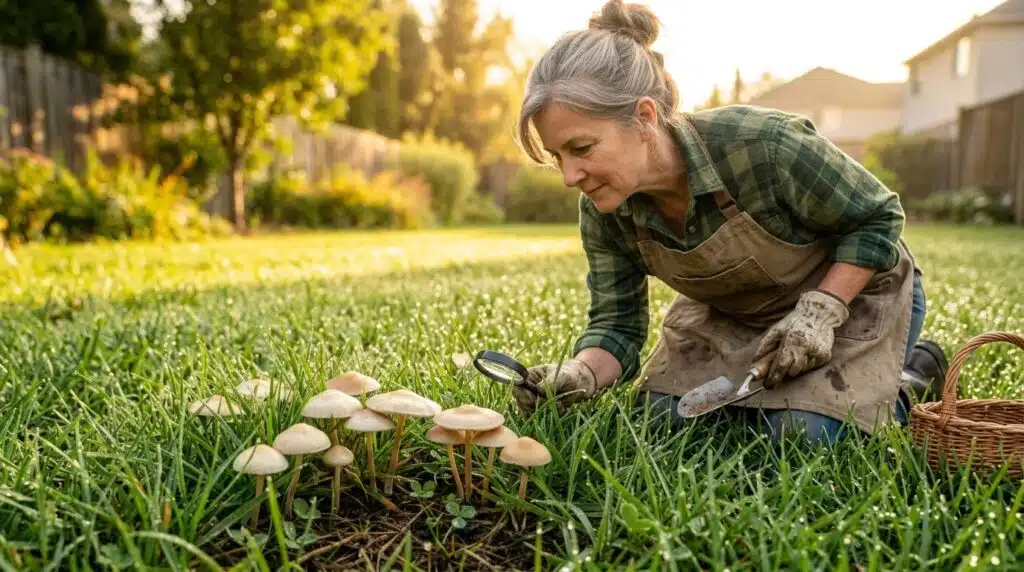
Mushrooms aren’t plants, and they’re not attacking your grass. They’re the visible fruiting bodies of fungi that live underground almost all year round as a thread-like network called mycelium.
The Conditions That Trigger Mushroom Growth
- Recent rain or heavy watering – moisture is the single biggest trigger for fungal fruiting, which is why mushrooms after rain seem to appear overnight.
- Decaying organic matter underground – old tree roots, buried scrap wood, or construction debris left under new sod all feed fungi from below.
- Thick thatch buildup – a spongy layer of dead grass and stems holds moisture and organic material right at the surface.
- Poor drainage or compacted soil – water that can’t move through the soil profile keeps the top few inches damp for days at a time.
- Shaded, poorly ventilated areas – shade slows evaporation, so soil under trees or along fence lines stays wet longer than open lawn.
- Newly installed sod – sod farms often use wood-based mulch or straw underlayment, and freshly disturbed soil is a magnet for fast-fruiting fungi.
Common Lawn Mushroom Causes And Practical Fixes
| Underlying Cause | What's Happening Below The Surface | Practical Fix |
|---|---|---|
| Excess soil moisture | Fungal mycelium thrives in consistently damp conditions | Water deeply but less often, early in the morning |
| Buried organic debris | Old roots, stumps, or scrap wood decompose and feed fungi | Dig out and remove buried wood or root masses where possible |
| Thatch buildup | A spongy organic layer traps moisture at the surface | Dethatch in early fall or spring using a rake or power dethatcher |
| Compacted, poorly drained soil | Water pools instead of draining through the soil profile | Core aerate once or twice a year to open up compaction |
| Heavy shade | Slower evaporation keeps soil damp for longer periods | Prune overhanging branches to improve airflow and sunlight |
| New sod installation | Wood mulch, straw, or disturbed soil under sod fruits quickly | Expect a short flush of mushrooms; rake them out as they appear |
Are Mushrooms In Your Lawn A Good Sign Or A Bad One?
Mushrooms usually mean your lawn has organic matter, moisture, and living fungal networks doing quiet, useful work underground. Where mushrooms become a genuine problem is pet and family safety, not turf health.
8 Mushrooms Commonly Found In Lawns (How Dangerous They Are To Pets)
Mushroom identification is genuinely difficult, even for trained mycologists working from a physical specimen. Treat everything below as a general guide, not a diagnostic tool. If your pet eats any lawn mushroom, call your veterinarian or an animal poison control hotline immediately.

1. Green-Spored Parasol (Chlorophyllum molybdites)
This is one of the most common toxic mushrooms in North American lawns, and it's easy to mistake for an edible parasol mushroom. It's large, white to tan, and often grows in wide circles known as fairy rings. As it matures, the gills underneath the cap turn a distinctive dull green, which is where it gets its name. For dogs and cats, ingestion typically causes vomiting and diarrhea that can start within 15 minutes to 3 hours. Most pets recover in one to two days with veterinary care, but severe fluid loss can be dangerous for puppies and small pets.

2. Fly Agaric (Amanita muscaria)
The classic red cap covered in white warts, straight out of a storybook illustration. It's less common in manicured lawns than in yards near pine or birch trees, but it does turn up in residential yards, especially in cooler, wetter climates. It contains compounds that affect the nervous system and can cause drooling, disorientation, tremors, and vomiting in pets that eat it.

3. Death Cap (Amanita phalloides)
If there's one mushroom to memorize, it's this one. The death cap has a smooth, greenish-yellow to off-white cap, white gills, and a skirt-like ring around the stem. The Merck Veterinary Manual describes it as the species most often implicated in human and animal mushroom deaths worldwide. Even a small amount can be lethal to a dog, and symptoms usually don't appear for 6 to 24 hours, which delays treatment at the worst possible time.

4. Destroying Angel (Amanita bisporigera and related species)
The death cap's equally dangerous cousin. Destroying angels are pure white from cap to stem, which makes them look deceptively clean and harmless next to green grass. They contain the same family of amatoxins as the death cap and cause the same delayed, severe liver and kidney damage.

5. Fool's Funnel (Clitocybe rivulosa and related Clitocybe species)
Smaller, pale tan to white, and easy to overlook in short grass, fool's funnel mushrooms contain muscarine, a compound that overstimulates the nervous system. Drooling, watery eyes, vomiting, diarrhea, and a slowed heart rate can begin within 15 minutes to 2 hours of eating it, and NAMA notes that Clitocybe species can be lethal to dogs.

6. Fairy Ring Mushroom (Marasmius oreades)
This is the classic lawn mushroom responsible for those dark green circles and rings you sometimes see in turf. On its own, it's generally considered low risk, although eating it can still upset a pet's stomach. The bigger risk is that far more dangerous species, like the green-spored parasol, love to grow in the exact same circular pattern.

7. Puffballs (Lycoperdon and Calvatia species)
Round, white, and ball-shaped with no visible cap, stem, or gills, puffballs are one of the easier lawn fungi to recognize. Ingestion of any puffball, young or old, can still cause vomiting and digestive upset in dogs and cats.
Be careful with look-alikes. A young "puffball" that shows the outline of a cap and stem when sliced in half may actually be an immature Amanita, and hard, dark-centered earthballs (Scleroderma species) look similar but are reported by NAMA as lethal to dogs. Treat any round white fungus in a pet area with caution.

8. Little Brown Mushrooms (LBMs) (Various genera, including toxic Galerina species)
Mycologists half-jokingly call small, nondescript brown mushrooms "LBMs" because there are hundreds of visually similar species, and a meaningful number of them are toxic, including several Galerina species that contain the same deadly amatoxins found in the death cap.

Quick Reference: Lawn Mushroom Identification And Pet Toxicity
| Mushroom | Typical Appearance | Toxicity To Pets |
|---|---|---|
| Green-Spored Parasol | Large white/tan cap, gills turn green with age, often in rings | Moderate to severe - common cause of vet visits |
| Fly Agaric | Red cap with white warty spots | Moderate - neurological symptoms |
| Death Cap | Greenish-yellow smooth cap, white gills, skirted stem | Severe - potentially fatal, delayed symptoms |
| Destroying Angel | Pure white cap, gills, and stem | Severe - potentially fatal, delayed symptoms |
| Fool's Funnel | Small pale tan/white funnel-shaped cap | Severe - rapid onset, often within 15 min to 2 hours |
| Fairy Ring Mushroom | Small tan cap, thin tough stem, grows in rings | Mild - usually stomach upset only |
| Puffballs | Round white ball, no visible cap or gills | Mild to moderate - digestive upset; watch for toxic look-alikes |
| Little Brown Mushrooms (LBMs) | Small, brown, nondescript, many look-alike species | Unknown/variable - assume risk |
Fairy Rings And Mushroom Circles In Your Lawn
If you've noticed mushrooms popping up in a near-perfect circle, sometimes with a ring of darker green grass around it, you're looking at a fairy ring. It happens because the underground fungal mycelium spreads outward from a single starting point in every direction at roughly the same speed, forming a ring rather than a random patch.
Fairy rings themselves are mostly a cosmetic nuisance rather than a serious lawn health threat. The bigger takeaway for pet owners is that rings are a favorite growing pattern for several mushroom species, including the genuinely dangerous green-spored parasol, so don't let familiarity with fairy rings lower your guard.

Mushrooms In Mulch, Garden Beds, And New Sod
Mushrooms In Mulch And Garden Beds
Wood mulch is basically fungus food. It's organic, it holds moisture well, and it breaks down slowly, which makes flower beds and mulched borders one of the most common places to spot small gray or brown mushrooms clustered together. If mushrooms keep coming back in the same mulch bed, raking the surface to break up the fungal mat, letting the mulch dry out between waterings, and refreshing old mulch every year or two will usually cut down on new fruiting significantly.
Mushrooms In New Sod
If you just had sod installed and mushrooms showed up within the first few weeks, don't panic. Many sod farms use straw, wood fiber, or biodegradable mesh to hold new sod in place, and that organic material fruits mushrooms almost immediately once it's watered heavily. This flush typically fades on its own within a few weeks. In the meantime, simply rake or mow off any mushrooms as they appear rather than treating the new lawn with chemicals.

How To Get Rid Of Mushrooms In Your Lawn
There’s no single product that eliminates lawn mushrooms permanently. Real, lasting control comes from changing the conditions that fungi need to thrive, combined with manually removing fruiting bodies as they appear.
- Remove mushrooms by hand as soon as you spot them, wearing gloves, and dispose of them in a sealed bag rather than composting them.
- Mow regularly and bag the clippings when mushrooms are present, since mowing over them can spread spores across the lawn.
- Improve drainage across the lawn with core aeration once or twice a year to relieve compacted soil.
- Dethatch in spring or fall if your lawn has more than half an inch of spongy thatch buildup.
- Water deeply but less frequently, ideally early in the morning so the surface has time to dry out during the day.
- Dig out and remove any buried stumps, roots, or construction scraps that are feeding fungi from underground.
- Prune back overhanging trees and shrubs to let more sunlight and airflow reach shaded, damp corners of the yard.
If your whole lawn struggles with drainage or thin, patchy grass alongside the mushroom problem, it's worth looking at your grass type and soil composition together.

Does Fungicide, Bleach, Baking Soda, Or Weed Killer Kill Lawn Mushrooms?
Lawn fungicides are formulated to target specific turf diseases, not the wide range of saprophytic fungi that produce mushrooms. Because the fungal network lives several inches underground, most surface-applied products never reach enough of it to make a real difference.
| Treatment | Does It Work On Lawn Mushrooms? | Notes |
|---|---|---|
| Lawn fungicide | Rarely effective long-term | Targets turf disease pathogens, not saprophytic mushroom-forming fungi |
| Weed killer / weed-and-feed | No | Formulated for broadleaf weeds, has no meaningful effect on fungi |
| Household bleach | Not recommended | Can kill grass and harm soil life without reaching underground mycelium |
| Baking soda | Minimal, temporary effect | May slightly raise soil pH on contact but doesn't address the underlying cause |
| Manual removal + cultural fixes | Most effective long-term approach | Combines drainage, aeration, and thatch control with hand-removal |

How To Stop Mushrooms From Coming Back For Good
- Keep an eye on watering habits and avoid letting sprinklers run into the evening, since overnight moisture is exactly what fungi need to fruit.
- Stay on top of thatch and organic debris so it doesn't accumulate into a food source at the soil surface.
- Aerate compacted areas at least once a year, especially in high-traffic zones or clay-heavy soil.
- Rake up grass clippings, fallen leaves, and dead plant material regularly instead of letting them break down in place.
- Address shaded, damp corners of the yard with pruning or by choosing more shade-tolerant, drought-resistant plantings nearby.
- Feed your lawn on a normal seasonal schedule so grass roots stay dense and outcompete fungi for space and nutrients.
A well-fed, well-drained lawn with healthy roots is naturally less hospitable to fungi. Our guides to organic lawn fertilizer and a seasonal grass fertilizing schedule are both good next stops.

Safety Guidelines: Keeping Pets And Kids Safe From Lawn Mushrooms
If You Suspect Your Pet Ate A Mushroom
- Call your veterinarian or an animal poison control hotline immediately, even if your pet seems fine so far. Some of the most dangerous mushrooms have a delayed onset of symptoms.
- Try to collect a sample of the mushroom, ideally the whole specimen including the base of the stem, and place it in a paper bag or wrapped in a damp paper towel for identification.
- Take a clear photo of the mushroom and the surrounding area before you remove it, in case the physical sample gets damaged.
- Watch for vomiting, diarrhea, drooling, weakness, tremors, disorientation, or yellowing of the gums and eyes, and report every symptom to your vet.
- Do not attempt to induce vomiting at home unless a veterinary professional specifically instructs you to, since some remedies can cause more harm.

Everyday Prevention Habits
- Do a quick visual sweep of the yard before letting pets out, especially first thing in the morning and after rain.
- Remove any mushrooms you find promptly, wearing gloves, and dispose of them where pets can't dig them back out.
- Train pets on a reliable "leave it" or "drop it" command, which can make a real difference in the seconds before a mushroom gets eaten.
- Supervise young children and curious puppies outdoors during peak mushroom season, typically after warm, wet weather.
- Keep the number for your vet and a 24-hour animal poison control hotline saved somewhere you can find it quickly.
If you're building a genuinely pet-safe yard, it's worth cross-checking your existing landscaping against our poisonous plants finder and, if you're planning new beds, our list of animal-resistant plants.

Regional Mushroom Watch: Florida, Texas, Arizona, And The UK
- Florida yards see year-round mushroom activity thanks to consistent heat and humidity, with the green-spored parasol being especially common in lawns across the state.
- Texas lawns, particularly around Austin and other central regions, see seasonal flushes after heavy spring and fall rains.
- Arizona yards see far fewer mushrooms overall due to the arid climate, but irrigated lawns and monsoon season can trigger short, intense flushes.
- UK gardens and lawns deal with a wider variety of species due to consistently damp, mild weather, including fairy ring mushrooms and various Amanita species.
Frequently Asked Questions About Mushrooms In Lawn
Why are mushrooms growing in my lawn?
Are mushrooms in the lawn a good sign?
Are lawn mushrooms bad for grass?
Should I remove mushrooms from my lawn?
How do I get rid of mushrooms in my lawn?
How do you kill mushrooms without killing grass?
What kills mushrooms in the lawn permanently?
How do I stop mushrooms from growing in my lawn?
Why do mushrooms appear after rain?
Do mushrooms mean my lawn is too wet?
Does fungicide kill lawn mushrooms?
Will weed killer kill mushrooms?
Does weed and feed kill mushrooms?
Will bleach kill mushrooms?
Does baking soda kill mushrooms?
How do I get rid of mushrooms in mulch?
Why are mushrooms growing in my mulch?
Why are mushrooms growing in my new sod?
Are mushrooms in new sod normal?
What causes fairy rings in lawns?
How do I get rid of fairy ring mushrooms?
Are yard mushrooms dangerous to dogs?
Are lawn mushrooms poisonous?
Can mushrooms grow overnight?
What should I do if my dog eats a mushroom?
Final Thoughts: A Mushroom-Aware Lawn Is A Safer Lawn
Lawn mushrooms are one of those backyard surprises that feel alarming the first time you notice them. Most of what pops up in your grass is harmless. But a real handful of species can genuinely hurt a curious pet, and there’s no foolproof way to tell them apart on sight. Prevention and a fast response are what actually matter.
For more ways to build a genuinely safe, healthy yard, take a look at our complete lawn care and maintenance guide.

Trusted External Resources
- ASPCA Animal Poison Control Center – 24-hour hotline for suspected pet poisoning emergencies in the United States.
- Animal PoisonLine (UK) – 24/7 pet poisoning advice line run by the Veterinary Poisons Information Service for UK pet owners.
- Merck Veterinary Manual: Mushrooms Toxic to Animals – veterinary reference on mushroom toxins, symptom onset times, and treatment.
- North American Mycological Association: Mushroom Poisonings in Dogs and Cats – species that poison pets, how to save a sample, and how to report a case.