Basement Size Calculator | Window, Door, Dehumidifier & Space Sizing

🏚️ Basement Size Calculator

Window, door, dehumidifier sizing & basement dimensions

Basement Sizing Calculators
Basement Window & Door Size Charts
Window TypeStandard Sizes (W × H)Common ApplicationsFrame Width
Standard Basement Window24×18", 28×18", 32×18", 36×18", 40×18"Light & ventilation2-3" (installed depth)
Egress Window (Bedroom)32×36", 36×36", 36×48", 42×48"Emergency exit (code required)Wide (6-12" sill depth)
Replacement WindowCustom to fit existing frameReplacing old/broken windowsVaries with opening
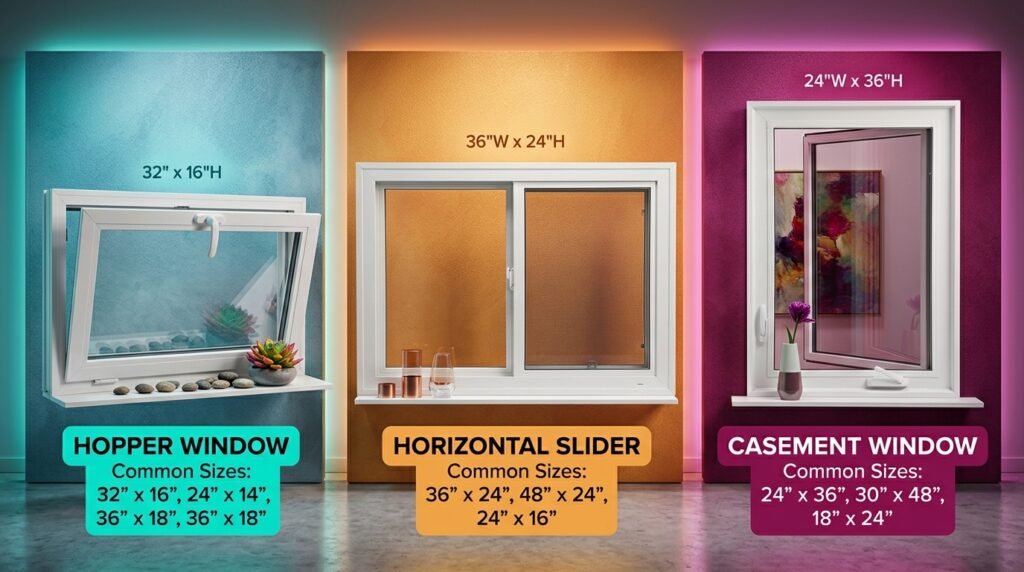
Horizontal Slider28×24", 32×24", 36×24", 40×24"Easy operation in tight spaces1.5-2"
Single Hung24×36", 28×36", 32×36", 36×36"Traditional basements2-2.5"
Casement (hopper)24×20", 28×20", 32×20", 36×20"Maximum light in small opening2-3"
🚪 Basement Door Sizes
Standard Basement Entry Door: 36" W × 80" H (most common)
Full-Size Door (wide opening): 42" W × 80" H
Narrow/Utility Door: 30" W × 80" H
Bilco-Style Basement Door (exterior): 40" W × 52" H (angled hatch style)
Pocket Doors (space-saving): 24" to 48" W × 80" H
📏 Egress Window Code Requirements
Minimum Opening (any direction): 5.7 sq ft OR 5 sq ft if opening height is 60" or less
Minimum Width: 32 inches
Minimum Height: 36 inches (or 48" recommended for safety)
Sill Height from floor: Maximum 44" (IBC Code)
Well Depth (below grade): Typically 36-48"
Basement Specifications & Standards
💨 Dehumidifier Sizing Chart
Small Basement (under 500 sq ft): 30-50 pints/day dehumidifier
Medium Basement (500-1000 sq ft): 50-70 pints/day dehumidifier
Large Basement (1000-1500 sq ft): 70-100 pints/day dehumidifier
Extra Large (1500+ sq ft): 100+ pints/day (consider 2 units)
Rule of Thumb: 1 pint per 100 sq ft for moderate moisture
💧 Dehumidifier Capacity by Moisture Level
Normal (50-60% humidity): 1 pint per 100 sq ft
Moderate (60-70% humidity): 1 pint per 75 sq ft
High (70-80% humidity): 1 pint per 50 sq ft
Extreme (80%+ humidity, wet): 1 pint per 25-30 sq ft
📐 Standard Basement Dimensions
Small Basement: 300-500 sq ft (typical home)
Medium Basement: 500-1000 sq ft (common)
Large Basement: 1000-1500 sq ft (full size home)
Finished Basement Room: 150-400 sq ft (bedroom/rec room)
Basement Ceiling Height: 7.5-8.5 feet (code minimum 7 feet for living)
🪟 Window Placement Standards
Spacing: Windows typically spaced 8-10 feet apart
Height from floor: Standard windows sill 2-3 feet above floor
Egress requirements: One per bedroom, 5.7+ sq ft opening
Headroom: 36-48" clearance above window (per code)
⚙️ Popular Basement Window Brands & Sizes
Andersen: 24×18", 28×18", 32×18", 36×18", 40×18" standard
Gordon (bi-fold door style): 24", 28", 32", 36", 40" widths
Milgard: Custom sizing available
Egress Wells: 40"×52"×12" standard depth
🔧 Basement Bar Sizing
Small Home Bar: 3-4 feet wide, 18-24" deep counter
Standard Home Bar: 4-6 feet wide, 24" deep counter
Full Service Bar: 6-8 feet wide, 30" deep counter
Counter Height: 36" standard (ADA: 34-36")
Barstool Clearance: 12" between edge and back wall (or no back)
📋 Basement Code Requirements
✓ Minimum ceiling height: 7 feet (7.5 feet for habitable rooms)
✓ Minimum floor area: 70 sq ft per room
✓ One egress window per bedroom minimum
✓ Proper ventilation/exhaust required
✓ GFCI outlets required near water sources

© 2026 Basement Size Calculator | For reference only | Always verify with local building codes and manufacturers

Basement Size Calculator

Complete Reference Guide

Windows · Egress · Dehumidifier · Bar · Doors · Low Basement Planning

The Complete Homeowner Reference — 2025 / 2026 Edition

Whether you’re finishing a basement, adding egress windows to meet building codes, sizing a dehumidifier for your square footage, or planning a basement bar — this guide gives you every measurement, formula, and standard size reference you need.

1. Basement Size Calculator & Square Footage

Knowing your basement’s exact size is the starting point for every other calculation in this guide — dehumidifier sizing, egress window compliance, bar layout, and renovation cost estimates all depend on accurate square footage and volume measurements.

How to Calculate Basement Square Footage

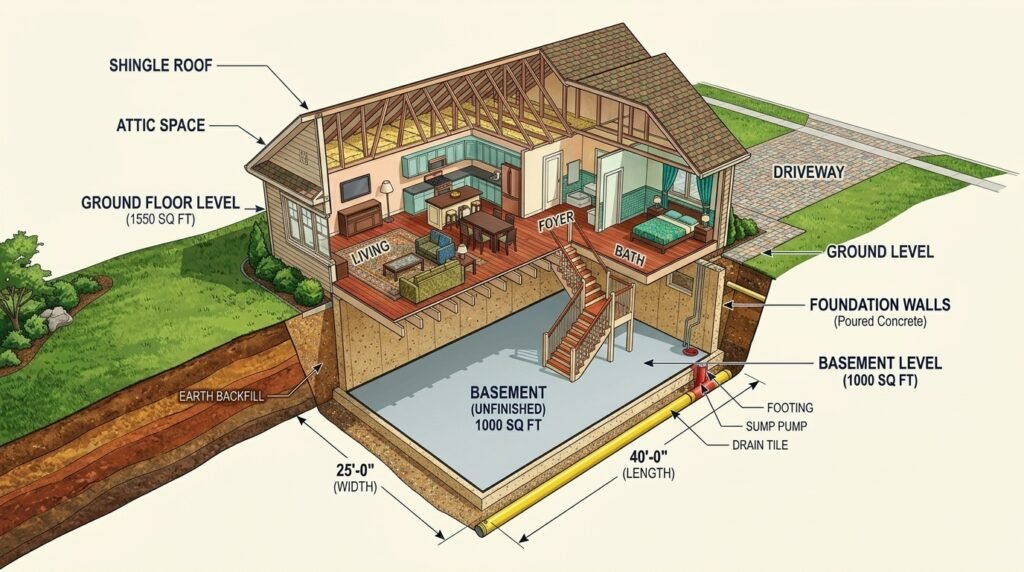
Simple Rectangular Basement

📐  Length (ft)  ×  Width (ft)  =  Square Footage

💡  Example: 40 ft × 25 ft = 1,000 sq. ft.

L-Shaped or Irregular Basement

  1. Sketch the floor plan on paper
  2. Divide the space into separate rectangles
  3. Measure each rectangle: Length × Width
  4. Add all rectangle areas together for total sq. ft.

💡  Example: Section A = 30×20 = 600 sq. ft.  +  Section B = 15×12 = 180 sq. ft.  =  780 sq. ft. total

Basement Volume Calculator

Volume is needed for dehumidifier sizing, HVAC calculations, and ventilation planning.

📐  Length (ft)  ×  Width (ft)  ×  Ceiling Height (ft)  =  Volume (cubic feet)

💡  Example: 40 ft × 25 ft × 8 ft ceiling = 8,000 cubic feet

Basement Size Reference Chart

Basement Type

Typical Square Footage

Typical Dimensions

Small basement

400 – 700 sq. ft.

20×20 ft  to  25×28 ft

Medium basement

700 – 1,100 sq. ft.

28×28 ft  to  30×36 ft

Large basement

1,100 – 1,600 sq. ft.

35×32 ft  to  40×40 ft

Full-house footprint

1,600 – 2,500 sq. ft.

40×40 ft  to  50×50 ft

Partial / crawl space

100 – 400 sq. ft.

Varies widely

ℹ️  The square footage of your basement does not count toward your home’s above-grade living area in most real estate calculations, even if it is fully finished.

2. Low Basement with Full-Sized Door — Planning Guide

A low basement is generally defined as one with a ceiling height below the standard 8 feet. Many older homes have basements with 6.5 ft, 7 ft, or even lower ceiling heights. Installing a full-sized door in a low basement requires careful planning around structural and code requirements.

Standard Door Heights vs. Low Basement Ceiling Heights

Door Type

Standard Height

Minimum Clearance Needed

Notes

Standard interior door

6 ft 8 in (80 in)

7 ft 0 in ceiling

Most common residential door

Standard exterior door

6 ft 8 in (80 in)

7 ft 2 in ceiling

Includes frame and header

Tall interior door

7 ft 0 in (84 in)

7 ft 6 in ceiling

Premium / modern spec

Low-clearance door option

6 ft 0 in (72 in)

6 ft 6 in ceiling

Available for tight spaces

Bifold / sliding door

Varies

Ceiling height only

No overhead swing clearance needed

Ceiling Height Requirements for a Full-Sized Door

A standard full-sized door (6 ft 8 in / 80 in tall) installed in a rough opening requires:

  • Rough opening height: door height + 1.5 in for sill plate + 1.5 in for header plate + 0.5 in clearance = minimum 83.5 in (about 7 ft)
  • Minimum finished ceiling height above the door frame: at least 2–4 inches above the top of the door
  • Total minimum ceiling height recommended: 7 ft 2 in to 7 ft 4 in for a standard full-sized door

⚠️  If your basement ceiling height is below 7 ft, a standard 6 ft 8 in door may still be possible with a reduced header, but you should consult a licensed contractor or structural engineer before modifying any load-bearing framing.

Building Code Minimum Ceiling Heights for Finished Basements

Space Type

IRC Minimum Ceiling Height

Applies To

Habitable rooms (bedroom, living, office)

7 ft 0 in

At least 50% of floor area

Bathrooms, laundry, hallways

6 ft 8 in

Throughout the space

Below beams / ducts / pipes

6 ft 4 in

Obstruction clearance only

Basement utility / storage area

No minimum

Non-habitable only

ℹ️  IRC = International Residential Code. Local codes may differ — always check with your local building authority before planning basement alterations.

Options for Installing a Full-Sized Door in a Low Basement

Option 1 — Underpinning / Lowering the Floor

The floor is excavated and lowered to increase ceiling height. This is the most effective solution but also the most expensive — typically $30,000 to $70,000+ depending on basement size and soil conditions.

Option 2 — Bench Footing

Instead of lowering the entire floor, a stepped or bench footing is created around the perimeter, lowering the central floor area while leaving the foundation walls intact. Costs range from $10,000 to $40,000.

Option 3 — Reduced-Height Door

Install a shorter door (6 ft 0 in or 6 ft 2 in) designed for lower ceiling heights. These are available from most door manufacturers and require minimal structural modification. This is the most practical and lowest-cost option when ceiling height is between 6 ft 6 in and 7 ft 0 in.

Option 4 — Pocket or Sliding Door

Pocket doors and barn-style sliding doors do not require overhead clearance for a swing arc and can be installed in spaces with ceiling heights as low as 6 ft 8 in without impacting structural framing above.

3. Basement Dehumidifier Size Calculator

Sizing a dehumidifier correctly ensures it operates efficiently without being underpowered (leaving moisture in the air) or oversized (cycling on and off too frequently and wearing out faster). Dehumidifier capacity is measured in pints of water removed per day.

How to Size a Dehumidifier for Your Basement

Step 1 — Measure Your Basement Square Footage

📐  Length (ft)  ×  Width (ft)  =  Square Footage

Step 2 — Assess Moisture Conditions

Moisture Level

Description / Signs

Moderately damp

Musty odour in humid weather; walls feel damp to the touch seasonally

Very damp

Musty odour always present; visible moisture on walls or floor

Wet

Seepage through walls after rain; standing water after heavy rain

Extremely wet

Water actively seeping in; flooding occurs regularly

Step 3 — Apply the Sizing Formula

The Energy Star program provides the standard sizing guidelines for residential dehumidifiers:

Basement Size

Moderately Damp

Very Damp

Wet

Extremely Wet

500 sq. ft.

30 pints/day

40 pints/day

45 pints/day

50 pints/day

1,000 sq. ft.

45 pints/day

50 pints/day

50 pints/day

60 pints/day

1,500 sq. ft.

45 pints/day

50 pints/day

60 pints/day

70 pints/day

2,000 sq. ft.

50 pints/day

55 pints/day

65 pints/day

75 pints/day

2,500 sq. ft.

50 pints/day

60 pints/day

70 pints/day

80 pints/day

3,000 sq. ft.

55 pints/day

65 pints/day

75 pints/day

90 pints/day

What Size Dehumidifier Do I Need for My Basement?

Use this practical decision guide based on your basement conditions:

If Your Basement Is…

Recommended Dehumidifier Size

Under 1,000 sq. ft., slightly damp

30 – 40 pint dehumidifier

Under 1,000 sq. ft., very damp or wet

50 pint dehumidifier

1,000 – 1,500 sq. ft., moderately damp

45 – 50 pint dehumidifier

1,000 – 1,500 sq. ft., wet or very damp

50 – 60 pint dehumidifier

1,500 – 2,500 sq. ft., any moisture level

50 – 70 pint dehumidifier

Over 2,500 sq. ft., any moisture level

70 – 90 pint dehumidifier

Whole-house or commercial basement

90 – 140 pint commercial unit

Adjustment Factors for Dehumidifier Sizing

  • High ceilings (above 9 ft): Increase recommended capacity by 10%
  • Frequent basement use (gym, living space): Increase by 10%
  • Laundry area in basement: Increase by 10 pints per day
  • Basement in a hot, humid climate (Southeast U.S., coastal areas): Increase by 10–15%
  • Well-sealed, insulated basement: You may be able to use the lower end of the range

💡  For a standard 1,000 sq. ft. basement that feels damp but has no visible water, a 50-pint dehumidifier is the most commonly recommended size.

Dehumidifier Size in Litres (International)

Outside the United States, dehumidifier capacity is measured in litres per day rather than pints.

📐  Pints Per Day  ÷  2.113  =  Litres Per Day

US Pints Per Day

Litres Per Day (approx.)

Typical Use

30 pints

~14 litres

Small basement under 500 sq. ft., mild dampness

40 pints

~19 litres

Small basement, moderately damp

50 pints

~24 litres

Standard mid-size basement

60 pints

~28 litres

Large or wet basement

70 pints

~33 litres

Very large or very wet basement

90 pints

~43 litres

Commercial / whole-house

4. Standard Basement Window Sizes

Basement windows come in a narrower range of standard sizes than above-grade windows. Most are designed to fit between floor joists and standard stud bays. Understanding standard sizes is the key to finding readily available replacements and avoiding custom orders.

What Are Standard Basement Window Sizes?

Standard basement windows are typically measured as width × height in inches. The most common standard sizes are:

Width × Height

Common Use

Notes

14″ × 8″

Narrow utility window

Very small — light only, no ventilation standard

16″ × 8″

Utility / storage area

Minimal light; common in older homes

24″ × 12″

Standard small basement

Most common size in homes built 1940s–1970s

30″ × 14″

Standard medium basement

Widely available; good light-to-space ratio

32″ × 16″

Standard medium-large

Very common; suits most utility and living spaces

36″ × 18″

Larger standard basement

Good natural light; common in newer homes

36″ × 24″

Large standard basement

Often used in finished basement living areas

48″ × 24″

Wide basement window

Living area use; may require additional framing

ℹ️  Window dimensions are typically listed as width × height (W × H). Always confirm the measurement convention with your supplier — some list height first.

Typical Basement Window Size by Home Era

Home Era

Typical Basement Window Size

Notes

Pre-1940s

12″ × 8″ to 16″ × 8″

Very small hopper or awning style

1940s–1960s

24″ × 12″ to 30″ × 14″

Utility focus; metal frames common

1970s–1990s

32″ × 16″ to 36″ × 18″

Vinyl frames begin to appear

2000s–2010s

36″ × 18″ to 36″ × 24″

Energy efficiency improvements

2015–present

36″ × 24″ to 48″ × 36″

Larger openings; egress more common

5. Replacement Basement Window Sizes

Replacement basement windows are designed to fit into an existing rough opening without requiring changes to the surrounding framing or masonry. The replacement window unit is slightly smaller than the rough opening to allow for shimming, levelling, and insulation.

How to Measure for Replacement Basement Windows

  1. Measure the width of the existing window frame opening at three points — top, middle, and bottom. Use the smallest measurement.
  2. Measure the height of the existing frame opening at three points — left, centre, and right. Use the smallest measurement.
  3. Deduct approximately 0.25 in from both width and height to allow for shimming clearance.
  4. Order replacement windows at the deducted measurement.

📐  Frame Opening Width  −  0.25 in  =  Replacement Window Width to Order

📐  Frame Opening Height  −  0.25 in  =  Replacement Window Height to Order

⚠️  Always measure the existing frame opening — not the old window unit itself. The window unit is smaller than the opening it fits into.

Common Replacement Basement Window Sizes

Rough Opening Size

Replacement Window Size

Style Options

14″ × 8″

13.75″ × 7.75″

Fixed / hopper

16″ × 8″

15.75″ × 7.75″

Fixed / hopper

24″ × 12″

23.75″ × 11.75″

Hopper / slider

30″ × 14″

29.75″ × 13.75″

Hopper / casement

32″ × 16″

31.75″ × 15.75″

Hopper / slider / casement

36″ × 18″

35.75″ × 17.75″

Slider / casement / awning

36″ × 24″

35.75″ × 23.75″

Slider / casement / awning

Replacement Window Materials

Frame Material

Durability

Insulation

Cost Range

Best For

Vinyl

High

Excellent

$80 – $400

Most basements — low maintenance

Fibreglass

Highest

Excellent

$200 – $800

Premium basements; harsh climates

Wood

Medium

Good

$150 – $600

Historic homes; interior-only framing

Aluminium

High

Poor

$75 – $300

Mild climates; commercial spaces

6. Custom Basement Window Sizes

Custom basement windows are ordered when your opening does not match any standard size — common in homes with non-standard rough openings, masonry foundations with unusual dimensions, or renovation projects requiring specific proportions.

When to Order Custom Basement Windows

  • Your existing rough opening does not match any standard size by more than 1 inch
  • You are cutting a new opening in a masonry or concrete foundation
  • You need a specific window style (tilt-and-turn, fixed triple-pane) not available in standard sizes
  • You are matching existing windows in a heritage or architecturally specific home
  • You require a non-standard glazing specification (impact-rated, laminated, tinted)

Custom Window Size Ranges

Dimension

Typical Custom Range

Notes

Minimum width

As narrow as 6 inches

Fixed glass only below 12 inches

Maximum width

Up to 96 inches

Multiple units may be joined

Minimum height

As short as 6 inches

Very narrow — fixed light only

Maximum height

Up to 60 inches

Larger sizes approach egress territory

Custom glazing

Any size within range

Tempered, laminated, double, triple pane

💡  Custom windows typically add 15–30% to the cost of a standard equivalent and require 4–8 weeks lead time. Measure twice and confirm dimensions with your supplier before ordering.

7. Andersen Basement Window Sizes

Andersen Corporation is one of the most widely recognised window manufacturers in North America. Their basement and below-grade window products are available in several series, each with distinct size ranges and specifications.

Andersen Basement Window Product Lines

Andersen 400 Series — Basement / Below-Grade Windows

The 400 Series is Andersen’s most popular residential window line. Below-grade versions are available as casement, awning, and fixed units suitable for basement applications.

Unit Size Code

Approx. Rough Opening (W × H)

Unit Dimensions (W × H)

C13

16″ × 14″

15.25″ × 13.25″

C23

20″ × 14″

19.25″ × 13.25″

C25

20″ × 18″

19.25″ × 17.25″

C33

24″ × 14″

23.25″ × 13.25″

C35

24″ × 18″

23.25″ × 17.25″

C37

24″ × 24″

23.25″ × 23.25″

C45

30″ × 18″

29.25″ × 17.25″

C47

30″ × 24″

29.25″ × 23.25″

ℹ️  Andersen window unit dimensions are approximately 0.75 in smaller than the rough opening on each dimension to allow for shimming and framing clearance. Always confirm exact specifications with current Andersen documentation or a certified dealer.

Andersen 200 Series (Perma-Shield) — Basement Applications

The 200 Series offers a fully clad, low-maintenance option often used in below-grade and basement applications due to its superior resistance to moisture and ground contact. Available sizes include the same general size codes as the 400 Series. The Perma-Shield exterior cladding is particularly well-suited for basement environments where condensation and humidity are higher than in above-grade locations.

Andersen 100 Series (Fibrex®) — Basement Applications

Made from Andersen’s proprietary Fibrex composite material (a blend of wood fibre and thermoplastic polymer), the 100 Series is highly moisture-resistant and dimensionally stable. Available in a range of sizes suitable for basements, with most standard rough opening sizes from 16×14 to 36×24 inches available off the shelf.

💡  For current Andersen sizing data, use the Andersen Window Size Calculator tool on their official website or request a copy of their current product specification sheets from an authorised Andersen dealer.

8. Basement Egress Window Sizes & Code Requirements

A basement egress window is a window large enough to serve as an emergency escape route from a below-grade space. If your basement contains a bedroom, sleeping area, or any habitable room, most building codes require at least one egress window — or egress door — in that space.

What Is the Size of a Basement Egress Window?

The International Residential Code (IRC) sets the national minimum standards for egress windows in the United States. These are minimum requirements — local codes may be more restrictive.

IRC Egress Requirement

Minimum Value

Minimum net clear opening area

5.7 square feet (sq. ft.)

Minimum net clear height

24 inches

Minimum net clear width

20 inches

Maximum sill height from floor

44 inches

ℹ️  ‘Net clear opening’ means the unobstructed opening when the window is fully open — not the frame or glass size. The window frame is always larger than the net clear opening.

⚠️  These are IRC minimums. Always verify your local jurisdiction’s requirements before purchasing or installing an egress window — some states and municipalities require larger openings.

Minimum Egress Window Dimensions in Practice

To achieve the minimum 5.7 sq. ft. net clear opening, here are the smallest window configurations that meet the IRC standard:

Window Width (clear)

Window Height (clear)

Net Clear Area

Meets IRC?

20 in (min.)

41.04 in

5.7 sq. ft.

Yes — barely

24 in

34.2 in

5.7 sq. ft.

Yes

28.5 in

28.8 in

5.7 sq. ft.

Yes (nearly square)

30 in

27.36 in

5.7 sq. ft.

Yes

36 in

22.8 in

5.7 sq. ft.

Yes (but only 22.8 in height — tight)

32 in

24 in (min.)

5.33 sq. ft.

No — below minimum area

💡  The most practical egress window sizes that comfortably meet IRC minimums are 36″ wide × 24″ tall (net clear) or 30″ wide × 28″ tall (net clear). These provide margin above the minimum and are widely available.

Egress Window Well Requirements

When a basement egress window’s sill is below grade (the ground level outside), a window well must be installed to allow the window to open and provide an escape route.

Window Well Dimension

Minimum Requirement

Width

At least 9 in wider than the window opening

Projection from wall

Minimum 36 inches

Area (if over 44 in deep)

Must have a ladder or steps built in

Cover / grate

Must be openable from inside without tools or a key

9. Basement Egress Window Size Chart

This chart covers the most commonly available egress-compliant basement window sizes, showing rough opening dimensions, net clear opening dimensions, and whether each size meets the IRC minimum requirements.

Egress Window Size Chart — Common Options

Rough Opening (W × H)

Net Clear Opening (W × H)

Net Clear Area

IRC Egress Compliant?

36″ × 24″

34″ × 22″

5.19 sq. ft.

No — below 5.7 sq. ft. minimum

36″ × 28″

34″ × 26″

6.12 sq. ft.

Yes ✓

36″ × 30″

34″ × 28″

6.61 sq. ft.

Yes ✓

36″ × 36″

34″ × 34″

8.03 sq. ft.

Yes ✓ (common choice)

40″ × 30″

38″ × 28″

7.39 sq. ft.

Yes ✓

44″ × 28″

42″ × 26″

7.58 sq. ft.

Yes ✓

48″ × 28″

46″ × 26″

8.31 sq. ft.

Yes ✓

48″ × 36″

46″ × 34″

10.88 sq. ft.

Yes ✓ (generous)

60″ × 36″

58″ × 34″

13.69 sq. ft.

Yes ✓ (very generous)

ℹ️  Net clear opening is typically 2 inches narrower and 2 inches shorter than the rough opening, accounting for the window frame. Exact figures vary by manufacturer — always confirm net clear opening with the specific product’s technical sheet.

Egress Window Installation Cost Reference

Task

Typical Cost

Cut new opening in poured concrete foundation

$1,500 – $4,000

Cut new opening in block foundation

$1,000 – $2,500

Window unit (egress-compliant)

$300 – $1,200

Window well installation

$500 – $2,000

Waterproofing and drainage for well

$300 – $800

Total installed (typical range)

$2,600 – $9,500

10. Basement Bar Size Guide

A basement bar is one of the most popular basement finishing projects. Getting the dimensions right ensures comfortable seating, proper workflow, and a result that feels like a real bar — not a cramped countertop.

Standard Basement Bar Dimensions

Bar Element

Standard Dimension

Notes

Bar counter height (standing)

42 inches

Standard bar height — best for stools

Bar counter height (seated / ADA)

34 – 36 inches

Lower seating; accessible option

Bar counter depth (overhang)

8 – 12 inches

Knee clearance for seating

Bar counter total depth

20 – 24 inches

Includes overhang and back workspace

Back bar counter height

36 inches

Standard work surface / prep area

Back bar counter depth

16 – 24 inches

Storage and workspace behind bar

Aisle width (between front and back)

36 – 48 inches

36 in minimum; 42 in comfortable

Minimum bar length (2 stools)

6 feet

18 in per stool, plus end clearance

Comfortable bar length (4 stools)

8 – 10 feet

Allows seating and a service zone

Full bar length (6+ stools)

12 feet and above

Includes service area and corner

Minimum Space Requirements for a Basement Bar

Bar Type

Minimum Space Needed

Recommended Space

Mini / wet bar (no seating)

4 ft × 4 ft

6 ft × 6 ft

Small bar (2 stools)

6 ft × 8 ft

8 ft × 10 ft

Standard bar (4 stools)

8 ft × 10 ft

10 ft × 12 ft

Full bar with back bar (6+ seats)

10 ft × 12 ft

14 ft × 14 ft

L-shaped bar (corner bar)

10 ft × 10 ft

12 ft × 14 ft

Basement Bar Height for Low Ceilings

In a basement with ceiling heights under 8 ft, standard 42-inch bar height can feel tight. Here are the recommended adjustments:

Ceiling Height

Recommended Bar Counter Height

Notes

6 ft 6 in (78 in)

34 – 36 in (counter height)

Use seated-height bar with standard stools

7 ft 0 in (84 in)

36 – 40 in

Lower bar height; use lower stools

7 ft 4 in (88 in)

40 – 42 in

Standard or near-standard bar height works

7 ft 6 in (90 in)+

42 in (standard)

Full standard bar height comfortable

💡  For low basements, a 36-inch counter-height bar with counter-height stools (26-inch seat height) works well and allows comfortable head clearance above seated guests.

Bar Stool Height Guide

Counter / Bar Height

Recommended Stool Seat Height

Stool Type

28 – 30 in (standard table)

16 – 18 in

Standard dining chair height

34 – 36 in (counter height)

23 – 28 in

Counter stool

40 – 42 in (bar height)

28 – 32 in

Bar stool

11. Gordon Basement Door Sizes

Gordon door products — including their well-known Bilco-style basement access doors and hatchway door systems — provide access to below-grade spaces from the exterior. These are the hinged metal or fibreglass doors you often see set flush into a sloped concrete surround at ground level, leading to a staircase below.

Standard Gordon / Bilco-Style Basement Door Sizes

Gordon and similar manufacturers offer basement access door systems in a range of standard sizes designed to fit different stairwell widths and opening dimensions:

Model / Size Designation

Exterior Opening (W × H)

Clear Opening (W × H)

Stair Width Served

Classic — Size A

46″ × 51″

38″ × 45″

Up to 38 in stair width

Classic — Size B

52″ × 57″

44″ × 51″

Up to 44 in stair width

Classic — Size C

55″ × 60″

47″ × 54″

Up to 47 in stair width

Classic — Size D

60″ × 65″

52″ × 59″

Up to 52 in stair width

Classic — Size E

65″ × 70″

57″ × 64″

Up to 57 in stair width

Wide / Commercial

Custom up to 96″ wide

Varies

Wide access; double leaf

ℹ️  Exact dimensions vary between Gordon, Bilco, and other manufacturers’ product lines. Always confirm the specific rough opening, frame opening, and clear opening dimensions with the manufacturer’s current specification sheet before ordering.

How to Choose the Right Gordon Basement Door Size

  1. Measure the width of your basement stairwell at the widest point
  2. Measure the length of the below-grade stair run (this determines the door leaf length)
  3. Select the size designation where the clear opening width is equal to or greater than your stairwell width
  4. Confirm that the exterior concrete or framing opening matches the rough opening for your chosen size
  5. Allow for a 1–2 inch perimeter gap between the door frame and the rough opening for shimming, setting, and sealing

Gordon Basement Door Materials

Material

Durability

Maintenance

Cost Range

Best For

Galvanised steel

High

Low

$300 – $700

Standard residential use

Fibreglass

Highest

Lowest

$600 – $1,400

Coastal / high-humidity climates

Aluminium

High

Low

$500 – $1,100

Lightweight; corrosion-resistant

Stainless steel

Highest

Lowest

$800 – $2,000+

Premium / commercial applications

12. Frequently Asked Questions

Q:  What size dehumidifier do I need for my basement?

For a standard 1,000 sq. ft. basement that feels damp but has no visible water, a 50-pint per day dehumidifier is the most commonly recommended size. For basements under 500 sq. ft. with mild dampness, a 30-pint unit is usually sufficient. For wet basements over 2,000 sq. ft., use a 70-pint or larger unit. Adjust upward by 10% if you run laundry in the basement or live in a hot, humid climate.

Q:  What are standard basement window sizes?

The most common standard basement window sizes are 24×12 inches, 30×14 inches, 32×16 inches, 36×18 inches, and 36×24 inches (width × height). In older homes built before 1970, smaller sizes like 16×8 and 24×12 are more common. Newer construction tends toward 36×18 and larger.

Q:  What is the size of a basement egress window?

The International Residential Code (IRC) sets the minimum egress window opening at 5.7 square feet of net clear area, with a minimum clear height of 24 inches and a minimum clear width of 20 inches. The sill must be no more than 44 inches above the finished floor. The most practical compliant sizes are 36×28 inches or 36×36 inches (rough opening), which provide clear openings that comfortably exceed the minimum.

Q:  What are the egress window size requirements for a basement bedroom?

Any basement bedroom must have at least one egress window meeting the IRC minimums: 5.7 sq. ft. net clear opening, 24 inches minimum clear height, 20 inches minimum clear width, and a sill no higher than 44 inches from the floor. If the window is below ground level, a window well is required. Local codes may impose additional requirements — check with your local building authority before installation.

Q:  What size dehumidifier do I need for a 1,000 sq. ft. basement?

For a 1,000 sq. ft. basement, the recommended dehumidifier size is 45–50 pints per day for a moderately damp basement, and 50–60 pints for a very damp or wet basement. If conditions are mild (no visible moisture, just a faint odour in humid weather), a 45-pint unit will often be sufficient.

Q:  What size dehumidifier do I need for a 1,500 sq. ft. basement?

For a 1,500 sq. ft. basement, use a 45–50 pint per day dehumidifier for mild dampness, a 50–60 pint unit for moderate dampness, and a 60–70 pint unit for a visibly wet basement. Add 10% to your selection if the space is also used for laundry or is located in a humid climate region.

Q:  What is a typical basement window size?

The most typical basement window size in modern homes is 32×16 inches or 36×18 inches (width × height). In older homes, 24×12 and 30×14 are more common. The right size depends on your home’s construction era, foundation type, and whether you need a window that meets egress requirements.

Q:  How do I measure for replacement basement windows?

Measure the width of the existing frame opening at three heights (top, middle, bottom) and use the smallest width. Measure the height at three widths (left, centre, right) and use the smallest height. Subtract 0.25 inches from each dimension to get the replacement window size to order. This allows shimming room for levelling and insulation.

Q:  What are Andersen basement window sizes?

Andersen offers basement-suitable windows in their 100, 200, and 400 Series. Common rough opening sizes range from 16×14 inches up to 36×36 inches and beyond, with unit dimensions typically 0.75 inches smaller than the rough opening on each side. For current exact sizes, consult the Andersen product specification sheets or use their online sizing tool at their official website.

Q:  How low can a basement ceiling be to still have a full-sized door?

A standard full-sized door (6 ft 8 in / 80 in tall) requires a minimum finished ceiling height of approximately 7 ft 2 in to accommodate the door, frame, and header. In a basement with a 7 ft ceiling, it may be possible to install a standard door with a reduced header, but this requires careful structural assessment. For ceilings below 6 ft 10 in, a shorter door (6 ft 0 in or 6 ft 2 in) or a pocket/sliding door is the practical solution.

Q:  What are Gordon basement door sizes?

Gordon-style basement access doors (also known as Bilco-type doors) come in several standard sizes. The most common residential sizes range from Size A (approximately 46×51 inch exterior opening) up to Size E (approximately 65×70 inch exterior opening). The size you need depends on your stairwell width — choose a size where the clear opening width equals or exceeds your stair width.

Q:  What is the standard basement bar height?

The standard basement bar counter height is 42 inches — the same as a commercial bar. For low-ceiling basements under 7 ft 6 in, a counter-height bar at 34–36 inches with counter-height stools is a more comfortable alternative. The minimum recommended aisle width behind the bar is 36 inches, with 42 inches being more comfortable.

Q:  What size basement egress window do I need for a bedroom?

The minimum egress window for a basement bedroom must have a net clear opening of at least 5.7 square feet, with at least 24 inches of clear height and 20 inches of clear width. The most commonly recommended sizes are 36 inches wide × 28–36 inches tall (rough opening), which give a comfortable margin above the minimum and are widely available from most window manufacturers.

Q:  Are custom basement window sizes more expensive than standard?

Yes — custom basement windows typically cost 15–30% more than equivalent standard-size units, and they usually require 4–8 weeks of manufacturing lead time versus 1–2 weeks for standard sizes. Custom windows are necessary when your opening is a non-standard size, but if your opening is close to a standard size, it is often more practical and cost-effective to adjust the framing to accommodate a standard unit.

13. Disclaimer

The information provided in this guide is intended for general educational and informational purposes only. All dimensions, size standards, cost estimates, and calculation methods are based on general industry averages and publicly available building standards and may not apply to every home, region, or specific product.

Building Codes: Code requirements including egress window minimums, ceiling heights, and structural clearances are based on the International Residential Code (IRC). Local, state, provincial, or municipal codes may differ and may impose additional or stricter requirements. Always verify applicable code requirements with your local building authority or a licensed contractor before undertaking any construction, alteration, or installation.

Product Dimensions: Window and door dimensions provided in this guide are representative of common industry standards. Exact dimensions vary between manufacturers and product lines. Always verify current specifications with the manufacturer’s official documentation or an authorized dealer before purchasing or ordering.

Dehumidifier Sizing: Dehumidifier capacity recommendations are based on general Energy Star and industry guidelines. Actual performance depends on your specific basement conditions, climate, air sealing, insulation, and occupancy. Consult a qualified HVAC or indoor air quality professional for site-specific advice.

Cost Estimates: All cost figures are approximate and based on general market data. Actual costs vary significantly by region, contractor, material quality, and site-specific conditions. Always obtain written quotes from licensed contractors before making financial decisions.

No Professional Advice: This guide does not constitute professional structural, engineering, plumbing, electrical, building code, or legal advice. The authors and publishers accept no responsibility for any outcomes, costs, injuries, or damages arising from the use of information in this guide.

Always consult a licensed contractor, structural engineer, or local building authority for advice specific to your home, project, and jurisdiction.