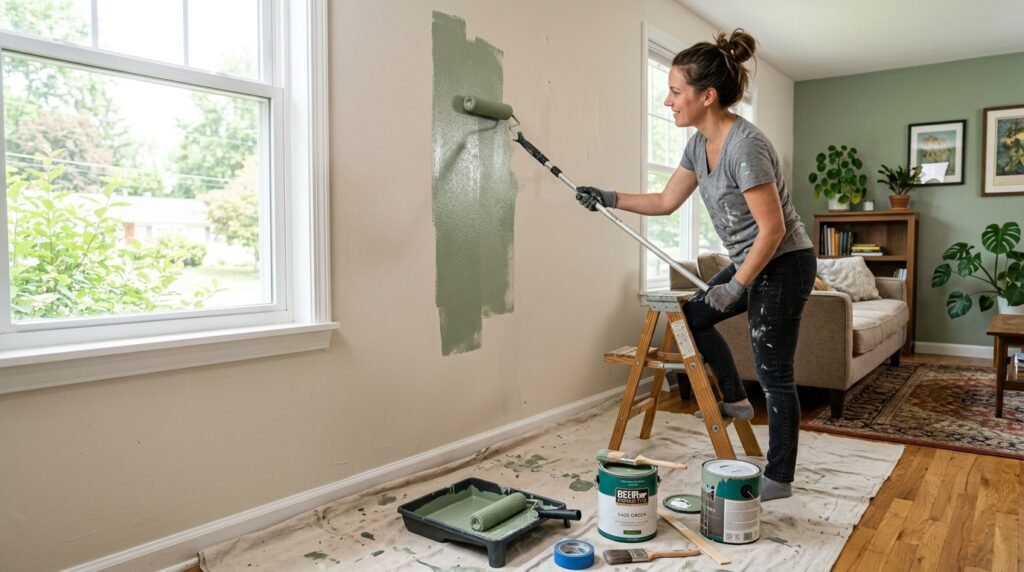
DIY painter rolling sage-green paint onto a living room wall

Free Paint Calculator Guide: How Much Paint Do You Actually Need?

There are two ways a painting project goes wrong on the paint-buying side: you guess low and end up making a second trip to the store mid-coat with wet paint drying unevenly while you wait in line, or you guess high and end up with three half-full cans taking up shelf space for the next five years. Neither is fun, and both come from the same root cause, skipping the math.

A paint calculator fixes that. This guide walks through the exact formula professionals use, real coverage rates by paint type, and worked examples for actual room sizes, so you can buy exactly what you need the first time. If you’d rather skip straight to plugging in numbers, our paint calculator does the math instantly.

Paint Calculator – Estimate Gallons, Cost & Coverage
Paint Calculator | Coverage, Cost & Drying Time

🎨 Paint Calculator – Estimate Gallons, Cost & Coverage

Coverage, costs, and drying times for all painting projects

Paint Calculator Pro
Paint Coverage & Standards
📐 Wall Paint Formula
Wall Area = (2 × Length + 2 × Width) × Height
Subtract: Doors (21 sq ft each), Windows (15 sq ft each)
📋 Standard Surface Areas
Door: 21 sq ft (standard 3×7')
Window: 15 sq ft (average)
Cabinet Door: 10-20 sq ft per door
Trim/Baseboard: ~1 sq ft per linear foot
Fence Panel: 32-48 sq ft per panel
Paint Type Coverage (sq ft/gal) Best Use
Latex 350-400 Interior walls
Oil-Based 300-350 Trim, cabinets
Enamel 250-350 Doors, surfaces
Epoxy 200-300 Special surfaces

© 2026 Paint Calculator Pro | For reference only | Always follow manufacturer guidelines

The Paint Calculator Formula, Explained

Every paint calculator, whether it’s a free online tool or a big-box retailer’s app, runs on the same basic math:

Total Paintable Area ÷ Coverage per Gallon × Number of Coats = Paint Needed

That’s genuinely it. The complexity people run into isn’t the formula itself, it’s getting the three inputs right: how much surface you’re actually painting, how far your specific paint spreads, and how many coats the job realistically needs.

Paint Coverage Rates: How Far Does a Gallon Really Go?

Paint Coverage Rates: How Far Does a Gallon Really Go?

Standard coverage metrics per container size and wall surface type.

Product
Typical Coverage per Gallon
Standard interior latex paint
350 to 400 sq ft
Primer
200 to 300 sq ft
Quart of paint
About 100 sq ft
Textured or porous surfaces
Reduce coverage by roughly 20%
US vs UK Paint Standards for Homes

US vs. UK Home Paint Standards & Terminology

Comparing container sizes, coverage rates, and finish names across US and UK paint markets.

Category
US Standard
UK Standard
Standard Can Sizes
Gallon (3.78 L) & Quart (0.95 L)
2.5 Liters, 5 Liters & 10 Liters
Coverage Rate
350–400 sq ft per US Gallon
10–13 m² per Liter (~400–520 sq ft per 3.78 L)
No-Gloss Wall Paint
Flat / Matte Latex Paint
Matt Emulsion Paint
Low-Sheen Wall Paint
Eggshell or Satin
Silk or Soft Sheen Emulsion
Trim & Door Paint
Semi-Gloss or Gloss Alkyd/Latex
Satinwood, Eggshell, or Full Gloss
International Paint Standards Guide
🌍

International Paint Standards Guide

Global frameworks for test methods, performance criteria, surface prep, and environmental safety.

Key International Standards Organizations
Organization
Region / Focus
Key Areas Covered
ISO
Global standard setter
ISO 12944 (Corrosion), ISO 4628 (Defects), ISO 2813 (Gloss)
ASTM International
US / Worldwide adoption
ASTM D3359 (Adhesion), ASTM B117 (Salt spray), ASTM D522 (Flexibility)
EN (CEN)
European Union
EN 13300 (Interior wall paint), EN 1062 (Exterior masonry)
NACE / AMPP
Global corrosion focus
Joint standards with ISO for protective coatings and surface preparation
1. Architectural & Interior Standards (BS EN 13300)
Classifies water-borne interior paints based on performance metrics rather than chemical composition:
  • Wet Scrub Resistance: Class 1 (< 5 µm loss @ 200 scrubs) to Class 5 (≥ 40 µm loss @ 40 scrubs).
  • Opacity (Hiding Power): Class 1 (≥ 99.5% coverage at specified yield) down to Class 4.
  • Gloss Levels: Gloss (> 60 @ 60°), Mid-Gloss (Satin/Semi-Gloss), Matt (< 10 @ 85°), and Dead Matt (< 5 @ 85°).
2. ISO 12944 Atmospheric Corrosivity Categories
Category
Environment Risk
Typical Real-World Examples
C1
Very Low
Heated indoor spaces (offices, schools)
C2
Low
Low pollution rural areas; unheated buildings
C3
Medium
Urban/industrial areas; low salinity coastal zones
C4
High
Industrial coastal areas with moderate salinity
C5
Very High
High humidity industrial zones; severe coastal & offshore
CX
Extreme
Offshore wind farms, extreme marine & chemical plants
3. Surface Preparation Standards Equivalents
Condition / Finish
ISO Standard (ISO 8501-1)
US Equivalent (SSPC / NACE)
Light Blast Cleaning
Sa 1
SSPC-SP 7 / NACE No. 4
Thorough Blast Cleaning
Sa 2
SSPC-SP 6 / NACE No. 3
Very Thorough Blast
Sa 2.5
SSPC-SP 10 / NACE No. 2 (Near-White)
Visually Clean Steel
Sa 3
SSPC-SP 5 / NACE No. 1 (White Metal)
4. Quality & Performance Testing Protocols
Cross-Cut Adhesion Test (ISO 2409 / ASTM D3359): Evaluates paint adhesion to the substrate via lattice grid cuts and tape pull.
Salt Spray Resistance (ISO 9227 / ASTM B117): Tests long-term anti-corrosion properties in salt-fog chambers.
Impact Resistance (ISO 6272 / ASTM D2794): Checks film flexibility and cracking resistance under rapid deformation.
Dry Film Thickness (ISO 2808 / SSPC-PA 2): Defines magnetic/electromagnetic procedures for DFT measurement.
5. Environmental & Safety Regulations
EU Directive 2004/42/CE: Sets strict VOC limits on decorative paints (e.g., interior matte capped at 30 g/L).
LEED & Green Seal (GS-11): Global green building standards requiring low-emission, non-toxic formulations.
REACH Regulation (EC 1907/2006): Restricts hazardous chemicals across international manufacturing supply chains.
Room floor plan sketch with measuring tape and paint swatches for calculating paint needed

How to Calculate Wall Area, Step by Step

  •       Measure the perimeter of the room (add up the length of all four walls)
  •       Multiply the perimeter by the ceiling height to get total wall area
  •       Measure each door and window, then subtract that area from your total
  •       Standard deduction estimates: about 20 sq ft per door, about 15 sq ft per window

If you’d rather not eyeball door and window sizes, our door size calculator and window size calculator give you exact standard dimensions to subtract, which matters more than you’d think on a room with several windows.

Worked Example: A 12×12 Room

Here’s how much paint you need for a 12×12 room with 8-foot ceilings, one standard door, and one window:

  •       Perimeter: (12 + 12 + 12 + 12) = 48 feet
  •       Wall area: 48 × 8 = 384 sq ft
  •       Subtract 1 door (20 sq ft) and 1 window (15 sq ft): 384 − 35 = 349 sq ft
  •       At 350 sq ft per gallon coverage, that’s almost exactly 1 gallon per coat
  •       For 2 coats (the standard recommendation), plan for roughly 2 gallons
More Real-World Paint Calculator Examples

More Real-World Paint Calculator Examples

Estimated paint quantities for common room dimensions, open layouts, and full-home estimates.

Scenario
Estimated Paint Needed
10×10 room, 1 coat, 8-ft ceilings
About 1 gallon (roughly 285 sq ft of net wall area after typical deductions)
12×12 room, 2 coats
About 2 gallons
Living room + hallway combined
2 to 2.5 gallons for 2 coats (roughly 500-600 sq ft of wall)
2,000 sq ft house (interior walls only, 2 coats)
Roughly 12 to 15 gallons (varies with ceiling height, floor plan, and layout openness)
Interior vs. Exterior Paint Calculations

Interior vs. Exterior Paint Calculations

The core formula stays the same outside, but a few things shift:

  •       Exterior siding, stucco, and brick are more textured than interior drywall, so budget for that same 15-20% reduction in coverage
  •       Exterior projects almost always need 2 coats for proper weather protection, even over a color you’re not changing
  •       Masonry and metal surfaces often need a specific primer type rather than a general-purpose one
  •       Wind, temperature, and humidity affect drying time and how evenly paint applies, which indirectly affects how much you’ll actually use

If you’re repainting siding as part of a bigger exterior refresh, our home renovation guide is a useful starting point for sequencing the whole project.

Ceilings and Trim: What&apos;s Different Ceiling Paint

Ceilings and Trim: What’s Different

Ceiling Paint

Calculate ceiling area as room length × width, not perimeter × height like walls. Ceilings usually only need 1 coat unless you’re covering a stain or making a major color change, and flat ceiling paint has slightly different coverage characteristics than wall paint, so check the can rather than assuming it matches your wall paint’s spread rate.

Trim, Doors, and Window Frames

Trim paint covers a much smaller area but often needs more coats for a smooth, durable finish, typically 2 to 3. Since trim area is small, most people buy a quart rather than a full gallon. Our rough opening calculator can help if you’re also planning any door or window framing work alongside the paint job.

Primer when you need it

Primer: When You Actually Need It

Primer isn’t always required, but skipping it in the wrong situation means uneven color, poor adhesion, or stains bleeding through your new paint.

  •       Going from a dark wall color to a light one: prime first, almost without exception
  •       Painting bare drywall, wood, or a patched repair area: prime first
  •       Covering water stains, smoke damage, or crayon marks: use a stain-blocking primer
  •       Repainting the same or a similar color over a sound existing coat: primer is usually optional

Since primer covers less per gallon than paint (200 to 300 sq ft), run it through the same formula separately rather than assuming your paint calculation covers both.

Paint Calculator by Unit Metric VS Imperial
Paint Calculator by Unit: Metric vs. Imperial

Paint Calculator by Unit: Metric vs. Imperial

If you're working in square meters and liters instead of square feet and gallons, the formula doesn't change, only the units do.

Measurement
Conversion
1 square meter
≈ 10.76 square feet
1 US gallon
≈ 3.785 liters
Typical paint coverage
≈ 32 to 37 square meters per gallon, or roughly 10–12 square meters per liter
Paint Calculator – Estimate Gallons, Cost & Coverage

Comparing Big-Brand Paint Calculators

Nearly every major paint brand offers its own free calculator, and while they all use the same underlying formula, the extra features differ:

  •       Sherwin-Williams: offers Quick, Custom, and Deck calculation modes, with wastage factored in automatically
  •       Behr: covers interior, exterior, and stain projects in one tool, sold exclusively through Home Depot
  •       Lowe’s: includes a rough man-hours estimate alongside gallons, useful if you’re budgeting your own time
  •       Dulux: the go-to for UK and Australian shoppers, calculating in square meters and liters by default
  •       Benjamin Moore and PPG: geared more toward room-by-room and professional-scale planning, respectively

Coverage assumptions vary slightly between brands, so if you’re comparing paint prices across brands, run the same room dimensions through two or three calculators rather than trusting just one number.

Paint Calculator – Estimate Gallons, Cost & Coverage

Paint Cost Estimator: Budgeting the Whole Project

Once you know how many gallons you need, the cost math is simple: gallons needed × price per gallon, plus supplies. But a full project budget includes more than the paint itself:

  •       Primer, if your walls need it
  • Brushes, rollers, and trays, see our paint brushes and rollers guide for picking the right tools for your surface
  •       Painter’s tape, drop cloths, and patching compound
  •       Labor, if hiring a professional rather than doing it yourself

DIY painting typically costs a fraction of a professional job, since labor is usually the largest line item on a professional quote, not the paint itself. Get at least two quotes if you’re hiring out, since labor pricing varies a lot by region and project complexity.

Common Mistakes That Throw Off Your Paint Estimate
⚠️

Common Mistakes That Throw Off Your Paint Estimate

Forgetting to subtract doors and windows: This alone can overestimate a small room's paint need by 10% or more.
Assuming all paint covers the same area: Premium and economy paints often have meaningfully different coverage rates—always check the can.
Skipping the waste factor: Add 10% to your total for spills, touch-ups, and future patch-ups, rather than buying the exact calculated minimum.
Ignoring texture: Popcorn ceilings, stucco, and heavily textured walls all drink up more paint than the standard coverage rate assumes.
Mixing up quarts and gallons: A quart is a quarter of a gallon, which is easy to mix up when you're estimating quickly.
One More Thing While You&apos;ve Got the Ladder Out
One More Thing While You've Got the Ladder Out
🪜

One More Thing While You've Got the Ladder Out

If you're already climbing up to cut in ceiling lines or repaint trim near the ceiling, it's a good moment to test your smoke alarms too, since you're right there anyway. According to NFPA research, a working smoke alarm cuts your risk of dying in a home fire by roughly 60%, yet nearly three out of five home fire deaths still happen in homes with no working alarm.
If your home was built before 1978, it's also worth a quick check of the EPA's lead paint guidance before sanding or scraping old paint, since lead dust from older painted surfaces is a real health hazard that proper prep work avoids.
Paint Calculator – Estimate Gallons, Cost & Coverage
Health & Safety Guidelines: Falling Injury & Allergy Care
🩹

Health Safety, Falling injury , Allergy Guideline

Falls are a leading cause of injuries worldwide. Proper prevention, immediate safety assessment, and first-aid steps can prevent further damage.

A. Fall Prevention
Home & Workplace Hazard Control:
  • Keep pathways, hallways, and stairs clear of clutter, cords, and loose rugs.
  • Ensure adequate lighting in stairwells, hallways, and entrances.
  • Install non-slip mats in bathrooms and showers.
  • Use handrails on stairs and grab bars in wet areas.
Personal Safety Measures:
  • Wear supportive, non-skid footwear; avoid walking indoors in slick socks.
  • Get regular vision and balance checks (especially for older adults).
  • Review medications with a physician if they cause dizziness or drowsiness.
B. Immediate Response After a Fall
If You Fall — Pause and Stay Calm: Do not try to stand up immediately. Assess your body for pain or numbness.
Roll and Lift: If uninjured, slowly roll onto your side, crawl to a sturdy piece of furniture (like a chair), place your hands on it, and slowly lift yourself up.
Call for Help: If you feel severe pain, cannot move, or suspect a head/neck injury, remain where you are and call for emergency assistance or attract attention.
If Assisting Someone Else: Do NOT move them if you suspect a head, neck, or spinal injury, or if there is obvious bone deformity. Check responsiveness and keep them warm with a blanket while waiting for medical help.
C. When to Seek Immediate Emergency Care
Call emergency services (e.g., 911 or your local emergency number) right away if the fallen person has:
  • Loss of consciousness, even for a few seconds.
  • Confusion, memory loss, vomiting, or severe headache (signs of concussion/traumatic brain injury).
  • Inability to move a limb or severe pain when pressing on a joint/bone.
  • Bleeding that does not stop with direct pressure.
  • Numbness, tingling, or weakness in the arms or legs.
🚨

2. Allergy Guidelines

Allergies occur when the immune system overreacts to a foreign substance (allergen). Reactions range from mild irritation to life-threatening emergencies.

A. Common Allergy Triggers
Airborne (Respiratory): Pollen, dust mites, pet dander, mold spores.
Foods: Peanuts, tree nuts, shellfish, fish, milk, eggs, wheat, soy.
Insect Stings: Bees, wasps, hornets, yellow jackets, fire ants.
Medications: Penicillin and related antibiotics, NSAIDs (e.g., ibuprofen, aspirin).
Contact: Latex, nickel, specific dyes, cosmetics, poison ivy.
B. Recognizing Reaction Severity
Type
Symptoms
Common Causes
Standard Action
Mild to Moderate
Sneezing, runny nose, itchy/watery eyes, localized skin rash/hives, mild swelling.
Pollen, dust, minor food exposure, local insect bite.
Over-the-counter antihistamines, nasal sprays, cold compresses. Remove allergen source.
Severe (Anaphylaxis)
Difficulty breathing, tightness in throat/chest, swelling of lip/tongue/face, dizziness, weak pulse, sudden drop in blood pressure.
Foods (nuts/seafood), insect stings, medications, latex.
Emergency! Use an epinephrine auto-injector (EpiPen) immediately and call emergency services.
C. Anaphylaxis Emergency Action Plan
Anaphylaxis is a medical emergency that can progress rapidly. Follow these steps immediately:
  1. Administer Epinephrine: Inject the epinephrine auto-injector into the outer thigh (can be administered through clothing if necessary). Note the time.
  2. Call Emergency Services: State clearly that someone is experiencing an anaphylactic emergency.
  3. Position the Person: Lay them flat on their back with their legs elevated. If they are vomiting or having trouble breathing, allow them to sit up or lay on their side (recovery position).
  4. Do Not Wait: Even if symptoms improve after the epinephrine injection, the person MUST go to an emergency room because a second wave of symptoms (biphasic reaction) can occur hours later.
  5. Second Dose: If emergency help has not arrived and symptoms persist or return after 5–15 minutes, administer a second epinephrine dose if available.
D. General Allergy Prevention Guidelines
Know Your Triggers: Obtain a professional diagnosis via skin-prick testing or specific IgE blood tests from an allergist.
Carry Emergency Medication: If prescribed an epinephrine auto-injector, keep two unexpired units with you at all times.
Read Labels Carefully: Check food and cosmetics ingredients thoroughly.
Medical Identification: Wear a medical alert bracelet listing your severe allergies.
⚠️ Disclaimer: This guide provides general educational information and is not a substitute for professional medical advice, diagnosis, or treatment. Always consult a qualified physician or healthcare provider regarding specific medical conditions or emergencies.
Frequently Asked Questions - Paint Calculator Guide

Frequently Asked Questions

Common scenarios, formulas, and estimates for your interior and exterior paint projects
For a 12x12 room with 8-foot ceilings, one standard door, and one window, expect around 349 square feet of net wall area. This works out to roughly 1 gallon per coat, or about 2 gallons for a standard 2-coat job.
Measure each door and window directly if you can, or use standard estimates of about 20 square feet per door and 15 square feet per window. Subtract that total from your gross wall area before dividing by coverage per gallon.
Roughly 12 to 15 gallons for interior walls with 2 coats. This varies significantly based on ceiling height and floor plan openness, since total floor area doesn't translate directly to wall area.
Use the standard formula (total exterior wall area divided by coverage per gallon, times number of coats), but reduce your coverage estimate by 15% to 20% for textured siding, stucco, or brick. Plan for 2 coats as the standard for weather protection.
After typical door and window deductions, a 10x10 room with 8-foot ceilings has roughly 285 square feet of net wall area, which fits comfortably within a single gallon for one coat.
Yes, but reduce the standard coverage rate by about 20% before dividing, as textured and porous surfaces absorb noticeably more paint than smooth drywall.
Total cost depends on gallons needed times price per gallon, plus primer, supplies, and professional labor if hiring out. DIY projects typically cost a fraction of professional jobs since labor is usually the largest expense on a contractor's quote.
Use the same formula as paint, but divide by primer's lower coverage rate of 200 to 300 square feet per gallon instead of the 350 to 400 square feet typical of finish paint.
Two coats is the standard recommendation for even color and durability, especially for any noticeable color change. A single coat can work for a same-color touch-up or refresh over an existing coat in good condition.
For a combined wall area of roughly 500 to 600 square feet, plan for about 2 to 2.5 gallons for a standard 2-coat job, though exact figures depend on ceiling height and connecting doorways.
Calculate ceiling area as length × width and expect 1 coat in most cases. Trim typically needs 2 to 3 coats for a smooth finish, but since total trim area is small, a quart is usually enough rather than a full gallon.
Yes, just calculate each room separately. Different colors require separate cans, so you'll want an accurate gallon count for each color rather than one combined total.
Multiply gallons by 3.785 to get liters, or divide square feet by 10.76 to convert to square meters first if working entirely in metric units.
Most professionals add about 10% on top of the calculated minimum to cover spills, touch-ups, and future patch repairs, rather than buying the exact bare minimum amount.
They can, slightly, since each brand's calculator uses its own product's specific coverage assumptions. Running the same measurements through two or three calculators is a reasonable way to sanity-check your estimate before buying.

The Bottom Line

The paint calculator formula is genuinely simple—the accuracy comes from measuring carefully, accounting for doors and windows, and being honest about your surface texture and number of coats. Get those three things right and you'll walk into the store once, buy exactly what you need, and never end up with three half-empty cans cluttering the garage.
Run your own numbers through our paint calculator, and if you're planning a bigger project, explore our home renovation guide and paint brushes and rollers guide as ideal next stops.
Scroll to Top