
Window Size Guide: Standard Dimensions, How to Measure & Choosing the Right Fit
Ordering the wrong window size is one of those mistakes that’s expensive in every direction — too small, and you’re stuck with gaps and drafts. Too big, and the window simply won’t fit the opening you’ve got. Either way, you’re paying for a mistake twice: once for the wrong window, and again for the right one.
This window size guide walks through everything you actually need to know — standard window sizes, how the confusing size codes work, what’s typical by room, and how to measure correctly the first time. Whether you’re replacing one window or planning a full renovation, this is the reference to bookmark.

Why Getting Window Size Right Matters More Than You Think
A window opening isn’t just a hole in the wall — it’s built to very specific rough opening dimensions that account for the frame, insulation gap, and flashing. Order a window even slightly off from that rough opening, and you’re looking at custom trim work, shimming, or in worse cases, cutting into the wall structure to make it fit.
This is exactly why a solid window size chart and a little upfront measuring saves so much money and frustration. Our window size calculator is built for exactly this — plug in your opening and get a clear read on what standard sizes will actually work before you order anything.

How to Measure a Window for Replacement
[Image Prompt: Person using a tape measure to measure window width and height from inside a home, photorealistic, natural daylight, close-up on tape measure]
How to measure window size correctly comes down to three measurements, taken from inside the home:
- Width — measure jamb to jamb (the inside vertical frame pieces) at the top, middle, and bottom of the window. Use the smallest of the three measurements.
- Height — measure from the head jamb (top) to the sill (bottom) on the left, center, and right sides. Again, use the smallest measurement.
- Depth — measure from the interior trim to the exterior trim, which matters for choosing the right replacement window style.
Window sizes are almost always written as width x height, so a window labeled 3050 is 3 feet wide by 5 feet tall — more on that size code system below. If your window sits in a rough opening that’s already framed, our rough opening calculator and window and door sills guide both help confirm you’re measuring the right reference points before you order.

Standard Window Sizes Chart & Notation Codes
📐 Understanding 4-Digit Size Codes: Window dimensions use a 4-digit notation representing feet and inches. Each pair of digits corresponds to width and height respectively. For example, code 2030 translates to 2 feet 0 inches wide by 3 feet 0 inches tall (24" x 36").
🔨 Rough Openings vs. Unit Size: Standard residential windows generally cluster between 24–48 inches in width and 36–72 inches in height. When framing, the rough opening typically measures 1/2 inch larger on all sides than the nominal window size to accommodate shimming, squaring, and insulation during installation.

Window Sizes by Type
Different window styles come with their own typical size ranges, since the way they open changes what’s structurally practical:
- Double hung and single hung window sizes — commonly range from 24″x36″ up to 48″x72″, and remain the most common residential window style in the US.
- Casement window sizes — typically narrower, from 14″–36″ wide, since the whole sash swings outward on hinges.
- Sliding window sizes (horizontal slider) — often wider than tall, ranging from 36″x24″ up to 84″x60″ or more, ideal for wide wall openings.
- Picture window sizes — vary enormously since these are fixed and non-operable, but 36″x48″ up to 96″x72″ is common for larger picture windows.
- Awning window sizes — usually smaller, 24″–48″ wide, hinged at the top and opening outward from the bottom.
- Bay and bow window sizes — these are actually combinations of three or more windows, so overall dimensions depend on the individual units combined; a typical bay window might span 6–10 feet total width.
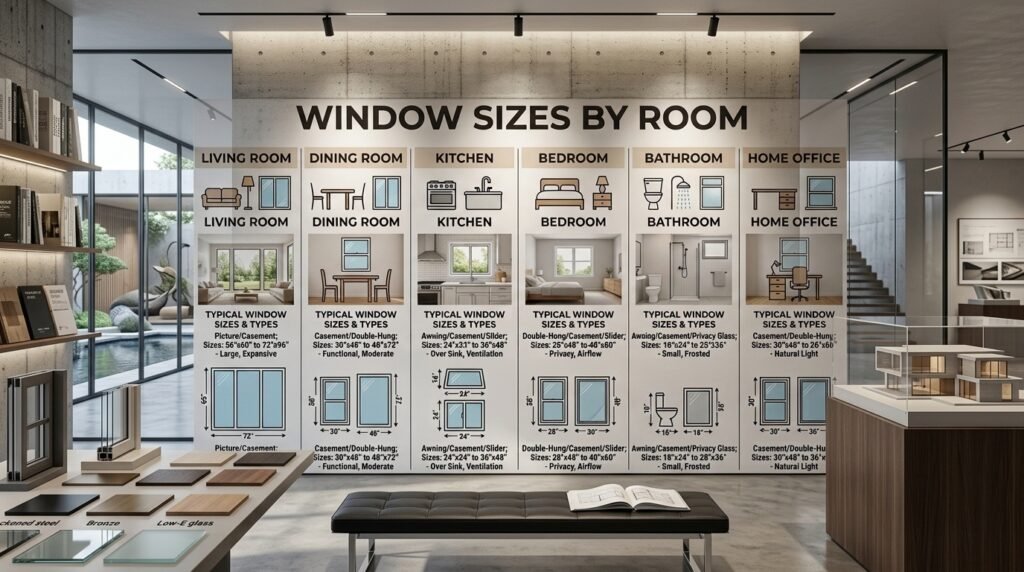
Window Sizes by Room
Window size by room follows some fairly predictable patterns, driven by both typical furniture layout and, in some rooms, building code:
- Bedroom window size: What is the standard window size for a bedroom? Commonly 3050 or 3060 (36″x60″ or 36″x72″), though the real requirement in most jurisdictions isn’t a specific size — it’s meeting egress window size requirements, covered in detail below.
- Kitchen window size: A standard kitchen window size above the sink often runs smaller and wider, like 3624 or 4830, to fit above counter height without interfering with cabinets.
- Living room window size: What size window do I need for my living room? Larger picture or combination windows, often 4-6 feet wide, are common here to maximize natural light.
- Bathroom window size: Typically smaller for privacy, often 24″x36″ or a frosted/obscured glass awning window.
- Basement window size: Smaller units unless a bedroom or habitable space is present, in which case egress rules apply the same as any bedroom.
If you’re planning window placement alongside other renovation work, our ceiling height calculator and basement size calculator help make sure window height works proportionally with the rest of the room.
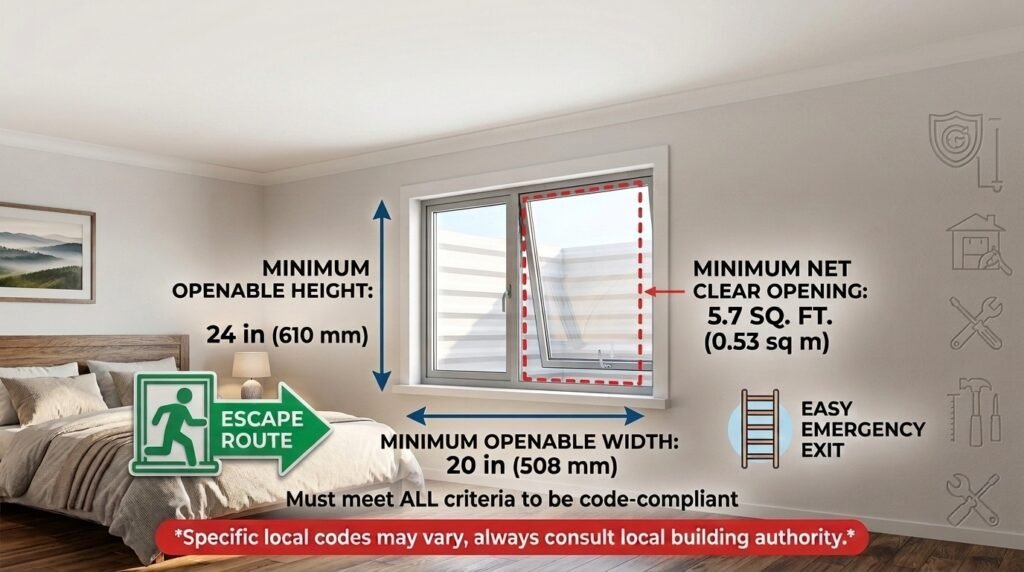
Egress Window Requirements: The Size Rule You Can’t Skip
This is the one window sizing rule that isn’t just a suggestion — it’s a fire safety requirement in most of the US, and it’s exactly the kind of thing worth double-checking during any bedroom renovation. According to the International Residential Code (Section R310), every bedroom (and any habitable basement space) needs at least one egress compliant window that meets specific minimums:
- A net clear opening of at least 5.7 square feet
- A minimum clear opening width of 20 inches
- A minimum clear opening height of 24 inches
- A sill height no more than 44 inches above the finished floor
A government building safety summary of the 2018 IRC breaks these requirements down clearly if you want the full official language. The reasoning is straightforward: in a fire or emergency, an egress window may be the only way out of a bedroom — and it needs to be large enough for both an occupant to escape and a firefighter in full gear to climb in if needed.
This is also a good moment to think about home fire safety more broadly, not just the exit route. Working smoke alarms cut the risk of dying in a home fire by roughly 60%, according to National Fire Protection Association research — meaning the egress window and a functioning smoke alarm work together as two halves of the same safety plan. If it’s been a while since you checked yours, our smoke detector calculator tells you exactly how many you need and where, which pairs naturally with any bedroom window project.

Choosing the Right Window Material
Material affects durability, insulation, and maintenance more than most people expect:
- Vinyl — affordable, low-maintenance, and a strong energy performer, making it the most common residential choice.
- Wood — classic look and good natural insulation, but requires more upkeep to prevent rot and warping.
- Aluminum — strong and slim-profile, though it conducts heat and cold more than other materials unless thermally broken.
- Fiberglass and composite (uPVC) — durable and dimensionally stable across temperature swings, often at a higher price point than vinyl.

Energy Efficiency Features Worth Knowing
Not all windows perform the same way once installed, even at the same size:
- Low-E glass has a microscopically thin coating that reduces heat transfer without noticeably darkening the glass.
- Double pane and triple pane windows trap insulating air (or gas) between layers of glass, cutting heat loss significantly compared to single pane.
- Argon filled windows replace the air between panes with argon gas, which insulates better than plain air.
- Tempered glass is required in many egress and low-sill applications, since it breaks into small, less dangerous pieces rather than sharp shards.
ENERGY STAR’s residential window program certifies windows based on NFRC-rated U-factor and solar heat gain, varying by climate zone — worth checking before buying if lowering energy bills is a priority alongside getting the size right.

Replacement vs. New Construction Installation
Replacement window sizes and new construction windows aren’t installed the same way, and it affects what fits:
- Insert (pocket) replacement fits inside your existing frame, which is simpler but slightly reduces the visible glass area.
- Full frame replacement removes the entire old frame down to the rough opening, giving more flexibility on size but requiring more labor.
- New construction windows have a nailing fin designed to be installed before siding goes on, common in new builds or major renovations.
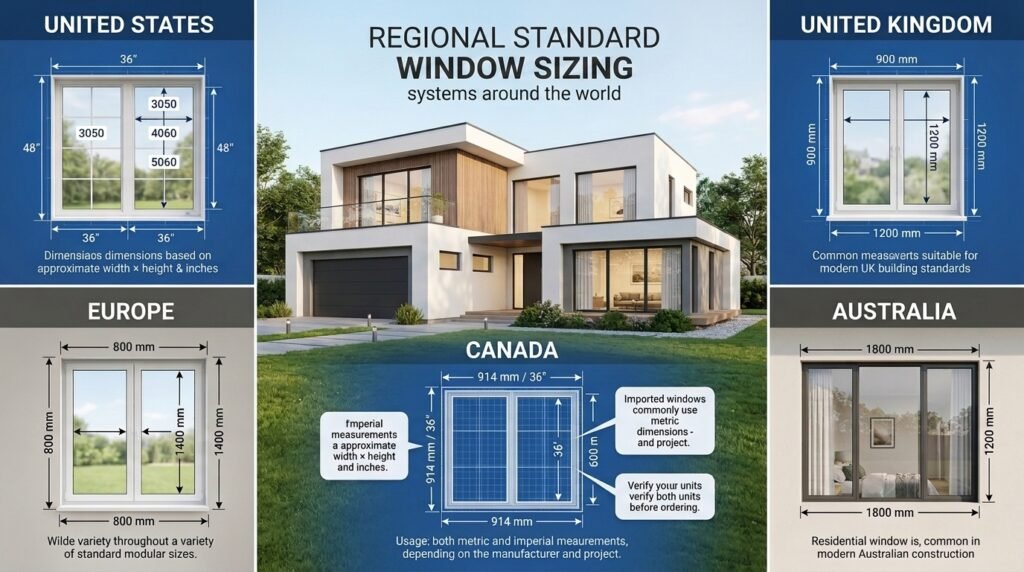
Regional window sizing
Standard window sizes shift somewhat by region. UK window sizes and European window sizes are typically measured in millimeters rather than the imperial 4-digit code common in standard window sizes US markets, and Canadian window sizes often follow metric conventions similar to Europe despite proximity to the US. Australian window sizes also lean metric. If you’re sourcing windows internationally or working with imported units, always confirm whether dimensions are metric or imperial before ordering.

New Window Cost Considerations
How much does it cost to replace a standard window depends heavily on size, material, and installation type, but stock sizes in standard materials like vinyl are consistently the most budget-friendly option. The cost difference between standard and custom windows can be substantial — custom sizing requires individual fabrication rather than pulling from existing manufacturing runs, so sticking with a stock size whenever your rough opening allows is the simplest way to control cost. If you’re budgeting for a larger renovation that includes windows, our construction loans guide and home renovation resources are worth a look for financing the bigger picture.
FAQ: Window Sizes And Measuring
Essential guidance on standard dimensions, rough openings, notation codes, and egress safety rules
Final Thoughts
Getting window size right isn’t about memorizing every code and chart — it’s about measuring carefully, understanding the size code system, and knowing when a rule (like egress) isn’t optional. Whether you’re replacing one drafty window or planning sizes for a full renovation, a few careful measurements upfront save real money and real headaches later.
Start with the room that needs it most, measure twice, and use the chart above as your reference point before you order. Getting it right the first time really is that much simpler than fixing it after the fact.