Standard Door Handle Size Backset – 60mm Or 70mm In US-UK
You measure twice, drill once — and then the new door handle just… doesn’t fit. Sound familiar?
Here’s the honest truth: door handle sizing trips up more DIYers than almost any other home hardware project. The backset, the spindle, the hole size — none of it is obvious until you’ve been burned once. And once you have, you never forget the phrase “60mm or 70mm backset” again.
This guide walks you through everything: standard door handle sizes across the US and UK, how backsets actually work, the tools you need, and how to install or replace a handle without any guesswork. By the end, you’ll know exactly what to measure before you buy anything.

What Is a Door Handle Backset, Really?
The backset is simply the distance from the edge of the door to the center of the handle or knob. It sounds small, but get this number wrong and your new hardware won’t line up with the existing hole — full stop.
In the US, the standard door hardware backset is almost always 2⅜ inches (60mm) or 2¾ inches (70mm). In the UK and much of Europe, door handle measurements are metric by default, so you’ll typically see 60mm as the standard backset, occasionally stepping up to 70mm on older or heavier doors.
Before buying replacement hardware, always check your door handle sizes against the old set — most passage and privacy handles are interchangeable across brands only if the backset and hole size match.

US vs. UK Door Handle Standards
Key Differences & Planning Considerations:
- The US relies heavily on cylindrical bored locksets (circular hole style). The UK and Europe favor mortice locks embedded directly into the structural door edge, altering installation methods.
- A 60mm backset is the near-universal default in the UK; 70mm is typically reserved for historic or heavy custom doors.
- US mounting height standards sit lower than UK accessibility guidelines, which target 1000mm+ to simplify physical reach-ability targets.

Standard Door Handle Size And Hole Measurements
Here’s where things get specific. Beyond the backset, three more measurements decide whether a handle actually fits your door.
- Cross bore (main hole): Standard door knobs and levers use a 2⅛ inch (54mm) hole.
- Latch hole (edge bore): Almost always 1 inch (25mm) in diameter.
- Door knob diameter: Typically between 2 to 2¼ inches for round knobs.
- Spindle size: Most modern handles use a 8mm square spindle, though older UK doors sometimes use a 7mm or 6mm spindle.
If you’re not sure what size hole saw for a door handle you need, a standard 2 1⁄8 inch hole saw covers the vast majority of interior and exterior doors sold in the US today.
For a full picture of how backset, hole size, and door thickness work together, it helps to cross-check against your actual door dimensions using a door size calculator before you commit to buying hardware.

Door Handle Height: Where Should It Actually Sit?
There isn’t one “official” law dictating door handle height, but industry convention puts it between 36 to 38 inches (roughly 900-965mm) from the floor. This range comes from ergonomic testing — it sits comfortably at wrist height for most adults.
If you’re planning accessible or ADA-compliant hardware, though, the requirements get more specific. It’s worth reviewing the ADA design standards for door hardware if you’re outfitting a commercial space, rental unit, or home designed for aging in place.
Types Of Door Handles (And When To Use Each)
Not every door needs the same hardware. Here’s a breakdown by function:
Passage Door Handles
No lock, no key — just a simple latch. Used for hallways, closets, and interior rooms where privacy isn’t a concern.
Privacy Door Handles
These have a small push or twist lock, ideal for bathrooms and bedrooms. In an emergency, they can usually be opened from outside with a thin tool.
Keyed Entry Door Handles
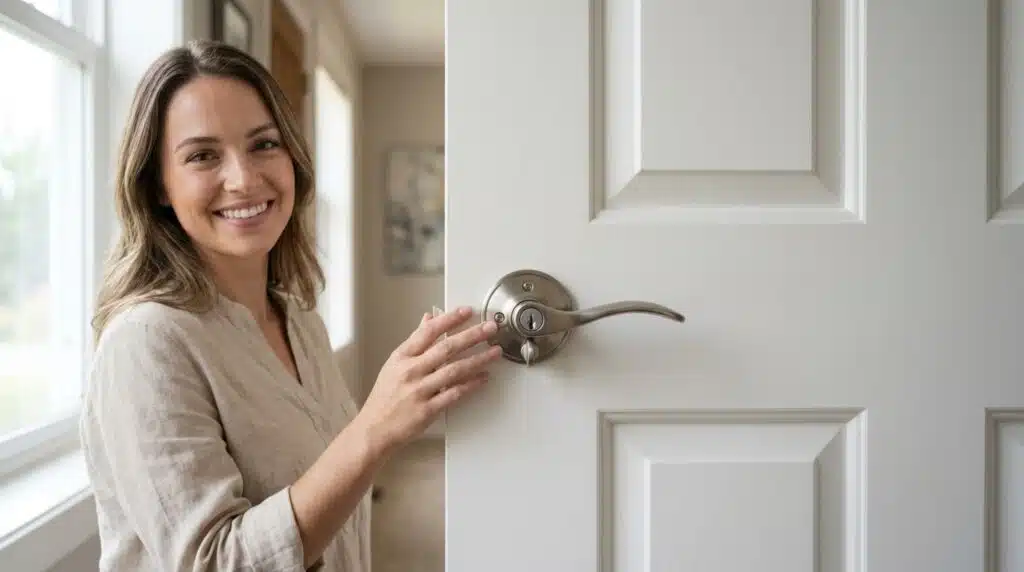
Built for exterior doors, front entryways, and any space that needs real security. These pair a locking mechanism with a key cylinder.
Dummy Door Handles
Purely decorative — no latch, no lock. Commonly used on double doors where one side stays fixed, or on closet doors that don’t need to seal shut.
Pull Door Handles
Long, straight handles usually found on modern or minimalist front doors, and increasingly popular on sliding and barn doors too.
Sliding & Barn Door Handles
Flush-mounted or recessed designs made specifically for tracks, since a protruding knob would get in the way of the sliding motion. Cast iron barn door handles have become especially popular with the modern farmhouse look.

Materials And Finishes: Function Meets Style
Choosing a finish isn’t just about looks — some materials hold up better in certain rooms.
- Stainless steel door handles — rust-resistant, ideal for exterior doors and coastal homes.
- Polished brass door handles — a warm, traditional look that pairs beautifully with Victorian or 1920s-style interiors.
- Bronze door handles — a darker, richer tone that suits rustic and farmhouse aesthetics.
- Chrome door handles — bright, reflective, and a strong match for contemporary spaces.
- Black steel door handles — currently one of the biggest door hardware trends, working well with both modern and industrial styles.
- Wrought iron door handles — heavy, ornate, and a natural fit for cottage or old-world design.
If you’re refreshing hardware room by room, it’s smart to plan finishes alongside other fittings — check out this shelf brackets selector if you’re coordinating metal tones across a full renovation.
Finish aside, durability matters just as much. Door hardware sold in the US is typically rated under ANSI/BHMA grading standards, where Grade 1 is the toughest and most commonly used for exterior or heavy-traffic doors, and Grade 3 suits lighter interior use.

How To Install A Door Handle (Step-By-Step)
What you’ll need: a screwdriver, a tape measure, and the new handle set (spindle and screws typically included).
- Remove the old handle by unscrewing the rosette or escutcheon plate on each side of the door.
- Slide out the spindle and latch assembly, keeping track of the screws.
- Measure the backset and cross bore to confirm your new handle matches — this is the step most people skip, and it’s the one that causes the most frustration.
- Insert the new latch into the edge bore, then feed the spindle through the cross bore.
- Attach both handle sides, tightening the connecting screws evenly so neither side wobbles.
- Test the latch by closing the door gently and checking that it catches the strike plate cleanly.
If your door frame itself needs attention — squeaks, misalignment, or a strike plate that doesn’t quite catch — it’s worth checking your hinge calculator and rough opening calculator to rule out a frame issue before blaming the handle.

How To Fix A Loose Or Fallen Door Handle
A door handle that’s suddenly loose — or has fallen off completely — is almost always down to one thing: a loose set screw.
- Locate the small set screw, usually hidden under the handle’s neck or behind the rosette.
- Tighten it with a hex key or flathead screwdriver, depending on the brand (Kwikset door handle set screw sizes, for example, commonly use a 1/16 inch hex key).
- If tightening doesn’t help, the spindle itself may be worn or bent, in which case replacing the full handle set is usually more reliable than patching it.
For manufacturer-specific torque and screw specs, most major hardware brands publish detailed installation guides — Kwikset’s official handleset support page is a solid reference if you’re working with their sets specifically.

Left Hand Vs Right Hand Door Handles: How To Tell
This trips up a lot of first-time buyers. To check handedness, stand on the side of the door where it swings toward you (the side with visible hinges facing you):
- If the hinges are on your left, it’s a left-hand door.
- If the hinges are on your right, it’s a right-hand door.
Thankfully, most modern handle sets are reversible, meaning you can flip the internal mechanism to suit either orientation — always check the packaging before assuming.

A Quick Word On Home Safety While You’re At It
While you’ve got the toolbox out for door hardware, it’s worth a two-minute detour to check your home’s fire safety setup too. According to the National Fire Protection Association, homes with working smoke alarms cut their risk of dying in a fire by roughly 55%, while U.S. Fire Administration data shows an estimated 2,700+ home fire deaths occur annually in the US, the overwhelming majority in homes without a working alarm.
It genuinely takes minutes to check whether your coverage is adequate — this smoke detector calculator tells you exactly how many alarms your home needs and where. Pair that with a few basic precautions from this top safety tips guide, and you’ve covered two important home upgrades in a single afternoon.
If you’re also upgrading exterior door security while replacing handles, a slide locks selector is worth a look too — many homeowners pair new keyed entry handles with an added slide lock for extra peace of mind.
FAQs: Door Hardware Installation
Standard architectural guidelines for interior handle scaling, metrics, and configurations

Final Thoughts
Door handle sizing isn’t complicated once you know what to actually measure — backset, cross bore, and spindle size cover 90% of the confusion most people run into. Get those three numbers right, and swapping out old hardware for something that matches your style takes less than half an hour.
Whether you’re going for polished brass on a Victorian front door or matte black steel on a modern interior, the fit matters just as much as the finish. Measure first, buy second, and you’ll never have to make a second trip to the hardware store for the same door.