Brackets Selector & Load Capacity Calculator | 15+ Types & Sizes

🔧 Brackets Selector & Load Capacity Calculator

Find the right bracket • Calculate load capacity • 15+ types & applications

Bracket Selector & Load Capacity Calculator
Bracket Types, Sizes & Complete Guide
Bracket Type Common Sizes Load Capacity Best For Material Options
1️⃣ L-Brackets 1×1", 2×2", 3×3", 4×4", 6×6" 50-500 lbs (depends on size) Shelf support, furniture corners, wood framing Steel, stainless, aluminum
2️⃣ Shelf Brackets 6", 8", 10", 12", 16", 20" 100-300 lbs per pair Floating/mounted shelves, kitchen/garage storage Steel, aluminum, stainless
3️⃣ Heavy-Duty Brackets 8-24" length 100-1000+ lbs Industrial shelving, workshop, heavy cabinets Steel, cast iron, galvanized
4️⃣ Corner Brackets 1-2", 3-4", 6+" 50-500 lbs Strengthening joints, cabinets, frames Steel, stainless, aluminum
5️⃣ Floating Brackets 6", 8", 10", 12" 100-300 lbs (hidden support) Modern floating shelves, clean look Steel, stainless
6️⃣ T-Brackets 2-8" height 100-400 lbs Joint reinforcement, table legs, framing Steel, aluminum
7️⃣ U-Brackets 1-6" width 50-400 lbs Pipe support, beam support, handrails Steel, stainless, galvanized
8️⃣ Decorative Brackets 6-24" length 50-300 lbs Mantels, porches, countertops, visual appeal Wrought iron, cast iron, aluminum, brass
9️⃣ Cabinet Brackets 4-12" depth 100-400 lbs Wall cabinet mounting, counter support Steel, aluminum, galvanized
🔟 Joist Hangers 2×4, 2×6, 2×8, 2×10 1000+ lbs (structural) Deck/floor framing, roof support, structural Galvanized steel, stainless (exterior)
1️⃣1️⃣ TV Mount 14-75"+ TVs 50-200 lbs Wall-mounted TV, fixed/articulating Steel, aluminum
1️⃣2️⃣ Folding Brackets 8-20" length 100-300 lbs per pair Folding tables, wall desks, space-saving Steel, aluminum
1️⃣3️⃣ Pipe Brackets ½", ¾", 1", 2" diameter 50-400 lbs (diameter-dependent) Plumbing, curtain rods, industrial shelving Steel, galvanized, stainless
1️⃣4️⃣ Adjustable Brackets Variable lengths 50-300 lbs Adjustable shelving, modular furniture Steel, aluminum
1️⃣5️⃣ Specialty Brackets Glass, corner, stainless, various Varies by type Glass shelves, corners, specialty applications Multiple (specialty materials)
🔍 Quick Bracket Selection Guide
For Light Shelves (under 50 lbs): Standard shelf brackets, corner brackets, L-brackets
For Medium Shelves (50-300 lbs): Heavy-duty brackets, shelf brackets, corner brackets
For Heavy Storage (300+ lbs): Heavy-duty industrial brackets, joist hangers
For Floating Shelves: Floating shelf brackets (hidden support), smooth modern look
For Structural Work: Joist hangers, heavy-duty structural brackets, galvanized steel
For Wet/Outdoor: Galvanized steel, stainless steel (corrosion-resistant)
For Decorative: Decorative cast iron, wrought iron, brass, ornamental brackets
⚙️ Bracket Size Measurements
L-Brackets: Measured by leg length (1×1", 2×2", etc) and thickness (1/16" to 1/4")
Shelf Brackets: Measured by depth/length from wall (6", 8", 10", 12", 16", 20")
Joist Hangers: Named by lumber size (2×4, 2×6, 2×8, 2×10)
Pipe Brackets: Named by pipe diameter (½", ¾", 1", 2")
Decorative: Measured by total length (6", 8", 10", 12", 16", 20", 24")
Thickness Categories: Light (1-2mm), Medium (3-4mm), Heavy (5mm+)
Bracket Specifications & Load Capacity Guide
📊 Load Capacity Reference Table
Light-Duty Brackets (50-200 lbs per bracket): Small L-brackets, standard shelf brackets, corner brackets, basic mounting
Medium-Duty Brackets (200-500 lbs per bracket): Larger L-brackets, heavy-duty shelf brackets, folding brackets, cabinet brackets
Heavy-Duty Brackets (500-1000 lbs per bracket): Industrial shelving brackets, thick steel construction, professional grade
Structural/Joist (1000+ lbs): Joist hangers, structural steel, galvanized, building code rated
Bracket Type Typical Capacity (Per Bracket) For 2 Brackets Recommended Safety Factor Common Application Weight
L-Bracket 1×1" 50-100 lbs 100-200 lbs 3-4x recommended 25-50 lbs (safe)
L-Bracket 2×2" 100-200 lbs 200-400 lbs 3-4x recommended 50-100 lbs (safe)
Shelf Bracket 6" 50-100 lbs 100-200 lbs 3x recommended 30-60 lbs (safe)
Shelf Bracket 12" 100-150 lbs 200-300 lbs 3x recommended 60-100 lbs (safe)
Heavy-Duty 16" 300-500 lbs 600-1000 lbs 3-4x recommended 150-250 lbs (safe)
Joist Hanger 2×6 1000+ lbs 2000+ lbs Building code approved 500-1000 lbs (structural)
TV Mount Bracket 50-200 lbs (TV weight) 100-400 lbs (TV weight) 3x recommended 32-75" TV (50-80 lbs)
Folding Bracket Pair 100-150 lbs per bracket 200-300 lbs (table) 3-4x recommended 60-100 lbs (safe)
🛠️ Material Specifications & Properties
Steel: High strength-to-weight ratio, affordable, prone to rust (paint/galvanize to protect), most common choice
Stainless Steel: Corrosion-resistant (best for wet environments), higher cost, excellent durability, food-safe
Galvanized Steel: Zinc-coated steel, rust-resistant, durable, ideal for outdoor/structural use, code-approved
Aluminum: Lightweight, corrosion-resistant, moderate strength (not for heavy loads), good for portable applications
Cast Iron: Very strong, decorative appearance, heavy, brittle (prone to cracking), rustic/vintage look
Wrought Iron: Ornamental, strong, expensive, decorative priority, artisan-crafted options
Brass: Decorative, excellent electrical conductivity, soft (less strong), decorative/specialty use
Plastic: Very light-duty only (under 50 lbs), affordable, durability limited, decorative only
⚠️ Safety Factor Explanation
Safety Factor 2x: Absolute minimum, NOT recommended for any application (dangerous)
Safety Factor 3x: STANDARD RECOMMENDED for most applications (load capacity ÷ 3 = safe working load)
Safety Factor 4x: HIGH SAFETY for critical applications (residential shelves, furniture, home use)
Safety Factor 5x: MAXIMUM SAFETY for structural/building code (joist hangers, load-bearing, professional)
Example: Bracket rated 300 lbs ÷ 3x safety = 100 lbs safe working load (for human safety)
📏 Thickness & Strength Relationship
1/16" thick (1.6mm): Light-duty brackets (under 50 lbs), decorative, limited strength
1/8" thick (3.2mm): General purpose (50-200 lbs), most common residential brackets
3/16" thick (4.8mm): Heavy-duty (200-500 lbs), professional grade
1/4" thick (6.4mm): Very heavy-duty (500+ lbs), structural, building code approved
5/16"+ thick (8mm+): Extreme heavy-duty (1000+ lbs), industrial/structural only
🔧 Installation Best Practices
Fastener Type Matters: Use appropriate fasteners (lag bolts for studs, toggle bolts for drywall, anchors for concrete)
Number of Fasteners: Minimum 2 per bracket (for stability), more for heavy loads
Fastener Grade: Grade 8 bolts stronger than Grade 5, use appropriate for load
Spacing: For shelves, brackets typically 16" to 32" apart (depends on shelf material & load)
Level Installation: Critical for safety and appearance, use level tool
Stud Location: Always mount to studs or use heavy-duty anchors (never drywall alone for heavy loads)
Pre-Drilling: Prevents stripping, especially for wood fastening
📋 Bracket Selection Checklist
□ Total weight to support: Calculate accurately (items + shelf material)
□ Number of brackets: Determine spacing (typically 2-4 brackets)
□ Safety factor: Apply 3-4x for safety (not just rated capacity)
□ Mounting surface: Studs, drywall, concrete? (affects fastener choice)
□ Environment: Indoor, outdoor, wet? (affects material choice)
□ Aesthetic: Visible or hidden? (affects finish & material)
□ Building codes: Structural work requires inspection/approval
□ Installation: DIY or professional? (complex installations need expertise)

© 2026 Brackets Selector & Load Capacity Calculator | 15+ bracket types • load calculations • safety guidelines • installation specs

What Are the Different Types of Brackets?

Uses, Benefits & Complete Buying Guide

A Complete Guide to 15 Types of Brackets: Sizes, Load Capacity & Applications

Brackets are some of the most versatile yet underappreciated hardware items used in construction, furniture-making, and home improvement. When sized, rated, and installed correctly, the right bracket works invisibly, bearing weight and strengthening joints to create the reliable spaces and surfaces we use daily.

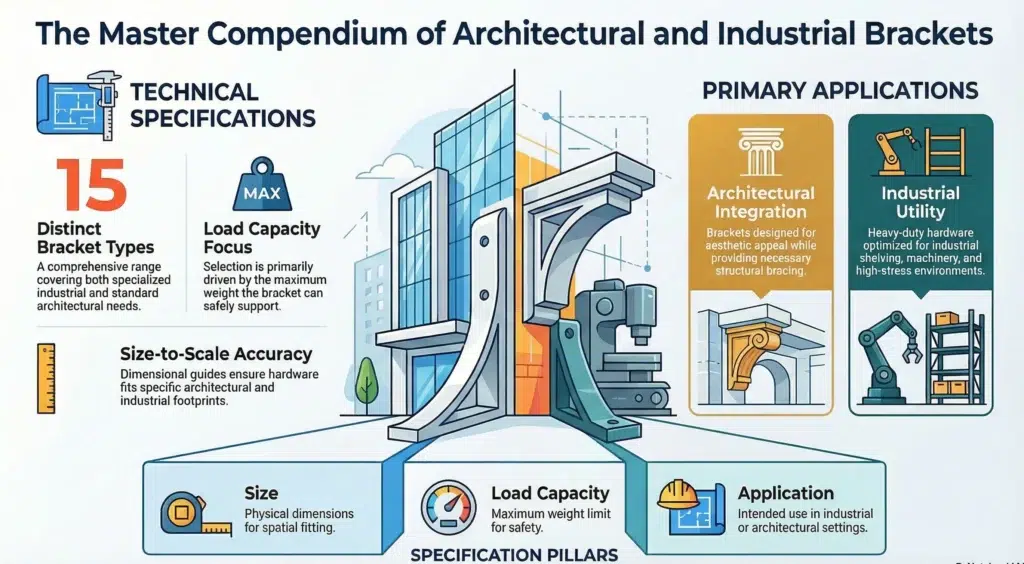
Brackets are structural hardware devices designed to connect, reinforce, and support various elements. From simple corner braces for furniture to heavy-duty joist hangers, understanding the different types is key to a safe and effective installation. This guide covers 15 major bracket types, including their standard sizes, load capacities, materials, and common applications, to help you make the right choice.

A Complete Guide to 15 Types of Brackets Sizes Load Capacity

The 15 Main Types of Brackets — Overview

Brackets are structural or supportive hardware devices that connect, reinforce, or suspend two or more building elements. They range from the smallest furniture corner brace to the heavy structural joist hanger used in deck construction. Understanding the full range of bracket types is the foundation of smart purchasing decisions.

A Quick Guide to the 15 Main Types of Brackets

L-Bracket (Angle Bracket)

  • Function: Right-angle support for shelves, furniture, framing
  • Load Capacity: 5–200 lbs
  • Materials: Steel, aluminum, stainless steel, plastic
  • Sizes: Various sizes available to fit different needs
  • Mounting Options: Wall-mount or surface mount with screws or bolts
  • Color Options: Available in black, white, silver, and other finishes
pannalli, solar, technology, bracket, support, light, electric current, solar, solar, solar, solar, solar

Shelf Bracket

  • Function: Shelf support from the wall
  • Load Capacity: 20–150 lbs
  • Materials: Steel, iron, aluminum, plastic
  • Installation: Wall-mounted or freestanding
  • Designs: Decorative, minimalist, adjustable
  • Usage: Organizing and displaying items on shelvesAdditional Features: Multiple shelves, hooks for hanging items, adjustable height
Outdoor wall display featuring a rustic shelf with terracotta pottery and an elegant lamp.

Heavy-Duty Bracket

  • Function: Industrial and heavy storage support
  • Load Capacity: 100–1,000+ lbs
  • Materials: Heavy gauge steelCompatibility: Perfect for warehouse, garage, or workshop storage

Heavy-duty brackets are the perfect solution for storing heavy and bulky items in your warehouse, garage, or workshop. They are specifically designed to provide industrial-strength support for all your storage needs.

Heavy-Duty Bracket

Corner Bracket

  • Function: Strengthening joints and corners
  • Load Capacity: 5–100 lbs
  • Materials: Steel, brass, aluminum Installation: Pre-drilled holes and screws included

A corner bracket is a valuable accessory for any DIY enthusiast or construction worker. It serves the important function of strengthening joints and corners, providing added support and stability to any structure.

Colorful traditional bar and restaurant in Dublin with a unique statue exterior.

Floating Shelf Bracket

  • Function: Hidden shelf support (no visible hardware)
  • Load Capacity: 20–100 lbs
  • Materials: Steel rod/plate, wood screws
  • Installation: Drill holes in wall, insert bracket and secure with screws

A floating shelf is a sleek way to add storage space to your home. The key to this design is the hidden shelf support, also known as a floating shelf bracket, which creates the illusion of a shelf with no visible hardware.

Floating Shelf Bracket

T-Bracket

  • Function: Reinforcing wood and metal joints
  • Load Capacity: 10–150 lbs
  • Materials: Steel, stainless steel
  • Installation: Pre-drilling required

T-Brackets are a commonly used type of bracket for reinforcing wood and metal joints. They are designed to provide extra support and stability, making them essential for any construction or DIY project.

T-Bracket

U-Bracket

  • Function: Pipe, beam, and handrail clamping support
  • Load Capacity: Varies by pipe
  • Materials: Steel, galvanized steel, stainless steel
  • Compatibility: Fits most pipes with a diameter of 1 inch or less

The U-Bracket is a versatile and essential tool for any construction or home improvement project. This simple yet effective device serves as a support for pipes, beams, and handrails, providing stability and strength to your structures.

Pipe, beam, and handrail clamping support

Decorative Bracket

  • Function: Countertop, mantel, porch aesthetic support
  • Load Capacity: 50–300 lbs
  • Materials: Iron, wood, brassInstallation: Screws, brackets and drill needed

Decorative brackets are a simple yet effective way to add aesthetic appeal to your countertops, mantels, or porch. Not only do they enhance the overall look of your space, but they also provide essential support for heavy objects.

A close-up of a decorative black metal hanging ornament with a beautiful bokeh background.

Cabinet Bracket

  • Function: Wall-mounting kitchen and bathroom cabinets
  • Load Capacity: 50–200 lbs
  • Materials: Steel, zinc alloy Compatible Cabinet Types: All standard cabinetry sizes and styles
  • Installation Instructions:

If you’re looking to give your kitchen or bathroom cabinets a sleek, modern look while also ensuring they are securely mounted on the wall, then a cabinet bracket is the perfect solution. 

clothes, cabinet, interior, sofa, carpet, bag, shoes, lamp, brown clothes, brown shoes, brown interior, brown lamp, Cabinet Bracket

Joist Hanger

  • Function: Structural floor, deck, roof framing
  • Load Capacity: 500–2,000+ lbs
  • Materials: Galvanised steel, stainless steel
  • Installation: Nails or screws

A joist hanger is an essential component in structural framing for floors, decks, and roofs. It is a metal bracket designed to support the weight of joists and transfer the load to the main structure of a building. Joist hangers come in various sizes and shapes to accommodate different types of joists.

Joist Hanger

TV Mount Bracket

  • Function: Wall-mounting televisions
  • Load Capacity: Up to 150 lbs
  • Materials: Steel, powder-coated finish
  • Compatibility: Fits most 32-70 inch TVs

If you’re tired of bulky TV stands taking up valuable floor space in your living room, a TV mount bracket may be the perfect solution for you. These brackets allow you to securely wall-mount your television, freeing up space and creating a sleeker look for your entertainment area.

TV Mount Bracket

Folding Bracket

  • Function: Collapsible support for fold-down surfaces
  • Load Capacity: 50–300 lbs
  • Materials: Steel, aluminum, or wood

Folding brackets are an essential tool for any home or garden enthusiast. These innovative brackets provide a collapsible support for fold-down surfaces, making them perfect for use in various areas of your home. With a load capacity ranging from 50 to 300 pounds, folding brackets can easily support heavy objects such as shelves, tables, and even workbenches.

Folding Bracket

Pipe Bracket

  • Function: Securing pipes, rods, and conduit
  • Load Capacity: Light to medium
  • Materials: Steel, plastic, brass, aluminum
  • Types: U-bolt, saddle, band, strap
  • Installation: Screw-in or bolt-on

A pipe bracket is a versatile hardware used for securing pipes, rods, and conduit in various settings. Whether you are looking to organize your plumbing installation at home or need a heavy-duty solution for industrial use, a pipe bracket is an essential component to have.

A metal pipe bracket clamped onto a stainless steel surface, showcasing an industrial design.

Adjustable Bracket

  • Function: Variable-position shelving and furniture
  • Load Capacity: 20–150 lbs
  • Materials: Steel, aluminum, plastic

Adjustable bracket systems have revolutionized storage and organization solutions for homes and gardens. These versatile brackets provide a convenient way to mount shelves, furniture, and other items at various heights and positions, making it easy to customize your space to meet your specific needs.

Adjustable Mounting Bracket

Specialty Bracket

  • Function: Glass shelves, stainless displays
  • Load Capacity: Varies by type
  • Materials: Stainless, glass-rated plastic
  • Installation: Wall-mounted

Specialty brackets are essential for creating a stylish and modern display in your home or business. These versatile brackets are designed to hold glass shelves and stainless steel displays, allowing you to showcase your favorite items with ease.

Custom & Specialty Metal Brackets

What Are L-Brackets (Angle Brackets)?

L-brackets, often called angle brackets, are a fundamental hardware component used in both DIY projects and professional construction. Their signature 90-degree “L” shape makes them the perfect solution for joining two surfaces, like a shelf and a wall, at a right angle. They are highly versatile and come in a wide range of sizes, materials, and finishes to suit different structural and aesthetic needs.

L-Bracket Sizes and Load Capacities

Choosing the right size L-bracket is crucial for ensuring your project is stable and secure. The size and thickness of the bracket directly impact its maximum load capacity. Below is a guide to common L-bracket sizes and their approximate weight limits.

| Size | Dimensions | Thickness | Max Load | | :— | :— | :— | :— | | Extra Small| 1″ × 1″ | 1.5 mm | 10 lbs | | Small | 2″ × 2″ | 2 mm | 30 lbs | | Medium | 3″ × 3″ | 3 mm | 60 lbs | | Large | 4″ × 4″ | 3.5 mm | 100 lbs | | Extra Large| 6″ × 6″ | 4 mm | 150 lbs | | Heavy-Duty | 8″ × 8″+ | 5+ mm | 200+ lbs |

Common Uses for L-Brackets

L-brackets are incredibly versatile. Here are some of their most frequent applications:

  • Installing Shelving: The most common residential use for L-brackets is to securely mount floating shelves to a wall.
  • Reinforcing Furniture: They are used to strengthen the corners and joints of cabinets, bookcases, chairs, and tables.
  • General Construction: In construction, L-brackets are essential for reinforcing wood framing, connecting beams, and building stud walls.
  • Mounting and Hanging: Angle brackets are ideal for mounting fixtures, tools, and equipment to walls in garages and workshops.

💡 Pro Tip: While L-brackets are sold individually, they should almost always be installed in pairs for stability. When installing a shelf, use at least two brackets and space them evenly to distribute the weight and provide reliable support. For longer or heavier shelves, add more brackets as needed.

How to Choose the Right Shelf Brackets?

Shelf brackets are essential hardware components designed to mount shelves securely to walls. Each L-shaped bracket typically features a longer vertical arm that fastens to the wall and a shorter horizontal arm to support the shelf from underneath, providing robust stability for various cantilever loads. Choosing the correct shelf bracket is crucial for ensuring both safety and functionality.

How to Choose the Right Shelf Bracket Size

The size of your shelf bracket should directly correspond to the depth of the shelf you plan to install. A general rule of thumb is to select a bracket that is slightly shorter than the shelf’s depth. This ensures the bracket remains mostly hidden from view while still providing adequate support. For example, a 10-inch deep shelf would typically require an 8-inch bracket.

To help you find the perfect match, here’s a quick guide to common shelf bracket sizes and their typical uses:

| Bracket Size | Recommended Shelf Depth | Max Load Capacity per Pair | Ideal Use | | :— | :— | :— | :— | | 6-inch Bracket | 7 to 8 inches | 40–60 lbs | Spice racks, small decorative displays, small bookshelves | | 8-inch Bracket | 9 to 10 inches | 50–80 lbs | Standard bookshelves, bathroom storage, displaying photos | | 10-inch Bracket| 11 to 12 inches | 60–100 lbs | Kitchen pantry shelves, home office organization | | 12-inch Bracket| 13 to 14 inches | 80–120 lbs | Deeper bookshelves, garage workshops, utility closets | | 16-inch Bracket| 17 to 18 inches | 100–150 lbs | Heavy-duty garage shelves, deep storage solutions | | 20-inch Bracket| 21 inches or more | 120–200 lbs | Industrial shelving, large pantry storage, heavy equipment |

Heavy-Duty Brackets

Engineered for high-load applications, these brackets are built from thick-gauge steel with multiple fixing points. When anchored to structural studs, they are rated for 100 lbs to over 1,000 lbs per bracket.

Heavy-Duty Bracket Specifications

8-inch BracketSteel Gauge: 10 gauge (3.4 mm) • Load Capacity: 100–200 lbs • Best For: Heavy kitchen shelves, workshop storage

12-inch BracketSteel Gauge: 10 gauge • Load Capacity: 150–300 lbs • Best For: Tool storage, heavy books

16-inch BracketSteel Gauge: 8 gauge (4 mm) • Load Capacity: 200–400 lbs • Best For: Garage shelving, servers

20-inch BracketSteel Gauge: 8 gauge • Load Capacity: 300–600 lbs • Best For: Industrial storage, machinery

24-inch BracketSteel Gauge: 6 gauge (5 mm) • Load Capacity: 500–1,000+ lbs • Best For: Workbenches, heavy-duty platforms

⚠️ Important: For maximum strength, mount heavy-duty brackets directly into wall studs or use masonry anchors. Drywall anchors alone are not sufficient for loads over 50 lbs.

How to Choose the Right Corner Bracket Size for Your Project

The right corner bracket size depends on the scale and structural demands of your project. Using a bracket that’s too small can compromise stability, while one that’s too large can be cumbersome and visually obtrusive. This guide will help you select the appropriate size for common applications.

Corner Bracket Size Chart

Our chart below outlines standard corner bracket dimensions and their typical uses, from small craft projects to heavy-duty construction.

| Size | Dimensions (per leg) | Common Uses | | :— | :— | :— | | Extra Small Corner Brackets| 1″ × 1″ | Picture frames, small boxes, delicate crafts | | Small Corner Brackets | 2″ × 2″ | Cabinet corners, chair joints, drawer frames | | Medium Corner Brackets | 3″ × 3″ | Wardrobe assembly, bed frames, bookshelf reinforcement | | Large Corner Brackets | 4″ × 4″ | Heavy furniture, workbenches, pergola joints | | Heavy-Duty Corner Brackets | 6″+ | Structural framing, sheds, decks, outdoor construction |

Heavy-Duty Floating Shelf Brackets

Achieve a seamless, modern look with our high-quality floating shelf brackets. These hidden brackets are designed to be completely concealed, creating the illusion that your shelf is suspended on the wall with no visible support. This sleek, minimalist design is achieved using a steel wall-mounted bracket (rod or plate) that slides into a hollowed-out shelf. Our invisible shelf brackets are perfect for creating stylish, space-saving storage in any room.

Find the Right Floating Shelf Bracket for Your Project

Choosing the correct bracket is crucial for ensuring your shelves are secure and can handle their intended load. Our brackets come in various sizes and styles to support everything from lightweight decorative displays to heavy-duty kitchen storage.

6-inch Hidden Rod Bracket

  • Best for: Lightweight displays and narrow shelves
  • Recommended Shelf Depth: 8–10 inches
  • Load Capacity: 20–40 lbs

8-inch Hidden Rod Bracket

  • Best for: Standard floating shelves in living rooms or bedrooms
  • Recommended Shelf Depth: 10–12 inches
  • Load Capacity: 30–60 lbs

10-inch Hidden Plate Bracket

  • Best for: Heavier items, bookshelves, and deeper shelves
  • Recommended Shelf Depth: 12–14 inches
  • Load Capacity: 50–80 lbs

12-inch Heavy-Duty Plate Bracket

  • Best for: Heavy-duty applications like kitchen shelves for dishes or pantry storage
  • Recommended Shelf Depth: 14–16 inches
  • Load Capacity: 60–100 lbs

💡 Important Installation Tip: For a secure and safe installation, always use a stud finder to locate and anchor your floating shelf brackets into wall studs. A bracket that is not properly secured can fail and cause a safety hazard.

How to Calculate a Shelf Bracket’s Load Capacity

Understanding the load capacity of your shelf brackets is crucial for a safe and secure installation. Use the following formulas to ensure your brackets can handle the intended weight.

Key Formulas for Load Capacity

1. Safe Working Load (SWL)

The Safe Working Load is the maximum weight a bracket system can safely support.

Formula: Safe Working Load = (Rated Capacity of one bracket × Number of Brackets) ÷ Safety Factor

What is a Safety Factor? The safety factor is a multiplier used to ensure your setup can handle more than the bare minimum load. For residential shelving, a standard safety factor of 3 or 4 is recommended. This means the hardware is rated to hold 3 to 4 times the actual intended load.

2. Actual Load Per Bracket

This formula helps you determine the weight each individual bracket will need to support.

Formula: Actual Load Per Bracket = Total Load (Weight) ÷ Number of Brackets

3. Minimum Bracket Rating

Use this to find the minimum rated capacity each bracket must have for your project.

Formula: Minimum Bracket Rating = (Total Load × Safety Factor) ÷ Number of Brackets

Examples of Calculating Bracket Weight Limits

Here are some real-world examples to help you understand how to apply these formulas.

Example 1: A shelf holding 120 lbs supported by 2 brackets.

  • Calculation: (120 lbs Total Load × 3 Safety Factor) ÷ 2 Brackets = 180 lbs
  • Result: Each bracket must have a minimum rated capacity of 180 lbs.

Example 2: A 60 lb cabinet mounted with 4 L-brackets.

  • Calculation: (60 lbs Total Load ÷ 4 Brackets) × 3 Safety Factor = 45 lbs
  • Result: Each bracket needs to be rated for at least 45 lbs.

Example 3: A 50 lb TV on a single articulating arm mount.

  • Note: For dynamic loads (items that move, like a TV arm), it’s wise to use a higher safety factor (e.g., 4).
  • Calculation: (50 lbs Total Load × 4 Safety Factor) ÷ 1 Bracket = 200 lbs
  • Result: The bracket must be rated to support at least 200 lbs.

Choosing the right bracket material

Choosing the right material for your shelf brackets is crucial for ensuring strength, durability, and style. This guide compares common bracket materials to help you make the best choice for your project, whether it’s for heavy-duty garage shelving or decorative indoor displays.

Carbon Steel Brackets

  • Strength: Very High
  • Corrosion Resistance: Low (requires a protective coating like paint or powder coating to prevent rust)
  • Weight: Heavy
  • Cost: Low
  • Best Use Case: Ideal for indoor, heavy-duty applications such as workshop shelving, garage storage, and industrial-style furniture where maximum strength is needed on a budget.

Galvanised Steel Brackets

  • Strength: Very High
  • Corrosion Resistance: High (zinc coating provides excellent protection against rust)
  • Weight: Heavy
  • Cost: Medium
  • Best Use Case: A perfect choice for outdoor projects, damp environments like basements, and agricultural buildings where moisture and weather exposure are concerns.

Stainless Steel Brackets

  • Strength: High
  • Corrosion Resistance: Excellent (naturally resistant to rust and corrosion)
  • Weight: Medium
  • Cost: High
  • Best Use Case: The ultimate solution for marine environments, coastal homes, outdoor kitchens, and bathrooms where superior rust resistance and a clean, modern look are essential.

Aluminium Brackets

  • Strength: Medium
  • Corrosion Resistance: Excellent
  • Weight: Very Light
  • Cost: Medium
  • Best Use Case: Suitable for lightweight applications where weight is a factor, such as in RVs, on balconies, and for modern, minimalist shelving.

Cast Iron Brackets

  • Strength: Very High
  • Corrosion Resistance: Moderate (typically painted or coated to resist rust)
  • Weight: Very Heavy
  • Cost: Medium
  • Best Use Case: Best for decorative, heavy-duty shelving that requires an antique or Victorian aesthetic. Its ornate designs add a classic touch to any room.

Brass Brackets

  • Strength: Medium
  • Corrosion Resistance: Excellent
  • Weight: Medium
  • Cost: High
  • Best Use Case: Used primarily for decorative purposes in period-style interiors, bathrooms, and kitchens where a touch of elegance and high corrosion resistance are desired.

How to Choose the Right Bracket for Your Project

Step 1: How to Calculate Your Bracket’s Load Capacity

Before you buy, it’s crucial to determine the load your brackets need to support.

  1. Determine the total weight: Weigh or accurately estimate the total load the shelf will hold, including the weight of the shelf itself.
  2. Apply a safety factor: Multiply the total weight by a safety factor. Use 3x for static loads (like a bookshelf) and 4x for dynamic loads (items frequently moved).
  3. Calculate per-bracket load: Divide the total calculated load by the number of brackets you plan to use.
  4. Choose the right rating: Always select brackets with a load rating that is higher than your calculated minimum requirement.

Step 2: How to Choose the Right Bracket Material for Your Environment

The material of your bracket is key to its longevity and performance.

  • For Indoor, Dry Areas:
    • Material: Standard steel or zinc-plated brackets.
    • Why: These are cost-effective and strong enough for environments without corrosion risk.
  • For High-Humidity Areas (e.g., Bathrooms, Basements):
    • Material: Stainless steel or chrome-plated brackets.
    • Why: These materials are resistant to rust and degradation caused by moisture.
  • For Outdoor, Covered Areas (e.g., Patios, Porches):
    • Material: Galvanized steel or aluminum brackets.
    • Why: They offer excellent resistance to rain and humidity.
  • For Coastal or Exposed Outdoor Areas:
    • Material: Marine-grade (316) stainless steel brackets.
    • Why: This is essential for preventing corrosion from salt in the air.
  • For Decorative or Period-Style Projects:
    • Material: Wrought iron, cast iron, or brass brackets.
    • Why: These materials match specific aesthetics like rustic, industrial, or vintage styles.

Step 3: How to Verify Fastener and Bracket Compatibility

Your bracket is only as strong as its fasteners.

  • Check fastener size: Ensure the bracket’s pre-drilled holes are the correct size for the screws or bolts you intend to use.
  • Count fixing points: For robust support, look for brackets with at least two fixing holes for the wall-mounted arm.
  • Confirm heavy-duty support: For heavy loads, verify that the holes are large enough to accommodate lag screws or bolts.
  • Avoid weak connections: Using fasteners that are too small for the holes will significantly reduce the connection’s strength and load capacity.

Step 4: How to Select a Bracket Finish to Match Your Style

The finish can complete the look of your project.

  • For modern and industrial looks: Powder-coated black or white finishes are popular choices.
  • For contemporary and Scandinavian designs: A brushed stainless steel finish offers a clean, minimalist aesthetic.
  • For farmhouse and vintage styles: An antique bronze or cast iron finish provides a classic, rustic feel.
  • For kitchens and bathrooms: Satin nickel or chrome finishes are durable and easy to clean.

Step 5: How to Check for Bracket Certification and Load Ratings

For safety and reliability, always look for third-party verification.

  • For structural brackets: Look for an ICC-ES report or equivalent engineering approval.
  • For TV mount brackets: Ensure the product is VESA compliant and has a UL listing for safety.
  • Trust independent testing: Prioritize brackets with independently tested load ratings over manufacturer-only claims, especially for heavy or critical applications.

Installation & Safety Tips

Selection Tips

  • Never select based on minimum capacity—buy 25% above calculated need
  • When in doubt, choose the larger bracket
  • Bracket length should be no more than 2″ shorter than shelf depth
  • Match material to environment before considering aesthetics
  • Buy brackets in sets when possible—consistent quality

Installation Tips

  • Always use stud finder before installing heavy brackets
  • Pre-drill pilot holes to prevent splitting
  • Use spirit level for every bracket—eye-level is unreliable
  • Mark and drill both bracket positions before installing either one
  • Apply thread-locking compound in high-vibration areas
  • Check all fastings annually, especially high-load applications

Safety tips

  • Never exceed rated load capacity—failure is typically sudden
  • For child-accessible shelves, use brackets rated well above load
  • Inspect cast iron brackets annually for cracks
  • Have structural joist hangers inspected by building inspector
  • Check fasteners before and after seasonal weather changes

Frequently Asked Questions

Q: What size shelf bracket do I need for 12-inch deep shelf?

A: Use a bracket with 10-12 inch long arm. The bracket should extend to within 1-2 inches of the shelf’s back edge. A shorter bracket creates leverage disadvantage and reduces load capacity.

Q: How much weight can a shelf bracket hold?

A: A standard medium-duty shelf bracket (3-4mm thick, 10-12″, anchored into stud) holds 80-150 lbs per bracket at 3× safety factor. A pair can safely support 160-300 lbs total. Always check manufacturer rating.

Q: What’s the difference between L-bracket and shelf bracket?

A: L-bracket: equal-length arms at 90°, both arms load-bearing. Shelf bracket: longer wall arm, shorter shelf support arm, optimized for cantilever loads.

Q: What bracket is used for floating shelves?

A: Floating shelves use concealed hidden shelf brackets—steel rods or steel plates that mount to wall and insert into shelf, leaving no visible hardware. Must anchor into studs.

Q: How many shelf brackets do I need?

A: Space brackets 24-32″ apart. 36″ shelf = 2 brackets. 48″ shelf = 2-3 brackets. 72″ shelf = 3 minimum. Add one bracket per additional 24″ for heavy loads.

🔗 External Links:

  1. Understanding different types of wall brackets and their uses
    https://engineerfix.com/the-different-types-of-wall-brackets-explained/
  2. Complete guide to wall bracket materials and performance
    https://www.alibaba.com/product-insights/types-of-wall-brackets.html
  3. What is a bracket? Types, functions, and applications explained
    https://mednfly.com/blog/mednfly-academy/what-is-a-bracket
  4. Bracket definition, types, and design principles guide
    https://www.china-me.com/news/article/the-complete-guide-of-brackets
  5. Architectural bracket types and structural uses overview
    https://en.wikipedia.org/wiki/Bracket_%28architecture%29

Disclaimer

The information in this guide is for general educational purposes only. Load capacity figures, size recommendations, and installation guidance are based on general industry standards and are provided as approximate reference values.

Structural applications must comply with local building codes and should be designed or reviewed by qualified professionals. The load capacity calculations use general safety factors for common residential applications. Always verify specifications with manufacturer technical data.

This guide does not constitute professional engineering or construction advice. For structural, load-bearing, or code-governed installations, consult a licensed contractor, structural engineer, or local building authority.

Scroll to Top