Benches Size Ideas: The Complete Bench Size Guide (cm, Inches & mm)
Ever brought home a lovely bench, only to find it sits too tall under the table, or squeezes three people into a two-person space? You are not alone. Getting the bench dimensions right is the whole difference between a seat people fight over and one nobody touches. This bench size guide walks you through every measurement that matters — bench height, bench depth, bench width, and the gap between the seat and your table — with every number given in cm, inches, and mm. Want the figures worked out instantly?
Try our bench size calculator, then read on so you understand the why behind each one. And because good seating starts with smart furniture spacing, we will cover that too.
Standard Bench Dimensions at a Glance
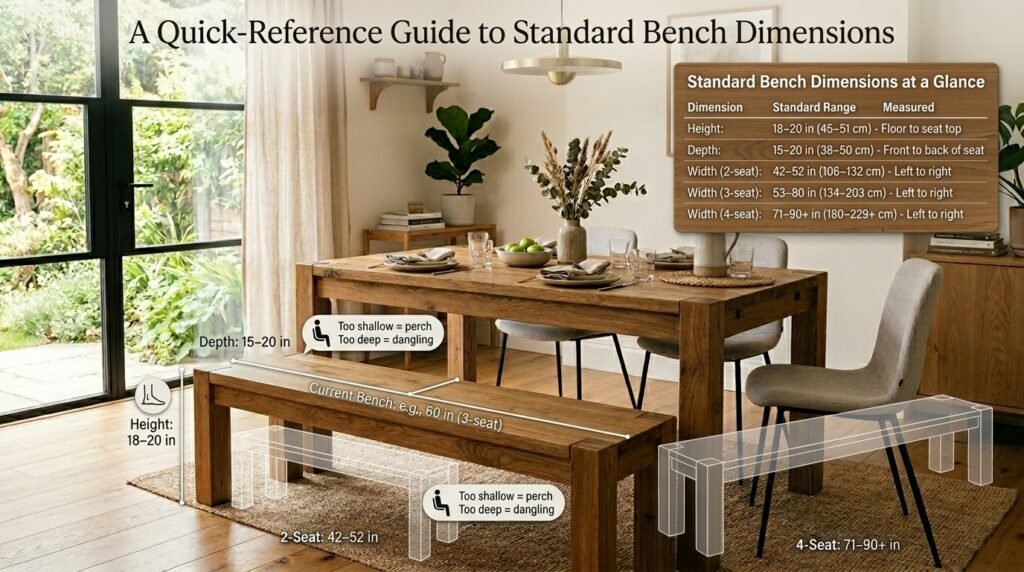
Let us start with the big picture. Most benches follow a predictable set of standard bench sizes, because the standard size of a bench is built around the human body — and once you know the ranges, bench sizing is simple. Here are the core bench measurements, including the key bench dimensions in cm and mm, that you will return to again and again. Treat the table below as your bench size chart (some call it a bench sizes chart) and your quick bench specifications sheet: it captures the typical bench dimensions and the average dimensions of a bench in one place. Most benches dimensions fall neatly inside these bands, so working out bench size in cm is easy.
Dimension | Inches | Centimetres (cm) | Millimetres (mm) |
Height (floor to seat) | 18–20 in | 45–51 cm | 450–510 mm |
Seat depth (front to back) | 15–20 in | 38–51 cm | 380–510 mm |
Dining seat depth | 16–18 in | 40–46 cm | 400–460 mm |
Width — 2 seats | 42–52 in | 106–132 cm | 1060–1320 mm |
Width — 3 seats | 53–80 in | 134–203 cm | 1340–2030 mm |
Width — 4 seats | 71–90 in | 180–229 cm | 1800–2290 mm |
Bench-to-table gap | 10–12 in | 25–30 cm | 250–300 mm |
Keep this bench size chart handy. Everything below explains the why behind each of these standard bench measurements and standard bench dimensions.
Quick Metric Reference (cm and mm)
Prefer the numbers on their own? Here is the metric cheat-sheet:
- Bench height cm: 45–51 cm (bench height mm: 450–510 mm; bench height from floor, same range).
- Average bench height cm: about 48 cm; standard bench height mm: 450–510 mm.
- Bench depth cm: 38–51 cm; standard bench seat depth cm: 40–46 cm.
- Standard bench seat depth 16 18 inches (16–18 in) = 40–46 cm.
- Bench width cm: 106–132 cm for two seats.
- Bench size cm: see the chart above; bench measurements cm at a glance cover height, depth, and width.
- Outdoor bench dimensions cm and dining bench dimensions cm: 45–51 cm high.
- Standard park bench seat height cm: 45 cm.
Bench Size Calculator
Stop guessing your bench dimension. Pick where it goes and how many people it seats, and this calculator gives you the right width, bench seat height cm, and depth — plus a dining-table legroom check so the bench tucks under perfectly. For the full breakdown, see our bench size guide, and plan the surrounding space with our furniture spacing tips.
Standard Bench Dimensions
| Room | Height | Depth |
|---|---|---|
| Dining | 17.5–18 in | 17–18 in |
| Outdoor / garden | 18–20 in | 12–20 in |
| Entryway / mudroom | 18 in+ | 14–17 in |
| Bedroom (end of bed) | ~18 in | 16–18 in |
| Shower (ADA) | 17–19 in | 15–16 in |
Frequently Asked Questions
How many people fit on a bench?
Allow 18 to 24 inches of width per adult. A 48-inch bench seats two comfortably, and a 72-inch bench seats three to four depending on how roomy you want it.
What size bench fits a 60-inch dining table?
About 42 to 48 inches. Keeping the bench roughly 12 inches shorter than the table lets it tuck underneath neatly and seats two to three people.
How much legroom should I leave under the table?
About 10 to 12 inches (25 to 30 cm) between the seat top and the table underside. With a standard 18-inch bench and a 30-inch table, you get roughly 12 inches — right in the comfort zone.
What size bench for the end of a king bed?
Around 60 to 65 inches wide. Match the bench width to the bed: about 45 inches for a queen and 60 to 65 inches for a king, sitting near 18 inches high.
Note: Results are a guide based on common design rules. Always measure your space and leave about 24 inches of walking room behind the bench.
Accessibility reference: U.S. Access Board — built-in benches.
Bench Height: How High Should a Bench Be?
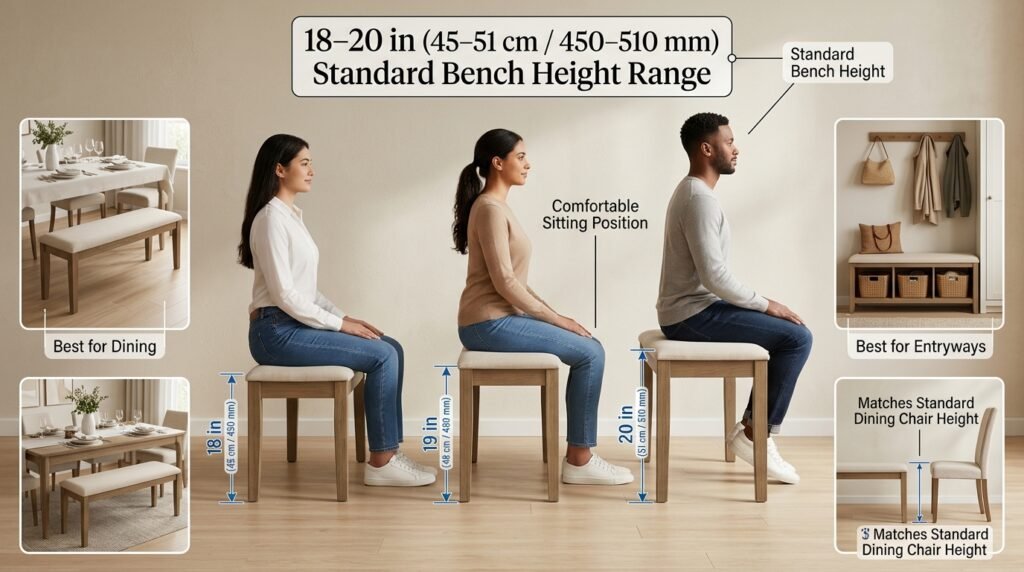
The sweet spot for bench height is 18 to 20 inches — a bench height in cm of 45 to 51 cm, or a bench height in mm of 450 to 510 mm. Measured floor to seat top, this bench height from the floor matches most chairs, so feet rest flat and knees sit comfortably. In bench height inches that is 18–20 in; the bench height in feet works out to roughly 1.5 ft. The average bench height in cm and the standard bench height in mm both land squarely in this band, which is exactly why the standard height of bench you see in shops barely changes from brand to brand.
So what is standard bench height? The bench height standard, and the matching bench seat height standard, is 45–51 cm (18–20 in). That single figure doubles as the standard height for a bench seat, the standard height of a bench seat, the standard height bench makers build to, and the standard height for benches in general. You will also hear it called the normal bench height, the normal height of bench, or simply the comfortable bench height — the bench seat height cm most people never think about until a seat gets it wrong.
Wondering about 18 inches vs 20 inches? Go lower (around 45 cm / 18 in) for dining, where it matches your chairs. Go a touch higher (around 51 cm / 20 in) for entryways, where a taller perch makes standing up easier. The ideal bench seat height in cm always depends on what the bench sits beside — match the height for bench to the furniture around it and the bench seating height takes care of itself. This is the standard sitting bench height, the typical bench height, and the height of seating bench you want in nearly every room.
In short, the height of a bench, the height of benches, the height of bench seat, and the benches height you should aim for all point to the same range, and these bench height dimensions hold whether you measure in cm, mm, inches, or feet. Put another way, the standard bench height and depth together come to 45–51 cm and 38–51 cm; the standard height of bench seat, the standard size of bench, and the seating bench height you settle on all trace back to these same numbers.
Bench Depth: How Deep Should a Bench Be?
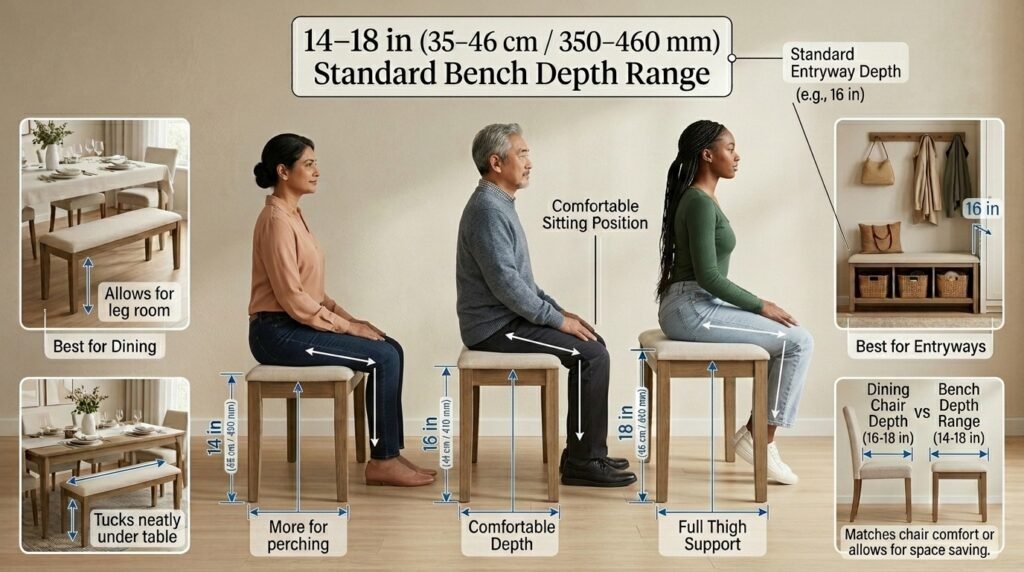
A good bench depth runs 15 to 20 inches — a bench depth in cm of 38 to 51 cm. So how deep is a bench, really? For dining, use the standard bench seat depth of 16 to 18 inches, which is a bench seat depth in cm of about 40 to 46 cm. That classic standard bench seat depth of 16–18 inches is the typical bench depth and the standard depth of bench most makers use. Too shallow and you perch; too deep and your feet dangle, so the seat depth bench buyers love sits right in the middle. The depth of a bench, or the depth of bench seat, is the quiet detail that decides whether a seat feels supportive — and the standard bench seat depth in cm rarely strays far from 40–46 cm.
Read bench seat height and depth together: an 18-inch high seat with a 17-inch deep seat is the classic comfortable bench seat dimensions pairing. Those dimensions of a bench seat — the height plus the bench seat depth cm — suit nearly every room, while the typical bench seat height stays at 45–51 cm.
Bench Width and Length: How Wide Should a Bench Be?
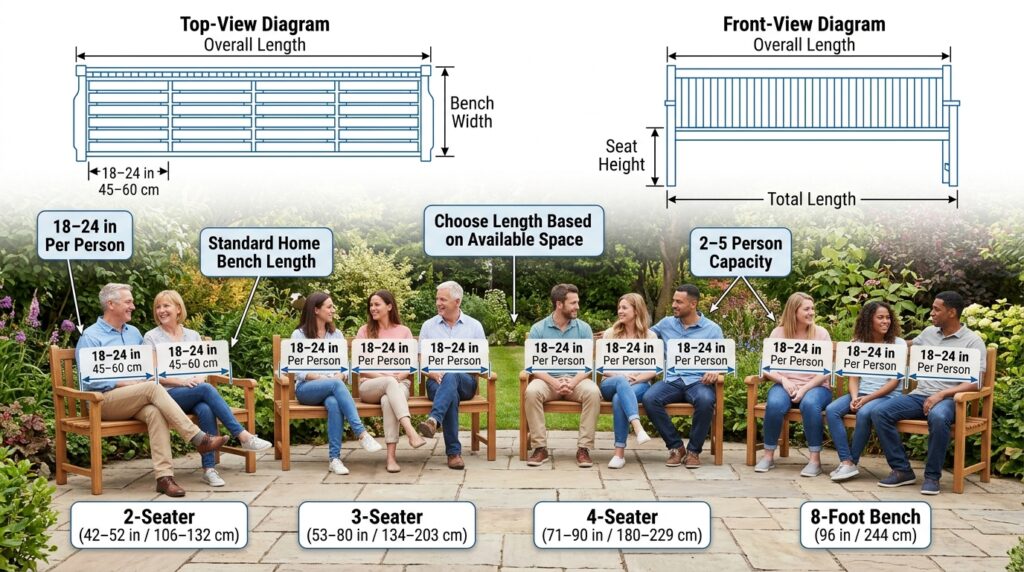
Bench width and bench length decide how many people you seat. The rule for the width of a bench is simple: allow 18 to 24 inches (45 to 60 cm) of seat per person. In metric, the standard width of a bench (also written standard width of bench) for two people is a bench width in cm of 106 to 132 cm, or a bench width in mm of 1060 to 1320 mm. The average width of a bench in homes, and the average bench seat width per person, follow straight from that per-person figure. From there, the standard bench width falls into clear bands:
- 2 seater bench dimensions: 42–52 in (106–132 cm) wide
- 3-seater (three seater bench): 53–80 in (134–203 cm) wide
- 4-seater: 71–90 in (180–229 cm) or more
So what size is a 3 person bench? Around 53 to 80 inches (134 to 203 cm). The 2 person bench width gives each adult elbow room, while the seating bench width and the width of a bench seat scale up together as you add people. As for length, the average bench length and the standard bench length in homes sit near 42 to 60 inches, though the length of bench you choose can be anything that fits — the bench seat length just has to suit the space. And how many does an 8 foot bench seat? At 96 inches (244 cm) wide, an 8-foot bench seats four to five adults on the 18–24 inch per-person rule.

Seating Capacity by Bench Width
Here is a quick guide to comfortable bench seat widths, so nobody ends up squished. Cram in more people than the width allows and the bench stops being a pleasure to use.
Capacity | Width range (in / cm) | Typical use |
2 adults | 40–52 in / 102–132 cm | Entryways, breakfast nooks, balconies |
3 adults | 53–80 in / 134–203 cm | Dining rooms, patios, gardens |
4 adults | 71–90 in / 180–229 cm | Large dining spaces, commercial areas |
5+ adults | Over 90 in / 229 cm | Custom builds, event and park spaces |
The Gap Between a Bench and a Table (the 43–51 cm Rule)
Two numbers decide whether sliding onto a bench feels easy or awkward. First, the bench seat sits 43 to 51 cm (about 17 to 20 inches) off the floor. Second, a standard dining table stands roughly 73 to 76 cm (28 to 30 in) tall. Tuck the bench underneath and that leaves around 25 to 30 cm (10 to 12 inches) of clear legroom between the seat top and the table underside.
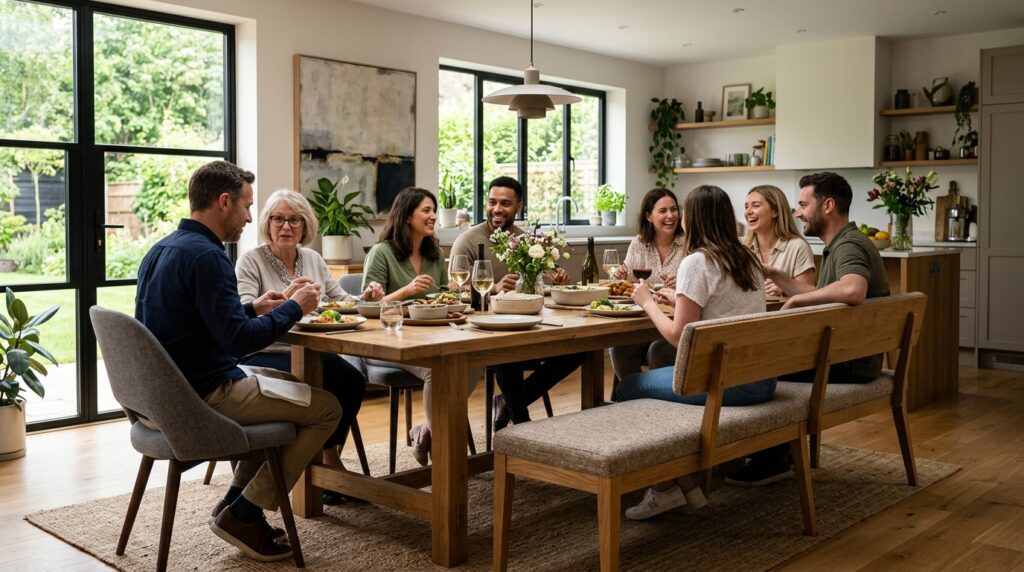
That 25 to 30 cm of thigh room is the comfort zone. Aim for at least 30 cm where you can, so legs slide in and out freely. Getting this bench height for table pairing right is the difference between a great dining setup and a cramped one. A handy shortcut: pick a bench seat about 30 cm (12 in) below your table top, and the bench seating height sorts itself out.
Standard Bench Dimensions Summary (Specifications)
If you want the whole thing on one line, here are the standard bench dimensions, written the way you will see them on a spec sheet. These bench specifications cover the average bench size that suits most homes:
- Height: 45–51 cm (18–20 in) — the bench standard size for seat height
- Seat depth: 38–51 cm (15–20 in); 40–46 cm for dining
- Width: 106–132 cm for two, scaling up per person
- Bench-to-table gap: 25–30 cm of legroom
That is the standard size bench most people picture, and it matches the standard size of a bench sold in stores. Whether a listing says standard bench dimensions, bench dimensions standard, or standard bench measurements, it describes this same set of numbers. Built-in joinery follows it too: built in bench dimensions cm sit in the same 45–51 cm height range, just sized to the wall. These are the core dimensions bench buyers rely on most — the seating bench dimensions (also written bench seating dimensions) and bench seat dimensions cm that make a seat comfortable. When you ask how big is a bench, this is the honest answer, covering the size of a bench, the bench seat dimensions, and the dimensions for a bench seat in one place. For better bench sizes, measure your space before you buy.
Standard Bench Size Chart
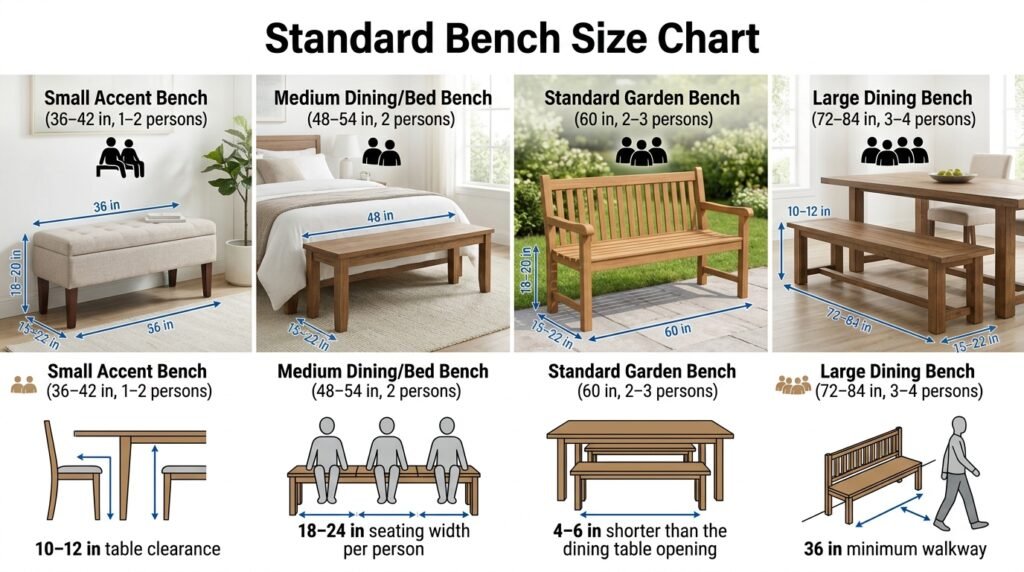
A quick spatial sizing reference for dining, entryway, outdoor garden, and end-of-bed accent seating configurations.
| Bench Style | Standard Length | Seating Capacity | Ideal Placement Context |
|---|---|---|---|
| Small Accent / Ottoman | 36” – 42” | 1 - 2 Persons | Compact entryways, vanity seating, small mudrooms |
| Medium Dining / Bed Bench | 48” – 54” | 2 Persons | Pairs with 5ft dining tables; fits Queen size beds |
| Standard Garden / Park | 60” | 2 - 3 Persons | Patios, backyard decks, standalone landscaping features |
| Large Dining / Perimeter | 72” – 84” | 3 - 4 Persons | Pairs with 6ft to 7ft dining tables; fits King size beds |
📏 Standard Bench Clearances
- Seat Height: 18” to 20” from the ground (standard dining chair match).
- Seat Depth: 15” to 17” for indoor dining; 18” to 22” for deep loungers or outdoor units.
- Table Gap: Maintain 10” to 12” of clear workspace space between the underside of a table apron and the top of the bench seat.
🪑 Seating Allowance Rules
- Per Person Width: Plan on 18” to 24” of clear layout linear length per single adult sitter.
- Dining Inset: Choose a bench length roughly 4” to 6” shorter than the clear space inside your dining table legs if you want to slide it completely out of traffic pathways when not in use.
Bench Dimensions by Room and Type
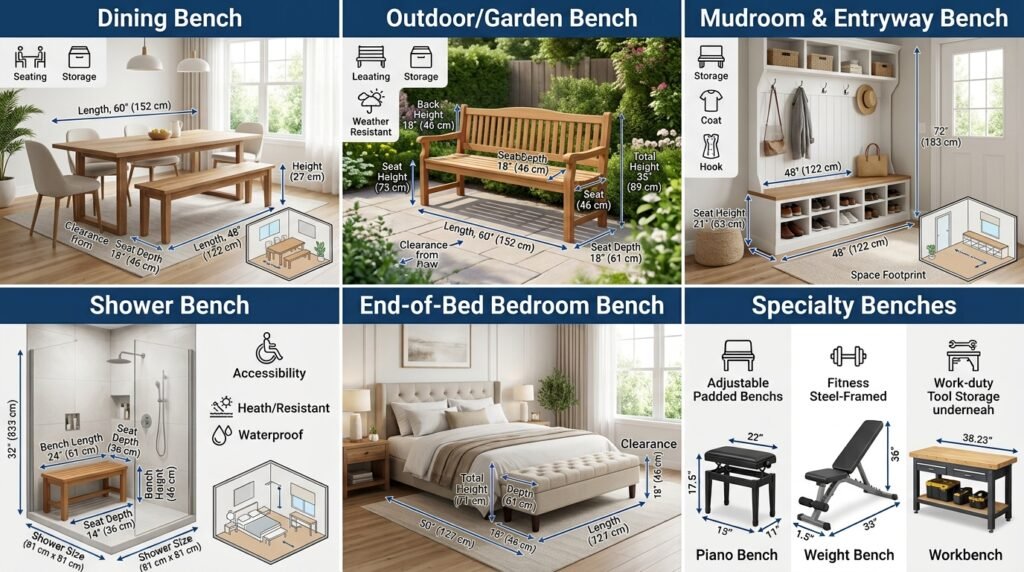
Every room and every job asks for slightly different sizes. Here is how the standard bench dimensions shift around your home, garden, and beyond.
Dining Bench Dimensions
For the dining room, the ideal dining bench size is a height of 17.5 to 18 inches (44 to 46 cm), a seat depth of 17 to 18 inches (43 to 46 cm), and a length of 42 to 60 inches (106 to 152 cm) to seat two or three. A reliable tip for the dimensions for dining table bench setups: pick a bench about 12 inches (30 cm) shorter than your table so it tucks underneath neatly. These dining bench dimensions in cm — and the matching table bench dimensions — work with almost any modern table, and they are the bench size for dining table shoppers ask about most. Pair it with the right table using our kitchen layout ideas.
Outdoor, Garden and Park Bench Dimensions
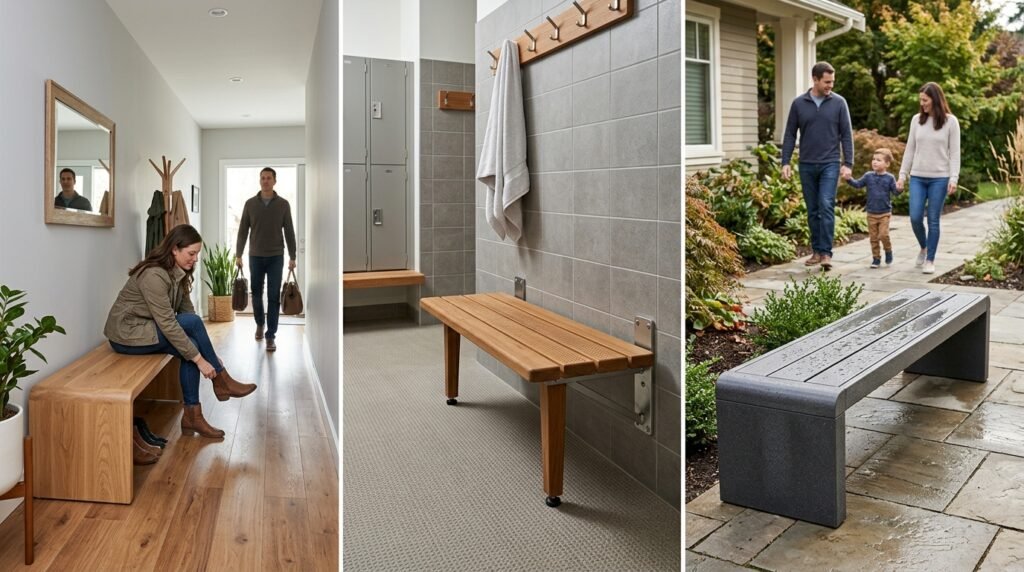
Garden bench dimensions run 18 to 20 inches (45 to 51 cm) high and 12 to 20 inches (30 to 51 cm) deep, so your outdoor bench dimensions scale with how many you want to seat: a 2-seater spans 40 to 50 inches (102 to 127 cm), a 3-seater 53 to 70 inches (134 to 178 cm), and a 4-seater up to 90 inches (229 cm). For metric planning, those outdoor bench dimensions in cm and the standard outdoor bench dimensions are easy to remember. The classic standard park bench dimensions sit in the same family — about 4 to 6 feet long with a park bench height of 18 inches (45 cm). In metric, the park bench dimensions cm work out to roughly 122 to 183 cm long, or park bench dimensions mm of 1220 to 1830 mm, which makes the standard park bench seat height in cm an easy 45 cm. The average park bench height and the park bench height standard both match that, and most park bench measurements (the standard park bench height included) stay inside this range. Planning a patio? Our modern patio guide helps you place outdoor seating beautifully, and the reference tables at Dimensions.com are a dependable cross-check.
Mudroom and Entryway Bench
An entryway or mudroom bench should be at least 18 inches (45 cm) high, 14 to 17 inches (35 to 43 cm) deep, and 35 to 48 inches (88 to 122 cm) long — just right for sitting to pull on boots. Add storage below to tame the clutter; our entryway organizer ideas pair perfectly. A slightly taller seat leaves room for a shoe tray underneath.
Shower Bench Dimensions
Shower bench sizes follow accessibility-friendly numbers: the average shower bench size is 17 to 20 inches (43 to 51 cm) high and 15 to 16 inches (38 to 41 cm) deep, with a slip-resistant surface. A built-in shower bench usually spans the full width of the alcove, while a corner shower bench fits a triangular footprint of roughly 16 to 18 inches (40 to 46 cm) per side. Pick moisture-proof materials so it lasts. For a full bathroom setup, see our bathroom shower selector.
Bedroom (End-of-Bed) Bench
An end-of-bed bench should match your bed width. Around 60 to 65 inches (152 to 165 cm) works for a king size bed, while about 45 inches (114 cm) suits a queen — both sitting near 18 inches (45 cm) high. A storage bench for king size bed setups adds a place to sit plus a spot to stash blankets and lay out clothes.
Specialty Benches: Piano, Weight Bench and Workbench
Not every bench is for sitting at a table. A piano bench is usually about 30 inches (76 cm) wide and 18 to 20 inches (45 to 51 cm) high. In the gym, a weight bench (the bench press pad) typically runs 48 to 52 inches (122 to 132 cm) long, 10 to 12 inches (25 to 30 cm) wide on the pad, and 17 to 18 inches (43 to 46 cm) high — so the standard bench depth weight bench specs quote refers to that pad width, not a seat. A workbench is different again: most stand 34 to 38 inches (86 to 97 cm) tall for standing work, so the standard bench depth workbench figure follows benchtop guidance, not seating rules. And the standard bench depth bench press lifters look up is the pad width above. Always check the maker’s specifications before buying.
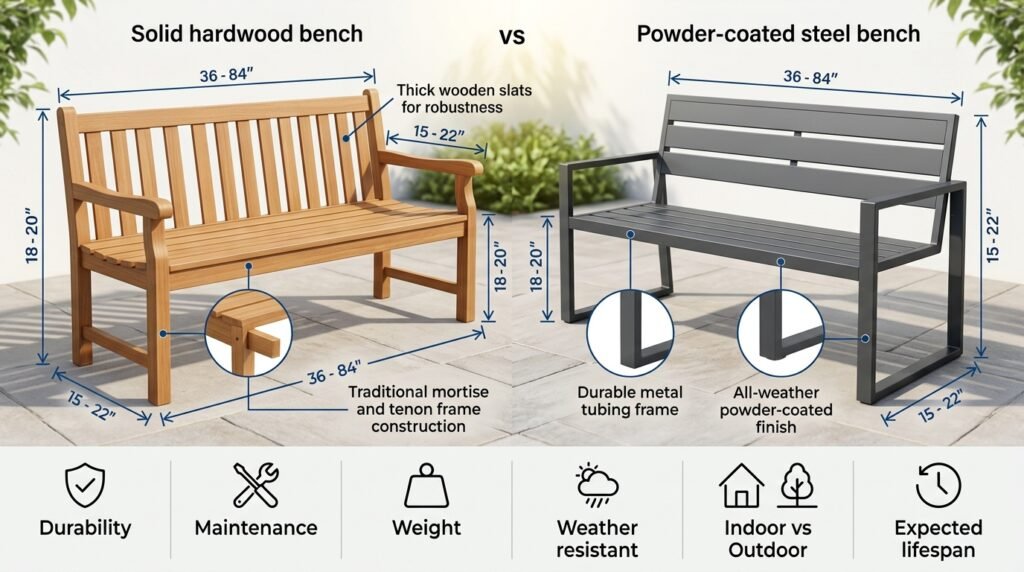
Wooden vs Metal Bench Dimensions and Materials
The right material balances looks, durability, and feel. Wood and timber bring warmth, metal and wrought iron add strength, and wicker or rattan suit relaxed outdoor settings. Worth knowing: wooden bench dimensions often run a touch chunkier than a metal one, because the frame is thicker — so on a solid wood bench dimensions can show a slightly narrower usable seat than the overall footprint. Allow for that when you measure. For bare wood or metal benches, a well-sized cushion makes all the difference — size it correctly with our cushion cover size guide, and browse coordinating pieces in our side tables selector.
Bench vs Individual Chairs
Should you choose a bench or individual chairs? Each has its place, and many people mix both — a bench on one side, chairs on the other — to balance function and style.
- Choose a bench for: saving space, a clean modern look, and flexible seating that slides away neatly
- Choose chairs for: back support, comfort over long meals, and a more formal feel
Space Planning and Safety Tips
A bench needs breathing room. Leave at least 24 inches (60 cm) of walking space behind it so people can pass and stand up easily, and measure your room before you buy.
- Check the weight capacity so the bench supports the heaviest likely user, plus a margin.
- Anchor wall-mounted benches into studs so they cannot pull loose.
- Use slip-resistant surfaces on shower and outdoor benches to prevent falls.
- Soften sharp corners with rounded edges in homes with children.
- Keep it stable by checking the legs sit level before use.
How to Choose the Right Bench Size
Pulling it together, ask three quick questions and the right seating bench size appears on its own:
- Where will it go? Dining, entryway, bedroom, or garden each suit a different size.
- How many people? Allow 18 to 24 inches (45 to 60 cm) of width per person — that sets the size of bench seat each person needs.
- Does it fit the space? Measure for the bench plus 24 inches (60 cm) of clearance behind it.
Bench Größentabelle: Quick Metric Size Chart
For readers who plan in metric, here is a compact bench size chart (Bench Größentabelle) with the key dimensions in cm and mm only.
Measurement (Maß) | cm | mm |
Height (Höhe) | 45–51 cm | 450–510 mm |
Seat depth (Sitztiefe) | 38–51 cm | 380–510 mm |
Width — 2 seats (Breite, 2 Plätze) | 106–132 cm | 1060–1320 mm |
Width — 3 seats (3 Plätze) | 134–203 cm | 1340–2030 mm |
Bench-to-table gap (Beinraum) | 25–30 cm | 250–300 mm |
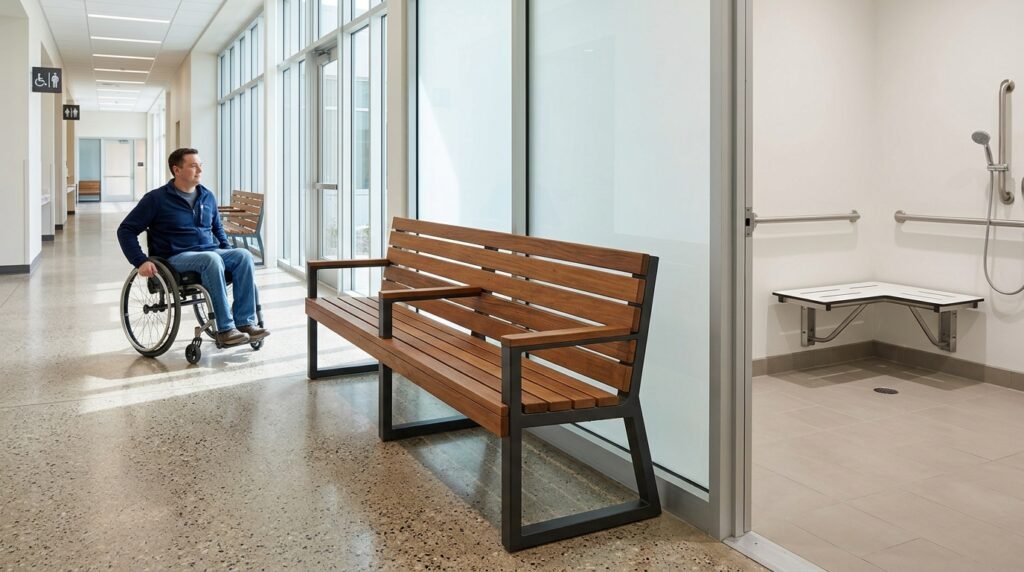
ADA Accessible Bench Sizes
Benches in public and commercial spaces must meet accessibility rules. The official standard sets the seat height at 17 to 19 inches (430 to 485 mm), a depth of 20 to 24 inches (51 to 61 cm), and a minimum length of 42 inches (106 cm), with the seat able to take a 250-pound load. You can read the exact requirements for built-in benches in the U.S. Access Board ADA guidance. These accessible numbers are a useful sanity check even for home projects, since they share the same human proportions as standard bench sizes.
Materials and Comfort
The right material balances looks, durability, and feel. Wood and timber bring warmth, metal and wrought iron add strength, and wicker or rattan suit relaxed outdoor settings. A solid wood bench size often runs a touch chunkier than a metal one because the frame is thicker, so allow for that when measuring. For bare wooden or metal benches, a cushion makes all the difference — size it correctly with our cushion cover size guide, and browse coordinating pieces in our side tables selector.
Bench Space Planning and Safety Tips
A bench needs breathing room around it. Leave at least 24 inches of walking space behind it so people can pass and stand up easily. Measure your room before you buy so the bench fits without blocking paths. A little planning keeps the space comfortable and safe.
- Check the weight capacity: make sure the bench supports the heaviest likely user, plus a safety margin.
- Anchor wall-mounted benches: fix them into studs so they cannot pull loose.
- Use slip-resistant surfaces: essential for shower and outdoor benches to prevent falls.
- Soften sharp corners: rounded edges are safer in homes with children.
- Keep it stable: a wobbly bench tips easily — check the legs sit level before use.
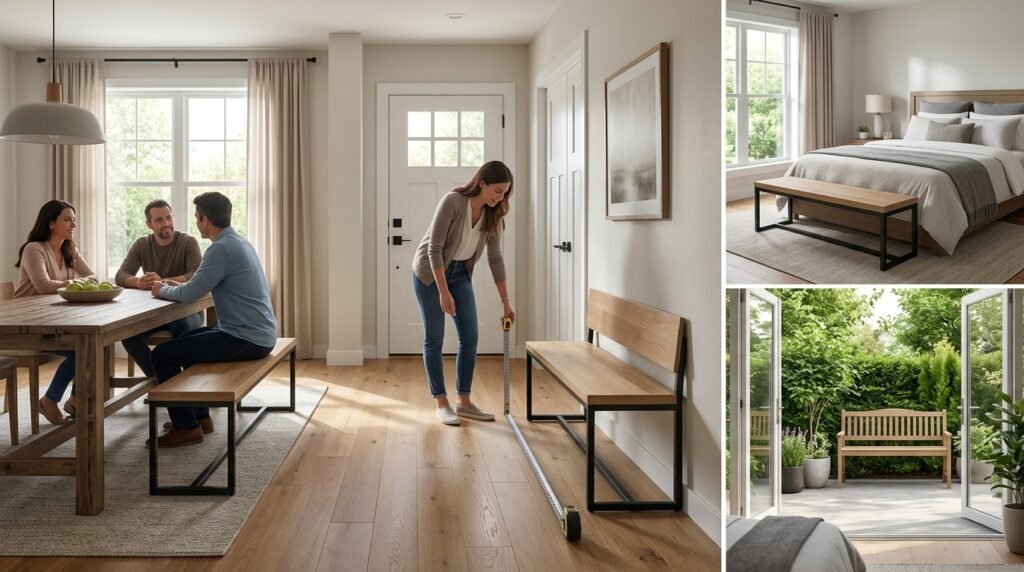
How to Choose the Right Bench
Pulling it all together, ask yourself three quick questions and the right seating bench size appears on its own.
- Where will it go? Dining, entryway, bedroom, or garden each suit a different size.
- How many people? Allow 18 to 24 inches of width per person to seat adults comfortably; that per-person figure sets the size of bench seat each person needs.
- Does it fit the space? Measure for the bench plus 24 inches of clearance behind it.
Answer those and you will land on a standard size bench that looks great and feels even better. For more room-by-room upgrades, our home renovation guide has you covered.
Final Thoughts
A bench is one of the most useful pieces of furniture you can own — when it is the right size. Match the height to your table (45–51 cm / 18–20 in), give each person 18 to 24 inches (45–60 cm), leave a 25–30 cm gap for legs, and keep safety in mind. Use our bench size calculator to lock in your numbers, and for more room-by-room upgrades, our home renovation guide has you covered.