Natural Marble Types: A Practical Guide to Varieties, Costs & Care
How the main marble varieties differ, what they typically cost in 2026, and how to keep them looking good.
By Jaweed, Prime Home and Garden · Published August 17, 2026 · Updated September 27, 2026
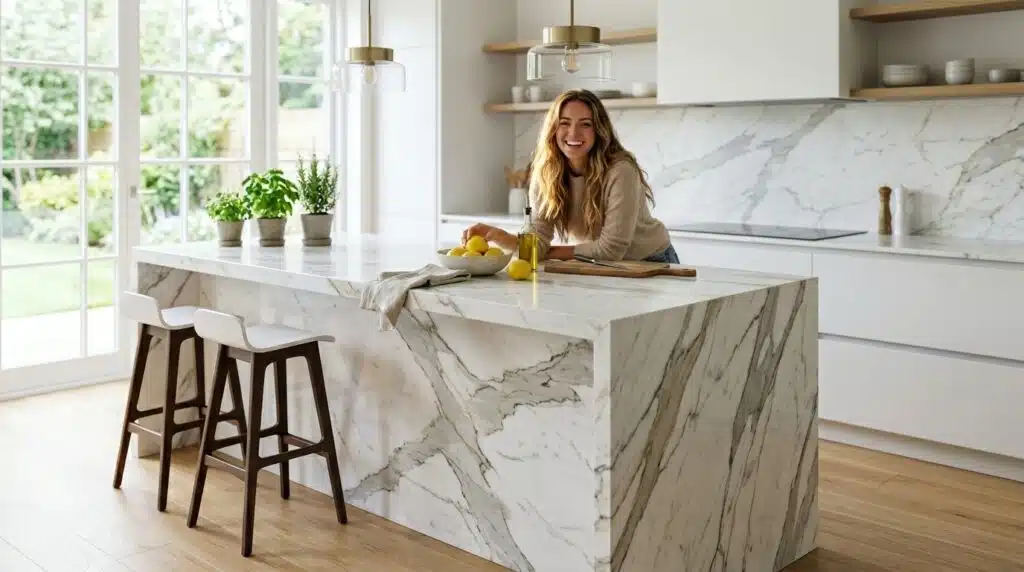
Picture two kitchens with the same layout, cabinets, and appliances. One has a countertop with soft gray veins drifting across bright white stone; the other has a plain laminate counter. Most people picture the first one when they hear the word "luxury." That's the pull of marble.
Marble is one of several natural stones people compare before a remodel, alongside granite, quartzite, and soapstone. It usually wins on looks and loses on maintenance, and this guide is built around that trade-off: which variety suits which room, what it realistically costs, and what caring for it involves.
Quick answer: Carrara is the most affordable and common white marble, Calacatta has bolder veining and a higher price, and darker stones such as Nero Marquina or Emperador suit statement spaces. Every true marble is softer than granite and etches when acids touch it, so plan on sealing it and cleaning it with pH-neutral products.
Related flooring and project guides
- Choose plank dimensions and estimate square footage with our wooden flooring size guide and calculator.
- Troubleshoot squeaks with our guide on why wood floors make noise.
- Clean hard floors safely with our eco-friendly wood floor cleaning guide.
- Learn why acidic cleaners damage calcium-based surfaces in our pH-neutral concrete cleaner guide.
- Estimate other project quantities with our building materials calculator.

What is marble? Composition and key properties
Marble is a metamorphic rock. It forms when limestone or dolomite is buried and exposed to heat and pressure over long geological periods, which recrystallizes the stone into a dense, interlocking mass of calcite (or dolomite) crystals. That crystal structure gives marble its glow and its ability to take a high polish.
The veining and color come from minerals that were mixed into the original limestone, such as clay, silt, sand, and iron oxides. Because those impurities are never distributed the same way twice, no two slabs are identical.
| Property | What it means at home |
|---|---|
| Composition | Mostly calcite (calcium carbonate); some marbles are dolomitic |
| Hardness | Calcite is 3 on the Mohs scale, so marble scratches more easily than granite, whose main minerals rate about 6–7 |
| Porosity | Absorbs liquids; sealing slows staining |
| Acid sensitivity | Lemon juice, vinegar, wine, and many cleaners etch (dull) the surface |
| Heat | Noncombustible and tolerates normal household heat, but sudden temperature shocks can crack or mark it |
That hardness gap is why a dropped ring or a knife can leave a mark on marble that a granite counter would shrug off. You can read how the scale works in the Mohs hardness scale guide on Geology.com.
Marble is quarried in many countries, including Italy, Greece, Spain, Turkey, India, and China. The quarries around Carrara in Tuscany have been worked since Roman times, and Michelangelo sourced stone from the area for his sculptures.

White marble types
White marble is the most requested category. The differences between the varieties come down mostly to background tone, vein thickness, and price.
| Type | Origin | Look | Often used for |
|---|---|---|---|
| Carrara | Italy | White to soft gray background, fine feathery gray veining | Countertops, floors, bathrooms; usually the most affordable Italian white |
| Calacatta | Italy | Bright white background, thick, bold veining | Kitchen islands, feature walls, statement pieces |
| Statuario | Italy | Very white background, distinct gray veining | High-end interiors, sculpture |
| Makrana | Rajasthan, India | Pure white, fine grain, little veining | Flooring, temples, monuments (the Taj Mahal is built from it) |
| Thassos | Thassos island, Greece | Brilliant white with almost no veining (a dolomitic marble) | Bathrooms, mosaics, feature walls |
Carrara vs Calacatta vs Statuario
- Carrara: a grayer background with soft, fine veining. It's the easiest to find and usually the least expensive.
- Calacatta: a whiter background with thick, dramatic veins. It's rarer and typically the most expensive of the three.
- Statuario: a white background with more defined gray veining than Carrara, but usually less dramatic than Calacatta. Pricing tends to sit between the two.
Names are used loosely in the trade, so always look at the actual slab you'll be buying rather than relying on the label.

Black, beige, and brown marble types
Black marble
| Type | Origin | Look | Often used for |
|---|---|---|---|
| Nero Marquina (Negro Marquina) | Basque Country, Spain | Deep black with crisp white veining | Floors, feature walls, vanities |
| Nero Portoro | Liguria, Italy | Black with gold and white veining | Statement pieces, bathrooms |
Black marble shows etching and water spots more readily than white marble, because the dull marks contrast with the dark polished surface.
Beige and brown marble
| Type | Origin | Look | Often used for |
|---|---|---|---|
| Crema Marfil | Alicante, Spain | Warm cream-beige with soft veining | Floors, bathrooms |
| Emperador (Dark) | Spain (similar stone also comes from Turkey) | Rich brown with lighter veins | Countertops, floors, feature walls |
| Light Emperador | Varies by supplier | Taupe to light brown with web-like veining | Modern interiors, bathrooms |

Green marble and specialty colors
Many "green marbles" are technically serpentinite, a different rock sold under the marble name. That matters: serpentine stones react differently to acids and moisture, so ask your supplier what the stone actually is before choosing a sealer or cleaner.
| Type | Origin | Look | Often used for |
|---|---|---|---|
| Verde Guatemala (Indian Green) | India, despite the name | Deep green with lighter veining | Bathrooms, feature walls, fireplace surrounds |
| Rainforest Green | India | Green with brown and gold branch-like veining | Feature walls, statement floors |
| Verde Tinos (Tinos Green) | Tinos island, Greece | Green serpentine-based stone | Countertops, some exterior uses |
Other colors you'll see in showrooms
Pink and red
From soft blush tones to deep reds. Often used as accents, inlays, or in smaller rooms.
Blue and purple
Rare and usually expensive, so they tend to appear in small statement pieces.
Gray
Gray backgrounds with lighter or silvery veining suit contemporary, low-contrast designs.
Gold and amber tones
Warm golden stones pair well with wood and brass on vanities and hearths.

Italian marble: what the label means
Carrara, Calacatta, and Statuario (compared above) all come from the Apuan Alps around Carrara in Tuscany, and Nero Portoro comes from Liguria. Italian marble has a long reputation for quality, but "Italian" describes where a stone was quarried, not a guaranteed grade. Slabs from the same quarry can vary a lot in whiteness, vein pattern, and defects.
| Variety | Look | Notes |
|---|---|---|
| Calacatta Gold | White background with warm gold and taupe veining | A Calacatta variation that pairs well with brass and warm wood |
| Arabescato | White background with bold, swirling gray veining | Sits visually between Carrara and Calacatta |
Tips for buying Italian marble
- Visit the stone yard and choose your actual slabs, or ask for photos of the specific slab numbers.
- Ask for the quarry or country of origin in writing on the quote.
- Check slabs for fills, resin repairs, and cracks, especially in the areas where your sink and cooktop cutouts will go.

Where to use marble in your home
Kitchen countertops and islands
Marble is a classic kitchen surface. Carrara is the budget-friendlier choice, while Calacatta gives a bolder look at a higher price. Expect a kitchen counter to develop etch marks and some patina over time; many owners accept that as part of the look, while others choose a less reactive stone for busy cooking zones. If you're planning a full remodel, our kitchen layout ideas guide and kitchen island calculator help you settle the footprint before you order stone.
Bathroom vanities and showers
Marble vanity tops and shower walls are among the most popular bathroom upgrades. Bathrooms see constant moisture plus acidic or staining products (toothpaste, cosmetics, hard water), so plan to reseal more often and use stone-safe cleaners. Our bathroom renovation calculator and bathroom shower selector are useful starting points.
Flooring and thresholds
A properly installed and maintained marble floor can last for decades. Polished marble can be slippery when wet, so a honed finish is often a better fit for bathrooms and entryways. Clean floors with a pH-neutral cleaner and a soft mop, never a vinegar solution. Marble also works in smaller details, such as a door threshold between rooms or a mosaic border within a porcelain floor. Use our flooring size calculator to work out square footage before ordering tile.
Feature walls
Book-matched slabs, where two consecutive slabs are opened like a book so the veins mirror each other, create striking focal points. Calacatta and Statuario are popular choices. Our wall panel style and size calculator can help with layout and coverage.
Backsplashes and fireplace surrounds
A marble backsplash often matches or complements the countertop below it. Around a fireplace, marble is noncombustible and handles normal radiant heat well, though direct flame and sudden temperature changes can still damage it. See our fireplace types and sizes guide for clearance and sizing.
Furniture
Marble dining, coffee, and side tables deliver the look at a smaller scale and lower cost than a full countertop project. Use coasters, since glasses of wine or juice are a common cause of etch rings. Our side tables selector calculator helps you match table dimensions to your room.
Outdoor use
Marble can be used for patios and paths, but outdoors it faces freeze-thaw cycles, de-icing salts, and acid rain, all of which can damage calcite stone over time. If you're set on marble outside, choose a honed or textured finish for grip, seal it, and ask your supplier whether the specific stone is rated for exterior use in your climate.

Marble slab and tile calculator
Enter the size of the surface you want to cover. The calculator converts inches to square feet, adds a cutting allowance, and estimates how many slabs (or, for floors, tiles) to budget for. It's a planning estimate: your fabricator's layout, vein matching, and seam placement decide the final count.

Marble slab sizes, thickness, and how to measure
Slab sizes vary by quarry and block, but most fall within the ranges below. Knowing them helps you understand where seams will land and why your fabricator may recommend more slabs than the raw square footage suggests.
| Application | Typical thickness | Typical size range | Notes |
|---|---|---|---|
| Kitchen countertops | 3 cm (about 1¼ in), or 2 cm (about ¾ in) with a sub-top | Slabs roughly 50–80 in wide × 90–130 in long | 3 cm is stiffer for overhangs and islands |
| Bathroom vanities | 2 cm or 3 cm | Vanity tops are often 22 in deep | Allow for sink and faucet cutouts |
| Floors | Tiles about 10–12 mm (⅜–½ in) | Tiles commonly 12 × 12 in to 24 × 24 in | Honed tiles offer better grip in wet areas |
| Feature walls | 2 cm, or thinner panels on some systems | Full slabs, often book-matched | Check wall load and fixing method with your installer |
How to measure for marble
- Measure the length of each surface at its longest point, in inches.
- Measure the depth or height at its widest point, in inches.
- Note the thickness you want (usually 2 cm or 3 cm) and any cutouts, overhangs, or backsplash pieces.
- Multiply length × width, then divide by 144 to get square feet. Add up all the pieces.
- Add a cutting allowance (commonly 10–20%) and have the fabricator template the space before cutting.
Example: a 96 × 26 in counter run is 96 × 26 ÷ 144 = 17.3 sq ft. With a 15% allowance you'd plan for about 19.9 sq ft. For other project materials, try our building materials calculator.

Marble countertop and flooring cost (2026)
Marble prices vary widely with the variety, slab quality, thickness, edge details, and local labor rates. The ranges below come from published 2026 US cost guides (see Sources); treat them as a starting point and get at least two written quotes from local fabricators.
| Item | Reported range |
|---|---|
| Marble countertops, installed | About $40–$150 per sq ft (HomeGuide); Angi reports an average near $60 per sq ft |
| Typical countertop project total | About $2,000–$5,000 (Angi); HomeGuide lists $1,200–$6,000 for 30–40 sq ft |
| Carrara (material) | About $40–$50 per sq ft |
| Statuario (material) | About $50–$125 per sq ft |
| Calacatta (material) | About $175–$200 per sq ft |
| Marble flooring, installed | About $10–$40 per sq ft (HomeGuide) |
Extra costs to ask about
- Removing and disposing of old countertops
- Edge profiles (priced per linear foot), sink and cooktop cutouts
- Sealing at installation and periodic resealing
- Delivery, templating, and any plywood sub-top for 2 cm slabs
Worked example: a 35 sq ft countertop at $60 per sq ft installed comes to about $2,100; the same area in premium Calacatta could cost several times that. Use the calculator above to get your square footage first.
If the stone is part of a bigger renovation, our construction loans guide explains financing options, and our kitchen cabinet cost calculator helps you budget the rest of the kitchen.

Marble finishes: honed vs polished
The finish changes how marble looks and how visible everyday wear will be.
| Feature | Polished | Honed |
|---|---|---|
| Appearance | Glossy and reflective | Matte to satin |
| Color and veining | Deeper, more saturated | Softer, more muted |
| Absorbency | Slightly less absorbent at the surface | More absorbent; may need sealing more often |
| Etching and scratches | Dull etch marks stand out against the shine | Etching and light scratches are less noticeable |
| Slip resistance | More slippery when wet | Better grip |
| Good fit for | Low-traffic, formal spaces, walls | Kitchens, floors, busy bathrooms |
Which to choose: honed marble is usually the more forgiving choice for kitchen counters and floors because it hides etching and offers better grip. Polished marble suits walls, fireplace surrounds, and low-traffic bathrooms where you want maximum shine.

Marble care: cleaning, sealing, stains, and etching
How to clean marble day to day
- Wipe away crumbs and grit with a soft microfiber cloth; grit is what causes fine scratches.
- Mix warm water with a few drops of mild, pH-neutral dish soap, or use a stone-specific cleaner.
- Wipe gently, rinse with a clean damp cloth, and dry the surface to prevent water spots.
- Don't use vinegar, lemon, bleach, ammonia, or abrasive powders and pads.
The same pH-neutral rule applies to other calcium-based surfaces, as explained in our pH-neutral concrete cleaner guide.
Sealing marble and how often to reseal
Sealing slows down how fast liquids soak in; it doesn't make marble stain-proof or stop acid etching. How often you reseal depends on the stone, the sealer, and how heavily the surface is used, so follow the sealer manufacturer's directions. A simple check is the water test: put a few drops of water on the surface and wait several minutes. If the spot darkens, the stone is absorbing water and is due for resealing.
Most fabricators use a penetrating (impregnating) sealer designed for natural stone. The Natural Stone Institute's care guidance is a good industry reference for cleaners and sealers.
Stains vs etching
These are two different problems. A stain is something that has soaked into the stone and darkened it, such as oil or coffee. An etch is a dull, lighter mark where an acid has chemically eaten into the surface; there's nothing to "remove," so the surface has to be re-polished or re-honed.
| Problem | Likely cause | What to try |
|---|---|---|
| Oil stain (darker spot) | Cooking oil, grease, cosmetics | A poultice of baking soda and water, or a commercial stone poultice |
| Organic stain (coffee, tea, wine) | Spills left to soak in | A poultice made for organic stains; follow the product directions |
| Rust stain | Metal cans or fixtures | A rust remover made specifically for marble; general rust removers can etch it |
| Water spots | Hard-water minerals | Wipe and dry after use; buff with a dry cloth |
| Dull etch marks | Acids such as lemon, vinegar, wine | Marble polishing compound for light etches; a stone restoration pro for deeper ones |
How to use a poultice
- Mix the poultice powder (or baking soda) with water to the consistency of peanut butter.
- Spread it about ¼ in thick over the stain, extending slightly past the edges.
- Cover with plastic wrap, tape the edges, and poke a few small holes.
- Leave it for 24–48 hours, then remove, rinse, and dry. Repeat if the stain has lightened but not disappeared.
Always test on a hidden spot first. The Natural Stone Institute has a detailed stain identification and removal guide.
Why is my marble turning yellow?
Yellowing usually comes from iron minerals in the stone oxidizing, moisture trapped under the surface, or wax and some sealers aging. A stone restoration professional can help identify which one you're dealing with.

Natural vs cultured vs engineered vs faux marble
It's worth settling which of these you want before asking for quotes, because fabricators price and handle each one differently, and the care routine afterward is very different.
| Feature | Natural marble | Cultured marble | Engineered marble | Faux marble |
|---|---|---|---|---|
| What it is | Quarried stone | Resin mixed with marble dust, cast in molds | Marble fragments bound with resin | Paint, laminate, epoxy, or print imitating marble |
| Veining | Unique to each slab | Uniform, repeating | More realistic than cultured, still consistent | Printed or painted |
| Sealing | Needed | Not needed (gel-coated, non-porous) | Usually not needed | Not needed |
| Weak points | Etching, staining, scratches | Scratches, heat damage | Heat damage, can still etch | Wear-through, low heat tolerance |
| Relative cost | Highest | Lower (HomeGuide reports about $50–$70 per sq ft) | Mid-range | Lowest |
Engineered quartz is a close cousin of engineered marble, but it's made from crushed quartz rather than marble, which makes it harder and more stain-resistant.

Marble vs granite vs quartz countertops
This is the comparison most people make before choosing a countertop. Here's how the three stack up for everyday kitchen use.
| Feature | Marble | Granite | Quartz (engineered) |
|---|---|---|---|
| Scratch resistance | Lowest (calcite, Mohs 3) | High | High |
| Acid etching | Etches easily | Rarely | Doesn't etch |
| Stain resistance | Needs sealing | Good when sealed | Non-porous, no sealing |
| Heat | Tolerates normal heat | Very heat-tolerant | Resin can scorch; use trivets |
| Maintenance | High | Medium | Low |
| Installed cost reported for 2026* | About $40–$150 per sq ft | About $80–$150 per sq ft on average | About $50–$200 per sq ft |
| Look | Soft, flowing natural veining | Speckled or flowing natural patterns | Consistent; many marble-look designs |
*Ranges from HomeGuide's 2026 cost guides; local prices vary. Premium varieties of any material can exceed these ranges.
Bottom line: choose marble if you love natural veining and accept patina, granite if you want a durable natural stone, and quartz if you want the lowest maintenance.
Quartzite is a different natural stone that's often confused with marble because of similar veining. It's much harder and resists etching far better, but some stones sold as "quartzite" are actually marble, so ask for an etch test on a sample. Porcelain slabs and tile are another low-maintenance marble look-alike.

Marble pros and cons
Pros
- Distinctive beauty: every slab's veining is unique.
- Long-lasting: with reasonable care, marble can last for the life of the home.
- Premium appeal: widely seen as a high-end finish by buyers.
- Cool surface: stays cool, which bakers like for rolling pastry.
- Noncombustible: handles normal heat around fireplaces.
- Repairable: scratches and etches can be professionally honed and re-polished.
Cons
- Porous: can stain without sealing and prompt cleanup.
- Scratches: softer than granite and quartz.
- Etches: acids leave dull marks.
- Ongoing care: needs resealing and stone-safe cleaners.
- Cost: premium varieties are expensive.
- Slippery when polished: choose honed for wet floors.
Marble around fireplaces and heat
Marble is noncombustible, which is why it's a long-standing choice for fireplace surrounds and hearths. A few practical points:
- Follow the fireplace or insert manufacturer's clearance requirements and your local building code; these set how close combustible materials, like a wood mantel, can be to the opening.
- Avoid direct flame contact and rapid temperature changes, which can crack or discolor stone.
- Soot and smoke can stain light marble; clean with a pH-neutral stone cleaner and keep the surround sealed.
If you're renovating a room with a fireplace, it's a good time to check your smoke alarms too. Our smoke detector calculator helps with placement, and our home safety checklist covers other quick checks.
Frequently asked questions about marble
Basics and types
What is marble made of?
Mostly calcite (calcium carbonate) crystals, formed when limestone recrystallizes under heat and pressure. Some marbles are dolomitic, and other minerals create the veining and color.
Where does marble come from?
Major sources include Italy (Carrara, Calacatta, Statuario), Greece (Thassos), Spain (Crema Marfil, Emperador, Nero Marquina), Turkey, India (Makrana), and China.
What is the difference between Carrara and Calacatta marble?
Carrara has a grayer background with soft, fine veining and is usually more affordable. Calacatta has a whiter background with bold, thick veining and costs more.
What is the most durable type of marble?
Dense, fine-grained marbles such as Makrana and dolomitic marbles such as Thassos tend to wear well, but every calcite or dolomite marble can still scratch and etch. If durability is the priority, consider granite, quartzite, or quartz.
How can I tell if a countertop is real marble?
Real marble has irregular veining that runs through the stone (visible at the edges), feels cool to the touch, and will etch from acid. Test with a drop of lemon juice only on an offcut or a hidden spot, since it will leave a permanent dull mark on real marble.
Cost and value
How much do marble countertops cost in 2026?
Published 2026 US guides put installed marble countertops at roughly $40–$150 per sq ft, with typical projects around $2,000–$5,000. Calacatta and other premium stones cost considerably more. Get local quotes.
How much does marble flooring cost?
HomeGuide reports about $10–$40 per sq ft installed, depending on the tile, pattern, and local labor.
Is marble more expensive than granite?
It depends on the variety. Carrara can cost about the same as mid-range granite, while Calacatta and other premium marbles usually cost more.
Does marble add resale value?
Many buyers see marble as a premium finish, especially in kitchens and main bathrooms, but its effect on sale price depends on your local market and the condition of the stone.
How long does countertop installation take?
Installation itself often takes a day. Templating, fabrication, and scheduling usually add one to several weeks, so ask your fabricator for their current lead time.
Care, cleaning, and repair
How do you clean marble?
Wipe with warm water and a few drops of pH-neutral soap or a stone cleaner, rinse, and dry. Avoid vinegar, lemon, bleach, ammonia, and abrasives.
How often should marble be sealed?
It depends on the stone, the sealer, and use. Do the water test: if a few drops of water darken the stone within several minutes, it's time to reseal. Follow the sealer's label.
Does marble scratch easily?
Yes, compared with granite and quartz. Calcite is 3 on the Mohs scale, so grit, knives, and pottery bases can scratch it. Use cutting boards and felt pads.
How do I prevent etching?
Wipe acidic spills immediately, use coasters and cutting boards, and use only pH-neutral cleaners. Sealer doesn't stop etching, so quick cleanup is what matters.
How do I remove a wine stain from marble?
Blot the spill right away. If a stain remains, apply a poultice for organic stains, cover it, and leave it 24–48 hours. If the spot is dull rather than dark, it's an etch and needs polishing instead.
Can I use baking soda on marble?
Yes, as a poultice paste for stains. Don't scrub with it as a dry powder, since its grit can dull a polished finish.
How can I polish marble at home?
Light etches can often be buffed out with a marble polishing compound made for your finish. Deep etches and scratches need a stone restoration professional.
Finishes and comparisons
Is polished or honed marble better for countertops?
Honed is usually more practical for kitchens because etching and scratches are less visible. Polished suits low-traffic areas where you want maximum shine.
Is cultured marble the same as real marble?
No. Cultured marble is resin mixed with marble dust and cast in molds, usually with a glossy gel coat. Real marble is quarried natural stone.
Is engineered marble the same as quartz?
No. Engineered marble uses marble fragments in resin; quartz countertops use crushed quartz in resin and are harder and more stain-resistant.
What's the best marble look-alike?
Quartz and porcelain slabs with printed marble veining are the closest low-maintenance alternatives. Quartzite is a natural option with marble-like veining and better etch resistance.
Using marble in specific rooms
Is marble good for kitchen countertops?
It can be, if you accept that it will etch and develop patina. For heavy daily cooking with acidic foods, many people choose honed marble or a less reactive stone.
Can you use marble in a shower?
Yes, if it's sealed and cleaned with stone-safe products. Squeegee after use to reduce water spots, and avoid acidic or abrasive cleaners.
Is marble safe around a fireplace?
Yes. Marble is noncombustible and handles normal fireplace heat. Follow the manufacturer's clearances and local code, and avoid direct flame contact.
Can marble be used outdoors?
It can, but freeze-thaw cycles, de-icing salts, and acid rain can damage it. Choose a stone and finish your supplier rates for exterior use in your climate.
Final thoughts
Marble earns its reputation: no engineered surface quite matches the depth and individuality of a real slab. The trade-off is real too. It needs more care than granite or quartz, and it isn't the right call for every busy kitchen. For a feature wall, a bathroom vanity, a fireplace, or a kitchen island you'll love looking at every morning, it's hard to beat.
Before you buy, choose your actual slabs in person, confirm thickness and finish in writing, and ask your fabricator which sealer and cleaners they recommend. Browse more ideas in our home design section.
Sources and methodology
Cost figures are taken from the published 2026 US cost guides listed below and were checked on September 27, 2026. Care guidance follows Natural Stone Institute recommendations. Prices change and vary by region, so use them for budgeting only.
- HomeGuide, marble countertops cost, marble flooring cost, granite countertops cost, and quartz countertops cost
- Angi, How much do marble countertops cost?
- Natural Stone Institute, care and cleaning products for natural stone and removing stains from stone
- Geology.com, Mohs hardness scale
Have a correction or a question about your own project? Contact us or read more about Prime Home and Garden.