Door Hinge Size Guide: Everything You Need to Know About Hinges, Screws, and Measurements
Introduction: The Hidden Frustration with Choosing the Right Hinge Size
You’re standing in your kitchen, staring at cabinet doors that won’t hang straight. Or maybe you’re replacing an old bedroom door hinge and realize the new one just doesn’t fit right. Perhaps you’re tackling bathroom renovation projects and need to understand cabinet door hinge size charts. Sound familiar?
The frustration is real. Door hinge sizes aren’t always labeled clearly, screw sizes vary wildly, and cabinet hinges seem to have their own secret sizing system. You end up guessing, buying the wrong size, and wasting both time and money.
Here’s the good news: understanding standard door hinge size, standard hinge sizes, and proper hinge screw sizing isn’t as mysterious as it seems. Once you understand the basics of what size screws for door hinges, measuring and selecting the right hinge becomes straightforward. Whether you’re hanging a new interior door, fixing cabinet doors, understanding cabinet hinge hole size, or tackling a full home renovation project, this comprehensive guide walks you through everything about standard door hinge sizes, door hinge screw size charts, cabinet hinge sizes, and more.
Understanding Standard Door Hinge Sizes and What Size Hinges You Actually Need
What Exactly Is a Door Hinge Size and Why Does It Matters?
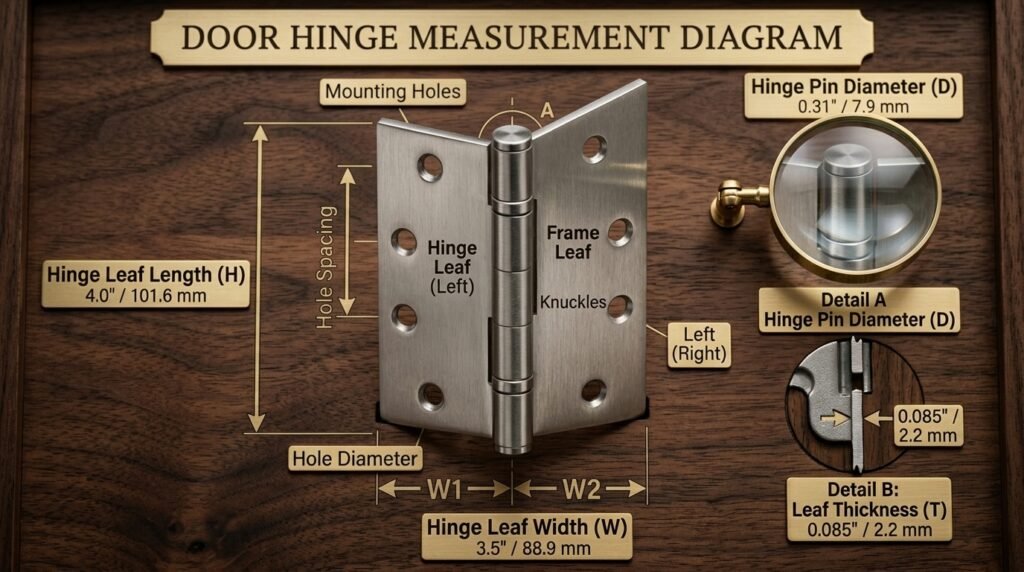
When people talk about door hinge size, standard hinge size, or average door hinge size, they’re usually referring to the hinge leaf length. This is the measurement from the top of the hinge to the bottom when it’s fully extended. Think of it as the overall height or width of the hinge plate. The common door hinge size you’ll encounter most often is based on this leaf measurement.
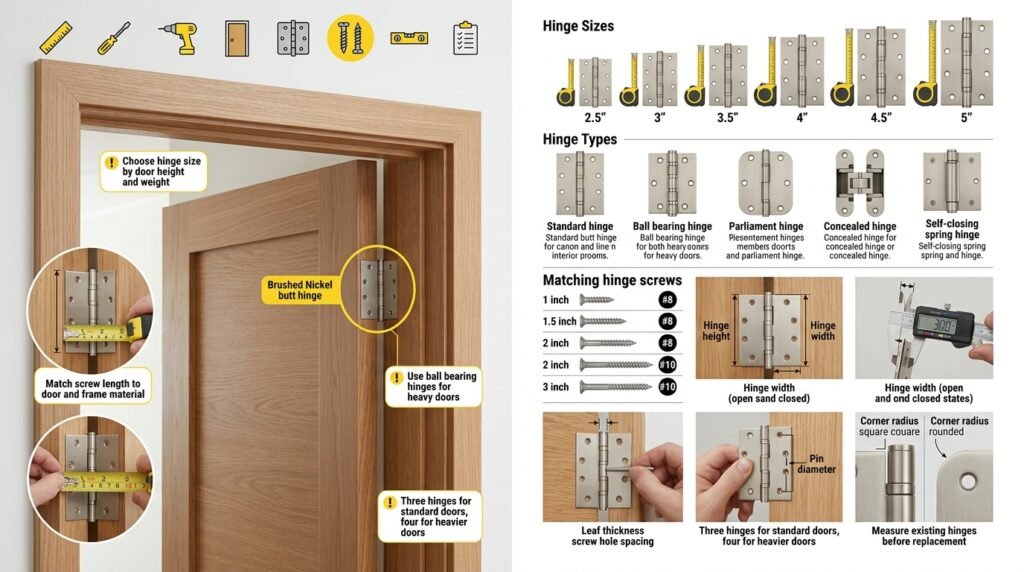
The most common standard door hinge size for residential interior doors is 3.5 inches tall. This is the standard interior door hinge size that works perfectly for most standard 1.375-inch thick interior doors. For exterior doors or heavier duty applications, you’ll often see 4-inch hinges or even larger sizes. Understanding are door hinges standard size is crucial—the answer is yes for most residential applications, but variations exist.
For comprehensive hinge selection guidance, check out the Hinge Outlet’s detailed hinge sizes guide
or Lowe’s hinge buying guide for additional residential door hinge specifications.
Common Standard Interior Door Hinge Sizes and Exterior Door Hinge Sizes:
- 3.5 inches: The most common size for standard interior doors and average door hinge size • 4 inches: Better for exterior door hinge size or where extra support is needed • 4.5 inches: For commercial applications or very heavy doors • 5 inches and larger: Specialty applications like gate hinge size charts or industrial doors
Are All Door Hinges the Same Size? Why Size Matters More Than You Think
The answer to “are all door hinges the same size” is a resounding no. Using the wrong hinge size might seem like a small mistake, but it creates real problems. A hinge that’s too small won’t distribute the door’s weight properly, causing the door to sag over time. Conversely, a hinge that’s too large might not fit properly in the door jamb recess.
The key is matching the hinge size to both your door thickness and the amount of weight it needs to support. Standard residential doors work fine with 3.5-inch butt hinges, but knowing whether all door hinges are the same size (they’re not) saves you from countless installation headaches. Butt hinges, ball bearing hinges, spring hinges, and specialty hinges all come in different dimensions. For a full walkthrough of installing hinges correctly during a door installation, This Old House’s guide to hanging an interior door is an excellent step-by-step reference.

The Complete Guide to Door Hinge Screw Sizes, Screw Size Charts, and What Size Screws for Door Hinges
What Size Screws for Door Hinges and Interior Door Hinges?
The standard door hinge screw size is #8 x 1.25 inches for most residential hinges. These screws are the workhorses of door installation, holding the hinge firmly to both the door and the jamb. Understanding what size screws for interior door hinges prevents frustrating installation errors. The hinge screw size you choose directly impacts your door’s longevity and performance.
Learn more from McKinney Hinge’s technical resources
which provide detailed door hinge screw size chart information.
Standard Door Hinge Screw Size Chart and Exterior Door Hinge Screw Size Information:
For Interior Door Hinges: #8 x 1.25 inches (the most common size and standard door hinge screw size) For Exterior Door Hinges: #10 x 1.5 inches (exterior door hinge screw size – larger and stronger) For What Size Screws for Exterior Door Hinges (Commercial): #10 x 2 inches minimum For Light Duty Cabinet Hinges: #6 x 0.75 inches (smaller for delicate work) For Heavy Duty Commercial Hinges: #10 x 2 inches or larger
Why the “#” Number Matters and How to Read Screw Specifications
The # The symbol followed by a number refers to the screw gauge. Higher numbers mean thicker screws. A #8 screw is thicker than a #6 screws. The number after the X represents the length in inches. So #8 x 1.25 means you’re getting a gauge-8 screw that’s 1.25 inches long. Understanding standard door hinge screw size and standard hinge screw size is essential knowledge.
For your average residential door, #8 x 1.25 inch wood screws work beautifully. They’re strong enough to hold the hinge securely without being overkill. When you’re replacing hinges and need to know what size screws for door hinges or what size screws for interior door hinges, the easiest approach is to remove the old hinge and take it to your local hardware store. Match the screw size visually, and you’ll get exactly what you need.

Cabinet Hinge Sizes Explained: Standard Sizes, Cup Sizes, and Hole Measurements
Are Kitchen Cabinet Hinges Standard Size and What Are Cabinet Hinge Sizes?
Kitchen cabinet hinges are quite different from door hinges, and yes, there are somewhat standard sizes—but with more variation than you’d expect. Are kitchen cabinet hinges standard size? Largely yes, though cabinet hinge sizes explained can be complex. Cabinet hinges are typically smaller and more specialized because they need to be hidden or semi-hidden behind cabinet doors. The cabinet door hinge size chart varies based on hinge type and overlay specification.
The most common cabinet hinge size is the European hinge or “Euro hinge,” which uses a 35mm cup hole. This became the industry standard because it allows for quick adjustability and clean aesthetics. Are all cabinet hinges the same size? Not exactly—but cabinet hinge sizes follow conventions. Traditional face-mounted hinges come in various sizes, but 2-inch and 2.5-inch lengths are common. Our kitchen cabinet sizes calculator helps you plan cabinet dimensions including hinge specifications accurately.
Cabinet Hinge Sizes Explained and Cabinet Door Hinge Size Chart Variations:
Standard Overlay Hinges: 1.5 to 2.5 inches long, used for face-mounted applications European Cup Hinges: 35mm cup diameter standard (some use 26mm or 40mm) Blum Hinge Sizes: Typically 35mm cup with various mounting depths (7mm, 8mm, or 10mm) Cabinet Hinge Screw Size: Typically #6 x 0.75 inches for cup installation
Cabinet Hinge Hole Size, Cup Size, and Forstner Bit Specifications
Here’s where cabinet hinges get specific. Understanding cabinet door hinge hole size is critical. The cup is the recessed part where the hinge sits inside the cabinet door. A 35mm cup diameter means you need a 35mm hole drilled into the door. If you’re replacing hinges and need to know cabinet hinge hole size or cabinet door hinge hole size, this number becomes absolutely critical to get right.
The standard cabinet hinge hole size is 35mm diameter and typically 12mm deep. Some premium brands like Blum use the same 35mm standard but offer varying mounting depths. This depth adjustment is one reason why European hinges became so popular—they offer micro-adjustments that make door alignment simple. The forstner bit size for cabinet hinges is 35mm for most standard applications. European hinge hole size standards remain consistent across quality manufacturers.
If you’re drilling your own cabinet hinge holes, a Forstner bit is essential. A 35mm Forstner bit creates the clean, flat-bottomed hole that cabinet hinges need. Regular drill bits create ragged holes and chip the veneer. For professional results on bathroom renovation projects with vanity cabinets, always use the correct forstner bit size for cabinet hinges.

Specialty Hinges and Their Unique Sizes: Ball Bearing, Piano, Spring, and Gate Hinges
Ball Bearing Hinges: Built for Heavy Duty Work and Commercial Applications
Ball bearing hinges are engineered for doors that get heavy use. Think commercial buildings or high-traffic entryways. Ball bearing hinges use ball bearings between the hinge plates to reduce friction and wear. These hinges come in sizes ranging from 3.5 inches to 5 inches or larger, and they typically use heavier gauge materials than standard butt hinges.
The benefit? They last much longer and handle weight more effectively than standard hinges. The trade-off is cost—they’re significantly more expensive. For your average home, standard butt hinges work fine, but if you have a heavy interior door that gets slammed regularly, ball bearing hinges might be worth the investment for longevity.
Piano Hinges and Continuous Hinges: Length, Flexibility, and Custom Sizing
A piano hinge runs the entire length of a door or lid. Instead of three or four separate hinges, one continuous hinge distributes weight evenly across the entire span. Piano hinges are available in different lengths—commonly 3 feet, 4 feet, 6 feet, or custom lengths. Can you cut a piano hinge to size? Yes. Cutting piano hinges to size requires a hacksaw and careful measurement, but it’s entirely possible for custom applications.
Piano hinges are perfect for heavy lids on storage benches, workbenches, or murphy beds where even weight distribution matters. A standard piano hinge is about 1 inch wide and comes in various thicknesses and materials (steel, stainless steel, brass). The continuous hinge design makes them ideal for applications where you need to cut a piano hinge to fit your specific dimensions.
Spring Hinges and Self-Closing Door Applications
Spring hinges automatically close doors without manual pushing. They’re common in commercial buildings and some residential applications (like bathroom or pantry doors). Spring hinges come in 3.5-inch and 4-inch sizes and require professional installation because the spring tension needs adjustment. Unlike standard hinges, spring hinges have internal mechanisms that control closing speed and tension.
Gate Hinges and Heavy-Duty Applications: Understanding Gate Hinge Size Charts
[Image: Comparison photo showing side-by-side view of standard door hinge versus heavy-duty gate hinge | Alt: “Standard interior door hinge versus heavy-duty gate hinge size comparison”]
Gate hinges and outdoor door hinges are built to handle weight and weather exposure. Gate hinge size chart specifications show these come in larger sizes—typically 4.5 inches to 6 inches or more. The hinge pin is much thicker (sometimes 0.5 inches in diameter), and the mounting plates are heavier gauge steel. Exterior door hinge sizes for gates require careful consideration of weight and climate.
A gate hinge size chart typically shows multiple options depending on gate weight. A small wooden gate might use 4-inch hinges, while a heavy metal gate requires 5-inch or 6-inch hinges with reinforced mounting plates. Door hinge pin sizes for gates are much larger than residential applications.

Blum Hinges: Understanding Premium Cabinet Solutions and Hinge Specifications
Why Blum Hinges Are the Industry Standard for Cabinet Making
Blum is an Austrian hinge manufacturer known for precision engineering and reliability. Blum hinge sizes and Blum overlay hinge sizes have become the gold standard in high-end cabinetry. If you’re building custom cabinets or upgrading your kitchen, you’ve probably heard about Blum hinges. Understanding Blum hinge hole size and Blum hinge plate sizes is essential for professional installations.
Blum hinges use a 35mm cup standard (same as most European hinges) but offer superior adjustability. Each hinge has three-way adjustment: height, depth, and side-to-side. This means you can fine-tune door alignment even after installation, which is a game-changer for cabinet makers. Blum hinge screw size and Blum hinge plate sizes are precisely engineered for their systems.
Blum Hinge Plate and Screw Sizes—Complete Specifications:
- Blum Cup Hole: 35mm diameter, 12-13mm deep (standard Blum hinge hole size) • Blum Hinge Screw: #6 x 0.75 inches (for mounting hinge cup) • Blum Plate Screw: #8 x 1 inch (for mounting bracket to cabinet) • Blum Overlay Hinges: Standard 1.5 to 2.5 inch leaf length depending on model • Blum Hinge Plate Sizes: Vary by hinge type and overlay specification
Blum Overlay Hinge Sizes and Cabinet Door Integration
Blum offers various overlay options—how much the door overlaps the cabinet frame. A full overlay door covers the frame completely, while a partial overlay leaves the frame partially visible. Blum overlay hinge sizes and Blum hinge plate sizes depend on which overlay style you choose. For most modern kitchen cabinets, Blum CLIP or BLUMOTION hinges with 110-degree opening angle are the go-to choice. These soft-close hinges prevent slamming and come with built-in dampers that make cabinet doors close slowly and quietly.

How to Measure Your Existing Hinges: Step-by-Step Measurement Guides
Step-by-Step: Measuring Hinge Size Like a Pro—Door Hinge Measurement Techniques
The easiest way to measure hinge size is to remove the old hinge and lay it flat on a ruler or measuring tape. Measure from the top of one leaf to the bottom—that’s your standard interior door hinge size or exterior door hinge size measurement. That’s your hinge size. If you can’t remove the hinge, measure from where the hinge pin sits to the top and bottom edges. Measure also the thickness (how much the hinge protrudes from the door) and note the pin diameter if visible.
[Image: Step-by-step photo guide showing proper measurement technique for door hinges with ruler in hand | Alt: “How to measure door hinge leaf length using a standard ruler”]
Measuring Cabinet Hinge Hole Size and Cabinet Door Hinge Hole Size
For cabinet hinges, measuring the cup hole is critical. Cabinet door hinge hole size determines your drilling specifications. Use a caliper or measuring tape to check the diameter. Cabinet hinge hole size standards show that most modern cabinets use 35mm, but older cabinets might use 26mm or non-standard sizes. Also measure the depth of the cup recess (how deep the hole goes into the door).
Standard European hinges are typically 12-13mm deep. Knowing cabinet hinge cup size and the proper cabinet door hinge hole size prevents you from buying hinges that sit too shallow or too deep. Professional cabinet makers always verify cabinet hinge hole size before ordering new hinges.
Quick Reference: What to Write Down When Measuring Your Hinges
- Hinge leaf length (e.g., 3.5 inches for standard door hinge size) • Hinge width (the measurement side-to-side) • Pin diameter (thickness of the pivot pin) • Screw hole spacing and size (are they #8 or #10?) • For cabinet hinges: cup diameter and depth (usually 35mm x 12mm) • Door thickness (standard is 1.375 inches) • Number of hinges currently installed
Take a photo of the old hinge or bring it to the hardware store. Visual comparison is often the fastest way to get an exact match and avoid costly mistakes. If you’re also sizing the door itself as part of a bigger project, our door size calculator and rough opening calculator make sure everything lines up before you buy hardware.

Common Hinge Problems and How Size and Selection Relate to Solutions
Why Does My Door Sag? Understanding Hinge Size Relationships to Door Sagging
Door sagging usually means your hinges are too small or too weak for the door weight. A sagging door places excessive stress on the hinge pins, causing them to bend or break. This is one of the most common door hinge problems. The solution is upgrading to larger or heavier-duty hinges. Understanding standard door hinge size might mean recognizing that your 3.5-inch hinges are undersized.
If you’ve got a heavy exterior door or a solid wood interior door, moving from 3.5-inch to 4-inch hinges (or adding a third hinge) often solves sagging immediately. For very heavy doors, ball bearing hinges are worth considering. Adding an extra hinge distributes weight more evenly and prevents the sagging problem entirely.
Cabinet Door Won’t Close Properly? Alignment and Adjustment Solutions
When cabinet doors won’t close evenly, the problem is usually hinge adjustment, not size. Modern European hinges have micro-adjustment screws that let you shift the door slightly left, right, up, or down. Before replacing hinges and learning new cabinet hinge sizes, try turning the adjustment screws on your current hinges. Before you stress about cabinet hinge sizes explained or needing new cabinet door hinge size specifications, test these adjustments first.
If adjustment doesn’t work, your hole might be drilled in the wrong location. Redrill the cup hole 2-3mm off-center in the direction you need the door to move. Understanding cabinet hinge hole size drilling can prevent this issue entirely.
Hinges Rusting or Corroding? Material Selection Matters More Than Size
Exterior door hinges need to resist rust and corrosion. Standard steel hinges corrode in wet climates. Upgrade to stainless steel hinges for exterior doors, or choose galvanized steel as a budget-friendly alternative. Exterior door hinge sizes stay the same, but material does. A 4-inch stainless steel hinge costs more than a 4-inch steel hinge, but it lasts decades without rust or maintenance.
Frequently Asked Questions About Door and Cabinet Hinge Sizes
No. Are door hinges standard size? For residential interiors, yes—3.5 inches is standard. But are all door hinges the same size across applications? Absolutely not. Standard interior door hinge size differs from exterior door hinge size (4 inches). Cabinet hinges are completely different. Always verify the exact hinge size before buying replacements.
For interior doors, #8 x 1.25 inch wood screws are standard—this is the standard door hinge screw size. What size screws for interior door hinges? #8 x 1.25. What size screws for exterior door hinges? Use #10 x 1.5 inch screws instead. For what size screws for cabinet hinges, use #6 x 0.75 inches. The best approach is to remove a hinge and match the screw visually at your hardware store.
The standard hinge screw size for residential interior doors is #8 x 1.25 inches. This standard door hinge screw size works reliably across most applications. Standard interior door hinge screw size rarely varies from this specification.
You could force them in, but it's not recommended. Larger screws may split the wood or damage the hinge screw holes. Always use the size the hinge was designed for. Mixing screw sizes compromises the integrity of your installation.
Standard European cabinet hinges use a 35mm cup hole—this is the cabinet hinge cup size and cabinet hinge hole size standard. What forstner bit size for cabinet hinges? Use a 35mm Forstner bit. The Forstner bit size for cabinet hinges creates the necessary 35mm cup hole diameter. Cabinet door hinge hole size standards remain consistent at 35mm for modern systems.
Cabinet hinge cup depth should be 12-13mm. This standard cabinet hinge hole depth allows proper hinge cup seating. Cabinet hinge cup size of 35mm with 12-13mm depth is the modern standard for European-style hinges.
4-inch hinges distribute weight over a slightly larger area, making them better for heavy doors. If your door sags with 3.5-inch hinges (the average door hinge size), upgrade to 4-inch or add a third hinge. For average residential doors, 3.5 inches is sufficient. But for solid wood or heavy doors, 4-inch is the better choice.
For custom or high-end cabinets, yes. Blum hinges offer superior adjustability and durability. Understanding Blum hinge sizes and Blum overlay hinge sizes is important because Blum products use 35mm cups but with better engineering. For basic cabinetry, standard European hinges work fine. Consider Blum if door alignment precision matters or you want soft-close functionality.
Yes, you can cut a piano hinge with a hacksaw. Can you cut a piano hinge to size? Absolutely. Cutting piano hinges to size requires marking your cut line carefully, using a fine-tooth blade, and cutting slowly. Deburr the cut edge with a file afterward. You can cut piano hinges to custom lengths for benches or boxes.
Exterior door hinges are typically larger (4 inches—this is the standard exterior door hinge size). Exterior door hinge specifications require heavier gauge materials and corrosion-resistant finishes like stainless steel. Interior door hinges are smaller (3.5 inches—the standard interior door hinge size) and use standard steel. Exterior doors also usually need three hinges instead of two due to extra weight.
Related Resources and Tools for Your Home Renovation Projects
If you’re working on comprehensive home projects beyond just understanding door hinge sizes, these resources will be invaluable:
Our kitchen cabinet sizes calculator helps you plan cabinet dimensions accurately, including understanding cabinet hinge sizes. For bathroom renovations that include vanity cabinets with European-style hinges, use our bathroom renovation calculator to plan your layout.
Planning a full home renovation project? Our home renovation guide walks through planning, budgeting, and execution. If you’re focused on overall door dimensions and framing specifications, our door size calculator and rough opening calculator ensure everything fits perfectly within rough openings.
For cabinet projects, check our kitchen cabinet cost calculator for budget planning, and our hinge calculator for pinpointing exact hinge requirements for your doors and cabinets.
For more general background on hinge design and terminology, these authoritative sources are helpful:

The Bottom Line: Getting Door Hinge Sizes and Cabinet Hinge Sizes Right
Door hinge sizes and cabinet hinge sizing might seem complicated at first glance, but once you understand the basics, selecting and installing hinges becomes straightforward. The key takeaways about standard door hinge sizes are simple and actionable:
Standard residential interior doors use 3.5-inch hinges with #8 x 1.25 inch screws. Exterior doors need 4-inch hinges with #10 x 1.5 inch screws. Cabinet hinges typically use a 35mm cup with European hinge specifications. Specialty applications (gates, heavy doors, commercial spaces) require larger or more robust hinges. Understanding whether all door hinges are the same size (the answer is no) prevents costly installation mistakes.
When in doubt, remove the old hinge and take it to your hardware store for visual matching. This is faster and more reliable than guessing at standard door hinge sizes. Write down your measurements, take photos, and verify everything before purchasing replacements.
Whether you’re replacing a single hinge, installing new cabinet doors, or tackling a full-scale renovation, understanding hinge sizes gives you the confidence to make smart choices. Your doors will hang straight, close properly, and function smoothly for years to come. Understanding standard hinge sizes and cabinet hinge specifications is foundational knowledge for any home improvement project involving doors or cabinets.
Happy building, and may your doors swing smoothly!