Blind Corner Cabinet: The Complete Guide to Dimensions, Organizers & Solutions
Open the door of that awkward cabinet in your kitchen corner, and what happens? You reach in, your arm disappears into the dark, and you feel around blindly hoping to touch whatever pot you’re looking for. If that sounds painfully familiar, you’re dealing with a kitchen blind corner cabinet — and you’re definitely not alone.
People search for this same feature under a dozen different names — blind corner kitchen cabinet, kitchen cabinet blind corner, cabinet blind corner, corner blind cabinet — all describing the cabinet that eats spatulas and never gives them back. The good news: this style isn’t a design flaw. It’s one of the smartest ways to use awkward corner space, once you understand its dimensions and the organizer hardware built to fix its one real weakness — accessibility.
This guide covers blind corner cabinet dimensions, the best blind corner cabinet organizer options, how blind corner cabinet solutions compare to a lazy Susan, and how blind corner base cabinet installation actually works. By the end, that dark, forgotten corner will make complete sense.

What Is a Blind Corner Cabinet?
Let’s start with the basics. What is a blind corner cabinet? It’s a kitchen base or wall cabinet installed where two runs of cabinetry meet at a 90-degree corner. From the front, it looks like a normal cabinet with a single door. But behind that door, the cabinet box extends sideways into the corner — creating a deep, hidden compartment that isn’t visible when you open the door head-on. That hidden section is the ‘blind’ part — hence the name, and the reason what is a blind corner base cabinet and what is blind corner cabinet searches all lead back to the same idea: genuinely useful extra volume that’s hard to reach without the right hardware.
Builders love blind corner cabinets because they’re cheaper and simpler to install than curved or diagonal corner units, and they keep a clean, continuous cabinet line along both walls. The tradeoff is accessibility — which is exactly the problem this guide is going to solve.
💡 Quick Tip: If your kitchen has an L-shaped or U-shaped layout, you almost certainly have at least one blind corner cabinet already, whether you’ve noticed it or not. Check where your two cabinet runs meet — that’s it.
Corner Cabinet Space Finder
Quickly find out how much space your blind corner cabinet actually needs on the wall to clear adjacent doors and handles.

Blind Corner Cabinet Dimensions, Sizes & Measurements
If you’re planning a renovation, blind corner cabinet dimensions — sometimes phrased as blind corner cabinet measurements or blind corner cabinet sizes — are the first thing to nail down. This category is remarkably standardized across manufacturers, which makes shopping and layout planning much easier.
Standard Blind Corner Base Cabinet Sizes
For blind corner base cabinet dimensions, the industry sticks to a fairly tight range, which defines the standard corner cabinet size most buyers should expect to see listed:
- Width: Most commonly 36 or 42 inches, though 33-inch and 39-inch options also exist depending on the manufacturer.
- Depth: 24 inches is the standard depth, matching regular base cabinets so the countertop stays flush.
- Height: 34.5 inches without the countertop — the same height as every other standard base cabinet in your kitchen.
A 36 blind corner base cabinet — often just called a 36 blind corner cabinet or 36 inch blind corner cabinet — is the most popular size for mid-sized kitchens, while a 42 blind corner base cabinet suits larger layouts. Some manufacturers label a 33 blind corner cabinet as their compact option, and 36 blind corner base cabinet dimensions charts typically show a range rather than one fixed number, since the cabinet can usually be pulled slightly wider from the corner.
Blind Corner Wall, Upper & Other Corner Cabinet Types
Up top, a blind corner upper cabinet — also called a blind corner wall cabinet or wall blind corner cabinet — follows a different size chart. A common configuration is a 24x24x12 blind corner wall cabinet, while a 36x18x12 upper corner blind cabinet suits taller wall runs, typically 12 inches deep. For blind corner upper cabinet solutions, the same pull-out and swing-out principles used in base cabinets apply, just scaled down.
Blind corner units aren’t the only way to handle a corner cabinet kitchen layout. A diagonal corner cabinet uses an angled front for corner sinks. A half moon corner cabinet or magic corner cabinet uses curved, two-stage rotating shelves, while a pull out corner cabinet is simply a blind corner base fitted with pull-out hardware. Each trades accessibility for storage volume, or vice versa.
Quick Reference: Blind Corner Cabinet Size Chart
| Cabinet Type | Common Width | Depth |
|---|---|---|
| Blind Corner Base (33") | 33" (up to 36") | 24" |
| Blind Corner Base (36") | 36" (up to 39") | 24" |
| Blind Corner Base (42") | 42" (up to 45") | 24" |
| Blind Corner Upper/Wall | 24"–36" wide | 12" |
Need to plan your exact layout before you order? Our kitchen cabinet sizes calculator was built exactly for this — punch in your corner measurements and it helps you quickly work out which cabinet width actually fits your space, without the back-and-forth math.

Blind Corner Cabinet Organizer Solutions That Actually Work
This is where most people land when searching for blind corner cabinet solutions or solutions for blind corner cabinets — because the dimensions are one thing, but actually using that hidden space is the real challenge. Hardware manufacturers have spent decades solving this with a growing range of blind corner cabinet hardware and accessories, also just called cabinet accessories in the trade.
Pull-Out Organizers and Cabinet Inserts
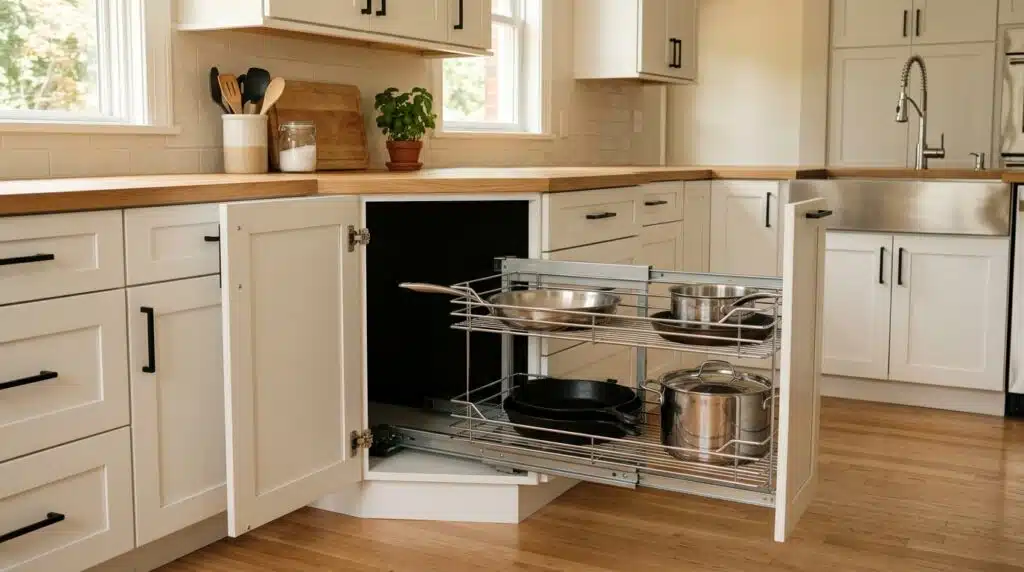
A pull-out organizer is the most popular fix — pull-out shelves or wire baskets on sliding shelves that glide the entire unit out on ball-bearing tracks. Many are sold as a blind corner cabinet insert that drops into an existing cabinet box.
The best-known name is rev-a-shelf blind corner cabinet organizer hardware, particularly the 5PSP Series — widely regarded as the best rev-a-shelf blind corner cabinet organizer line for the price, with the rev-a-shelf 5psp-18-cr blind corner review consensus consistently positive. Rev-A-Shelf also makes the Girasolo 587 Series, using a soft-close pivot mechanism, and half-moon organizers. You can buy blind corner cabinet organizer online usa-wide through major retailers, with a cheap blind corner cabinet insert under 100 realistic for a basic wire pull-out.
Full Access Trays, IKEA Inserts & Swing-Out Systems
For maximum reach, look for a blind corner base cabinet with full access trays system — a magic corner or Hafele mechanism using two-part swinging and sliding trays. If your kitchen uses flat-pack cabinetry, search specifically for a blind corner cabinet insert for ikea kitchen, since IKEA’s SEKTION line uses different internal dimensions than most stock cabinets.
A swing out corner cabinet mechanism uses hinged shelves that rotate outward, while half-moon organizers use D-shaped rotating shelves — a hybrid between lazy Susan convenience and true blind corner organizer depth, ideal for a blind corner cabinet organizer kitchen upgrade during a remodel.
💡 Quick Tip: If you’re retrofitting an existing cabinet, measure your opening width and depth before shopping. Most kits are sized for a 15-inch or 18-inch door opening — getting this wrong is the number one return reason. Knowing how to install a pull out shelf in a blind corner cabinet before you buy, including floor-mount vs. door-mount styles, saves a return trip.
Already have a favorite storage layout in mind for the rest of your kitchen? Our kitchen organizer guide and knife drawer organizer pair nicely with a newly organized blind corner shelf or blind corner cabinet accessories setup.

Blind Corner Cabinet Organizer DIY: Budget Solutions
Not ready to invest in a full pull-out system? A blind corner cabinet organizer DIY approach can genuinely work if your goal is just to stop losing things in the back.
- Lazy Susan insert: A simple two-tier rotating turntable drops into the blind section and instantly makes items spinnable and visible.
- Stackable wire baskets: Freestanding baskets with handles let you pull out a whole ‘shelf’ of items at once, even without rail hardware.
- Labeled bins by zone: Divide the cabinet into front, middle, and back zones — daily items up front, occasional items pushed back.
- Grabber tool or hook: For upper blind corner cabinets, a small grabber saves you from climbing on the counter to reach the back corner.
For blind corner cabinet solutions DIY projects, the goal isn’t matching a professional system — it’s to stop treating that corner like storage purgatory. Even basic bins make a measurable difference.

Blind Corner Cabinet vs. Lazy Susan: Which Is Better?
This is one of the most searched comparisons in kitchen design — blind corner cabinet vs lazy susan which is better comes up constantly — and the honest answer is: it depends on what you’re storing. A lazy susan corner cabinet and a blind corner cabinet solve the same problem differently.
Lazy Susan: Best for Easy, Frequent Access
A lazy susan cabinet uses a rotating tray — spin it, and whatever you need rotates to the front. This is what people mean by a blind corner lazy susan cabinet, blind corner cabinet lazy susan, or lazy susan for blind corner cabinet — swapping a static blind shelf for a rotating one. Lazy susan cabinet ideas work best for smaller, frequently grabbed items like spices and oils. The tradeoff: the round shape wastes some space in the corners of the square box, and heavier items can be awkward to spin.
Blind Corner: Best for Bulky Storage
A blind corner cabinet, paired with a pull-out or full-access-tray organizer, generally offers more usable volume for larger items — stand mixers, big stockpots, roasting pans. If you've ever owned a blind base corner cabinet for people who hate lazy susans, you know the complaint: spinning trays wobble and items slide off. A well-organized blind corner sidesteps that entirely; nothing spins, nothing rolls off.
| Factor | Lazy Susan | Blind Corner Cabinet |
|---|---|---|
| Best for | Small, frequent-use items | Bulky, occasional-use items |
| Access style | Rotates into view | Slides or swings out |
| Wasted space | Corners of the square box | Minimal with pull-out hardware |
| Moving parts | Central spinning post | Slides, hinges, or pivots |
| Typical cost | Lower | Higher with premium hardware |

Common Blind Corner Cabinet Problems (And Quick Fixes)
Most complaints boil down to a corner cabinet hard to reach experience that makes people avoid the space entirely. Nearly every complaint has a straightforward fix.
- “I can’t reach anything.” The classic kitchen corner wasted space complaint — solved by adding a pull-out or swing-out organizer instead of a static shelf.
- “Not enough storage.” A blind corner cabinet not enough storage hack: vertical dividers and stackable bins effectively double usable capacity without new hardware.
- “The door keeps swinging open.” Usually a magnetic catch or hinge tension issue — a blind corner cabinet door keeps swinging open fix, or simply how to fix a blind corner cabinet door, means replacing a worn catch or adjusting the hinge tension screw.
- “I can’t maximize the space.” Focus on maximize corner cabinet space — and how to maximize space in a blind corner cabinet specifically — by combining a pull-out system with vertical storage, since most wasted volume is vertical, not horizontal.
For general corner cabinet organization ideas, grouping items by how often you use them beats organizing purely by size. The best way to organize pots and pans in blind corner storage is nesting by size with lids stored separately in a vertical rack.

Blind Corner Base Cabinet Installation: What to Know Before You Start
If you’re doing a full kitchen remodel, blind corner base cabinet installation has a few quirks regular cabinets don’t. General corner cabinet installation tips apply too: dry-fit everything, check door swing, and never assume two ‘standard’ cabinets will line up without a filler.
Understanding “Pull”
The single most important concept in base blind corner cabinet installation is ‘pull’ — the distance the cabinet must sit away from the adjacent wall so its door and drawer can swing open without hitting anything. Minimum pull is typically around 3 inches; maximum pull can run up to 9 inches depending on hardware and door style. Skipping this calculation is the single most common installation mistake — the door ends up swinging into the neighboring cabinet or appliance handle.
Filler Strips, Rough Opening & Hinges
Most blind base corner kitchen cabinet installs require a filler strip to create pull clearance. When framing the space, factor in the rough opening carefully — a blind corner cabinet rough opening dimensions chart from your manufacturer is worth requesting, since the visible door width is smaller than the total floor footprint once you include the blind extension. For digital planning, an archicad blind corner base cabinet object models pull clearance automatically, which is where kitchen cabinet layout corner planning software earns its cost.
A corner cabinet hinge for a blind corner door is typically a wide-angle European-style hinge rated for heavier doors. A blind corner cabinet hinge type and size guide from the manufacturer will specify the correct opening angle for your door width.
DIY Installation and Cost
A diy blind corner cabinet pull-out install is doable for confident DIYers — measure the opening, secure the base track, and test the swing. A full how to build a blind corner cabinet from scratch project is best left to someone comfortable with box construction. Wondering how much does a blind corner cabinet cost to install? As part of a remodel, expect a few hundred dollars in labor alone; retrofitting just a pull-out organizer is far cheaper and often a weekend project. Costs vary by region — corner kitchen cabinet renovation cost uk pricing runs differently than US figures due to labor rates. Manufacturer kitchen cabinet corner solutions before and after photos, including 36 inch blind corner cabinet with pull out shelf transformations, are worth a look before committing.
💡 Quick Tip: Always dry-fit the cabinet and test the door swing before securing anything permanently. It takes ten extra minutes and prevents a very expensive redo.
Planning a bigger kitchen remodel corner cabinet overhaul? Our kitchen layout ideas guide and kitchen island calculator help you map the room before cabinets go in. Our hinge calculator and slide locks selector take the guesswork out of hardware shopping.

Blind Corner Cabinet Hardware, Manufacturers & Brands
Knowing the blind corner cabinet manufacturers and blind corner cabinet brands worth trusting saves research time. A handful of names dominate the blind corner cabinet hardware and accessories market for good reason.
- Rev-A-Shelf: The most recognized name in blind corner hardware, from basic wire pull-outs to the premium Girasolo pivot system and half-moon organizers.
- Häfele: Known for the Magic Corner II — a two-stage pull-out and swing mechanism. Comparing hafele corner cabinet solutions? Request a current hafele magic corner ii price quote directly, since pricing varies by region.
- Blum: A premium European brand offering blum corner cabinet solutions with soft-close, smooth-glide technology, often specified in custom kitchens.
For anyone designing digitally, blind corner cabinet CAD files are typically available from these manufacturers’ websites — useful for confirming clearances before you buy. See how Rev-A-Shelf’s blind corner hardware lineup compares across pull-out, pivot, and half-moon styles directly from the manufacturer.

How to Organize a Blind Corner Cabinet: Practical Tips
Wondering how to organize a blind corner cabinet once the hardware is in? Here’s the practical, no-nonsense approach.
- Front zone: Reserve this for what you reach for weekly — everyday pots, the cutting board, mixing bowls.
- Back zone: This is where seasonal or occasional items belong — holiday bakeware, the turkey roaster, the ice cream maker you use twice a summer.
- Group by task, not by shape: Keep all your baking gear together and all your stovetop gear together, rather than organizing purely by size.
- Use vertical dividers: Flat items like baking sheets and cutting boards get lost easily in deep spaces — vertical slot dividers keep them upright and visible.
If you’re figuring out what to put in a blind corner kitchen cabinet for the first time, start with your least-used large items. This cabinet’s biggest strength is volume, so let it hold what your other cabinets can’t.

Blind Corner Cabinet for Small Kitchen Ideas
In a smaller kitchen, every inch matters more, which makes solving the kitchen corner cabinet storage problem even more worthwhile. For genuine blind corner cabinet for small kitchen ideas, a well-fitted pull-out organizer in a compact 33-inch or 36-inch cabinet adds the equivalent of an entire extra cabinet’s worth of usable kitchen storage without expanding the floor plan. A 15 inch blind corner cabinet pull out unit is often the right scale for tight layouts — small enough for a narrow door opening while still bringing full access to the hidden depth behind it. These kitchen storage solutions corner options are especially popular in galley kitchens and apartments, and good cabinet design means thinking about how the blind corner interacts with the rest of the layout, not just in isolation.
Renovating a small kitchen overall? Our home renovation guide and kitchen cabinet cost calculator help you plan the budget and scope before the first cabinet comes out.
Frequently Asked Questions About Blind Corner Cabinets
What is a blind corner cabinet?
What are the standard blind corner cabinet dimensions?
How do I organize a blind corner cabinet?
Is a blind corner cabinet better than a lazy Susan?
How much does it cost to install a blind corner cabinet organizer?
What is the rough opening for a blind corner cabinet?
Can I install a pull-out shelf in an existing blind corner cabinet?
What's the best blind corner cabinet organizer brand?
Do blind corner cabinets work for small kitchens?
What's the difference between a blind corner base cabinet and an upper blind corner cabinet?

Your Blind Corner Cabinet Doesn’t Have to Be a Black Hole
Here’s the thing about blind corner cabinets: the design itself isn’t the problem. The problem is leaving that hidden space unorganized and hoping for the best. Once you understand the dimensions, pick the right pull-out or swing-out hardware, and set up a system for what goes where, that corner becomes one of the most useful cabinets in your entire kitchen.
Whether you’re planning a full renovation, retrofitting an existing cabinet with a Rev-A-Shelf pull-out, or just organizing what you already have with labeled bins, the goal is the same: turn wasted, hard-to-reach space into storage you actually use.
Ready to plan your layout? Our kitchen cabinet sizes calculator makes it simple to work out exact measurements before you order, and our blind corner cabinet organizer roundup dives deeper into specific product picks if you’re ready to buy. Happy organizing.
Helpful Tools & Related Guides on PrimeHomeAndGarden.com
Kitchen Planning & Calculators
- Kitchen Cabinet Sizes Calculator — work out exact cabinet dimensions for your layout
- Kitchen Cabinet Cost Calculator — budget your full cabinet run before you order
- Kitchen Island Calculator — plan island clearance alongside your corner cabinets
- Hinge Calculator — get the right hinge size and count for any cabinet door
- Slide Locks Selector — match the right slide hardware to your cabinet type
- Shelf Brackets Selector — size brackets correctly for adjustable shelving
Kitchen Organization Guides
- Blind Corner Cabinet Organizers — our full product roundup for pull-out and swing-out systems
- Kitchen Organizer Guide — organize every other cabinet and drawer in the room
- Knife Drawer Organizer — pair with your newly organized corner cabinet
- Kitchen Layout Ideas — plan your full kitchen flow around corner cabinet placement
- Home Renovation Guide — start-to-finish planning for a full kitchen remodel