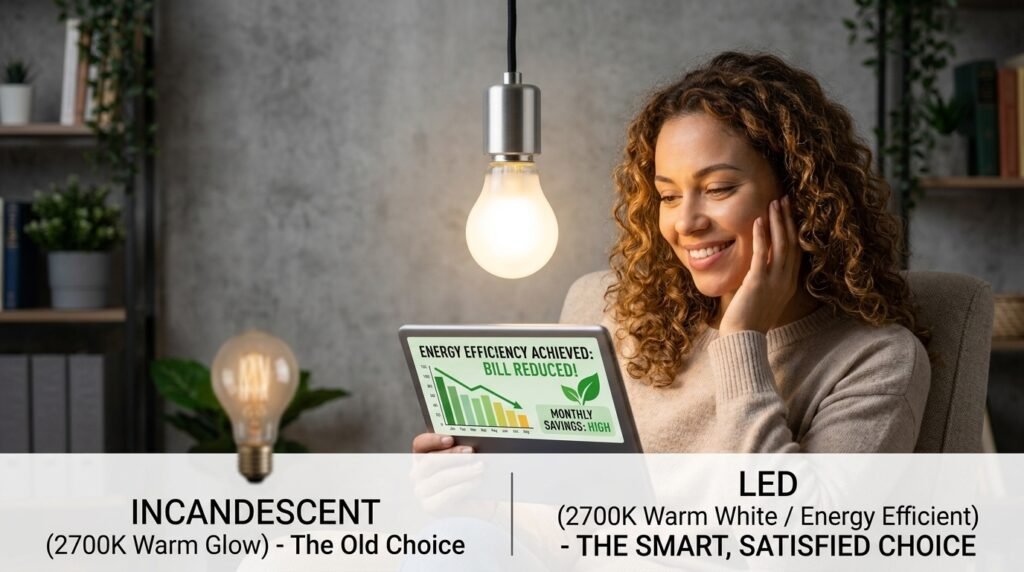
LED Light vs Incandescent – 75-90% Less Energy, Big Savings
Introduction: The Light Bulb Decision That Actually Matters
You’ve probably stood in the lighting aisle, holding two boxes, wondering if it really matters which one you buy. It does — more than most people realize.
Old incandescent bulbs turn about 90% of the electricity they use into heat, not light. That’s why they burn your fingers if you touch one. LED lights flip that equation. According to the U.S. Department of Energy, residential LEDs use at least 75% less energy and last up to 25 times longer than incandescent bulbs — and the good ones use closer to 90% less.
This guide is your complete LED lighting guide — covering LED light bulbs, LED light fixtures, LED strip lights, wiring, troubleshooting, safety, and the best LED lighting solutions for every room and use case, from bedrooms to garages to trailers. Whether you’re planning a simple LED lighting installation or a full LED retrofit lighting project, choosing energy efficient lighting and knowing where to find the best LED lights for your space makes the whole job easier — and this guide walks you through exactly what to buy and how to install it.

1. LED vs Incandescent: What The Numbers Actually Show
💡 Key Takeaway: Switching to LEDs reduces energy consumption by up to 90% while providing a lifespan that lasts over 25 times longer than traditional incandescent bulbs.
Let’s start with the comparison everyone searches for.
A 10-watt LED bulb produces roughly the same light as a 60-watt incandescent bulb. Multiply that across a whole house, and the LED lighting cost savings add up fast. The DOE estimates the average household saves about $225 a year simply by switching to LED lighting, since lighting makes up around 15% of a typical home’s electricity bill.
Here’s a real-life example: if you’re still running incandescent bulbs, switching just five commonly-used fixtures to LED can pay for itself within a single year — and then keep saving you money for the next two decades. That’s the real story behind LED vs incandescent cost comparison 2026: it’s not close.
This same incandescent vs LED light bulbs comparison holds true no matter which fixture you’re looking at — the physics of how each bulb makes light doesn’t change from room to room.
Sodium vs LED Lighting
Outdoors, the comparison shifts slightly. Sodium vs LED lighting, or sodium lights vs LED as it’s often searched, is a common question for driveways, parking lots, and streetlights. Sodium lights give off that familiar orange glow and were popular for decades, but they use significantly more energy and don’t render colors accurately. A sodium light vs LED side-by-side test almost always favors LED today, since it delivers better visibility, uses less power, and lasts far longer — which is why LED has replaced sodium lighting in most municipal and residential upgrades.
LED vs UV Light
It’s also worth clearing up the difference between UV and LED light, since the two get confused. Standard LEDs produce visible light for everyday illumination, while UV LEDs are a specialized type built to emit ultraviolet wavelengths for things like curing resin, sanitizing surfaces, or blacklight effects — they’re not interchangeable with the LED bulbs you’d use to light a room.

2. LED Lighting Benefits Beyond The Electric Bill
The LED lighting benefits go beyond saving money:
- Longevity: A quality LED bulb can run for 25,000+ hours — about 23 years at three hours a day of use
- Durability: No fragile filament means LEDs handle bumps and vibration far better, which is why they’re standard in automotive LED lighting
- Instant brightness: No warm-up delay, unlike some older CFL bulbs
- Better light quality control: You can choose exact colors and color temperatures
- Lower cooling costs: Since LEDs release far less heat, your air conditioning doesn’t have to work as hard in summer
Pair your new LED lighting install with better lighting placement, and you’ll notice both lower bills and a home that just feels brighter and more welcoming. For a deeper look at doing this safely and efficiently, this guide on LED lighting that’s bright, safe, and efficient is a great next read.

3. Types Of LED Lights And Where To Use Them
Understanding the types of LED lights available makes shopping much easier.
LED Strip Lights
LED strip lights are flexible circuit boards lined with small LEDs, and they come in a few key varieties:
- RGB LED strip lights change between red, green, and blue combinations
- RGBW LED strip adds a dedicated white diode for cleaner white light alongside color
- Addressable LED strip lets you control each individual LED separately for animated effects
- LED neon strip mimics the look of glass neon tubing without the fragility
- LED rope lights indoor work well for soft accent lighting along stairs or shelving
- Flexible COB LED strip packs LEDs closer together for a smoother, dot-free glow
- Commercial LED strip lights are built for continuous, heavy-duty use in retail and hospitality settings
You’ll also want the right accessories: an LED strip channel protects and diffuses the light, while an LED strip holder keeps everything mounted neatly. If you’re only lighting a small space, a small LED strip or a 3 ft LED strip light may be all you need; larger installs often call for a 50 ft LED lights reel with a joined power run.
LED Strip Power And Wiring
Every strip light needs a properly sized LED strip light power supply. Undersizing it is one of the most common installation mistakes. Use an LED strip light power supply calculator to match your strip’s wattage per foot to a supply that has enough headroom — a good rule of thumb is adding 20% extra capacity.
For wiring, most single-color strips use simple two-wire connections, but RGB and RGBW strips need a 4 pin LED strip light wiring diagram (or more, for RGBW) to keep each color channel correctly matched. Many kits also include an inline LED tape light switch, which is worth installing even on a simple strip so you’re not unplugging the power supply every time. If you’re unsure how to wire yours, following the printed LED strip light connection diagram on the packaging — and understanding LED strip light wiring basics before you start — avoids most LED strip lights wiring diagram confusion and troubleshooting headaches later.
Two quick things worth knowing before you buy: can you cut LED strip lights shorter? Yes, but only at the marked cut lines spaced along the strip — cutting anywhere else damages the circuit. And can you use dimmable bulbs in a non-dimmable fixture? You can, but they simply won’t dim; pairing a dimmable bulb with an actual dimmer switch is what unlocks that feature.

4. LED Wiring & Installation: Getting It Right The First Time
A proper LED light wiring diagram saves you time and prevents flickering, dead sections, or a bulb that won’t turn on at all.
Home & Fixture Wiring
- 12V LED light wiring diagram setups are common for landscape lighting, cabinets, and low-voltage runs
- Know what gauge wire for LED lights 12V and what gauge wire for LED light strips before you buy — thinner gauge wire over long runs causes voltage drop and dim spots
- An LED driver (also called an LED driver power supply) converts your home’s AC power into the steady DC voltage LEDs need
- Decide between hardwired LED installation (permanent, wired into a junction box) and plug-in LED installation (simpler, movable)
Recessed Lighting Retrofits
If you’re swapping out old can lights, a recessed lighting retrofit — sometimes called retrofit recessed lighting — is one of the most rewarding upgrades you can do in a weekend. Knowing how to install LED recessed lighting starts with matching your new trim to your existing housing size, so you’re not cutting into drywall. Look for a recessed kit with the right can light trim for your ceiling style, and measure your existing housing before ordering an 8 inch LED recessed lighting retrofit kit. For older homes, remodel recessed lighting kits are designed to work without cutting into the attic space above, and most let you replace recessed light fixture hardware in minutes without an electrician.
- Can lights in bedroom: choose warm 2700K-3000K trims for a cozy feel
- Can lights in garage: go with cooler 4000K-5000K for task visibility
- Compare a few options before buying — the best retrofit LED can lights usually have dimmable drivers and a wide beam angle
Automotive & Trailer Wiring
- 3 wire LED light wiring diagram and 3 wire LED light bar wiring diagram setups typically include power, ground, and switch
- 5 wire LED tail light wiring diagram and LED tail light wiring diagram configurations handle brake, turn signal, and running light functions separately
- Trailer LED lights wiring diagram setups follow a standard color code, but always double-check against your trailer’s connector type
- LED light bar wiring diagram and motorcycle LED light wiring diagram setups often need a relay to avoid overloading a factory switch
- Know how to connect 3 wire LED light to 2 wire systems by identifying the ground, power, and switched wires before splicing
- LED tube light connection diagram setups usually bypass the old fluorescent ballast entirely — check your tube’s packaging to confirm
- Knowing how to wire a trailer with LED lights starts with matching your trailer’s plug type (4-pin, 5-pin, or 7-pin) to the tow vehicle before touching any wiring
- LED reverse lights, LED pod lights, and full LED light bars — including a 12V LED light bar for a truck bumper — typically wire through a relay so the factory switch only carries a small trigger current
- When replacing LED tail lights, confirm your wiring diagram matches your specific make and model, since brake, turn, and running light circuits aren’t wired the same way across vehicles
If your electrical panel is aging and you’re planning several new lighting circuits, it’s worth reading about the benefits of upgrading electrical panels before you start a bigger retrofit project.

5. LED Troubleshooting: Fixing Common Problems
Even quality LEDs run into issues occasionally. Troubleshooting LED lights — whether it’s a single bulb, a full LED lighting troubleshooting job across a room, or LED light fixture troubleshooting on a built-in fixture — usually comes down to checking power, connections, and compatibility, in that order. Here’s how to work through the most common ones.
- LED lights not turning on: check the driver, the connection points, and whether the bulb is rated for your fixture type
- LED ceiling light not working but has power: usually a failed driver or a loose connector, not the LEDs themselves
- One LED recessed light not working: isolate that single fixture’s wiring before assuming the whole circuit has failed
- LED landscape lights not working: often caused by corroded low-voltage connectors after rain
- LED faucet light not working: typically a battery or waterproof seal issue
- LED lights flicker when AC turns on: this points to a shared circuit voltage dip, not a faulty bulb
- LED dimmer light flickering: happens when a non-dimmable LED is paired with a dimmer switch, or an incompatible dimmer is used with dimmable LEDs
- LED lights glowing when off: caused by tiny amounts of current leaking through the switch wiring — a common and mostly harmless quirk, though there are fixes
- Arc fault breaker tripping with LED lights: some cheaper drivers create electrical noise that AFCI breakers misread as a fault
- LED trailer lights not working on one side: check the ground wire on that side first — it’s the single most common failure point
- Why LED lights flicker: most often a voltage mismatch, an incompatible dimmer, or a failing driver — rarely the diodes themselves
- How to stop LED lights glowing when off: adding a small bypass capacitor at the switch usually eliminates the residual current causing the glow
- How to troubleshoot LED strip lights specifically: check the power supply output with a multimeter first, then inspect each connector along the run for a loose crimp
- How much electricity do LED strip lights use per month? A typical 16-foot strip run draws only a few dollars’ worth of electricity monthly, even used daily — one of the reasons strip lighting has become so popular for accent use
If you’ve already covered the basics and things still aren’t working, it’s often faster (and safer) to call a licensed electrician than to keep guessing at wiring.

6. LED Safety: Separating Myth From Fact
Can LED lights catch on fire, or will LED lights catch fire under normal use? In general, no — not from normal operation. LEDs run far cooler than incandescent or halogen bulbs, which is a major part of why they’re considered safer. Poor-quality drivers, overloaded circuits, or improper installation are the real culprits when something does go wrong, not the LED itself.
A few other safety questions worth answering directly:
- Do LED lights use a lot of electricity? No — this is one of their biggest selling points. They use a fraction of the electricity that incandescent and even fluorescent lighting requires.
- Radio interference from LED lights: cheaper dimmable drivers can occasionally cause static on AM radios or interference with Wi-Fi signals; better-shielded drivers avoid this.
- Does LED lights attract silverfish or does LED lights attract spiders? LEDs emit far less UV light than incandescent bulbs, and insects are drawn largely to UV wavelengths and heat — so LED lighting actually attracts noticeably fewer bugs than traditional bulbs.
If fire safety at home is on your mind while you upgrade your lighting, this broader safety tips guide covers everyday hazards worth checking at the same time.

7. How To Remove LED Strip Lights Without Damage
Adhesive-backed LED strips are easy to install but can be tricky to remove cleanly.
How to remove LED strip lights without removing paint: warm the adhesive gently with a hairdryer on low heat, then peel slowly at a low angle rather than pulling straight up. Going slowly is the real secret — rushing is what tears paint.
If residue is left behind, a small amount of rubbing alcohol on a cloth usually lifts it without damaging most painted or finished surfaces. This method answers both how to take LED lights off without ripping paint and general strip-removal questions safely.

8. LED Layout & Calculators: Plan Before You Buy
Before ordering fixtures, use an LED lighting layout calculator or LED light layout calculator to figure out how many fixtures a room actually needs based on square footage and ceiling height. An LED recessed lighting calculator and LED spacing calculator help avoid the classic mistake of installing too few cans, which leaves rooms with dark corners.
As a rough guide, divide your ceiling height by two to get your ideal can spacing in feet — a good ceiling height calculator makes this math painless. Kitchens with pendant fixtures benefit from planning tools too; this kitchen pendant lights calculator helps you get spacing right above an island or sink.

9. Residential, Commercial, And Outdoor LED Lighting Ideas
Around The House
For LED lighting for home, popular choices include LED lights for bedroom setups with warm dimmable bedroom LED lamps, modern LED ceiling lights for living rooms, and decorative LED lights for shelving or accent walls. If you want something that feels more like aesthetic lights than plain task lighting, look at cool LED lights in a soft blue-white tone paired with a circle light fixture as a statement piece over a bed or sofa.
LED shelf light strips and small LED interior lamps make display cabinet lighting and bookshelves pop, while concealed lighting for bathrooms creates a spa-like glow without visible fixtures. Don’t forget lights for TV stand areas — bias lighting behind a screen reduces eye strain during evening viewing.
Different rooms call for different setups: LED lighting for kitchen spaces works best under cabinets and over islands, LED lighting for garage areas benefit from brighter, cooler-toned fixtures, and LED lighting for office spaces should prioritize even, glare-free brightness over decorative style.
Commercial & Industrial Spaces
Commercial LED lighting and commercial lighting retrofit projects typically involve high bay LED lights for warehouses, high lumen LED fixtures for large open spaces, and LED shop lights or LED garage lights for workspaces. Broader building lighting upgrades often mix fixture types — industrial LED spotlights for targeted work areas, standard panels for open floor space, and a dedicated office light fixture style for administrative areas within the same facility. Homeowners with detached structures shouldn’t overlook LED carport lights either, since they cover the same practical need on a smaller scale.
Many businesses approach this as one of several LED lighting upgrades for commercial buildings, bundling office, warehouse, and parking-area lighting into a single project to maximize the rebate and energy-savings potential. The ENERGY STAR commercial lighting upgrade guide is a solid resource for scoping a project like this properly.
If you’re upgrading a garage into a proper workshop, pairing new garage lights with a solid storage system makes the whole space more functional — this garage organizer guide is worth checking out at the same time.
Outdoors
Driveway LED lights, outdoor wall lighting, and outdoor pergola lighting extend your living space after sunset. For entertaining areas, RGB LED for patio setups let you shift from bright white for dinner to warm color tones for a relaxed evening.

10. LED Bulbs, Components, And Smart Options
An A19 light bulb is the standard pear-shaped bulb most lamps use, and it’s now widely available as an integrated LED bulb. If you’re still running an old fluorescent tube light, you can convert fluorescent tubes to LED directly, often without needing to touch the fluorescent shop light ballast at all, depending on the tube type you choose.
Behind the scenes, every fixture relies on a few core LED components: the LED driver, correctly rated LED wire, and in some cases replaceable LED light covers, a light panel, or a full LED panel light/LED panel lights setup for drop-ceiling commercial spaces. Even small parts matter — a stripped LED screw on a fixture mount is a common, easily overlooked repair. Keep basic LED replacement parts on hand if you manage multiple fixtures, since drivers fail more often than the diodes themselves.
Not every LED is built the same, either. High power LED chips and high output LED lamps are designed for maximum brightness in industrial settings, while standard LED fixtures and LED light panels cover everyday residential and office needs. You’ll also see green LEDs used in signage, indicator lights, and some grow-light spectrums, since that wavelength serves specific practical purposes beyond general illumination. For a cleaner architectural look, modern track lighting with swappable LED heads is a flexible option for galleries, kitchens, and retail displays.
LED Light Conversion, Savings, And ROI
Thinking about LED light bulbs energy savings in real terms helps the switch feel less abstract. A basic LED light conversion — swapping incandescent bulbs for LED equivalents room by room — typically pays for itself through lower bills within one to two years for a home, which is a strong LED lighting ROI by any household budgeting standard. Combined with a LED lighting lifespan that can stretch past two decades, the math heavily favors making the switch sooner rather than later.
Smart & Color-Changing Lighting
Smart LED lighting has made color and brightness control effortless. Wi-Fi LED lighting and Bluetooth LED lighting both let you control fixtures from your phone, while color changing LED strips let you set colorful lights for room decor in seconds — no rewiring required. Warm LED Christmas lights add flexibility for holidays and everyday decor alike, and understanding your options in LED light colors — from a cozy 4000K light color to a true warm lighting LED tone below 3000K — makes it much easier to pick the right mood for any space.

11. Color Temperature Guide: Choosing The Right Kelvin
Color temperature — measured in Kelvin — decides whether your light feels cozy or clinical, and it’s one of the most searched LED lighting guide topics for good reason.
- 2700K: warm, golden, similar to an old incandescent bulb — best for bedrooms and living rooms
- 3000K: slightly brighter warm white — a flexible choice for kitchens and hallways
- 4000K: neutral white with a cooler edge — good for offices, garages, and bathrooms
- 5000K+: crisp, daylight-like tone — best for task lighting, workshops, and security lighting
If you’re deciding between the two most common choices, the difference between 2700K and 3000K LED comes down to warmth versus brightness — 2700K leans cozier, 3000K feels slightly more energetic without turning cold. For a visual breakdown of the full Kelvin scale, Feit Electric’s lighting color temperature guide is a genuinely useful reference to bookmark.
There’s also growing interest in tunable white LED lighting for circadian rhythm — fixtures that shift from cooler tones in the morning to warmer tones at night, mimicking natural daylight patterns to support better sleep and alertness.

12. Specialty LED Lighting
Beyond standard household use, LEDs show up in some interesting niche applications:
- DIY LED aquarium light builds let hobbyists customize spectrum and intensity for plants and fish
- LED grow lights provide the specific light wavelengths indoor plants need to thrive without natural sunlight
- General DIY LED light projects — from custom art pieces to under-cabinet strips — are more accessible than ever thanks to affordable components

Facts & Figures: Why This Switch Is Worth It
- LEDs use 75-90% less energy than incandescent bulbs for the same brightness, per the U.S. Department of Energy.
- A quality LED bulb lasts up to 25 times longer than an incandescent bulb.
- The average U.S. household could save about $225 per year on energy costs by switching fully to LED lighting.
- Lighting makes up roughly 15% of a typical home’s electricity use — a meaningful chunk to cut down.
- Nationwide LED adoption is projected to save the equivalent output of more than 90 large power plants annually by 2035.
FAQs: LED Light vs Incandescent
Everything you need to know about energy savings, color temperatures, commercial retrofits, and smart setup

Final Thoughts: A Small Switch With A Big Payoff
Swapping incandescent bulbs for LEDs is one of the easiest upgrades you can make at home. It’s not glamorous, but few improvements pay for themselves this quickly while also making your space brighter, safer, and more comfortable.
Start with the rooms you use most. Then move to outdoor and garage lighting. Before long, you’ll wonder why you waited this long to make the switch — and your electricity bill will remind you every month that it was worth it.