Electrical Panel Replacement Cost: $1,200 To $4,500 In 2026 (Complete Guide)
Your lights flicker every time you turn on the microwave. The breaker box hums louder than it used to. And that faint burning smell near the hallway closet? You’ve been ignoring it for weeks.
If any of that sounds familiar, you’re not imagining things. Your electrical panel — also called an electric panel, electric breaker box, or residential breaker box depending on who you ask — is the metal box quietly running your entire home, and it might be telling you it’s done.
The good news is that replacing an electrical panel isn’t the scary, budget-breaking project it sounds like. Most homeowners in 2026 pay somewhere between $1,200 and $4,500, depending on the size of the upgrade, where they live, and what’s hiding behind that panel door. This guide walks you through exactly what drives that cost, what the process looks like, and how to know if it’s time to make the call.

What Is An Electrical Panel, And Why Does It Matter So Much?
Think of your electrical service panel as the traffic cop of your house. Every bit of electricity that enters your home from the utility line passes through it before being split into individual circuits for your kitchen, bedrooms, HVAC, and everything else plugged in.
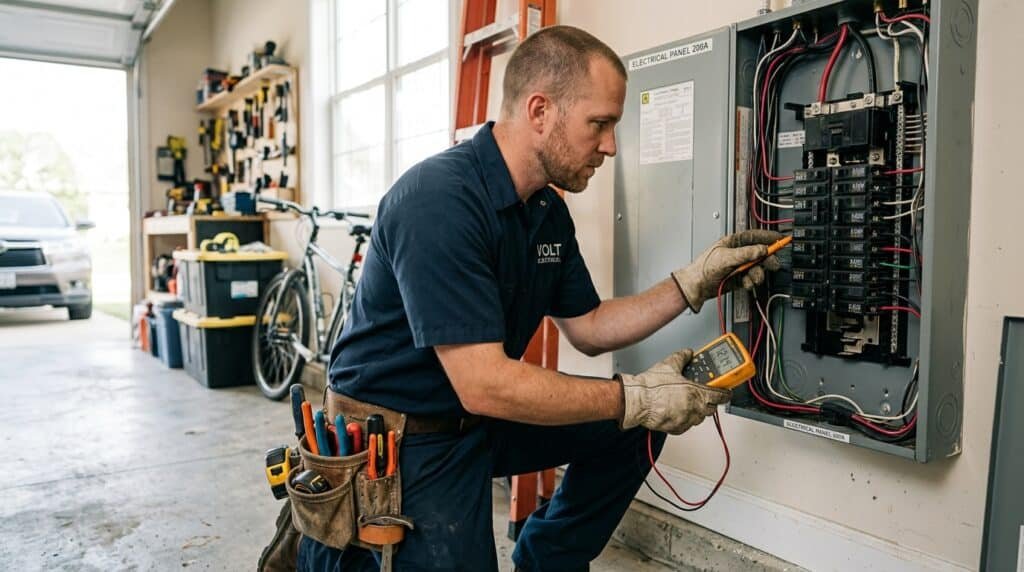
Inside, you’ll find a few key components working together:
- Branch circuits that carry power to specific rooms or appliances
- The neutral bus bar and grounding bus bar, which manage return current and safety grounding
- A bonding screw that connects the neutral and ground systems in your main panel
- Breaker spaces (or breaker slots) that hold each individual circuit breaker, including feeder breakers for subpanels and tandem breakers where extra circuit capacity is tight
- The service disconnect, which lets you cut all power in an emergency
- The utility meter and meter socket, which sit just before the panel and measure how much power your home draws
Older homes often still run on a basic breaker panel or, in some cases, a legacy fuse box. Newer builds lean toward a load center — sometimes called a residential load center or electrical distribution panel — rated for higher amperage, since modern households simply draw more power than they did 30 years ago — think electric vehicles, heat pumps, home offices, and multiple large appliances running at once.
Main Panel Vs. Sub Panel: What’s The Difference?
Not every panel in your house is the main electrical panel. Many homes — especially larger ones, or those with a detached garage or finished basement — also have a sub panel, which branches off the main panel to serve a specific area without running every circuit back to one central box. If you’re comparing a main breaker panel vs sub panel setup for an addition or workshop, the short version is: the main panel handles the whole house and houses the service disconnect, while a sub panel simply extends capacity to one zone.
You might also hear your panel called a panelboard, an electrical panel box, or a circuit breaker box — these are all different names for the same core equipment, just favored by different regions and trades.

Signs You Need An Electrical Panel Replacement
Most people don’t wake up one day and decide to replace their panel for fun. Something usually pushes them to act. Here’s what typically starts the conversation:
- Breakers keep tripping, even when you’re not overloading a circuit
- The panel feels warm or hot to the touch
- You hear buzzing or crackling near the panel
- There’s a burning smell or visible scorch marks
- You’re adding a hot tub, EV charger, or solar system and need more capacity
- Your panel still uses Federal Pacific Stab-Lok or Zinsco breakers
- You’re doing a home electrical service upgrade as part of a larger renovation
A tripped breaker repair here and there is normal. A pattern of it isn’t. If you’re Googling “why does my breaker keep tripping” more than once a month, that’s your panel asking for help.
When A Panel Becomes A Genuine Fire Risk
An overloaded electrical panel doesn’t just cause inconvenience — it’s one of the more overlooked home fire risks. U.S. Fire Administration data shows hundreds of thousands of residential fires happen every year, with electrical malfunctions consistently ranking among the leading causes of both injuries and property loss. A panel running hot, buzzing, or paired with recalled breakers is exactly the kind of hidden hazard that catches people off guard.
Modern electrical code leans hard on prevention rather than just reaction. Arc fault circuit interrupters (AFCI) and ground fault circuit interrupters (GFCI) are now required in most living spaces and wet areas, offering overload protection and shutting a circuit down the moment they detect a dangerous electrical arc fault — long before it becomes a visible problem. If your panel predates these protections, it’s worth asking your electrician about adding them during any upgrade.
This is also where your smoke detectors become non-negotiable. Data from the National Fire Protection Association shows that homes with working smoke alarms cut the risk of dying in a fire by roughly 60%, while a large share of home fire deaths happen in properties where no smoke alarm was present or working at all. Interconnected alarms on every level of your home — paired with a panel that’s actually safe to run — are the two cheapest insurance policies you’ll ever buy. If you haven’t checked how many you need or where to place them, our smoke detector calculator makes it simple to map out full-home coverage in a few minutes.

Electrical Panel Replacement Pricing & Sizing Matrix
⚡ Key Variables Influencing Operational Costs:
- Core Drivers: Materials scale directly with service size. Transitioning from a 100 amp baseline to a 200 amp framework introduces $600 to $1,200 in extra material and labor outlays but provides long-term service future-proofing.
- Site Variables: Local municipal inspection fees, meter main combo hardware replacements, regional technician labor rates, panelboard brand preferences (Square D, Eaton, Siemens, GE), and physical accessibility bounds (such as finished drywall paths vs open garage walls) alter final project invoicing.
- Capacity Planning: A licensed technician's formal load calculation dictates final parameters. Smaller footprints with gas fixtures can operate on 100 amps, whereas layouts using central heat pumps, heavy ventilation, or EV chargers require a 200 amp foundation.

The Electrical Service Upgrade Process, Step By Step
Here’s what actually happens once you book the job:
- Load calculation — your electrician calculates your home’s total electrical demand to size the new panel correctly
- Permit filing — most municipalities require an electrical permit before any panel work begins
- Power shutdown — the utility disconnects service, usually for a few hours
- Old panel removal — the outdated breaker panel and wiring connections come out
- New panel installation — including the service disconnect, bus bars, and breaker spaces
- Rewiring branch circuits — each circuit gets reconnected to the new panel
- Inspection — a licensed inspector confirms everything meets current electrical code
- Power restoration and testing — breakers get tested individually before you’re handed the keys again
Most straightforward 200 amp upgrades take one full day. Larger jobs involving a meter main combo or major rewiring can stretch to two or three days.

Federal Pacific And Zinsco Panels: A Safety Warning Worth Repeating
If your home still has a Federal Pacific Stab-Lok or Zinsco panel, this section matters more than any other on this page.
Both brands were manufactured decades ago and have since been flagged repeatedly by electricians and safety researchers for breakers that fail to trip during an overload — the exact moment they’re supposed to protect you. That’s not a minor inconvenience; it’s the difference between a contained short circuit and an electrical fire prevention failure.
If you’re not sure what’s behind your panel door, a quick electrical panel inspection checklist review from a licensed electrician can confirm it in minutes, and a written electrical inspection report gives you documentation for insurance or resale. Replacing a recalled panel isn’t optional maintenance — it’s one of the higher-priority home safety upgrades you can make, right alongside working smoke alarms and carbon monoxide detectors.
Recalled panels often show up alongside other older-home wiring issues, so it’s worth having your electrician check for knob and tube wiring or aluminum wiring at the same time. Both were common decades ago, and both carry their own well-documented safety concerns that pair naturally with a panel upgrade.

Electrical Panel Maintenance And Inspection Checklist
A panel replacement isn’t a “set it and forget it” project. Regular upkeep keeps your new system running safely for decades.
- Schedule an annual inspection with a licensed electrician
- Keep the panel area clear of storage, dust, and moisture
- Check for loose breakers or breaker labels that have faded
- Re-label your panel clearly after any renovation
- Watch for signs of an overheating breaker, like discoloration
- Test your whole house surge protector if one is installed
Good electrical panel labels matter more than people realize. In an emergency, being able to instantly find the right breaker can save precious minutes. Many electricians will also leave you with a proper electrical panel schedule — sometimes called a panel directory — mapping every breaker to the exact room or appliance it feeds, which is worth keeping taped inside the panel door for the next time something trips. If you’re overhauling more than just the panel, our guide on benefits of upgrading electrical panels breaks down the full return on investment.

Smart Electrical Panels: The Next Generation
Smart electrical panels are quickly becoming one of the most searched upgrades in this space, and for good reason. Brands like Span and Leviton now offer panels that let you monitor energy use circuit-by-circuit from your phone, automatically manage backup power during outages, and integrate with solar and battery systems.
These panels typically cost more upfront than a standard breaker panel, but they pair naturally with:
- Whole home battery backup systems and general backup power systems
- Standby generators and generator transfer switches for automatic outage protection
- Solar ready panel configurations built to accept a future solar-plus-storage setup
- A broader energy management system that tracks and shifts usage across your whole home
- Broader home electrification goals, like replacing gas appliances with electric ones
If energy monitoring and long-term efficiency are priorities for you, it’s worth exploring our smart ways to save energy at home guide alongside your panel decision — the two upgrades work best together.

Electrical Panels For EV Chargers And Solar
If you’re planning to install a home EV charger or add solar, your existing panel might not have the room. A 200 amp panel for electric vehicle charging is now the baseline recommendation for most Level 2 home chargers, and some larger homes benefit from 400 amp service if solar, a pool, and an EV charger are all in the mix. People searching for the best electrical panel for EV charger setups, or specifically an electrical panel for a Tesla charger, usually land on the same answer: 200 amp minimum, with extra breaker spaces held in reserve.
Going solar brings its own version of this question. A solar panel electrical upgrade often means adding a dedicated backfeed breaker and confirming your busbar rating can handle both incoming utility power and outgoing solar power safely — and if you’re adding storage, a battery backup electrical panel setup lets you keep key circuits running during an outage even without the grid.
Before committing to a charger, it’s worth checking your panel’s available breaker spaces and total load capacity. Our EV charger installation guide and electric vehicle charger resource both walk through compatibility in more detail.

DIY Vs. Hiring A Licensed Electrician
It’s tempting to search “how to wire a breaker panel” and try to save on labor costs, but this is one home project where DIY carries real risk. Panel work involves the main service disconnect, which stays energized even when individual breakers are off. One wrong move can mean a serious shock or worse.
Licensed electricians also pull the required electrical permit, schedule the inspection, and carry insurance if anything goes wrong. That protection alone is usually worth the labor cost. A good rule of thumb: labeling breakers or replacing a single existing circuit breaker is reasonable for a confident DIYer — anything touching the main panel or service entrance should go to a professional.
When you’re ready to search “electrical panel near me,” look for a licensed electrician with verifiable reviews, proof of insurance, and comfort pulling permits in your city — not just the fastest quote.

If You’re In The UK: Consumer Unit Basics
Everything above applies just as much across the Atlantic — it’s just called something different. In the UK, what Americans call an electrical panel is almost always called a consumer unit, or sometimes still a fuse box UK homeowners grew up with, or a distribution board in trade language.
A few terms worth knowing if you’re pricing a consumer unit replacement:
- RCD (residual current device) and RCBO units combine overload and shock protection in one device
- MCB (miniature circuit breaker) is the UK equivalent of a standard American circuit breaker
- A dual RCD consumer unit or split load consumer unit splits circuits across two RCDs, so one nuisance trip doesn’t cut power to the whole house
- A high integrity consumer unit takes that splitting further, for higher-risk properties
- An 18th edition consumer unit simply means it meets the current BS 7671 wiring regulations, the UK’s equivalent of the NEC
Consumer unit cost typically runs higher than a comparable US panel once labour and Part P building regulations compliance are factored in, and most UK homeowners work with brands like Wylex, Hager, MK, and Schneider consumer units. If you’re asking “what is a consumer unit” for the first time, think of it exactly like the American breaker box described throughout this guide — same job, different name, different regulatory framework.

FAQs: Electrical Panel
Important infrastructure guidelines covering breaker panels, structural safety, sizing metrics, and installation expectations
The Bottom Line
An electrical panel replacement isn’t the most exciting home project you’ll ever take on, but it might be the most important one. It’s the difference between a home that quietly and safely powers your life — and one working against you every time you turn on the dryer and the kitchen lights simultaneously.
Whether you’re dealing with a recalled Federal Pacific panel, planning ahead for an EV charger, or just tired of breakers tripping for no reason, the fix usually costs less than people expect and pays for itself in safety alone. Pair it with working smoke alarms, and you’ve covered two of the most important safety upgrades your home can have.
If your panel is showing any of the warning signs above, don’t wait for the “right time.” Get a licensed electrician out for a load calculation and quote — it’s a conversation that costs nothing and could save a lot.