Kitchen Pendant Lights: Sizes, Spacing & Height Guide
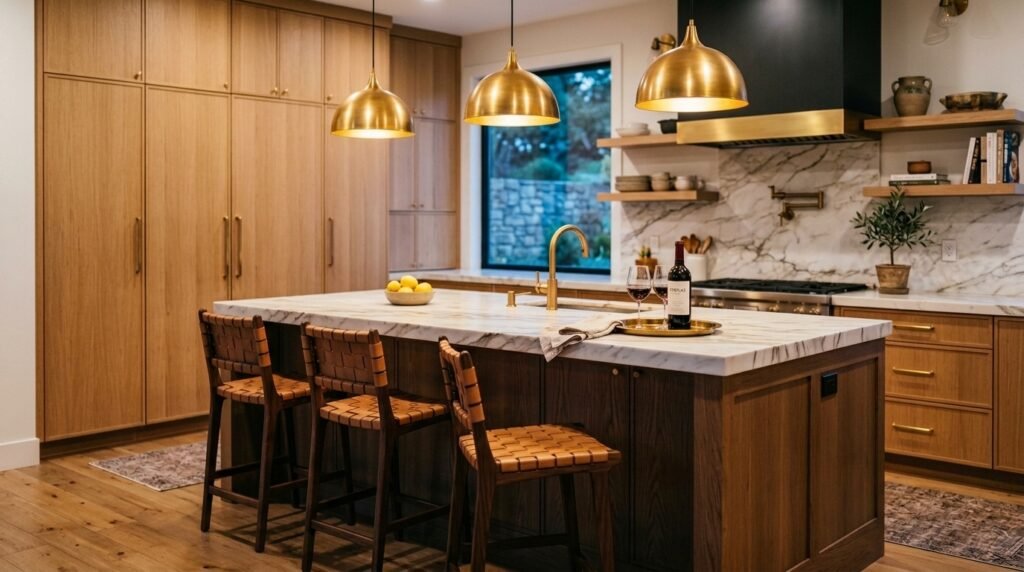
[Image prompt: Photorealistic modern kitchen island lit by three warm brass pendant lights hanging above a marble countertop, soft evening ambiance, bar stools tucked underneath, natural wood cabinetry in the background, shot on 35mm lens]
Stand in front of any kitchen island that just feels right, and pendant lighting is usually doing more work than you’d think. Get the height wrong, the spacing off, or the size mismatched, and even a beautiful kitchen can feel oddly unfinished. Get it right, and those same three lights become the room’s focal point.
This kitchen pendant lights guide walks you through everything — sizing, height rules, spacing formulas, how many you actually need, the best styles and materials, bulb choices, and a full installation rundown. Think of it as your one-stop kitchen pendant lighting guide, written in plain English.

What Are Kitchen Pendant Lights, and Why Do They Matter So Much?
A pendant light is simply a single fixture that hangs from the ceiling on a cord, chain, or rod. Unlike a chandelier, which usually holds several bulbs and branches outward, a pendant is a compact, focused source of light — which is exactly why kitchen pendant lights work so well over an island, sink, or breakfast bar.
Pendant lighting does double duty in a kitchen. It provides task lighting for chopping, reading recipes, and cleaning up, while also acting as a decorative lighting element and often the room’s focal point. That combination of function and style is why kitchen island lighting gets so much attention in every kitchen renovation.
📐 Kitchen Pendant Lights Calculator
Calculate optimal pendant sizes, space placements, and hanging heights for your kitchen island
📐 Sizing Your Pendant Lights
Getting the size right is critical for visual balance and functionality. A pendant that's too small will get lost, while one that's too large can overwhelm the space.
| Sizing Method | How It Works | Example |
|---|---|---|
| Island Width Formula | Choose a pendant diameter roughly equal to island width ÷ 5. | For a 40-inch wide island, look for pendants around 8 inches in diameter. |
| The "Subtract 12" Rule | Subtract 12 from island length and width in inches. The smaller number is the maximum diameter for a single pendant. | For a 48" x 24" island, 24-12 = 12. The largest single pendant is 12 inches in diameter. |
| The Room Formula | Add the length and width of your kitchen in feet. The sum is the number of inches wide your pendant should be. | A 10' x 8' kitchen: 10+8 = 18-inch pendant. |
Recommended Diameters by Island Size:
| Island Length | Recommended Pendant Diameter |
|---|---|
| Smaller Islands (under 4-5 ft) | 8 - 12 inches |
| Standard Islands (6-7 ft) | 12 - 16 inches |
| Larger Islands (7-9+ ft) | 14 - 20+ inches |
📐 Hanging Height: The Golden Rule
The height at which you hang your pendants is crucial for both function and aesthetics.
Standard Height:
- 30 to 36 inches above the kitchen island or countertop is the industry standard.
- This height provides focused light for tasks while reducing glare.
Adjusting for Ceiling Height:
- For standard 8-foot ceilings, use the 30–36 inch rule.
- For taller ceilings, add 3 inches for every additional foot of height.
| Ceiling Height | Recommended Hanging Height |
|---|---|
| 8 ft (standard) | 30 – 36 inches above counter |
| 9 ft | 33 – 39 inches above counter |
| 10 ft | 36 – 42 inches above counter |

Kitchen Island Pendant Light Sizes
Getting pendant light size right starts with your island’s width. Most designers recommend a pendant diameter rule where each fixture’s width sits somewhere around one-third to one-half of your island’s width, divided by the number of lights you’re hanging.
A simple pendant proportion guide to keep in mind:
- Subtract about 12 inches from your island’s total width to estimate a reasonable pendant proportion for a single large fixture.
- For multiple kitchen pendant light size choices, smaller, narrower pendants tend to look better in a row than one oversized piece squeezed into a tight run.
- Mini pendant lights kitchen setups work well for narrow islands or breakfast bars, while an oversized pendant light kitchen choice suits large, open-concept islands with high ceilings.
Don’t forget your kitchen island dimensions overall — length, width, and countertop height all factor into how big your fixtures should feel in the space.

Pendant Height Rules
This is the question almost everyone searches: how high to hang pendant lights over kitchen island spaces. The most widely used standard — echoed across Cedar & Moss’s pendant height guide — is what’s often called the 30–36 inch hanging rule, measuring from the countertop up to the bottom of the fixture.
Here’s how to adjust that kitchen pendant light height for your own kitchen:
- Standard 8-foot ceilings – aim for the lower end, around 30 inches above the counter.
- Vaulted ceilings or taller rooms – add roughly 3 inches of hanging height for every extra foot of ceiling height beyond 8 feet.
- Large households with taller family members – lean toward the higher end (34–36 inches) to avoid blocked sightlines.
- Pendant lights over kitchen sink areas usually sit a bit higher than island pendants, since sink tasks involve more upward movement and splashing.
If your pendants ever feel like they’re sitting awkwardly low, don’t worry — pendant lights too low how to fix usually just means adjusting the adjustable cord or adjustable chain included with most fixtures, no rewiring required.

Pendant Spacing Rules
Once height is sorted, pendant spacing is next. The general center-to-center spacing guideline calls for about 24–30 inch spacing between each fixture, though this flexes based on your island width and how many pendants you’re using.
A simple kitchen pendant light spacing guide:
- Measure your island’s total length.
- Divide by the number of pendants you want, then adjust so there’s roughly equal space from each end to the nearest fixture.
- Keep your pendant diameter rule for kitchen island setups in mind — wider pendants need a bit more room between them to avoid a cluttered look.
A pendant spacing calculator can take the guesswork out of this step entirely if math isn’t your strong suit — just plug in your island length and pendant count for an instant layout.

How Many Pendants Do You Need?
This depends almost entirely on your island size:
- How many pendant lights over a 6 foot island? Two pendants is the standard answer for most 6-foot islands.
- How many pendant lights over an 8 foot island? Three pendants generally works best, though two larger fixtures can also cover the space nicely.
- For anything longer, linear pendant lights kitchen island setups (also called linear kitchen island lighting or a single long island lighting fixture) often outperform multiple round pendants, giving even, unbroken light across the whole surface.
Whatever number you land on, symmetry matters more than the exact count — evenly spaced fixtures always read as more intentional than an odd, lopsided layout.

Best Pendant Styles for Every Kitchen
Different kitchens call for different looks. Here’s a rundown of the most popular pendant light styles:
- Modern kitchen pendant lights – clean lines, often glass or matte black, minimal ornamentation.
- Farmhouse kitchen pendant lights – think aged metal cages, wood accents, and warm brass tones.
- Industrial kitchen pendant lights – exposed bulbs, black metal, and a slightly utilitarian edge.
- Coastal pendant lights – light woven textures, white or natural finishes, breezy and relaxed.
- Minimalist pendant lights / contemporary pendant lights – simple geometric shapes with little visual noise.
- Vintage pendant lights / cottage pendant lights – softer curves, antique-inspired finishes, nostalgic charm.
- Sculptural pendant lights – bold, artistic shapes that double as a piece of art in the room.
If you’re renovating toward a specific aesthetic, browsing kitchen layout ideas first can help you settle on a style direction before you start shopping for fixtures.

Best Pendant Materials
Material choice changes the whole personality of a kitchen. Popular options include:
- Glass pendant lights – including clear glass pendant lights, frosted glass pendant lights, blown glass pendant lights, and fluted glass pendant lights, plus classic globe pendant lights.
- Brass pendant lights and antique brass pendant lights – warm, traditional, and increasingly popular in modern farmhouse spaces.
- Matte black pendant lights, often paired as black and brass pendant lights or black and gold pendant lights for contrast.
- Bronze pendant lights, chrome pendant lights, and polished nickel pendant lights – all reliable metal finishes for different design eras.
- Wood pendant lights and rattan pendant lights – natural texture, popular in coastal and cottage kitchens.
- Travertine pendant lights and alabaster pendant lights – softer, stone-inspired finishes that diffuse light beautifully and add an organic, high-end feel.
Choosing between glass vs metal pendant lights for kitchen spaces often comes down to how much visual weight you want — glass feels lighter and more open, while metal tends to feel bolder and more grounded.

Color Temperature & Bulbs
Bulb choice matters just as much as the fixture itself. LED kitchen pendant lights are the standard now for energy-efficient lighting, offering long life and low running costs.
The biggest decision is pendant light colour temperature. As Lumens’ lighting guide on color temperature explains, kitchens generally look best somewhere between warm and neutral white — most homeowners land in the 3000K lighting to 4000K range for that clear-but-cozy balance, while 2700K lighting leans warmer and more relaxed, better suited to dining nooks than active prep zones.
A few quick tips on bulb selection:
- Choose dimmable kitchen pendant lights wherever possible — the flexibility to shift from bright task lighting to a softer evening glow is worth the small extra cost.
- Pay attention to lumen output, not just wattage, when comparing bulbs for brightness.
- Warm white lighting works well for ambient lighting and dining areas, while slightly cooler tones suit active prep area lighting.

Installation Guide
Ready to actually install pendant lights? Here’s the basic pendant light installation process:
- Confirm your junction box. Every pendant needs a properly wired electrical box in the ceiling — this is not a DIY step to skip if one isn’t already there.
- Check your ceiling adapter. Some pendants need a ceiling adapter to convert an existing fixture mount to fit a new pendant canopy.
- Handle the pendant wiring. Basic pendant wiring connects to the existing circuit, but if you’re not confident working with electrical connections, this is a good moment to call in a licensed electrician.
- Adjust cord or chain length. Use the adjustable cord or adjustable chain to set your fixture at the correct height based on the 30–36 inch rule covered earlier.
- Mount and secure. Attach the canopy to the ceiling plate, ensuring pendant mounting hardware is fully tightened before turning the power back on.
If you’re wondering can pendant lights be dimmable, the answer is yes, as long as you pair them with a compatible dimmer switch and dimmable bulbs — not all LED bulbs dim smoothly, so check compatibility before buying.

Kitchen Island Design Ideas
Pendant placement isn’t limited to islands. Consider these spots too:
- Pendant lights above dining table – a classic pairing, especially in an open concept kitchen where the island and table share sightlines.
- Pendant lighting for peninsula kitchen layouts – works the same way as island lighting, just adjusted for the peninsula’s shape.
- Pendant lights for breakfast bar seating – smaller pendants often work best here to avoid crowding a narrower surface.
- Pendant lights for open concept kitchen spaces – layered kitchen lighting (mixing pendants with recessed and under-cabinet lighting) keeps large open areas from feeling flat.
- Galley kitchen and breakfast nook areas – smaller, single pendants add a cozy touch without overwhelming a tighter footprint.
For pendant lights for low ceiling kitchen situations, look for flush-mount-style pendants or fixtures with minimal cord drop, so you keep enough headroom while still getting that decorative touch.

Pendant Lights vs Chandeliers
The pendant light vs chandelier kitchen debate usually comes down to scale and function. Pendants are compact, focused, and ideal for direct task lighting over islands, sinks, and counters. Chandeliers spread light more broadly and tend to work better centered over a dining table where ambiance matters more than precision task lighting. Many modern kitchens use both — pendants over the island, a chandelier or larger fixture over the adjoining table — as part of an overall layered lighting plan.

A Word on Home Safety While You Renovate
Anytime you’re up on a ladder working on ceiling fixtures, it’s worth checking your smoke detectors too. Working smoke alarms cut the risk of dying in a reported home fire by more than half, according to the National Fire Protection Association’s smoke alarm research. Homes without working alarms make up a disproportionate share of home fire deaths, often simply because a battery had died or a unit had outlived its typical ten-year lifespan.
Since you’ll already have the ladder out for your pendant light installation, take a minute to test your existing alarms — or use a smoke detector calculator to make sure your kitchen and the rest of your home have full coverage.

Finishing Touches for Your Kitchen Lighting Project
A few related upgrades pair naturally with new pendant lighting:
- If your kitchen renovation includes new cabinetry, check a kitchen cabinet sizes calculator to plan your layout before the lighting goes in.
- Planning your island’s full footprint? A kitchen island calculator helps you nail down dimensions before ordering pendants.
- For broader open-plan lighting decisions beyond the kitchen, browse LED lighting that’s bright, safe, and efficient for ideas that extend the same warm glow into adjoining rooms.
- If your project touches walls near your new lighting, a wall panel style and size calculator can help keep proportions consistent throughout the space.
💡 Kitchen Pendant Lights FAQs
How do I choose kitchen pendant lights?
What size pendant lights for kitchen island?
How many pendant lights over island seating do I need?
What is the best colour temperature for kitchen pendant lights?
How bright should kitchen pendant lights be?
Can pendant lights be dimmable?
How do I wire kitchen pendant lights?
What's the difference between pendant lights and a chandelier in the kitchen?

Final Thoughts
Kitchen pendant lighting looks effortless when it’s done right, but it’s really just a handful of proportions working together — the correct height, sensible spacing, a size that fits your island, and a style that matches your kitchen’s personality. Nail those basics, and your pendants will do exactly what they’re supposed to: light the space beautifully while tying the whole room together.
And while you’re up there adjusting cords and testing your new fixtures, take an extra minute to check your smoke alarms too. It’s a small step that adds real peace of mind to a kitchen you just gave a whole new glow.