Window Size Calculator - Calculate Window Dimensions & Materials 2025

Window Size Calculator

Calculate window dimensions and costs for all window types and materials

Calculate Window Specifications

Window Calculation Results

Window Dimensions
-
Window Area
-
Rough Opening
-
Material Cost
-
Installation Cost
-
Total Project Cost
-

Quick Tip: Standard double-hung windows are thirty six inches wide by forty eight to sixty inches tall. Rough openings are typically half an inch wider and half an inch taller than window size. Energy Star certified windows can save one hundred to four hundred dollars per year on energy bills.

Standard Window Sizes

Window Type Common Widths Common Heights Typical Use Rough Opening
Single-Hung 24", 30", 36" 36", 48", 60", 72" Bedrooms, bathrooms Width + 0.5", Height + 0.5"
Double-Hung 24", 30", 36", 48" 48", 60", 72" Living rooms, bedrooms Width + 0.5", Height + 0.5"
Casement 18", 24", 30", 36" 36", 48", 60", 72" Kitchen, bathroom, egress Width + 1", Height + 1"
Awning 24", 30", 36", 48" 18", 24", 30", 36" Above doors, bathrooms Width + 1", Height + 1"
Sliding (Glider) 48", 60", 72", 96" 36", 48", 60" Living rooms, large openings Width + 0.5", Height + 0.5"
Picture Window 36", 48", 60", 72", 96" 48", 60", 72", 96" Living rooms, views Width + 0.5", Height + 0.5"
Bay Window 84", 96", 108", 120" 48", 60", 72" Living rooms, dining rooms Custom framing required
Bow Window 96", 120", 144" 48", 60", 72" Living rooms, panoramic views Custom framing required
Garden Window 36", 48", 60" 36", 48", 60" Kitchen, plants Width + 2", Height + 2"
Skylight 22.5", 30.5", 46.5" 26.5", 38.5", 46.5", 70.5" Roof, natural light Between rafters + flashing

Window Material Comparison

Material Price Range Durability Maintenance Energy Efficiency Best For
Vinyl $200 - $600 Good Very Low Very Good Budget-friendly, low maintenance
Wood $400 - $1,200 Excellent High Excellent Traditional homes, aesthetics
Aluminum $250 - $700 Very Good Low Fair Modern design, commercial
Fiberglass $500 - $1,500 Excellent Very Low Excellent Premium choice, extreme climates
Composite $350 - $900 Very Good Low Very Good Wood look, low maintenance
Wood-Clad $500 - $1,400 Excellent Medium Excellent Interior wood, exterior protection
Steel $300 - $900 Excellent Low Good Security, commercial use

Glass Type and Energy Ratings

Glass Type U-Factor R-Value Cost Multiplier Annual Energy Savings Best For
Single Pane 1.0 - 1.2 R-1 1.0x $0 (baseline) Garages, sheds (not recommended)
Double Pane 0.30 - 0.50 R-2 to R-3 1.3x $50 - $100 Standard residential
Triple Pane 0.15 - 0.30 R-3 to R-5 1.8x $100 - $200 Cold climates, noise reduction
Low-E Double Pane 0.25 - 0.35 R-3 to R-4 1.5x $75 - $150 Most climates, UV protection
Low-E Triple Pane 0.15 - 0.25 R-5 to R-7 2.2x $150 - $250 Extreme climates, premium
Argon Filled Double 0.20 - 0.30 R-3 to R-4 1.6x $100 - $175 Better insulation, standard upgrade
Krypton Filled Triple 0.12 - 0.20 R-6 to R-8 2.5x $200 - $350 Maximum efficiency, passive house

Window Installation Costs

Window Type Labor Cost Difficulty Level Time Required Additional Costs
Single/Double-Hung $100 - $300 Easy 1-2 hours Trim, caulk, flashing
Casement $150 - $350 Medium 2-3 hours Hardware, trim, weatherstrip
Awning $150 - $300 Medium 1.5-2.5 hours Hardware, trim, caulk
Sliding $150 - $400 Medium 2-3 hours Track, trim, weatherstrip
Picture Window $150 - $500 Medium-Hard 2-4 hours Extra support, trim
Bay Window $500 - $1,500 Hard 6-10 hours Platform, roofing, support
Bow Window $600 - $2,000 Hard 8-12 hours Custom framing, roofing, support
Garden Window $200 - $600 Medium-Hard 3-5 hours Shelf, trim, flashing
Skylight $300 - $1,000 Hard 4-8 hours Flashing, roofing work, shaft
Transom $100 - $250 Easy-Medium 1-2 hours Trim, caulk

Window Replacement ROI

Replacement Type Average Cost Resale Value Added ROI Percentage Energy Savings/Year Payback Period
Vinyl Window Replacement $3,500 - $7,500 $2,500 - $5,500 70-75% $200 - $400 10-20 years
Wood Window Replacement $6,000 - $15,000 $4,500 - $11,000 70-75% $300 - $500 12-25 years
Fiberglass Upgrade $8,000 - $20,000 $6,000 - $15,000 75-80% $400 - $600 13-30 years
Energy Star Windows $5,000 - $12,000 $3,500 - $9,000 70-75% $300 - $600 8-20 years
Single to Double Pane $4,000 - $10,000 $3,000 - $7,500 75-80% $400 - $800 5-15 years
Bay/Bow Addition $3,000 - $10,000 $2,500 - $8,000 80-85% $100 - $300 10-30 years

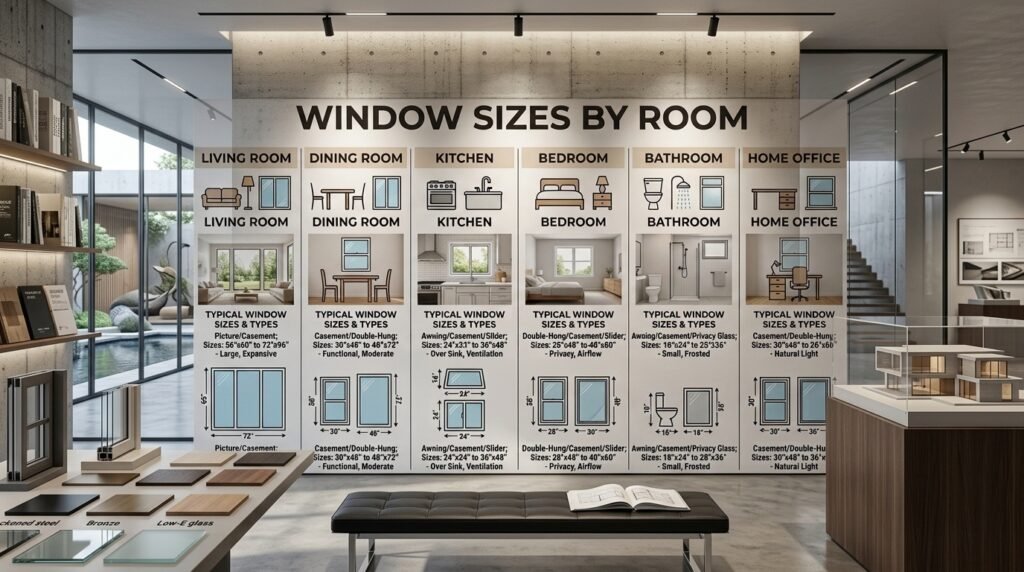
Window Sizes by Room Type

Room Type Recommended Size Window Type Glass Type Typical Cost (Installed)
Living Room 48" x 60" or larger Double-hung, picture, bay Low-E double pane $400 - $1,000
Master Bedroom 36" x 60" Double-hung, casement Low-E double pane $350 - $700
Secondary Bedroom 30" x 48" to 36" x 60" Single or double-hung Double pane $300 - $600
Kitchen 30" x 36" to 48" x 48" Casement, awning, garden Low-E double pane $350 - $900
Bathroom 24" x 36" to 30" x 48" Single-hung, casement, awning Obscure glass, double pane $300 - $600
Dining Room 48" x 60" or larger Double-hung, picture, bay Low-E double pane $400 - $1,200
Office/Den 36" x 48" to 48" x 60" Double-hung, casement Low-E double pane $350 - $700
Basement 32" x 18" (egress: 36" x 48") Casement, slider, hopper Double pane $250 - $600

Energy Star Requirements by Climate

Climate Zone U-Factor Requirement SHGC Requirement Recommended Glass Annual Savings
Northern (Cold) ≤ 0.27 Any Low-E triple pane, gas filled $300 - $600
North-Central ≤ 0.28 ≤ 0.40 Low-E double pane, argon filled $250 - $500
South-Central ≤ 0.30 ≤ 0.25 Low-E double pane, tinted $200 - $400
Southern (Hot) ≤ 0.40 ≤ 0.25 Low-E double pane, reflective $250 - $500

Window Maintenance Schedule

Task Frequency Material Type Cost DIY Difficulty
Clean Glass Monthly All $0 - $10 Easy
Clean Tracks/Sills Quarterly All $0 - $5 Easy
Lubricate Hardware Annually All $5 - $15 Easy
Paint/Stain Wood Every 3-5 years Wood, wood-clad $50 - $200 per window Medium
Replace Weatherstripping Every 5-10 years All $10 - $30 per window Easy-Medium
Caulk/Seal Gaps Every 2-3 years All $5 - $20 per window Easy
Inspect for Condensation Seasonally All $0 Easy
Replace Seals (Failed IG) As needed (15-20 years) Double/triple pane $150 - $400 per window Professional

Important Disclaimer

This Window Size Calculator provides estimates based on standard industry dimensions and typical installation practices. Actual window sizes, costs, and rough opening requirements may vary based on manufacturer specifications, local building codes, and installation methods.

Results serve as planning tools only and should not replace professional measurements or contractor quotes. Always consult with licensed contractors and follow local building codes for accurate window specifications and installation requirements.

We make no guarantees regarding accuracy of calculations, dimensions, energy savings, or cost estimates. Users assume all responsibility for window purchasing and installation decisions. Window prices vary significantly by brand, features, glass type, and retailer.

Energy savings estimates are based on average utility rates and typical usage patterns. Actual savings will vary based on climate, home insulation, window orientation, and usage. Always verify rough opening dimensions with manufacturer specifications before ordering windows. Check for tax credits and rebates for energy-efficient windows in your area.

Window Sizes Calculator: Your Complete Guide to Measuring and Sizing Windows

A window sizing calculator lets you measure your windows quickly and accurately. If you’re replacing windows, buying blinds, or planning a renovation, it’s important to know standard window sizes and how to measure them. Start by measuring the width and height, check your local building codes, use a digital calculator to confirm your numbers, and then order the right products. Knowing these steps ahead of time helps you feel prepared and confident as you work on your home improvement project.

Why You Need a Window Sizing Calculator

Getting your window measurements right is essential. Ordering the wrong size can waste money and delay your project. For example, if you buy a custom sash for $800 and it’s too wide, you can’t return it, and your project will be delayed. A sizing calculator helps you avoid these problems by making sure your measurements are correct, whether you’re checking by hand or using a digital tool.
Professional installers use sizing tools every day, because they save time and help prevent mistakes. No matter if you’re measuring a small mobile home window or a large casement window, using the correct method is key.

Understanding Standard Window Sizes

Most homes have standard window sizes. Knowing the size of an egress window, a typical bedroom window, and other standard dimensions helps you plan your project. Blinds also come in standard size ranges.

Common Window Dimensions

Window Type
Typical Width
Typical Height
Common Use
Standard Single Hung
28-36 inches36-48 inchesBedrooms, living areas
Double Hung Egress
30-36 inches48-72 inchesBedrooms, safety
Casement Window
24-36 inches36-60 inchesKitchens, side openings
Standard Kitchen Window
36-48 inches24-36 inchesKitchen installations
Bay Window
VariableVariableLarger spaces
Basement Window
24-36 inches14-24 inchesBasements, cellars

Measuring Window Width and Height Correctly

Step 1: Measure the Width
To measure window width accurately, take measurements at the top, middle, and bottom of the window opening. Write down all three and use the smallest one for the best fit. This way, your new window will fit even if the opening isn’t perfectly square, which is helpful if you’re worried about uneven frames. Before you begin, gather a tape measure, a level, a notepad for your numbers, and a smartphone to take photos of your setup and any unusual spots.
Step 2: Measure the Height
Next, measure the height from top to bottom on the left, center, and right sides of the window opening. Write down all three numbers and use the smallest one.
  • Step 3: Measure the Depth
  • Finally, check how far the window frame goes into the wall. This measurement is essential for installing the window properly.
  • Keep in mind that the rough opening size is usually different from the final window size. The rough opening is the framed hole in the wall where the window goes. Be sure to leave space for the frame and sealant so the window fits properly.
The rough opening size is not the same as the final window size. A rough opening size chart shows how much extra space you need for a good fit. Always leave room for the frame and sealant.

Specific Window Size Categories

Egress Window Sizing

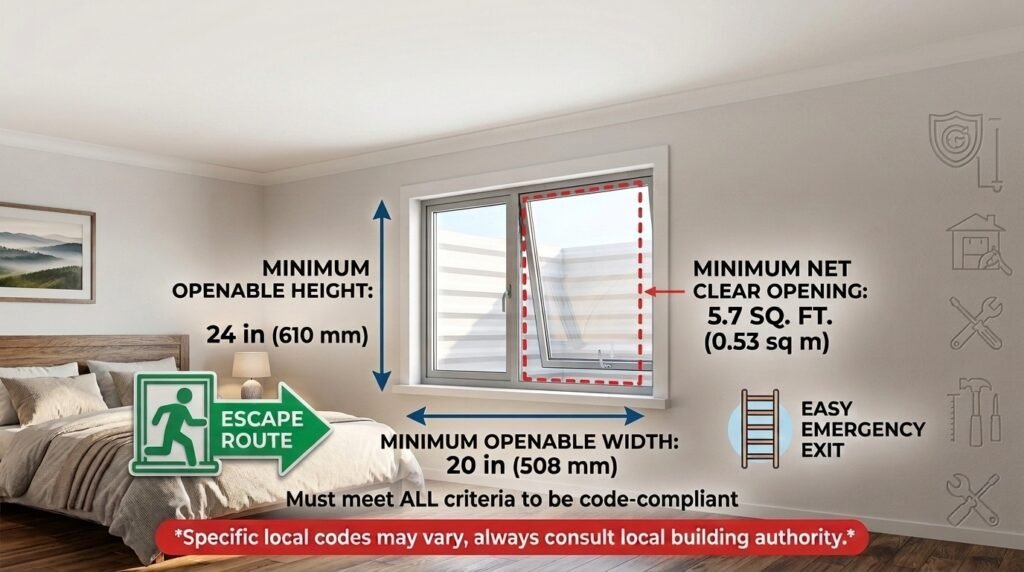
Safety codes require bedrooms to have proper exit windows. For basement bedrooms, the minimum egress window size is 5.7 square feet. The window well cover should match the size of your window opening. Egress windows must meet local building codes, so check your ZIP code for the rules in your area. This helps you meet all safety and legal standards.
What size is an egress window? Most code-compliant egress windows are 30 to 36 inches wide and 48 to 60 inches tall. The size requirements for basement egress windows vary by location. Check with your local building department before installing. A casement egress window size chart will show approved dimensions.

According to Windows Canada, mobile home windows are typically smaller than those found in standard houses, often ranging from 14 to 28 inches wide and 18 to 36 inches high. Replacement basement window sizes for mobile homes can vary by manufacturer.

According to Homeedit, a common standard size for single and double-hung windows is 24 inches wide by 36 inches tall. Since mobile home window sizes can differ from those of regular homes, always check your measurements before ordering.

Basement and Cellar Windows

Basement window size depends on your needs. Small basement windows can be 20 inches wide by 12 inches tall, while larger ones might be 32×24 inches or bigger. Cellar windows are usually similar in size to basement windows.
Egress windows must be larger than regular basement windows. Glass block windows are available in sizes from 8×8 inches to 12×12 inches per block. Larger window assemblies can be up to 48×48 inches or more.

Kitchen and Living Areas

Standard kitchen windows are usually 24 to 48 inches wide and 24 to 36 inches tall. Bay window sizes depend on your space. Transom windows are smaller, usually 8 to 20 inches tall and 24 to 60 inches wide. Garden windows are often 36 to 48 inches wide.

Screen Sizes

Window screen sizes depend on your window type. Standard screens come in common sizes. To measure for a screen, measure the frame opening, not the glass. Andersen screens are made to fit their windows.
Spline size for window screens varies by brand. The most common sizes are 0.140, 0.160, or 0.180 inches in diameter. RV and camper windows often need special or custom screens.

Working With Blinds and Coverings

Choose your window blinds based on your window’s measurements. Standard blind sizes range from 18 to 96 inches. A size chart can help you pick the right one.
To get the right size blinds, measure carefully. For inside-mount blinds, measure the width and height inside the window frame. For outside-mount blinds, measure the wall area where you’ll attach the blind. Measure first before choosing curtains.
Window shutter sizes need to match the window opening for a good fit. Standard shutter sizes usually increase in 12-inch steps so that you can customize them based on style and placement. According to the CSA Group’s standard on window installation, recommended clearances around windows typically include about 1/2 inch on each side, 1/2 inch at the top, and 1/4 inch at the bottom. The required size for window headers depends on both the width of the window and the structural load from the roof above.
Rough opening sizes are different from finished window sizes. Always check a rough opening size chart before you start. Rough opening sizes are different from finished window sizes. Always check a rough opening size chart before you start framing. These sizes usually match standard window dimensions, with extra space for framing and adjustments. Window size and position are used for mailing. Legal envelope sizes and window positions follow office standards. These sizes are standardized for business.
The standard window envelope size for DL envelopes is 4.125 x 9.5 inches. A 10-window envelope size is larger. Large envelopes with windows are used for billing, statements, and official documents.

Understanding Your Window Product Type

To choose the right window, you need to know your window style. Common types include single-hung, double-hung, casement, sliding, and specialty windows. Each type has its own standard sizes and rough opening needs.
Product type selection affects the approach to your sizing calculator. Specialty windows, such as bay and garden windows, have different measurement methods. Transom windows and accent windows use smaller standard measurements.
Using a Digital Sizing Calculator, you can find modern sizing calculators online or as apps. A window sizing calculator uses your measurements to suggest products. The best calculators ask for your window’s width and height and account for standard sizes and rough opening requirements. For a reliable option, try the ‘Window Pro Size App’ or ‘SizeIt Smart Calculator.’ These tools provide accurate suggestions and pricing. Some show available windows in your area, while others give you instant pricing.
According to the Michigan State Housing Development Authority, egress windows are required in all new sleeping and living areas in Michigan unless another secondary means of escape is provided. These windows must have a minimum clear opening of 20 inches wide by 24 inches tall, with a total clear opening of 5.7 square feet. This sets Michigan’s egress window requirements, which may differ from those in other states. Minimum bedroom window sizes also vary by location. Always check your local codes before you measure.

To be extra sure, do a quick compliance check:

1. Have you confirmed local window size requirements based on your zip code?
2. Do your planned window installations meet the minimum size regulations for bedroom and emergency exit windows?
3. Are there any specific regional restrictions or guidelines to be aware of during installation?
By finishing this checklist, you can move forward confidently, knowing your project meets local rules.

Measuring Tips and Common Mistakes

  • Measure three times in each direction and use the smallest number. This helps you get accurate results and prevents fit issues.
  • Avoid these common DIY measuring mistakes to save time and money: mixing inches and centimeters can lead to incorrect orders.
  • Always use the same unit for all your measurements. If you only measure the glass and not the whole frame, your replacement windows might end up too small or too large.
  • Also, don’t assume every window in a room is the same size. Each window opening can be different.
  • If you’re replacing the whole window unit, include the frame in your measurements. For new installations, measure the wall opening, not just the glass.
  • Use a level or measuring square to check that the corners are square. Watch out for unusual frame shapes or styles that could affect your measurements.
  • Also, taking photos of your windows and your measurements gives you a handy reference for later. Comparing Window Brands and Sizing
Each manufacturer has its own standard sizes. Marvin, Andersen, and Milgard all have their own size charts and product lines. Always check the specifications for each brand. Prices for sizes like 3060 and 3050 can vary by manufacturer. Standard sizes are helpful, but brand sizing is essential as well.

Converting and Calculating Window Sizes

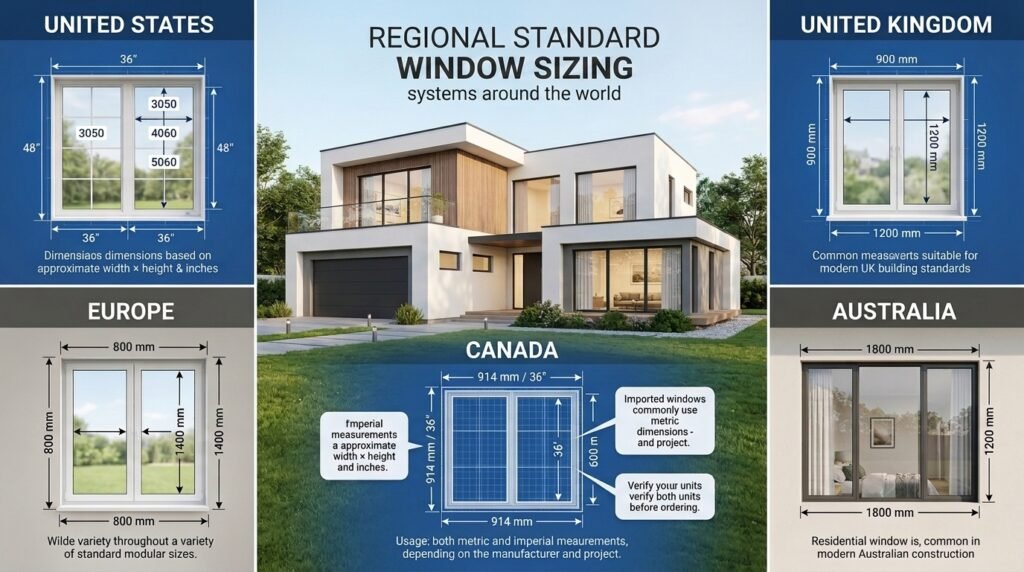
Converting window sizes from feet to centimeters makes comparisons easier, especially if you’re outside the US. Most calculators can switch between units, but always double-check your conversions to avoid mistakes.
To measure for replacement windows, follow the same steps: measure width, height, and depth. Getting these measurements right helps you avoid costly mistakes and delays.

Technology and Smart Measuring

Modern tools make measuring windows easier. You can use your smartphone camera to document your windows. Some mobile apps show measurements, and some retailers offer virtual consultations.

Ordering Your Replacement Windows

After you measure, ordering is simple. Pick the product type you want, choose a size from the options, and check rough opening requirements with your installer.
Order your windows early to allow for shipping time. Ask about return policies in case your measurements are off. Having a professional install your windows makes sure they fit and work well.

Door Dimensions, Hardwood Flooring, and Carpet Combinations

Choose the Perfect Flooring and Door Combinations for Your Home

When remodeling your home, door dimensions and flooring choices work together to create a cohesive aesthetic. This guide compares standard door sizes with popular hardwood flooring and carpet combinations to help you make informed decisions.

1. Standard Door Dimensions Overview

Understanding door dimensions is crucial for proper installation and home design. Most residential doors follow standardized measurements to ensure compatibility with door frames and openings.

Door Type

Width

Height

Common Use

Standard Entry Door

36 inches

80 inches

Front/back entrances

Interior Door

28-32 inches

80 inches

Bedrooms, bathrooms

Pocket Door

30-36 inches

80 inches

Space-saving entries

French Doors

15-20 inches each

80 inches

Patio/garden access

Bifold Doors

30-36 inches

80 inches

Closets, cabinets

Double Doors

48-72 inches wide

80 inches

Formal entries

Sliding Glass Door

48-96 inches

80 inches

Patio access

2. Popular Hardwood Flooring Options

Hardwood flooring adds warmth and elegance to any space. Different wood types, finishes, and plank widths create distinct looks and feel underfoot.

Wood Type

Color Range

Hardness

Plank Width

Price Range

Oak

Light to medium brown

Medium

1.5-3 inches

$3-$8/sq ft

Maple

Pale to golden yellow

Very hard

1.5-3.5 inches

$4-$10/sq ft

Hickory

Multi-toned brown

Very hard

2-5 inches

$4-$12/sq ft

Cherry

Light to dark reddish

Medium

2-4 inches

$5-$15/sq ft

Walnut

Dark chocolate brown

Medium

2-5 inches

$6-$20/sq ft

Brazilian Cherry

Deep red tones

Very hard

2-4.5 inches

$8-$18/sq ft

3. Top Carpet Flooring Choices

Carpet offers comfort, warmth, and sound absorption. Modern carpet options come in various styles, colors, and performance grades suitable for different areas of your home.

Carpet Type

Feel

Durability

Best For

Price Range

Plush/Saxony

Soft, velvety

Good

Bedrooms, living areas

$2-$5/sq ft

Twist

Textured, springy

Excellent

High-traffic areas

$3-$6/sq ft

Frieze

Long, wavy fibers

Very good

Casual spaces

$2-$4/sq ft

Berber

Looped, nubby

Excellent

Active families

$2.50-$5/sq ft

Shag

Long, deep pile

Fair

Bedrooms only

$2-$6/sq ft

Saxony Blend

Mixed fibers

Very good

Most rooms

$3-$7/sq ft

Performance

Stain-resistant

Excellent

Kitchens, pets

$3-$8/sq ft

4. Top 10 Hardwood and Carpet Combinations

These proven combinations create harmonious flows throughout your home while meeting practical needs for different rooms.

1. Classic Elegance: Light Oak + Cream Plush Carpet

Pair light oak hardwood in main living areas with soft cream plush carpet in bedrooms. This combination creates a sophisticated, cohesive look while maintaining warmth. The light wood brightens spaces, and the cream carpet adds luxury comfort. Works well with neutral door frames in oak or white stain.

2. Contemporary Chic: Hickory + Charcoal Twist Carpet

Multi-toned hickory hardwood in open-plan living spaces transitions beautifully to charcoal twist carpet in bedrooms and private areas. The bold contrast creates visual interest while maintaining sophistication. Choose dark-stained interior doors for a unified, modern aesthetic.

3. Warm Traditionalist: Medium Cherry + Warm Beige Saxony

Medium-toned cherry hardwood pairs perfectly with warm beige saxony carpet for a timeless traditional look. This combination works in both formal and casual settings. Interior doors in cherry stain create a seamless flow and reinforce the warm, inviting atmosphere.

4. Modern Minimalist: Walnut + Gray Berber Carpet

Deep walnut hardwood flooring combined with practical gray berber carpet creates a sophisticated, modern aesthetic. The dark wood grounds the space while gray carpet adds versatility. Pair with white or light gray interior doors for contrast and contemporary appeal.

5. Luxury Statement: Brazilian Cherry + Neutral Performance Carpet

Deep red-toned Brazilian cherry commands attention in primary living spaces, while neutral performance carpet in active areas ensures practicality. This premium combination handles both beauty and function. Use dark-stained solid wood doors to emphasize luxury throughout.

6. Balanced Blend: Maple + Light Gray Frieze Carpet

Pale maple hardwood creates a bright, airy foundation, complemented by light gray frieze carpet for texture and warmth. This combination maximizes light in spaces while providing comfortable, casual styling. White shaker-style interior doors enhance the contemporary feel.

7. Timeless Neutral: Golden Oak + Taupe Twist Carpet

Golden oak hardwood in living areas flows into sophisticated taupe twist carpet in secondary spaces. This neutral combination provides maximum versatility for furniture and décor changes. Use stained oak interior doors for seamless transitions throughout your home.

8. Bold Contrasts: Dark Walnut + Cream Berber Carpet

Rich dark walnut flooring creates drama and sophistication, while cream berber carpet provides practical comfort and visual lightness. The high contrast creates visual interest while the berber’s durability handles daily wear. Pair with natural wood or light-stained doors for balance.

9. Cozy Warmth: Hickory + Medium Brown Shag Carpet

Multi-toned hickory hardwood in living spaces transitions to plush medium brown shag carpet in private bedrooms. While shag requires careful placement, the warmth created in bedrooms is unmatched. Use light natural wood interior doors to soften the darker tones.

10. Sophisticated Casual: American Cherry + Sage Green Carpet

Medium-toned American cherry flooring pairs with unexpected sage green carpet for a sophisticated yet approachable look. This combination works especially well in homes with updated design sensibilities. Choose natural wood interior doors or consider a contrasting painted finish.

5. Room-by-Room Flooring and Door Strategy

Entry/Foyer

Flooring: Hardwood (oak, maple, or hickory)

Carpet Option: N/A

Door Recommendation: Solid exterior door (36″ standard)

Tips: Hardwood in entry creates impressive first impression. Use standard 36″ exterior doors. No carpet as high-traffic area requires durability.

Living Room

Flooring: Hardwood

Carpet Option: Optional area rug

Door Recommendation: Interior pocket door (optional)

Tips: Hardwood provides elegant backdrop for furniture. Consider 30-32″ interior doors. Area rugs define spaces without full carpet installation.

Dining Room

Flooring: Hardwood

Carpet Option: Optional under table

Door Recommendation: 36-48″ double doors or single 32″

Tips: Easy-clean hardwood ideal for dining. Large openings benefit from double 24″ doors or single 36″ door. Carpet under table adds comfort.

Kitchen

Flooring: Hardwood or hard surface

Carpet Option: Not required

Door Recommendation: 32″ interior door

Tips: Avoid carpet in kitchens due to spills. Hardwood or tile recommended. Standard 32″ interior doors to other rooms.

Master Bedroom

Flooring: Hardwood or soft carpet

Carpet Option: Plush saxony recommended

Door Recommendation: 28-32″ interior door

Tips: Hardwood with large area rug or full carpet. Plush carpet adds luxury. Standard 28-32″ interior doors maintain flow.

Secondary Bedrooms

Flooring: Carpet

Carpet Option: Twist or berber

Door Recommendation: 28″ interior door

Tips: Practical twist or berber carpet handles daily wear. Smaller 28″ doors save space. Soft underfoot for comfort.

Bathrooms

Flooring: Tile or hardwood

Carpet Option: Bath mat only

Door Recommendation: 32″ interior door

Tips: Avoid carpet in bathrooms. Tile or waterproof hardwood essential. Standard 32″ interior doors for accessibility.

Home Office

Flooring: Hardwood or low-pile carpet

Carpet Option: Performance carpet if used

Door Recommendation: 32″ interior door

Tips: Professional look with hardwood. If carpet needed, choose low-pile for rolling chairs. Standard 32″ interior door.

6. Creating Seamless Transitions Between Rooms

  1. Transition Strips: Use wood or metal trim to connect hardwood to carpet. Reduces trip hazards and creates clean lines. Choose finishes that match your hardwood or door frames.
  2. Threshold Installation: Install quality thresholds at doorways between different flooring types. Proper thresholds protect subfloors and create smooth transitions. Select finishes coordinating with doors.
  3. Molding Selection: Baseboard and trim color affects overall aesthetic. Match door frames and trim for cohesion. Consider 4-6″ baseboards with hardwood, 3-4″ with carpet areas.
  4. Color Continuity: Plan floor colors to flow logically through homes. Light colors expand spaces; dark tones create coziness. Transition gradually between different wood tones using neutral areas.
  5. Directional Flow: Hardwood in main living areas creates visual flow. Carpet in private spaces feels intimate. Use door placement to define spaces while maintaining connection.
  6. Underlay and Padding: Proper padding under carpet prevents shifting and adds insulation. Hardwood underlayment prevents moisture and noise. Quality products ensure durability across all floor types.

7. Installation and Maintenance Considerations

Before Installing

  • Measure all doorways carefully—standard doors are 36″ wide, interior doors 28-32″ wide
  • Check subfloor moisture levels before any flooring installation
  • Verify rough opening dimensions match your door frame specifications
  • Plan flooring layout to minimize cuts and waste
  • Account for acclimation time, especially for hardwood (5-7 days in room)

Hardwood Installation

  • Professional installation recommended for best results
  • Allow proper expansion gaps (1/2″ from walls) to prevent buckling
  • Install perpendicular to doorways for visual appeal
  • Use quality adhesive or nailing systems based on installation method
  • Sand and finish last for best protection and appearance

Carpet Installation

  • Professional installation ensures proper stretching and seaming
  • Quality padding (minimum 5/8″ dense foam or 6-9 lb density) extends carpet life
  • Seaming at doorways should be minimal—plan layout to avoid thresholds
  • Use tack strips or adhesive appropriate for subfloor type
  • Proper ventilation during installation and curing prevents rippling

Door Hanging

  • Ensure rough opening is 2-3″ wider than door width for frame and plumb adjustments.
  • Level and plumb frames before hanging doors for smooth operation.
  • Use quality hinges and hardware for longevity.
  • Allow proper clearance above all flooring types (3/8″ for carpet, 1/4″ for hardwood).
  • Seal bottom edge of doors to prevent moisture and sound transfer.

8. Cost Comparison: Flooring and Door Options

Material Type

Cost Per Sq Ft

Installation Cost

Lifespan

Hardwood Flooring

$3-$20

$8-$15/sq ft

25-30 years

Carpet (Standard)

$2-$7

$3-$8/sq ft

8-15 years

Interior Doors (Solid Core)

$200-$600 each

$50-$100 install

30+ years

Interior Doors (Hollow Core)

$50-$200 each

$30-$50 install

20+ years

Exterior Door

$400-$1500

$100-$200 install

20-30 years

Threshold/Transition

$20-$50 each

Included in door

10+ years

Quality Door Hardware

$30-$150 set

Included in install

15+ years

Professional Installation Average

N/A

$2000-$8000 total

Value added

9. Maintenance and Care Tips

Hardwood Floor Care
  • Vacuum weekly, sweep daily to remove grit that damages finish.
  • Use damp (not wet) microfiber mop for cleaning—never use water heavily.
  • Place protective pads under furniture legs to prevent indentation.
  • Use doormats to trap dirt and reduce tracked-in moisture.
  • Refinish every 7-10 years to restore beauty and protection.
  • Avoid direct sunlight with UV-blocking window treatments.
Carpet Care
  • Vacuum twice weekly in high-traffic areas, once weekly elsewhere.
  • Address spills immediately to prevent permanent staining.
  • Use carpet protector treatments for stain resistance.
  • Professional steam cleaning every 12-18 months extends life.
  • Rotate furniture periodically to prevent matting.
  • Use area rugs in high-traffic zones to protect carpet underneath.

Door and Hardware Care

  • Wipe doors monthly to remove dust and fingerprints.
  • Apply wood conditioner annually to maintain finish.
  • Tighten hinges and hardware twice yearly.
  • Check weatherstripping on exterior doors for gaps.
  • Replace worn door seals to improve energy efficiency.
  • Paint or stain interior doors every 5-7 years as needed.

10. Design Tips for Visual Harmony

The 60-30-10 Rule

Use your primary flooring (60%), secondary flooring (30%), and accent color (10%) to create visual balance. For example, 60% hardwood, 30% carpet, and 10% dark stained doors.

Understand Undertones

Match undertones across materials. Warm-toned hardwoods pair with warm carpet; cool tones work together. Door frames should complement both flooring choices.

Light and Dark Contrast

Contrasting light and dark floors can be stunning, but transition them thoughtfully. Use doors to mark transitions between different flooring types.

Texture Adds Interest

Mix smooth hardwood with textured carpet for visual and tactile interest. Textured door panels or hardware finishes add depth to plain door styles.

Consider Existing Architecture

Complement your home’s era. Historic homes suit traditional combinations; modern spaces work with contemporary choices. Use doors as architectural elements.

Test Before Committing

Get large samples of hardwood, carpet, and door stains. View in your space under different lighting. Live with samples for a week before deciding.

The Grout and Grading Rule

If using tile transitions, match grout color to predominant floor tone. Grade transitions from darker to lighter as you move through home.

Don’t Forget Baseboards

Baseboards connect floors to walls. Match door trim color for cohesion. Consider 4-6″ baseboards in main areas, 3-4″ in secondary spaces.

11. Quick Reference: Standard Specifications

Door Measurements Quick Reference

Door Type

Standard Width

Standard Height

Exterior Entry

36 inches

80 inches

Interior Standard

28-32 inches

80 inches

Interior Pocket

30-36 inches

80 inches

Double Doors

48-72 inches total

80 inches

Flooring Width Quick Reference

Material

Standard Width Range

Best Visual Effect

Oak Hardwood

1.5-3 inches

Traditional

Maple Hardwood

1.5-3.5 inches

Clean, formal

Wide Plank

5-7+ inches

Contemporary

Narrow Plank

1-1.5 inches

Classic


FAQ: Window Sizes Calculator

What Are Standard Window Sizes?

Standard window sizes are manufactured in common dimensions to fit most homes. Typical widths include 24, 28, 30, 36, 42, and 48 inches, with heights ranging from 36 to 72 inches. A 36-inch-by-48-inch window is generally considered a standard size for most residential applications.

How Are Window Sizes Expressed?

Manufacturers typically list window dimensions as width by height in inches. For instance, a “3060” window is 30 inches wide by 60 inches tall, while a “3050” window is 30 inches wide by 50 inches tall. European windows may use centimeters, so always verify the unit of measurement when ordering.

What Is a Standard Bedroom Window Size?

Bedroom windows usually measure between 28 and 36 inches wide and 36 to 60 inches tall. The most common dimensions fall between “3040” (30×40 inches) and “3660” (36×60 inches).

What Is the Average Window Size?

The average residential window is approximately 32 inches wide by 54 inches tall. However, this varies by room; living rooms often feature larger windows (36 to 48 inches wide), while bedrooms typically have windows between 28 and 36 inches wide. According to a report from Angi, an egress window must have a minimum opening height of 24 inches, a minimum width of 20 inches, and a total net clear opening of at least 5.7 square feet, so just referring to a “3060” size may not accurately reflect these requirements.
For safety compliance, egress windows are generally 30 to 36 inches wide and 48 to 60 inches tall. Building codes often require a minimum opening area of 5.7 square feet. While the minimum dimension allowed in most areas is “3060” (30×60 inches), it’s crucial to check your local building codes, as requirements vary by region.

How Do I Calculate Egress Window Size?

To calculate the size of an egress window, consult your local building codes first. Then, measure the opening. To find the square footage, multiply the opening’s width by its height (in inches) and divide by 144. A window measuring 36 to 48 inches wide and 36 to 60 inches high is often considered practical for many homes. For standard fiberglass insect screening on such windows, a 0.140-inch spline size is recommended according to Quality Window Screen.
The most common spline diameters for window screens are 0.140, 0.160, and 0.180 inches. To find the correct size, check your original spline or consult your window manufacturer, as different brands use different sizes. RV and camper windows often use standard spline dimensions.

How Do I Measure for a Window Screen?

For an accurate measurement, measure the frame opening, not the glass. Use a tape measure to record the width at the top, middle, and bottom, and the height at the left, center, and right. When ordering a replacement screen, always use the smallest of your three measurements for both width and height to ensure a precise fit.

How Do I Measure for Replacement Windows?

To measure for replacement windows, take three measurements of the frame opening’s width (top, middle, and bottom) and three of its height (left, center, and right). Use the smallest of the three width measurements and the smallest of the three height measurements to ensure the new window will fit correctly.

What Are Standard Window Screen Sizes?

A 2026 guide on standard window sizes in Canada provides detailed information on typical window dimensions and egress requirements. Still, it does not specify standard window screen widths and heights.

What Are Standard Basement Window Sizes?

According to Windows Canada, standard basement window sizes usually range from 13 to 32 inches wide and 10 to 24 inches high for non-egress windows. In comparison, egress windows required for emergency exits are typically 24 to 48 inches wide.

What Is a Standard Window Size for Blinds?

Blinds are available in a wide variety of sizes. Common widths range from 18 to 96 inches, and heights from 12 to 84 inches. A standard window blind size chart will list common combinations, such as 24×36, 30×48, and 36×60 inches.

What Size Wreath Should I Use for My Windows?

For windows under 24 inches wide, a 12 to 16-inch wreath is ideal. For windows 24 to 36 inches wide, choose an 18- to 24-inch wreath. For windows more expansive than 36 inches, a 24- to 36-inch wreath (or multiple smaller ones) will look best.

Window Sizing for Special Applications

Some windows have unique sizing requirements. Garden windows typically measure 36-48 inches wide, while transom windows are often 8-20 inches tall and 24-60 inches wide. Bay window sizes vary greatly depending on the space and architectural style. It’s also important to note that some terms, such as “TCP window size,” relate to computer networking and are not tied to physical window measurements.

Final Tips for Window Sizing Success

Measuring your windows correctly now helps you avoid problems later. A good sizing calculator makes the process easier. Accurate measurements save you money and stress.
Don’t guess your window sizes. Take your time, measure carefully, and write down each number. Compare your measurements to standard sizes and double-check everything before you order.
If you’re unsure, ask a professional. Window installers measure windows every day and can make sure you get exactly what you need. Their help is worth the investment for peace of mind. For example, consider consulting a professional if you have complex window shapes like arches or circles, structural issues like unstable walls, or if you’re installing windows in high-rise buildings. In these cases, professional advice ensures safety and accuracy, helping you avoid costly mistakes.

Resources and Further Help

Most window manufacturers have online sizing guides. You can get building code information from your local planning department. Professional installers can check your measurements before you order, and many home improvement stores offer free consultations.
An egress window size chart from your local building department shows code requirements. Standard window sizes for blinds are widely available from major retailers. RV and camper window dimensions are available from specialized suppliers.

Conclusion

A window sizing calculator makes it easy to measure and order new windows. Knowing standard sizes, carefully measuring width and height, and choosing the right product type are all important. Whether you’re replacing standard windows or installing special ones, good measurements help you avoid costly mistakes.
Take your time measuring. Use a sizing calculator to check your numbers, and ask a professional if you have questions. With the correct measurements, your new windows will fit well and improve your home. Take your time measuring. Use a sizing calculator to check your numbers, and ask a professional if you have questions. With the correct measurements, your new windows will fit well and improve your home for years to come. Once your windows arrive, follow the basic installation steps: prepare the opening, test-fit the window, apply sealant, and fasten the unit securely. For more details or help, check the manufacturer’s guides or online resources.

Coordinating door dimensions with hardwood flooring and carpet combinations transforms your home into a cohesive, attractive space. By understanding standard measurements, popular combinations, and design principles, you can make informed decisions that balance aesthetics with practicality.