Silt Fence Selector & Installation Calculator

🚧 Silt Installation & Selector Tool

7 Categories • 15+ Variations • Technical Comparison • Material Calculator

7 Main Categories
CategoryFeaturesRecommended Use
1. StandardWoven fabric, wood/steel stakesGeneral perimeter control
2. ReinforcedWire-backed, handles high pressureHeavy runoff areas
3. Super SiltChain-link or industrial backingMajor construction sites
4. TurbidityFloating systems, aquatic filterShorelines, ponds, lakes
5. Compost SockBio-degradable straw/coirSustainable/Green sites
6. High-VisibilityBright orange, safety alertRoadwork & Public zones
7. Pre-AssembledLabor-saving preset stakesQuick-response projects
Comprehensive Material Calculator

📋 Installation Requirements

0 Rolls (100ft ea)
0 Total Stakes
0 Labor Hours (Est.)

*Estimates are based on standard trench-method installation.

Technical Specifications

Standard height options: 24", 36", 42". Geotextile strength varies by site flow requirements.

Professional Tips

Always entrench the bottom 6-12 inches. Stake support should be on the downstream side.

© 2026 Silt Fence Solution Suite | Mobile Responsive & Site-Ready

Comprehensive Silt Fence Buying and Installation Guide: Types, Methods, Costs, and Erosion Control Solutions

Silt Fence

Installation Specifications, Equipment Options, and Step-by-Step Procedures

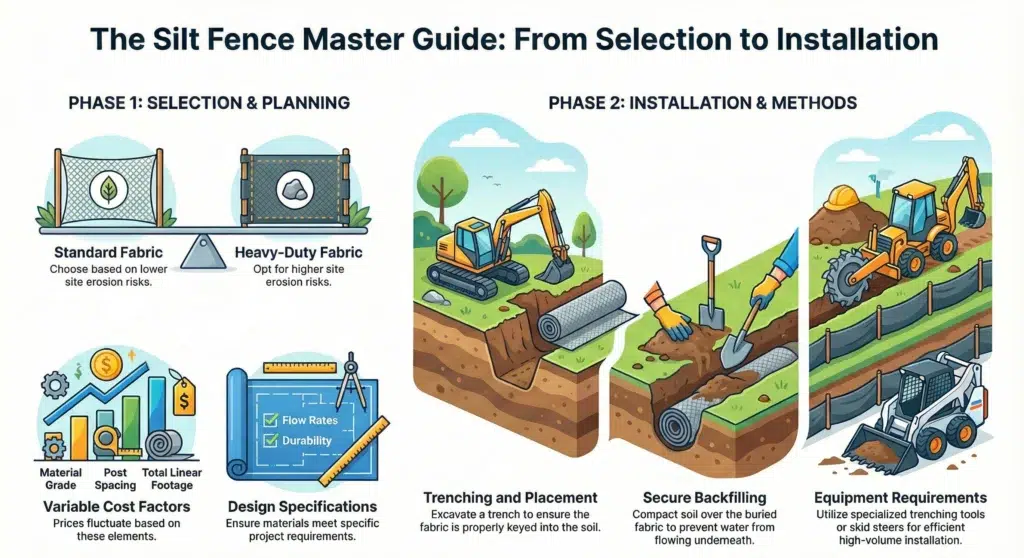
Silt fences are temporary sediment-control barriers commonly used on construction sites, erosion-control projects, and environmental restoration efforts. Selecting the appropriate silt fence type—standard, reinforced wire-backed, pre-assembled, super silt fence, floating turbidity barrier, compost filter sock, or high-visibility orange—ensures project success and regulatory compliance. This guide details all seven major silt fence types, including specifications, installation methods (manual trenching, power trenching, skid-steer installation), cost ranges, equipment options, regulatory requirements, site planning, and troubleshooting to ensure effective sediment control.


⚡ QUICK START In 60 Seconds

NEED A SILT FENCE? ANSWER 3 QUESTIONS:

Q1: What’s your application?

  • Construction site → Standard or reinforced silt fence
  • Steep slope → Reinforced wire-backed silt fence
  • Large project → Super silt fence or pre-assembled
  • Water body (pond/stream) → Turbidity barrier (floating)
  • Eco-friendly project → Compost filter sock
  • High-visibility needed → Orange high-visibility silt fence
  • Quick installation → Pre-assembled silt fence

Q2: How much area to cover?

  • Small (under 500 linear feet) → Standard + manual installation
  • Medium (500–1,500 linear feet) → Reinforced + power trenching
  • Large (1,500+ linear feet) → Super silt fence + machinery
  • Very large → Machine installer rental (bobcat, skid steer, vermeer)

Q3: What’s your budget?

  • Minimal → Standard silt fence, manual trenching ($0.30–0.50/LF)
  • Moderate → Reinforced silt fence, power installation ($0.75–1.50/LF)
  • High → Super silt fence + equipment ($2–5/LF)
  • Premium → Complete system with turbidity barriers ($3–8/LF)

First Step: Assess site conditions and regulatory requirements. 

Installation: Choose manual trenching or equipment rental. 

Budget: Calculate total linear feet multiplied by cost per foot. 

Compliance: Confirm local sediment control requirements.

Next Step: Identify the appropriate silt fence type from the options below.


5-Minute Decision Tree

QUESTION 1: What type of project?

🏗️ Construction Site → Standard or reinforced silt fence

🏗️ Steep Slope (5%+ grade) → Reinforced wire-backed silt fence

🏗️ Large Grading/Excavation → Super silt fence

🏗️ Temporary Sediment Control → Standard silt fence (adequate)

🏗️ Water Body (pond/stream/river) → Turbidity barrier (floating)

🏗️ Eco-Friendly/Green Project → Compost filter sock

🏗️ Public Safety Needed → Orange high-visibility silt fence

🏗️ Quick Install, Labor-Limited → Pre-assembled silt fence


QUESTION 2: What’s the installation timeline?

Today/This Week → Pre-assembled (fastest) or manual trenching

Next Few Days → Standard silt fence with rented equipment

Next Week+ → Any type (more time for planning)

Seasonal/Temporary → Standard silt fence (lowest cost)


QUESTION 3: Installation capability?

👷 Do-It-Yourself → Manual trenching, standard or pre-assembled

👷 Basic Tools Only → Pre-assembled or power trenching rental

👷 Equipment Available → Super silt fence with machinery

👷 Professional Installation → Any type (contractor handles)

 Silt Fence Fundamentals

What Is a Silt Fence?

Definition: A temporary sediment control barrier made from geotextile fabric supported by stakes, used to prevent erosion and contain sediment on construction sites and during land disturbance activities.

Primary Purpose: Control and contain sediment runoff while allowing water to pass through the fabric, preventing sediment from leaving the project site.

Regulatory Status: Temporary (not permanent). Must be installed during site disturbance and removed after project completion. Typically required by local environmental regulations for construction sites disturbing land.

How It Works:

  1. Water flows toward the fence
  2. Water passes through the geotextile fabric
  3. Sediment particles are trapped in the fabric or settle behind the fence
  4. Clear water exits the site
  5. Sediment remains contained

Why It Matters:

  • Environmental protection (prevents sediment pollution)
  • Regulatory compliance (often required by law)
  • Cost savings (prevents fines, liability)
  • Site cleanliness (reduces cleanup costs)

 7 Main Silt Fence Types

TYPE 1: Standard Silt Fence (Most Common)

Standard silt fence

Description: Basic, most commonly used silt fence type. Made from woven geotextile fabric, installed with wooden or steel stakes. Suitable for general sediment control on most construction sites.

Specifications:

Height Options

  • 24″ (2 feet)
  • 30″ (2.5 feet)
  • 36″ (3 feet)
  • 48″ (4 feet)

Common Sizes

  • 100 linear feet (standard roll)
  • 150 linear feet
  • 300 linear feet
  • 500 linear feet
  • Custom lengths available

Fabric Weight/Strength

  • 4 oz per square yard (lightweight)
  • 5.5 oz per square yard (standard)
  • 6 oz per square yard (heavier)

Installation Method

  • Manual trenching with a shovel
  • Power trenching (tractor or skid steer)
  • Post-hole digger for stakes

Stakes Used

  • Wooden stakes (1″×2″ or 2″×2″)
  • Steel posts (T-posts or square tube)
  • Typical spacing: 4–6 feet apart

Cost Range

  • Fabric alone: $0.25–0.50 per linear foot
  • Complete installation: $0.50–1.00 per linear foot
  • Stakes additional: $0.10–0.25 per linear foot

Best Applications

  • General construction site perimeter
  • Moderate slope erosion control
  • Standard sediment control projects
  • Budget-conscious applications

Advantages

  • Low cost
  • Easy installation
  • Widely available
  • Simple maintenance
  • Effective for normal conditions

Disadvantages

  • Limited strength on high slopes
  • Can fail under heavy water flow
  • Manual installation labor-intensive
  • Requires regular maintenance
  • Eventually degrades (6–12 months typical lifespan)


TYPE 2: Reinforced Silt Fence (Wire-Backed)

Close-up of barbed wire fence with clear blue sky background.

Description: Includes wire mesh for added strength. Handles higher water flow and pressure. Used on slopes or heavy runoff areas. The wire provides additional structural support.

Specifications:

Wire Backing Types

  • Welded wire mesh (3/4″–1″ openings)
  • Chain-link backing
  • High-strength wire grid
  • Reinforcing wire (smaller gauge)

Height Options

  • 24″ (2 feet)
  • 30″ (2.5 feet)
  • 36″ (3 feet)
  • 48″ (4 feet)

Fabric + Wire Weight

  • Approximately 2–3 times heavier than standard
  • More durable under pressure
  • Better retention of sediment

Installation Method

  • Power trenching (power + manual)
  • Equipment installation (bobcat, skid steer)
  • Manual installation is possible, but labor-intensive

Stakes Used

  • Heavy-duty steel posts (essential)
  • Spacing: 3–4 feet apart (closer than standard)
  • Deeper installation (8–12 inches minimum)

Cost Range

  • Fabric + wire: $0.40–0.75 per linear foot
  • Complete installation: $1.00–2.00 per linear foot
  • Equipment rental: $100–300 per day

Best Applications

  • Sloped construction sites (5%+ grade)
  • High-runoff areas
  • Areas with expected heavy water flow
  • Areas near sensitive waterways
  • Prolonged sediment control projects

Advantages

  • Stronger than standard
  • Handles higher water pressure
  • Longer lifespan (12–18 months typical)
  • Better sediment retention
  • More durable on slopes

Disadvantages

  • Higher cost than standard
  • More labor-intensive installation
  • Heavier material is harder to handle
  • Requires stronger stakes
  • More maintenance needed

TYPE 3: Pre-Assembled Silt Fence

A picturesque dirt road bordered by a rustic wooden fence in a lush forest landscape in Szymbark, Poland.

Description: Fabric already attached to stakes. Quick installation and labor-saving. Ideal for small to medium projects. Comes ready to install.

Specifications:

What’s Included

  • Geotextile fabric
  • Stakes (wooden or plastic)
  • Fabric pre-fastened to stakes
  • Sometimes includes ground anchors

Stake Options

  • Wooden stakes (pre-drilled)
  • Plastic stakes
  • 3–4 stakes included in a typical 100 LF roll

Height Options

  • 24″ (2 feet) is the most common
  • 30″ (2.5 feet)
  • 36″ (3 feet)

Installation Method

  • Push stakes directly into the ground (no digging if the soil is soft)
  • Minimal tools required
  • Fastest installation method
  • Suitable for smaller projects

Installation Speed

  • Time to install: 30–60 minutes per 100 LF
  • vs. Standard silt fence: 2–3 hours per 100 LF
  • Significant labor savings

Cost Range

  • Complete kit: $1.00–2.00 per linear foot
  • No separate stake purchasing needed
  • Total cost may be higher per LF, but lower labor cost

Best Applications

  • Small to medium projects (under 1,000 LF)
  • Quick temporary installations
  • Seasonal/short-duration projects
  • Budget-limited projects (when labor is valued highly)
  • Projects with limited crew availability

Advantages

  • Fastest installation
  • Minimal tools needed
  • Ideal for small projects
  • Pre-configured (no assembly needed)
  • Reduced labor time

Disadvantages

  • Higher cost per linear foot
  • Limited for large projects
  • Stakes may be lighter-duty
  • Less effective on slopes
  • Not suitable for high-flow areas

TYPE 4: Super Silt Fence (Heavy-Duty)

Super Silt Fence (Heavy-Duty)

Description: Heavy-duty version with chain-link or strong wire backing. Designed for large construction sites. Handles high sediment loads and fast-flowing water.

Specifications:

Backing Material

  • Chain-link fence (most common)
  • Heavy-gauge wire mesh
  • Structural reinforcement frame
  • Sometimes includes posts as an integral part

Height Options

  • 36″ (3 feet) typical
  • 48″ (4 feet) common
  • 60″ (5 feet) available
  • Custom heights for specific needs

Weight and Durability

  • Much heavier than standard
  • Double or triple the fabric thickness
  • Heavy-duty backing material
  • Designed for an 18–24-month lifespan

Installation Method

  • Equipment essential (bobcat, skid steer, excavator)
  • Power trenching required
  • Sometimes bolted to permanent structures
  • Professional installation typical

Stakes/Supports

  • Heavy steel posts (4″×4″ or larger)
  • Spacing: 2–3 feet apart (closer than standard)
  • Deep installation (12–18 inches)
  • Guy-wire support is sometimes used

Cost Range

  • Material alone: $1.00–2.50 per linear foot
  • Installation equipment: $300–800 per day
  • Total project: $3–8 per linear foot
  • Large projects: Negotiate volume pricing

Best Applications

  • Major construction sites (1,000+ LF)
  • Active grading/excavation areas
  • High-sediment-load areas
  • Steep slopes (10%+ grade)
  • Long-duration projects (6+ months)
  • Areas with regulatory scrutiny

Advantages

  • Maximum durability
  • Handles extreme conditions
  • Longest lifespan
  • Highly effective sediment control
  • Requires minimal maintenance

Disadvantages

  • Highest cost
  • Requires equipment
  • Professional installation needed
  • Difficult to remove/relocate
  • Over-designed for small projects

TYPE 5: Turbidity Barrier (Floating Silt Fence)

Turbidity Barrier (Floating Silt Fence)

Description: Used in water bodies like rivers, lakes, and ponds. Floats on the water surface. Controls sediment movement in aquatic areas.

Specifications:

Key Difference from Land Silt Fence

  • Floats on water (not anchored to ground)
  • The sediment curtain hangs down from the float
  • Allows water flow, blocks sediment movement
  • Used in active waterways

Float Material Options

  • Foam flotation (most common)
  • Plastic buoyancy tanks
  • PVC pipe flotation
  • Sealed air chambers

Curtain/Skirt Material

  • Geotextile fabric (same as land silt fence)
  • Heavier weight typical (for water pressure)
  • Depth: 4–8 feet typical (depending on water depth)
  • Width: 50–500 linear feet

Anchoring System

  • Weights (anchors, chains, cables)
  • Stakes/posts at the water bottom (shallow water)
  • Divers/professional installation (deep water)
  • Current resistance engineering

Installation Method

  • Boat deployment (typical)
  • Wading installation (shallow water)
  • Professional installation (recommended)
  • Surveying/positioning critical

Cost Range

  • Turbidity barrier rental: $1,000–5,000+ per month
  • Purchase cost: $2,000–15,000+ for typical installation
  • Installation/removal: $500–3,000
  • Professional deployment: Additional cost

Best Applications

  • Shoreline construction (erosion control)
  • Bridge/pier construction near water
  • Dredging operations
  • Restoration projects near waterways
  • Environmental remediation
  • Sand/gravel extraction near water

Advantages

  • Only option for water sediment control
  • Floating design handles water level changes
  • Can be redeployed
  • Professional environmental compliance
  • Effective in moving water (streams)

Disadvantages

  • High cost
  • Professional installation required
  • Complex deployment/removal
  • Ongoing maintenance of the water
  • Engineering design often requires

TYPE 6: Compost Filter Sock (Eco-Friendly Alternative)

Compost Filter Sock (Eco-Friendly Alternative)

Description: Made from compost, straw, or coir materials. Eco-friendly and biodegradable. Used instead of traditional silt fences in green projects. Decomposes naturally at the end of use.

Specifications:

Material Composition

  • Coconut coir (coir fiber—most common)
  • Compost (various types)
  • Straw (less common, lower durability)
  • Blended materials

Diameter Options

  • 4″ (typical)
  • 6″
  • 9″ (larger projects)
  • Custom sizes

Length Options

  • 25 linear feet
  • 50 linear feet
  • 100 linear feet
  • 500+ linear feet (delivered by pallet)

Installation Method

  • Laid on ground (no trenching required)
  • Placed along contours
  • No stakes are typically needed
  • Can be weighted down (optional)
  • Manual placement (labor-light)

Installation Speed

  • Very fast (roll out and position)
  • 30–45 minutes per 100 LF typical
  • Minimal training required

Lifespan

  • 6–12 months (completely biodegrades)
  • Decomposes into soil amendment
  • No removal needed (integrates into site)
  • Climate-dependent (slower in dry areas)

Cost Range

  • Material: $0.30–0.75 per linear foot
  • Installation: Minimal (labor-light)
  • Total: $0.50–1.00 per linear foot
  • Removed at end: $0 (left to decompose)

Best Applications

  • Green building projects
  • Environmental restoration
  • Native plantings
  • Rain gardens
  • Eco-certification required sites
  • Temporary sediment control (6–12 months)
  • Areas wanting zero plastic waste

Advantages

  • Completely biodegradable
  • No removal required
  • Becomes a soil amendment
  • Environmental approval
  • Very fast installation
  • Low labor cost

Disadvantages

  • Shorter lifespan (not for 18+ month projects)
  • Less structural strength
  • Weather-dependent degradation
  • Lower sediment retention
  • Inappropriate for industrial sites
  • May attract pests if compost-based

TYPE 7: High-Visibility Silt Fence (Orange)

Description: Bright-colored (usually orange). Provides both sediment control and site safety marking. Common in roadwork and public areas.

Specifications:

Color Options

  • Bright orange (most common)
  • High-visibility yellow-orange
  • Reflective striping is sometimes included
  • Meets ANSI visibility standards

Visibility Purpose

  • Worker safety (prevents tripping)
  • Equipment operator awareness
  • Public communication (construction area)
  • Combined sediment + safety function

Fabric Type

  • Can be standard silt fence fabric (orange)
  • Can be reinforced (orange with wire backing)
  • Can be pre-assembled (orange)
  • Base material is the same as other types

Installation Method

  • Same as the underlying silt fence type
  • No special installation requirements
  • Color provides an additional visibility benefit

Regulatory Purpose

  • Meets OSHA visibility requirements
  • Satisfies roadwork visibility standards
  • Complies with construction zone marking
  • Doubles as a silt fence + safety barrier

Cost Range

  • Slight premium to standard ($0.05–0.15/LF additional)
  • Often the same cost as standard (supply varies)
  • Installation cost: Same as standard

Best Applications

  • Roadwork and highway construction
  • Public-area projects
  • High-traffic construction zones
  • Projects where worker safety is critical
  • Projects near pedestrian areas
  • Municipal/government projects

Advantages

  • Dual function (sediment + safety)
  • Improved visibility reduces accidents
  • No additional installation
  • Small or no cost premium
  • Regulatory compliance

Disadvantages

  • Limited availability (fewer suppliers)
  • Slightly higher cost sometimes
  • May fade over time (UV exposure)
  • Same sediment control as standard

Silt Fence Specifications & Selection

Fabric Types & Weights

Lightweight fabric (4–5 oz)

  • Cost: Lowest
  • Durability: 3–6 months
  • Best for: Short-term projects, temporary controls
  • Water flow: Handles moderate flow
  • Sediment retention: Adequate

Standard Fabric (5.5–6 oz)

  • Cost: Mid-range
  • Durability: 6–12 months
  • Best for: Most construction sites
  • Water flow: Good for typical runoff
  • Sediment retention: Good

Heavy fabric (8–9+ oz)

  • Cost: Higher
  • Durability: 12–18 months
  • Best for: Long-term projects, slopes
  • Water flow: Handles higher flow
  • Sediment retention: Excellent

Wire-Reinforced (6–10 oz + wire)

  • Cost: Higher
  • Durability: 12–18 months
  • Best for: Slopes, high flow areas
  • Water flow: Excellent
  • Sediment retention: Excellent

Height Selection Guide

24″ (2 feet)

  • Cost: Lowest
  • Best for: Low slopes, light runoff
  • Sediment depth: Limits sediment accumulation
  • Setup: Minimal material needed
  • Common use: Small projects, budget projects

30″ (2.5 feet)

  • Cost: Mid-range
  • Best for: Moderate slopes, typical projects
  • Sediment depth: Better accumulation
  • Setup: Standard choice
  • Common use: Most construction sites

36″ (3 feet)

  • Cost: Mid-range + premium
  • Best for: Steep slopes, heavy runoff
  • Sediment depth: Good accumulation space
  • Setup: More material needed
  • Common use: Grading projects, slopes

48″ (4 feet)

  • Cost: Premium
  • Best for: Very steep slopes, major projects
  • Sediment depth: Excellent accumulation
  • Setup: Most material needed
  • Common use: Large excavations, major projects

Stake Type Comparison

Wooden Stakes (1″×2″ or 2″×2″)

  • Cost: $0.10–0.25 each
  • Installation: Shovel, post-hole digger
  • Durability: 6–12 months (can rot)
  • Best for: Temporary installations
  • Removal: Easier to pull out
  • Environmental: Biodegradable

Steel T-Posts

  • Cost: $0.50–1.50 each
  • Installation: T-post driver (manual or powered)
  • Durability: 2–5 years+ (won’t rot)
  • Best for: High-wind areas, reusable projects
  • Removal: Requires tool (T-post puller)
  • Environmental: Reusable, recyclable

Steel Square Tube Posts

  • Cost: $1.00–3.00 each
  • Installation: Heavy equipment typically
  • Durability: 10+ years
  • Best for: Large projects, permanent structures
  • Removal: An excavator is typically needed
  • Environmental: Reusable, recyclable

Plastic Stakes (Pre-Assembled)

  • Cost: $0.25–0.75 each (included in kit)
  • Installation: Hand-push in soft ground
  • Durability: 6–12 months
  • Best for: Small projects, quick installation
  • Removal: Easy hand-pull
  • Environmental: Recyclable plastic

Installation Methods

Method 1: Manual Trenching

Tools Needed

  • Shovel (round-point)
  • Post-hole digger
  • Level
  • Tape measure
  • Work gloves
  • Staple gun (or nails)

Step-by-Step Procedure

Step 1: Mark the Fence Line (15 min)

  • Identify the perimeter of the sediment control area
  • Use spray paint or chalk to mark
  • Ensure the line follows the site plan
  • Mark stake locations every 4–6 feet

Step 2: Trench the Perimeter (20–30 min per 100 LF)

  • Shovel a 6–8 inch deep trench
  • Keep trench straight
  • Trenching is the most labor-intensive step
  • Remove rocks, roots
  • The trench should be 12–18 inches wide

Step 3: Install Stakes (5–10 min per 100 LF)

  • Place stakes in the trench at marked locations
  • Ensure stakes are upright
  • Use the level to verify
  • Drive stakes 12–18 inches into the ground
  • Spacing: 4–6 feet apart

Step 4: Unroll Fabric (5 min per 100 LF)

  • Unroll the geotextile fabric
  • Position the fabric behind the stakes
  • Ensure fabric reaches the bottom of the trench
  • Allow some fabric to extend above the ground

Step 5: Secure Fabric to Stakes (10–15 min per 100 LF)

  • Use a staple gun to fasten fabric to stakes
  • Staples every 6–12 inches
  • Secure the top edge of the fabric
  • Secure fabric in trench with dirt/tamping

Step 6: Backfill Trench (10 min per 100 LF)

  • Fill the trench with excavated soil
  • Tamp down firmly
  • Ensure fabric stays vertical
  • Complete backfilling around the fence line

Step 7: Inspect and Test (5 min per 100 LF)

  • Check for gaps or tears
  • Ensure fabric is taut
  • Verify stakes are secure
  • Test with water (optional)

Total Installation Time

  • Approximately 2–3 hours per 100 linear feet
  • Experienced crew: 1.5–2 hours per 100 LF
  • Inexperienced: 3–4 hours per 100 LF

Cost Calculation (Manual)

  • Labor: $150–250 per 100 LF
  • Materials: $50–75 per 100 LF
  • Total: $200–325 per 100 LF
  • Economies of scale: Lower cost for larger projects

Best Applications

  • Small projects (under 500 LF)
  • Areas with difficult equipment access
  • Very tight spaces
  • Budget-limited projects
  • Projects with available labor

Advantages

  • No equipment rental cost
  • Flexible scheduling
  • Can navigate tight spaces
  • Simple to perform
  • Easy to adjust/repair

Disadvantages

  • Labor-intensive
  • Time-consuming
  • Physically demanding
  • Inconsistent quality
  • Limited scalability

Method 2: Power Trenching (Tractor-Mounted)

Equipment Needed

  • Trenching machine (tractor-mounted or walk-behind)
  • Tractor or skid steer (for mounted trencher)
  • Operator
  • 1–2 manual laborers (assisting)

Equipment Rental Cost

  • Walk-behind trencher: $75–150 per day
  • Tractor + trencher: $200–400 per day
  • Typical rental: 1 day covers 500–1,000 LF
  • Delivery may be additional: $50–200

Trenching Speed

  • Typical: 500–800 LF per day
  • Experienced operator: 1,000–1,500 LF per day
  • Variable soil conditions affect speed
  • Includes stake installation by manual crew

Installation Procedure

Step 1: Mark Perimeter (15 min)

  • Identify and mark the fence line
  • Mark with spray paint every 10 feet
  • Ensure a clear path for equipment

Step 2: Operate trencher (3–5 hours per 500–1,000 LF)

  • Start trencher at the perimeter point
  • The operator follows the marked line
  • Trencher digs a 6–8 inch trench
  • Crew follows behind with stakes/fabric

Step 3: Manual Installation Following Trencher

  • Install stakes while the trench is fresh
  • Unroll fabric
  • Secure fabric to stakes
  • Backfill trench

Step 4: Final Inspection

  • Verify trench continuity
  • Check all connections
  • Ensure fabric secure

Total Installation Time

  • Approximately 1 day for 500–1,000 LF
  • Experienced: 1,000–1,500 LF per day
  • Faster than manual by 50–70%

Cost Calculation (Power Trenching)

  • Equipment rental: $200–400 per day
  • Operator: $60–100 per hour (6–8 hours typical)
  • Manual labor: $150–200 per day
  • Materials: $50–75 per 100 LF
  • Total: $0.75–1.50 per linear foot

Best Applications

  • Medium projects (500–2,000 LF)
  • Accessible terrain
  • Linear fence runs
  • Time-sensitive projects
  • Projects with an adequate budget

Advantages

  • Much faster than manual
  • More consistent trench depth
  • Reduced manual labor
  • Good cost-benefit for medium projects
  • Cleaner installation

Disadvantages

  • Equipment rental cost
  • Requires accessible terrain
  • Operator skill needed
  • Can’t navigate tight spaces
  • Weather dependent (muddy conditions)

Method 3: Skid Steer / Equipment Installation

Equipment Options

Bobcat Silt Fence Installer

  • Bucket attachment with built-in fabric dispenser
  • Creates a trench and installs in one pass
  • Highly efficient
  • Typical model: Bobcat 463 or larger

Vermeer Silt Fence Installer

  • Standalone machine for silt fence installation
  • Trenches and fabric installation simultaneously
  • Operator-controlled pace
  • Professional-grade efficiency

Skid Steer Trencher Attachment

  • Trencher attachment for any skid steer
  • Manual crew follows with fabric/stakes
  • More flexible than specialized equipment
  • Rental: $150–250 per day

Tracked Excavator with Trencher

  • For very large projects
  • Handles difficult terrain
  • Very efficient
  • High hourly cost

Equipment Rental Costs

  • Bobcat with silt fence bucket: $300–600 per day
  • Vermeer silt fence installer: $400–800 per day
  • Skid steer trencher: $200–400 per day
  • Operator (if included): Often an additional $60–100/hour

Installation Speed

  • 1,000–3,000 linear feet per day
  • Professional machine: Up to 5,000+ LF per day
  • Operator experienced with equipment

Installation Procedure

Step 1: Setup & Layout (15–30 min)

  • Operator reviews site plan
  • Mark’s fence line (if not pre-marked)
  • Sets up equipment for terrain

Step 2: Machine Installation (3–6 hours)

  • The operator drives the machine along the fence line
  • Machine simultaneously:
    • Digs trench
    • Installs stakes (if equipped)
    • Deploys fabric
    • Partially backfills
  • Manual crew may assist with connections/overlaps

Step 3: Final Finishing (1–2 hours)

  • Verify all connections
  • Overlap splice sections
  • Final backfilling
  • Clean up the area

Total Installation Time

  • Approximately 1 day for 1,000–3,000 LF
  • Professional: 3,000–5,000+ LF possible
  • Very efficient for large projects

Cost Calculation (Equipment Installation)

  • Equipment rental: $400–800 per day
  • Operator: Often included or $75–125/hour
  • Manual crew: 1–2 people @ $15–20/hour
  • Materials: $50–75 per 100 LF
  • Total: $1.00–3.00 per linear foot

Best Applications

  • Large projects (2,000+ LF)
  • Time-critical projects
  • Accessible terrain
  • Linear installations
  • Professional/commercial projects

Advantages

  • Fastest installation method
  • Most consistent quality
  • Lowest per-foot cost for large projects
  • Professional results
  • Handles difficult terrain (some equipment)

Disadvantages

  • High equipment cost
  • Requires equipment access
  • Operator skill required
  • Can’t navigate tight spaces
  • Weather dependent

Regulatory Requirements

When Is Silt Fence Required?

General Rule: Construction sites that disturb soil (e.g., land grading, excavation) typically require sediment control under EPA and state regulations.

Specific Triggers:

  • Site disturbance: 5,000+ square feet (EPA threshold)
  • Soil exposure: Any disturbed soil area
  • Water proximity: Sites near waterways are stricter
  • Local regulations: May be more stringent than state/federal
  • Erosion potential: High-risk sites always require

Federal Requirement (EPA):

  • Construction General Permit (CGP) requires sediment control
  • Applies to sites 1+ acres disturbed
  • May apply below 1 acre (local discretion)
  • Best Management Practices (BMPs) required

State Variations:

  • Most states have similar requirements
  • Some states are more stringent
  • Specific silt fence standards vary
  • The local authority has jurisdiction

Local Regulations:

  • City/county ordinances vary widely
  • May be stricter than the state
  • Permits often required
  • Inspections common
  • Fines for non-compliance: $500–10,000+ per day

Permit Requirements:

  • Stormwater Pollution Prevention Plan (SWPPP) is common
  • Site plan with sediment control shown
  • Maintenance schedule required
  • Inspection documentation
  • Removal/restoration plan

Performance Standards

Type A Silt Fence Specification

  • Standard silt fence
  • Geotextile fabric, minimum 4 oz/sq yd
  • Stakes every 4–6 feet
  • Height: 24–36″
  • 6–8″ burial depth minimum
  • Perimeter silt fence requirement

Type C Silt Fence Specification

  • Reinforced/wire-backed silt fence
  • For slopes 2:1 or steeper
  • Heavy-duty fabric, 6+ oz/sq yd
  • Wire backing required
  • Stakes 3–4 feet apart
  • 8–12″ burial depth

Type S Super Silt Fence Specification

  • Chain-link backing or equivalent
  • For slopes 1.5:1 or steeper
  • High-durability fabric
  • Heavy stakes, close spacing
  • Professional installation
  • More stringent maintenance

Turbidity Barrier Standards

  • For water bodies
  • Engineering design required
  • Professional installation
  • Regular inspections required
  • Removal plan required

Maintenance & Troubleshooting

Regular Maintenance

Weekly Inspection Checklist

  • ☑️ Check for gaps or tears in fabric
  • ☑️ Verify stakes are upright
  • ☑️ Ensure no sediment accumulation is blocking water flow
  • ☑️ Look for signs of undercutting
  • ☑️ Check stake/fabric connections

Maintenance Tasks

Sediment Removal

  • Frequency: When sediment builds up 12+ inches
  • Method: Remove with shovel/equipment
  • Disposal: Offsite to approved location
  • Cost: $500–2,000 per event (depends on volume)

Fabric Repair

  • Torn fabric: Patch with duplicate fabric + staples
  • Loose connections: Re-staple or reattach
  • Separated stakes: Re-tighten, may need new stakes
  • Cost: Minimal (materials) + labor

Stake Replacement

  • Replace if pulled loose or bent
  • Check all stakes quarterly
  • Replace wood stakes if rotting (wooden)
  • Cost: $0.50–3.00 per stake

Winter Maintenance

  • Remove accumulated ice
  • Add extra bracing if there is a risk of wind damage
  • Monitor for freeze/thaw damage
  • May need temporary removal/reinstallation

Common Problems & Solutions

Problem 1: Water Flows Over Top of Fence

  • Cause: Fence too low for water volume
  • Solution: Raise fence height (if possible)
  • Alternative: Add a second tier of silt fence
  • Prevention: Size appropriately for runoff

Problem 2: Water Undermines Fence (Undercutting)

  • Cause: Water channels under the buried portion
  • Solution: Extend the buried trench deeper
  • Add riprap or an energy dissipation device
  • Prevention: Deeper burial depth

Problem 3: Sediment Accumulation Too High

  • Cause: Inadequate sediment removal
  • Solution: Remove accumulated sediment
  • Frequency: More often
  • Prevention: Plan removal schedule

Problem 4: Fabric Tears or Damage

  • Cause: Physical damage, weathering, vegetation growth
  • Solution: Patch torn fabric
  • Replacement: Replace the fabric section
  • Prevention: Regular inspection, trim vegetation

Problem 5: Stakes Pulled Loose

  • Cause: Insufficient driving depth, poor soil
  • Solution: Reinstall stakes deeper
  • Increase stake spacing (closer together)
  • Use heavier stakes
  • Prevention: Better initial installation

Problem 6: Fence Blows Over (High Wind)

  • Cause: Insufficient support, high exposure
  • Solution: Add guy-wires or bracing
  • Increase stake number/depth
  • Reduce fabric height (if possible)
  • Prevention: Plan for wind in design

Problem 7: Vegetation Growth Behind Fence

  • Cause: Sediment buildup allows plant growth
  • Solution: Clear vegetation regularly
  • Remove sediment more frequently
  • Prevention: Regular maintenance

Problem 8: Connection Points Fail

  • Cause: Inadequate overlaps, poor stapling
  • Solution: Re-overlap and re-staple connections
  • Replace with new material if severely damaged
  • Prevention: Better initial installation technique

Cost Analysis & Budgeting

Material Cost Breakdown (Per 100 Linear Feet)

Standard Silt Fence (24″–30″)

  • Fabric: $25–40
  • Stakes (wooden, 20 @ $0.15): $3–5
  • Staples/fasteners: $2–3
  • Total materials: $30–48

Reinforced Silt Fence (30″–36″)

  • Fabric + wire: $40–75
  • Stakes (steel, 20 @ $0.50–1.00): $10–20
  • Hardware: $5–10
  • Total materials: $55–105

Pre-Assembled Silt Fence (24″)

  • Complete kit: $100–200
  • Includes fabric + stakes
  • Total materials: $100–200

Super Silt Fence (36″–48″)

  • Fabric + heavy backing: $100–250
  • Heavy-duty stakes: $30–50
  • Hardware: $10–20
  • Total materials: $140–320

Turbidity Barrier (Per Month Rental)

  • Equipment rental: $1,000–5,000
  • Deployment/removal: $500–3,000
  • Monitoring/maintenance: $200–1,000
  • Total: $1,700–9,000/month

Labor Cost Breakdown (Per 100 Linear Feet)

Manual Installation

  • Crew size: 2–3 people
  • Time: 2–3 hours
  • Labor cost: $150–250
  • Equipment: None

Power Trenching

  • Crew: 1 equipment operator + 2 laborers
  • Time: 30–60 minutes
  • Labor cost: $100–150
  • Equipment rental: $200–400/day (covers 500–1,000 LF)

Skid Steer/Equipment Installation

  • Crew: 1 operator + 1–2 laborers
  • Time: 15–30 minutes
  • Labor cost: $75–125
  • Equipment rental: $300–800/day (covers 1,000–3,000+ LF)

Total Project Cost Examples

Small Project: 300 Linear Feet, Manual Installation

  • Materials: $90–145
  • Labor: $450–750
  • Total: $540–895
  • Cost per LF: $1.80–3.00

Medium Project: 1,000 Linear Feet, Power Trenching

  • Materials: $300–480
  • Equipment rental: $250–400
  • Labor: $300–450
  • Total: $850–1,330
  • Cost per LF: $0.85–1.33

Large Project: 3,000 Linear Feet, Equipment Installation

  • Materials: $900–1,440
  • Equipment rental: $400–800
  • Labor: $450–750
  • Total: $1,750–2,990
  • Cost per LF: $0.58–1.00

Major Project: 5,000+ Linear Feet, Equipment Installation

  • Materials: $1,500–2,400
  • Equipment rental: $800–1,600
  • Labor: $750–1,250
  • Total: $3,050–5,250
  • Cost per LF: $0.61–1.05

Comprehensive FAQ

Installation Questions

Q: How deep should a silt fence be buried?

A: Minimum 6–8 inches. For reinforced or heavy-duty fences on slopes, 8–12 inches is recommended. Deeper burial prevents undercutting when water flows under the fence. If the soil is unstable or the water flow is high, go deeper.


Q: How far apart should stakes be?

A: Standard spacing is 4–6 feet for standard silt fence. For reinforced fences on slopes, 3–4 feet spacing. For super silt fence, 2–3 feet spacing. Closer spacing provides more support for higher water pressure.


Q: Can I install a silt fence myself?

A: Yes, manual installation is straightforward. Tool requirements: shovel, post-hole digger, staple gun. Time: 2–3 hours per 100 LF. Physical demands are moderate to high. For large projects, equipment rental may be more cost-effective despite the equipment cost.


Q: How long does silt fence installation take?

A: Manual: 2–3 hours per 100 LF. Power trenching: 30–60 minutes per 100 LF. Equipment installation (skid steer/bobcat): 15–30 minutes per 100 LF. Total time depends on site conditions, soil type, and crew experience.


Q: What’s the best way to connect overlaps?

A: Overlap at least 12 inches. Secure overlap with staples every 6 inches. For heavy-duty or sloped installations, use additional fastening. Test for water overlap, if possible, to ensure proper connectivity.


Q: Do I need a permit for a silt fence?

A: Check local requirements. Most jurisdictions require it for construction sites disturbing 5,000+ sq ft. A permit typically requires a SWPPP (Stormwater Pollution Prevention Plan) showing a silt fence. Fines for unpermitted silt fences can range from $500 to $ 10,000+ per day.


Q: How often should I maintain silt fence?

A: Inspect weekly minimum. Remove accumulated sediment when the buildup reaches 12 inches. Repair tears immediately. Replace damaged stakes. In high-flow situations, daily inspection may be necessary.


Material Questions

Q: What’s the difference between standard and reinforced silt fence?

A: Standard silt fence is geotextile fabric only. Reinforced includes wire backing (mesh or chain-link) for additional strength. Reinforced handles increase the water flow and work better on slopes. Cost is 50–100% higher for reinforced.


Q: How long does a silt fence last?

A: Standard silt fence: 6–12 months. Reinforced: 12–18 months. Super silt fence: 18–24 months. Compost filter: 6–12 months. Degradation depends on UV exposure, water flow, and sediment load. Expect eventual replacement.


Q: What fabric weight is best?

A: 5.5–6 oz is standard and adequate for most projects. 4 oz works for light-duty, temporary applications—8+ oz for slopes or high-flow areas. Heavier isn’t always necessary—consider project-specific conditions.


Q: Is a compost filter sock as effective as a regular silt fence?

A: For sediment control, a standard silt fence is more effective. A compost filter provides adequate control in low-sediment situations and offers environmental benefits (biodegradable, soil amendment). Not suitable for industrial sites or high-sediment areas.


Q: What color should silt fence be?

A: Standard colors are tan/beige (geotextile natural) or orange (high-visibility). Orange is required in some jurisdictions for safety/visibility. Functional differences are minimal—color choice is primarily regulatory/safety-driven.


Equipment Questions

Q: What’s the cost to rent equipment for silt fence installation?

A: Walk-behind trencher: $75–150/day. Tractor with trencher: $200–400/day. Bobcat silt fence installer: $300–600/day. Vermeer slit fence installer: $400–800/day. For most projects under 1,000 LF, Manual is more cost-effective. Over 1,000 LF: Equipment rental is typically more cost-effective overall.


Q: Is it worth renting equipment for a small project?

A: For under 500 LF: Manual installation is usually cheaper ($200–400 material + labor). For 500–1,000 LF: Equipment rental borderline ($250–400 equipment + $300–400 labor vs $450–750 manual labor). For over 1,000 LF, equipment rental is usually cheaper per foot overall.


Q: Can I use a regular trencher, or do I need a silt fence-specific machine?

A: Regular trencher works fine. Slit fence-specific machines (Bobcat silt fence installer, Vermeer) are optimized and faster, but regular trenchers do the job—regular trenching requires a manual crew to follow with fabric/stakes.


Q: What’s a skid steer silt fence installer?

A: Skid steer attachment that installs silt fence in one pass (trenches + installs fabric + stakes + backfills). Brands: Bobcat, Vermeer, others. Cost: $300–600 per day rental. Speed: 1,000–3,000+ LF per day. Professional-grade quality.


Regulatory Questions

Q: When is a silt fence required?

A: Whenever construction disturbs soil and creates erosion risk. EPA threshold: 1+ acre disturbance. Local requirements may be lower (5,000 sq ft common)—sites near water: Almost always required. Check with the local authority for specific requirements.


Q: What are Type A, C, and S silt fences?

A: Type A: Standard silt fence (24–36″ height, 4–6 ft stake spacing). Type C: Reinforced for slopes 2:1 or steeper (30–36″ height, wire backing, 3–4 ft spacing). Type S: Super for slopes 1.5:1 or steeper (chain-link backing, professional installation). Regulations specify the type based on site conditions.


Q: Do I need an inspection?

A: Many jurisdictions require periodic inspections (weekly or monthly). Inspection verifies proper maintenance, sediment removal, and the absence of damage. Non-compliance can result in fines. Document inspections for regulatory records.


Q: What happens if I don’t install silt fence where required?

A: Fines: $500–10,000+ per day. Site shutdown orders possible. Environmental liability if sediment damages waterways—contractor liability (if outsourced). Best to comply—penalties exceed the cost of proper installation.


Removal & Restoration Questions

Q: When should a silt fence be removed?

A: Remove when sediment control is no longer needed (project completion or permanent sediment controls installed). EPA guidance: Remove within 14 days of project completion. Do not remove before permanent controls are in place.


Q: How is a silt fence removed?

A: Manual removal: Pull stakes, roll up fabric, dispose. Equipment removal: Skid steer excavator pulls everything and loads it into the truck. Disposal: Dispose of at a landfill or an approved facility—cost: $200–$ 500 for small projects; $1,000+ for large projects.


Q: Can I reuse silt fence?

A: Possibly, if the fabric is undamaged and still has life remaining. Stakes may be reusable (especially steel). Typically, the cost of storage/handling makes reuse uneconomical unless the project is immediate. Most installations are single-use.


Q: What do I do with the removed silt fence?

A: Fabric: Dispose of the landfill. Wooden stakes: Can be disposed of or burned (if permitted by regulations). Steel stakes: Salvage and reuse, or scrap. Accumulated sediment: Dispose at approved location (never to landfill if contaminated).


Typical Installation Detail

Side View:

Ground Surface ____________________________________
              |←Fabric Height|
              |              |
        _____|============__|____
        |   Silt Fence      |
        |   Geotextile      |
    ____|___________________|____
        |  Trench (6-8")     |
        |  Backfilled        |
       __|__________________|__
        Foundation/Bedrock

Top View (Perimeter Layout):

        Construction Site (Disturbed)
    ====================================
    ||||||  Silt Fence (Entire Perimeter)
    ====================================
         Clear sediment-laden
         water exits to
         undisturbed area

Cost Comparison Quick Reference

Small Project (300 LF): Manual Installation

  • Materials: $30–50
  • Labor: 6–9 hours @ $15–20/hr = $90–180
  • Total: $120–230
  • Per LF: $0.40–0.77

Medium Project (1,000 LF): Power Trenching

  • Materials: $100–160
  • Equipment rental: $200–400
  • Labor: 4–6 hours crew = $120–180
  • Total: $420–740
  • Per LF: $0.42–0.74

Large Project (3,000 LF): Equipment Installation

  • Materials: $300–480
  • Equipment: $400–800
  • Labor: 6–9 hours crew = $180–270
  • Total: $880–1,550
  • Per LF: $0.29–0.52

Major Project (5,000+ LF): Professional Equipment

  • Materials: $500–800
  • Equipment: $800–1,600
  • Labor: 8–12 hours crew = $240–360
  • Total: $1,540–2,760
  • Per LF: $0.31–0.55

Resources

Erosion Control Standards & Specifications

Installation & Equipment Information

  • https://www.youtube.com – Installation videos and equipment demonstrations

Materials & Supplies

  • https://www.lowes.com – Silt fence materials, stakes, and supplies

Regulatory Compliance & Guidelines

  • https://www.houzz.com – Professional erosion control contractor directory

DISCLAIMER

This silt fence installation and selection guide provides general guidance on silt fence types, installation methods, and specifications.

Always consult local environmental regulations, stormwater permits, and professional engineers for specific requirements in your jurisdiction.

Regulatory requirements vary significantly by location—EPA guidelines serve as the baseline, but state and local regulations may be more stringent. Permits are often required, and non-compliance penalties can be substantial.

Installation specifications must comply with local requirements. Type A, C, and S designations are examples; your jurisdiction may have different standards. Consult your local environmental or building department for applicable specifications.

Professional installation is recommended for large projects, steep slopes, or high-sediment situations. Improper installation can result in regulatory non-compliance and environmental liability.

Cost estimates are approximate and vary widely based on location, soil conditions, site access, and current material/labor costs. Always obtain quotes from local suppliers and contractors.

This guide does not replace professional engineering consultation for complex projects, proximity to sensitive water bodies, or regulatory compliance questions. When in doubt, consult a licensed environmental engineer or professional sediment control contractor.