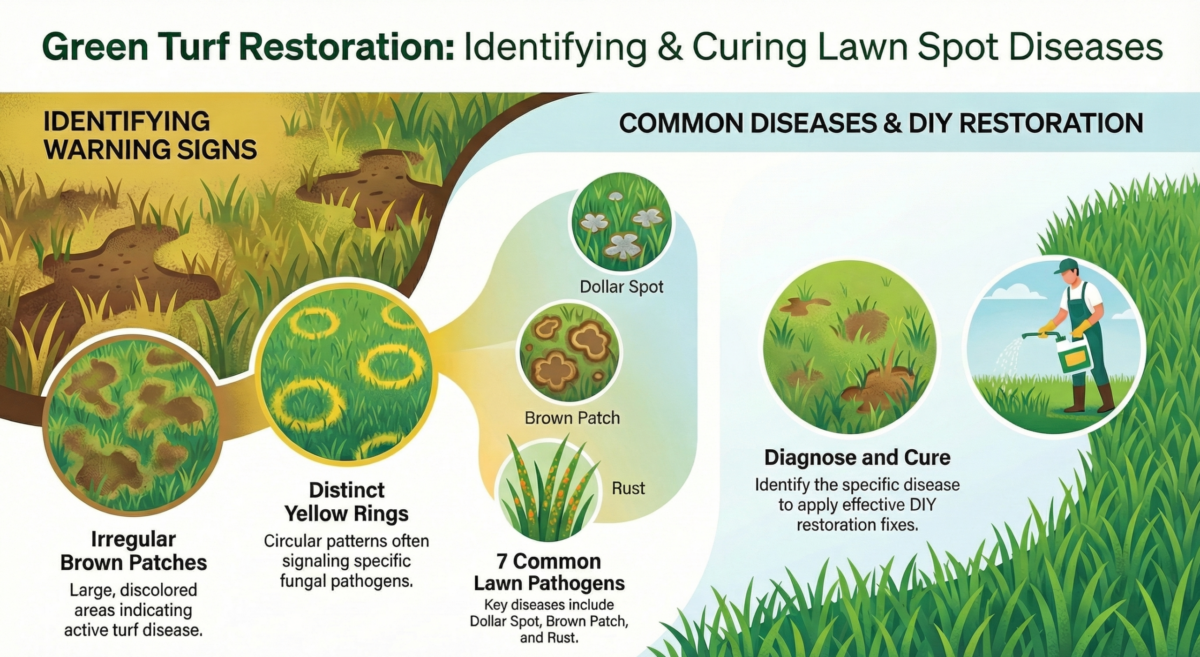
🌿 Comprehensive Lawn Spot Disease Guide
Complete Identification • Treatment • Repair • Home Remedies • All Lawn Types
• Most common lawn complaint
• Tan, brown, or dark brown color
• Various sizes (1 inch to large patches)
• Can appear suddenly or gradually
POSSIBLE CAUSES:
1. FUNGAL DISEASE (60% of cases)
• Dollar spot, gray leaf spot
• Treatment: Fungicide spray
2. DOG URINE DAMAGE (25% of cases)
• Brown/dead ring with green center
• Nitrogen burn from concentration
• Treatment: Reseed/sod, water lawn
3. COMPACTION/TRAFFIC (10% of cases)
• From heavy walking/vehicle use
• Poor drainage in compacted area
• Treatment: Aerate, overseed
4. UNDERWATERING/HEAT STRESS (5% of cases)
• Drought stress during hot weather
• Brown despite watering
• Treatment: Deep water, check soil
QUICK IDENTIFICATION:
• Ring pattern = likely dog damage
• Gradual spread = likely fungus
• In traffic area = likely compaction
• Scattered spots = likely disease
• Yellow, gold, or pale green color
• Often with darker border
• Can spread rapidly
• More common in summer
POSSIBLE CAUSES:
1. FUNGAL DISEASE (40%)
• Gray leaf spot, dollar spot early stage
• Usually hot/humid conditions
2. NITROGEN DEFICIENCY (30%)
• Pale/weak growth
• Uniform yellowing
• Treatment: Nitrogen fertilizer
3. DOG URINE (20%)
• Yellow halo around brown center
• Distinct ring pattern
• Treatment: Reseed
4. OVERWATERING (10%)
• Yellowing from root stress
• Soggy soil
• Treatment: Improve drainage
QUICK IDENTIFICATION:
• Uniform color = nutrient issue
• With dark border = fungus likely
• Ring pattern = dog damage
• In wet areas = drainage issue
• White, pale, or silvery appearance
• Often small and circular
• Fine webbing visible in morning dew
• More common in cool seasons
POSSIBLE CAUSES:
1. POWDERY MILDEW (40%)
• White powdery coating
• Cool, damp conditions
• Usually spring/fall
2. DOLLAR SPOT (30%)
• Small white/tan spots
• Fine webbing
• Bermuda grass typical
3. SALT DAMAGE (20%)
• From road salt or deicing products
• Usually edges of driveway
• Pale, bleached appearance
4. FROST DAMAGE (10%)
• After frost or freeze
• Temporary discoloration
• Usually recovers
QUICK IDENTIFICATION:
• Powdery coating = powdery mildew
• Webbing visible = dollar spot
• Near driveway = salt damage
• After freeze = frost damage
• Dark brown to black color
• Can be small spots or large patches
• Often on individual blades
• Usually fungal in nature
POSSIBLE CAUSES:
1. FUNGAL DISEASE (70%)
• Anthracnose, leaf spot fungi
• More common in shaded areas
• Treatment: Fungicide
2. GRUB DAMAGE (20%)
• From Japanese beetle/white grub
• Grass can be pulled up easily
• Treatment: Grub control
3. THATCH DECOMPOSITION (10%)
• Dark spots from dead material
• Excess thatch buildup
• Treatment: Dethatch
QUICK IDENTIFICATION:
• On blades = fungal disease
• Can lift grass easily = grubs
• Entire area dark = thatch issue
• Spreads in shade = fungal
• Unusually dark green color
• Often lush, vigorous growth
• Usually circular
• Often in patches
POSSIBLE CAUSES:
1. DOG URINE CENTER (70%)
• High nitrogen from urine
• Green center, brown ring
• Treatment: Water dilution
2. EXCESS FERTILIZER (20%)
• Uneven fertilizer application
• Concentrated nutrient spot
• Treatment: Dilute with water
3. DIFFERENT GRASS SPECIES (10%)
• Weed species growing
• Different color naturally
• Treatment: Manual removal
QUICK IDENTIFICATION:
• Ring pattern = dog damage
• Spot pattern = overfertilizer
• With other weeds = wrong species
| Spot Type | Color | Pattern | Main Cause | Treatment Priority |
|---|---|---|---|---|
| Brown Spots | Brown/Tan | Circular | Disease/Dog/Compaction | Fungicide or Reseed |
| Yellow Spots | Yellow/Gold | Varies | Fungus/Nutrients/Dog | Identify cause first |
| White Spots | White/Pale | Small/Scattered | Mildew/Salt/Frost | Environmental fix |
| Black Spots | Dark/Black | Scattered | Fungus/Grubs | Fungicide or Grub control |
| Dark Green | Deep Green | Patches | Dog/Overfertilizer | Water dilution |
| Bare Spots | No Grass | Any | Disease/Damage/Compaction | Reseed or Sod |
• Azoxystrobin: $15–$25 (dollar spot)
• Propiconazole: $20–$30 (gray leaf spot)
• Chlorothalonil: $12–$20 (broad spectrum)
• Mancozeb: $10–$18 (preventive)
APPLICATION TIMING:
✓ Early morning or evening
✓ Every 7–14 days
✓ When disease first appears
✓ No rain expected for 24 hours
PROFESSIONAL TREATMENT:
• Cost: $50–$150 per application
• 2–4 applications per season
• Expert diagnosis included
• Total: $100–$600/year
• 1 tbsp baking soda
• 1 tbsp oil (neem or mineral)
• 1 tbsp soap
• 1 gallon water
• Cost: ~$0.50 per application
• Effectiveness: Moderate
2. NEEM OIL SPRAY:
• 1 tbsp neem oil
• 1 tsp soap
• 1 gallon water
• Cost: ~$1.00 per application
• Effectiveness: Good (preventive)
3. MILK SPRAY (For Powdery Mildew):
• 1 part milk
• 9 parts water
• Spray every 7–10 days
• Cost: ~$0.20 per application
• Effectiveness: Good
4. SULFUR DUST (Organic):
• Apply when temp below 85°F
• Every 7–10 days
• Cost: ~$0.30 per application
• Effectiveness: Very good
5. SOIL AMENDMENT (For Nutrients):
• Add compost (yellow spots)
• Aerate compacted areas
• Add nitrogen fertilizer
• Cost: $20–$50
• Effectiveness: High
1. Hose down spot immediately
2. Dilute urine with water
3. Water entire lawn heavily
4. May prevent permanent damage
PERMANENT REPAIR:
1. Remove dead grass
2. Loosen soil 2–3 inches
3. Add topsoil/compost mix
4. Seed or sod
5. Water 2–3 weeks
Cost: $20–$100 per spot
PREVENTION STRATEGIES:
✓ Designate bathroom area
✓ Increase dog's water intake
✓ Hose down after each use
✓ Train dog to use one spot
✓ Use commercial urine reducers ($15–$30)
GRASS SEED REPAIR TIMELINE:
• Seeding cost: $5–$15 per spot
• Ready to mow: 3–4 weeks
• Sodding cost: $30–$100 per spot
• Ready to mow: 1–2 weeks
1. Remove any dead grass
2. Add topsoil (raise level)
3. Compact lightly
4. Seed or sod
5. Water well
Cost: $10–$30 per spot
IMPROVING DRAINAGE:
✓ Aerate lawn (annual)
✓ Add compost/organic matter
✓ Grade away from structures
✓ Install drainage tile (if severe)
✓ Create swales or rain gardens
COST BY SEVERITY:
• Minor grading: Free–$50
• Aerating: $100–$300
• Drainage tile: $500–$2000
• Professional grading: $300–$1000
✓ Don't apply if rain expected in 24 hrs
✓ Keep pets/children away 24 hours
✓ Apply early morning or evening
✓ Don't mix different fungicides
✓ Store safely (cool, dry location)
✓ Follow label directions exactly
→ Brown = Disease, dog damage, or compaction
→ Yellow = Fungus, nutrients, or dog damage
→ White = Mildew, salt, or frost
→ Black = Fungus or grubs
→ Dark green = Dog damage or overfertilizer
→ Bare = Multiple possible causes
STEP 2: WHAT'S THE PATTERN?
→ Ring with green center = Dog damage
→ Circular/uniform = Fungal disease
→ Scattered spots = Often fungal
→ Large area = Environmental or disease
→ Dry texture = Likely underwatering
STEP 3: WHEN DID IT START?
→ Spring = Disease emerging or root issues
→ Summer = Heat stress or fungal peak
→ Fall = Disease pressure or dormancy
→ After winter = Cold damage or disease
→ Sudden = More likely damage/stress
→ Gradual = More likely disease
STEP 4: ENVIRONMENTAL FACTORS?
→ Wet area = Drainage problem
→ Heavy traffic = Compaction
→ Dog uses area = Urine damage
→ Shaded spot = Fungus likely
→ Near driveway = Salt damage
✓ First fertilization
✓ Apply pre-emergent (weeds)
✓ Begin regular mowing
✓ Repair winter damage
✓ Check for spring dead spot
✓ Aerate if needed
SUMMER (JUNE-AUGUST):
✓ Monitor for gray leaf spot
✓ Deep watering (early morning)
✓ Regular mowing
✓ Reduce nitrogen fertilizer
✓ Watch for heat stress
✓ Fungicide if disease appears
FALL (SEPT-NOVEMBER):
✓ Dethatch lawn
✓ Aerate
✓ Fall fertilization
✓ Overseed bare spots
✓ Apply fungicide (spring dead spot prevention)
✓ Clean up leaves
WINTER (DEC-FEBRUARY):
✓ Minimal maintenance
✓ No fertilizer
✓ No fungicide
✓ Clean up debris
✓ Plan spring projects
1. Remove dead grass
2. Loosen soil
3. Add grass seed
4. Add starter fertilizer
5. Water 2–3 times daily, 2–3 weeks
Cost: $5–$15 per spot
Time: 3–4 weeks to mow
METHOD 2: SODDING (Fastest):
1. Remove dead grass
2. Loosen soil
3. Level area
4. Lay sod tightly
5. Roll firmly
6. Water for 2–3 weeks
Cost: $30–$100 per spot
Time: 1–2 weeks to mow
BEST TIMING:
• Spring (March-May): Best overall
• Fall (Sept-Nov): Good for cool season
• Avoid: Summer heat, winter dormancy
GRASS SEED CHOICE:
• Match your lawn type
• Use quality seed blend
• Follow rate on package
• Keep moist until germination
• DIY fungicide: $30–$120/year
• Professional service: $100–$600/year
• Best for: Homeowners comfortable spraying
FOR DOG DAMAGE:
• DIY repairs: $5–$30 per spot
• Professional repair: $50–$200 per spot
• Prevention products: $15–$30
FOR BARE SPOTS:
• DIY seeding: $5–$15 per spot
• DIY sodding: $30–$100 per spot
• Professional service: $100–$300 per spot
FOR MAJOR PROBLEMS:
• Full lawn fungicide: $100–$600/year
• Full lawn aeration: $100–$300
• Full lawn reseed: $200–$1000
• Professional lawn care plan: $500–$2000/year
WHEN TO CALL PROFESSIONAL:
✓ Widespread disease (>25% of lawn)
✓ Can't identify problem
✓ Multiple issues combined
✓ Want guaranteed results
✓ Don't want to DIY
Circular = Fungicide or Reseed
Ring pattern = Reseed (dog damage)
Traffic area = Aerate & Reseed
Dry = Water more deeply
YELLOW SPOTS:
Uniform = Fertilize (nitrogen)
With border = Fungicide spray
Ring pattern = Reseed (dog damage)
Wet area = Improve drainage
BARE SPOTS:
All causes = Reseed or Sod
Low area = Fill & Seed
High traffic = Aerate & Seed
Dog damage = Immediate seeding
WHITE/PALE SPOTS:
Powdery = Baking soda spray
Near driveway = Flush with water
After frost = Monitor (may recover)
Fine webbing = Dollar spot (fungicide)
Complete Lawn Spot Disease Identification & Treatment Guide: Symptoms, Causes, Solutions & Home Remedies
Identify & Treat Lawn Spot Diseases: Comprehensive Guide to Fungal Infections, Environmental Damage, Dog Damage & Complete Lawn Restoration
Lawn spot diseases affect residential lawns of all sizes, causing brown spots on lawn, yellow spots on lawn, white spots on lawn, black spots on lawn, and dark green spots on lawn. Understanding lawn disease identification—whether symptoms indicate fungal diseases, environmental damage, dog urine spots, seasonal issues, or physical problems like low spots and bare spots in lawn—enables effective targeted treatment and complete lawn restoration. This comprehensive guide covers lawn spot identification for all lawn conditions, from fresh brown spots in lawn during summer to brown spots in lawn after winter, bald spots in lawn, dead spots in lawn, bare spots on lawn, low spots in lawn, and specialized situations like dog spot lawn repair and gravel parking spot lawn damage.
Solutions include complete bare spot restoration (reseeding lawn bare spots, filling low spots in lawn, fixing bald spots in lawn, growing grass in bare spots), dog urine damage treatment (fixing dog pee spots, repairing urine spots in lawn, dog brown spots on lawn repair), fungicide treatments for fungal lawn diseases, home remedies, cultural practices, seasonal lawn care adjustments, professional lawn care consultation, and comprehensive prevention strategies. Whether addressing brown spots on my lawn, fixing yellow spots on lawn, treating white spots on lawn grass, identifying black spot lawn disease, understanding why lawns have dark green spots, repairing bare spots in lawn from dogs, filling large low spots in lawn, removing gravel parking spot damage, addressing brown spots after mowing or winter, or achieving complete lawn restoration, this guide provides complete solutions for every lawn situation.
⚡ QUICK START (60 Seconds)
LAWN SPOTS ON YOUR PROPERTY? ANSWER 3 QUESTIONS:
Q1: What color are the spots?
- Brown spots on lawn → Fungal disease, dog damage, or stress
- Yellow spots on lawn → Disease, nutrient deficiency, or dog damage
- White spots on lawn → Fungal powdery mildew or disease
- Black spots on lawn → Severe fungal disease
- Dark green spots on lawn → Fertilizer overgrowth (not disease)
- Dead spots in lawn → Severe disease or concentrated dog damage
Q2: What’s the pattern/location?
- Circular spots → Fungal disease or dog urine damage
- Irregular patches → Fungal disease or environmental stress
- Concentrated areas → Dog damage or traffic wear
- Low spots holding water → Drainage issue, not disease
- After winter → Winter kill or frost damage
- After mowing → Scalping damage or disease progression
Q3: How extensive is the damage?
- Few small spots → Home remedy treatment
- 10-25% of lawn → Fungicide treatment needed
- 25%+ affected → Professional lawn care or reseeding
- Large bare patches → Reseeding required
- Entire lawn issue → Complete assessment needed
☑️ First Step: Identify spot type and location 🏥 Home Remedy: Baking soda spray or neem oil
🩹 Fungicide: Choose specific to disease
🌱 Reseeding: Bare spots require seeding
🐕 Dog Damage: Treatment protocol available
🎯 NEXT STEP: Find your lawn situation below
⚡ 5-MINUTE DECISION TREE
QUESTION 1: What is the primary lawn issue?
🌾 Brown spots on lawn → Fungal disease OR dog damage OR seasonal stress
🌾 Yellow spots on lawn → Disease OR nutrient deficiency OR dog damage
🌾 White spots on lawn → Fungal powdery mildew or disease
🌾 Black spots on lawn → Severe fungal disease (urgent treatment)
🌾 Dark green spots on lawn → Overgrowth (not disease)
🌾 Bare/bald spots in lawn → Dead from disease, dogs, or physical damage
🌾 Dead spots in lawn → Severe problem (disease, dogs, or environmental)
🌾 Low spots in lawn → Drainage/grading issue (not disease)
QUESTION 2: What’s the likely cause?
🦠 Fungal disease → Brown/yellow/black spots, expanding, seasonal patterns
🐕 Dog urine damage → Circular brown ring with dead center, distinctive smell
❄️ Winter/seasonal damage → Brown spots after winter, spring browning
💧 Environmental stress → Drought, overwatering, poor drainage
🧑🌾 Lawn care damage → Scalping, mowing issues, foot traffic
🌿 Nutrient deficiency → Pale yellowing (not spots typically)
📍 Physical damage → Low spots, compaction, drainage
QUESTION 3: What treatment is appropriate?
🏥 Home remedy → Baking soda spray, neem oil (mild cases)
💊 Fungicide → Professional treatment for fungal diseases
✂️ Prune/remove → Remove infected material
🌱 Reseed → Bare spots require reseeding
💧 Fix drainage → Low spots need grading or fill
🐕 Dog damage → Special repair protocol
🔧 Lawn care → Adjust mowing, watering, fertility
📊 LAWN SPOT SOLUTIONS COMPARISON AT A GLANCE
HOME REMEDIES
💰 Cost: $5-20
⏱️ Effectiveness: 50-70% for mild
🌿 Natural/Organic: Yes
🕐 Application: Weekly
🌱 Best for: Early detection, prevention
FUNGICIDE TREATMENTS
💰 Cost: $30-100+ per application
⏱️ Effectiveness: 80-95% for fungal
🌿 Natural/Organic: Some options
🕐 Application: Per label (7-14 days)
🌱 Best for: Established fungal infections
RESEEDING BARE SPOTS
💰 Cost: $50-200 for supplies
⏱️ Effectiveness: 85-95% success
🌿 Natural/Organic: Yes
🕐 Timeline: 3-4 weeks germination
🌱 Best for: Filling bare/dead spots
PROFESSIONAL LAWN CARE
💰 Cost: $300-1,500 per season
⏱️ Effectiveness: 90%+ comprehensive
🌿 Natural/Organic: Varies
🕐 Timeline: Ongoing management
🌱 Best for: Complex/severe situations
LAWN RESTORATION (COMPLETE)
💰 Cost: $1,000-5,000+
⏱️ Effectiveness: 95%+ complete restoration
🌿 Natural/Organic: Varies
🕐 Timeline: 6-12 months
🌱 Best for: Severely damaged lawns
PART 1: LAWN SPOT IDENTIFICATION BY COLOR
BROWN SPOTS ON LAWN
Overview: Brown spots are most common lawn complaint. Multiple causes possible. Diagnosis critical.
Visual Characteristics:
- Circular or irregular brown patches
- May expand over time (fungal) or remain static (dog damage)
- Various sizes (tiny to large patches)
- May have dark border or halo
- Progressive browning or sudden appearance
Likely Causes:
Fungal Disease (Most Common)
- Spots expand progressively
- Dark borders common
- Seasonal patterns (summer peak typically)
- Disease indicators: spreading pattern, visible fruiting bodies
- Treatment: Fungicide
Dog Urine Damage
- Circular spots with brown outer ring
- Dead/tan center
- Distinctive ammonia smell
- Localized to dog’s favorite spots
- Static (don’t expand)
- Treatment: Dilution, repair, training
Seasonal/Winter Damage
- Appears in spring or after weather stress
- Widespread browning
- Grass should recover with warming
- Treatment: Patience, spring care
Environmental Stress
- Drought damage (dry spots, browning)
- Poor drainage (wet spots, disease-prone)
- Soil compaction (stressed grass)
- Treatment: Environmental correction
Lawn Care Issues
- Scalping (mower too low)
- Dull blades (tissue damage)
- Heavy foot traffic
- Treatment: Adjust practices
Thatch/Disease Interaction
- Heavy thatch with fungal disease
- Moisture retention promotes disease
- Treatment: Dethatch + fungicide
How to Diagnose Brown Spots:
- Observe progression – Fungal spots expand daily; dog damage stays localized
- Check for smell – Dog urine has distinctive ammonia odor
- Test soil moisture – Wet soil indicates drainage problem
- Look for fungal growth – Tiny fruiting bodies visible in centers (use magnifying glass)
- Consider season – Spring/winter suggests environmental; summer suggests fungal
- Assess lawn pattern – Dog damage in specific areas; disease spread more random
Solutions for Brown Spots:
- Small spots (few): Remove infected material, improve conditions
- Moderate (10-25%): Fungicide treatment, environmental correction
- Extensive (25%+): Professional assessment, possible reseeding
- Dog damage: Dilution, repair training, dedicated potty area
YELLOW SPOTS ON LAWN
Overview: Yellow spots can indicate disease, nutrient deficiency, or dog damage. Proper diagnosis essential.
Visual Characteristics:
- Yellow circular spots (disease indicator)
- Overall pale yellowing (nutrient deficiency indicator)
- Yellow with brown ring (sometimes dog damage)
- Size varies from small to large patches
- May or may not expand
Likely Causes:
Nutrient Deficiency (Most Common Yellowing)
- Nitrogen deficiency primary cause
- Entire lawn appears pale yellow
- Not circular spots typically
- Improves with nitrogen fertilizer
- Treatment: Soil test, apply nitrogen
Fungal Disease
- Yellow circular spots
- Spots expand progressively
- Dark borders sometimes present
- Season-dependent
- Treatment: Fungicide
Dog Urine Damage
- Yellow halo around brown center
- Circular pattern
- Localized to specific areas
- Distinctive smell
- Treatment: Dilution, training
Environmental Stress
- Drought yellowing
- Overwatering yellowing
- Poor drainage yellowing
- Treatment: Fix environment
How to Diagnose Yellow Spots:
- Soil test – Determines nutrient status (do first!)
- Observe pattern – Circular spots indicate disease; uniform yellowing indicates deficiency
- Check expansion – Disease spots expand; nutrient issues uniform
- Assess drainage – Poor drainage indicates environmental, not disease
- Note season – Summer suggests fungal; spring/fall suggests deficiency
- Smell test – Dog damage has distinctive odor
Solutions for Yellow Spots:
- Nutrient deficiency: Soil test, apply appropriate nutrients (usually nitrogen)
- Fungal disease: Fungicide treatment, environmental correction
- Dog damage: Dilution, repair, training
- Drainage issue: Improve drainage (may require professional)
WHITE SPOTS ON LAWN
Overview: White spots less common than brown/yellow. Usually fungal (powdery mildew).
Visual Characteristics:
- White powdery appearance (powdery mildew)
- White spots on blades
- Less common than other colors
- Usually lighter in appearance
Likely Causes:
Powdery Mildew
- White powder on leaf surfaces
- Usually in shade or high humidity
- Reduces light exposure
- Treatment: Improve air circulation, apply fungicide
Fungal White Spot Disease
- White spots with borders
- Progressive spread
- Different from powdery mildew
- Treatment: Fungicide
Disease-Specific White Spots
- Varies by lawn type and disease
- Requires professional identification sometimes
- Treatment: Fungicide appropriate to disease
Solutions for White Spots:
- Powdery mildew: Improve air circulation (remove shade, aerate), apply fungicide
- Fungal white spot: Fungicide treatment, environmental correction
- Uncertain: Professional identification recommended
BLACK SPOTS ON LAWN
Overview: Black spots indicate serious fungal disease. Early treatment critical.
Visual Characteristics:
- Dark/black spots on grass
- May have concentric rings
- Progressive spread typical
- Serious disease indicator
Likely Causes:
Severe Fungal Disease
- Dark spots indicate advanced stage
- Rapid progression possible
- Requires immediate treatment
- Treatment: Urgent fungicide application
Advanced Disease Stage
- Earlier stage spots have darkened
- Disease progression indicates spreading
- Professional assessment recommended
- Treatment: Fungicide, possibly professional care
Solutions for Black Spots:
- Immediate fungicide treatment (within 1-2 days of noticing)
- Professional assessment (disease type identification)
- Consider professional lawn care (severity indicates)
- Possible reseeding (if spread extensively)
DARK GREEN SPOTS ON LAWN
Overview: Dark green spots NOT disease—this is abnormal overgrowth (usually positive).
What They Are:
Dark green spots indicate localized overgrowth from:
- Excess fertilizer application
- Uneven fertilizer spreading
- Localized nutrient concentration
- Not harmful to lawn
- Temporary appearance
Why They Appear:
- Fertilizer overapplication
- Streaky fertilizer spreading
- Organic matter concentration
- Temporary nitrogen boost
Solutions:
- Not disease, so no treatment needed
- Use as fertilizer application indicator
- Adjust future applications
- Water thoroughly (helps distribute)
- Allow growth to normalize (weeks typically)
PART 2: BARE SPOT & BALD SPOT COMPLETE RESTORATION
BARE SPOTS IN LAWN – IDENTIFICATION & REPAIR
Causes of Bare Spots:
Fungal Disease
- Large dead patches from severe infection
- Requires disease treatment first
- Then reseed after treatment
Dog Damage
- Direct urine damage
- Heavy traffic spots
- Focused urination areas
- Treat underlying issue first
Environmental Stress
- Winter kill
- Drought damage
- Waterlogging
- Poor soil
- Shade conditions
Physical Damage
- Heavy foot traffic
- Vehicle damage
- Construction damage
- Gravel parking spot damage
Poor Soil
- Compaction (foot traffic, vehicles)
- Infertile soil
- Poor drainage
- Low organic matter
COMPLETE BARE SPOT REPAIR PROCEDURE
Step 1: Assess the Bare Spot (15 minutes)
- Identify cause (disease, dogs, physical, environmental)
- Note location and size
- Check soil quality
- Assess existing grass health around spot
- Determine if large bare spot needs complete restoration
Step 2: Prepare the Area (30-45 minutes)
- Remove all dead grass and debris
- Remove any rocks, roots, compacted material
- Loosen soil 3-4 inches deep (use garden fork or aerator)
- Break up compacted soil completely
- Remove any remaining dead plant material
Step 3: Improve Soil Quality (30 minutes)
- Add quality topsoil (1-2 inches recommended)
- Mix in compost (improves fertility and structure)
- Add organic matter (peat moss or aged manure)
- Rake smooth and level
- Ensure good contact with surrounding grass edges
- Firm lightly (don’t compact)
Step 4: Select Appropriate Seed (10 minutes)
- Match existing lawn grass type exactly
- Choose quality seed (high germination rate important)
- Select variety matching sun/shade conditions
- Avoid cheap seed (poor germination)
- Consider blend for better adaptability
Step 5: Sow Seed (15 minutes)
- Spread seed evenly and consistently
- Light rake to ensure soil contact (seed needs contact)
- Don’t bury seed (needs light for germination)
- Apply starter fertilizer (optional but helpful)
- Apply mulch lightly (straw or seed mulch only)
Step 6: Establish Watering Schedule (Ongoing)
- Keep soil moist (not soggy) until germination
- Germination typically 7-14 days
- Water lightly and frequently (once or twice daily)
- Once grass emerges, reduce watering gradually
- Maintain moisture until established (3-4 weeks)
Step 7: Post-Germination Care (3-4 weeks)
- Avoid foot traffic on new seed area
- First mowing at highest mower setting
- Gradually reduce mowing height over weeks
- Maintain appropriate watering
- After 4-6 weeks, treat as regular lawn
Reseeding Timeline:
| Task | Timeline | Duration |
|---|---|---|
| Preparation | Start immediately | 1 hour |
| Soil improvement | Next 1-2 days | 1-2 hours |
| Seed sowing | Within 1 week | 30 minutes |
| Germination | 7-14 days | Ongoing |
| Emergence | 7-21 days | Ongoing |
| Establishment | 3-4 weeks | Daily care |
| Full recovery | 6-8 weeks | Weekly care |
Success Factors:
- Seed quality critical (invest in good seed)
- Soil preparation critical (determines success more than seed)
- Watering schedule critical (most common failure point)
- Proper timing (spring/fall better than summer)
- Sunlight requirement (must match existing condition)
- Foot traffic avoidance (new grass very delicate)
Success Rate: 85-95% with proper technique
FIXING BALD SPOTS IN LAWN
Bald Spots Definition: Areas with no grass growing, bare soil exposed. Same repair procedure as bare spots above.
Additional Considerations:
Why Bald Spots Form:
- Severe disease/death
- Heavy traffic (concentrated)
- Vehicle damage
- Dog activity (concentrated)
- Poor soil preventing growth
Prevention of Future Bald Spots:
- Distribute traffic patterns
- Improve drainage
- Fix underlying disease
- Improve soil quality
- Adjust light conditions if possible
PART 3: DOG URINE DAMAGE IDENTIFICATION & REPAIR
IDENTIFYING DOG PEE SPOTS
Visual Indicators:
Brown Ring with Dead Center
- Circular pattern typical
- Brown outer ring (scalding effect)
- Dead/tan center (severe burn)
- 3-6 inch diameter typical
- Clear edges (not expanding)
Behavioral Indicators:
- Appears shortly after dog uses area
- Concentrated in dog’s favorite spots
- Multiple spots if dog regularly uses area
- Progressive if untreated
Smell Test:
- Strong ammonia/urine smell
- Distinctive odor (definitive indicator)
- Persists until diluted/treated
- Most reliable identification method
Progression Pattern:
- Static (doesn’t expand like disease)
- Clear causation (you observe dog using)
- Localized (contained to dog contact area)
- Repeatable pattern (same dog, same spot)
DOG URINE DAMAGE REPAIR PROTOCOL
Immediate Treatment (Within Hours):
Step 1: Dilute the Urine
- Flush area thoroughly with water
- Hose down multiple times
- Use 10-15 gallons water minimum
- Soak soil thoroughly
- Repeat daily for 3-4 days
Step 2: Neutralize Salts
- Apply gypsum to affected area
- Follow product instructions
- Gypsum helps neutralize salts
- Alternative: lime (use carefully)
- Water in thoroughly
Step 3: Restore Soil
- Loosen affected soil
- Mix in compost (helps recovery)
- Apply organic matter
- Improve drainage if needed
- Create better growing conditions
Step 4: Reseed Area
- Follow bare spot reseeding procedure above
- Loosen soil 3 inches deep
- Add topsoil and compost
- Sow quality seed
- Maintain moisture until established
Long-Term Prevention:
Dog Training:
Designate potty area
- Establish specific spot for dog to use
- Consistently redirect to area
- Reward/praise use of designated area
- Takes 2-4 weeks typically
Immediate flushing
- Flush with water immediately after use
- Dilutes urine before burns lawn
- Most effective prevention
- Requires consistent effort
Barrier methods
- Temporary fencing around vulnerable areas
- Redirect traffic patterns
- Protect high-value areas temporarily
Product Solutions:
Dog Urine Spot Treatment Products:
- Cost: $15-30
- Effectiveness: Varies (treat symptom, not cause)
- Application: Per product instructions
- Prevention: Limiting (doesn’t prevent damage)
Gypsum Amendments:
- Cost: $10-20
- Effectiveness: Helps neutralize salts
- Application: Spread on affected area
- Multiple applications may be needed
Grass Seed/Repair Kits:
- Cost: $20-50
- Effectiveness: 85-95%
- Application: Follow kit instructions
- Best combined with dilution
Cost of Dog Damage Repair:
- Small spot (1-2): $5-15 (DIY with supplies at home)
- Multiple spots (3-5): $20-50 (seed + supplies)
- Extensive damage: $100-300+ (professional restoration)
- Prevention (training): Cost of time investment
PART 4: LOW SPOTS & DRAINAGE ISSUES IN LAWN
IDENTIFYING LOW SPOTS IN LAWN
Characteristics:
Visual Indicators:
- Depressions visible in lawn surface
- Water pools after rain
- Wet areas longer than surrounding
- Often circular or irregular shape
- May worsen over time (settling)
Causes:
Settling/Grading Issues:
- Soil settling (organic matter decomposition)
- Poor original grading
- Heavy foot traffic
- Vehicle traffic
- Compaction over time
Drainage Problems:
- Poor surface drainage
- Inadequate subsurface drainage
- Hardpan layer blocking drainage
- Clay soil with poor drainage
Erosion/Damage:
- Water runoff erosion
- Settling from excavation
- Animal burrowing
- Root removal creating voids
FILLING LOW SPOTS IN LAWN
Step 1: Assess the Low Spot (15 minutes)
- Identify extent of depression
- Determine size and depth
- Check if water drains eventually
- Assess if true low spot or drainage issue
- Note surrounding grass health
Step 2: Small Low Spots (Less Than 1 Inch Deep)
Procedure:
- Loosen soil in depression
- Add quality topsoil in thin layers
- Firm lightly between layers
- Build up gradually to grade
- Seed if needed
- Water to settle
Time: 30-45 minutes Cost: $5-15
Step 3: Medium Low Spots (1-3 Inches Deep)
Procedure:
- Loosen entire depression area
- Add topsoil base layer (2 inches)
- Add compost/organic matter
- Build up in layers
- Firm lightly (avoid compaction)
- Add final topsoil layer
- Seed area
- Water thoroughly
Time: 1-2 hours Cost: $15-50
Step 4: Large Low Spots (3+ Inches Deep)
Options:
Option A: Fill with Topsoil
- May require significant topsoil
- Cost increases with depth
- May require multiple trips
- Professional equipment helpful
Option B: Grading/Re-contouring
- Professional grading necessary
- Reshape entire area
- More expensive ($500-2,000+)
- Addresses root cause
Option C: French Drain Installation
- If drainage is issue
- Professional installation
- Expensive ($500-3,000+)
- Permanent solution for water pooling
Filling Large Low Spots Procedure:
- Excavate if necessary (professional equipment)
- Evaluate drainage (fix if needed)
- Add base material (gravel, if poor drainage)
- Add topsoil (quality soil critical)
- Grade properly (slight slope away from structures)
- Compact lightly (avoid over-compaction)
- Add finish topsoil (1-2 inches)
- Seed completely (new grass for area)
- Water thoroughly (establish grass)
PART 5: SEASONAL LAWN SPOTS & SEASONAL DAMAGE
BROWN SPOTS IN LAWN AFTER WINTER
What Happens in Winter:
Winter Kill:
- Grass dies from extreme cold
- Ice damage
- Desiccation (freezing wind damage)
- Snow mold fungal disease
Frost Damage:
- Frost heaving (soil expansion)
- Root exposure
- Drying damage
De-icing Chemical Damage:
- Salt burn (from road salt, de-icer)
- Chemical scalding
- Creates brown patches
Spring Recovery:
Natural Recovery (Most Likely Scenario):
- Grass should green up as weather warms
- Takes 2-4 weeks typically
- Full recovery 4-8 weeks
- Most winter damage temporary
Accelerating Recovery:
Spring Fertilization
- Apply nitrogen in early spring
- Promotes new growth
- Helps recovery
- Typical application rate per lawn size
Watering
- Adequate moisture important
- Avoid overwatering (promotes disease)
- Water early morning
- Deep but less frequent
Aeration
- Helps compacted soil
- Improves root growth
- Reduces thatch
- Timing: Early spring ideal
Overseeding
- Reseed damaged areas
- Choose hardy seed
- Early spring best timing
- See bare spot reseeding procedure
When Brown Spots Persist:
If spots don’t improve after 6 weeks of spring growth:
- May indicate fungal disease (not winter damage)
- Treat as fungal infection
- Apply fungicide
- Consider professional assessment
BROWN SPOTS IN LAWN AFTER MOWING
Why Mowing Creates Brown Spots:
Scalping (Most Common):
- Mower blades too low
- Removes too much leaf blade
- Injures crown tissue
- Creates brown appearance immediately
- Grass usually recovers (1-2 weeks)
Blade Damage:
- Dull mower blades tear grass (rather than cutting)
- Torn tissue browns within hours
- Weakens grass
- Promotes disease susceptibility
- Sharp blades critical
Disease Opportunity:
- Damaged grass susceptible to fungal disease
- Stressed grass more disease-prone
- Combination of scalping + disease = serious damage
- Prevention: Proper mowing practices
Heavy Foot Traffic During Mowing:
- Wet grass compaction
- Soil damage
- Creates weak spots
- More susceptible to disease
Prevention:
- Sharpen blades regularly (every 15-20 hours use)
- Mow at appropriate height (never remove more than 1/3 blade)
- Avoid mowing wet grass (reduces compaction/damage)
- Mow frequently (prevents excessive removal)
- Alternate mowing direction (prevents soil compaction patterns)
Recovery from Mowing Damage:
- Stop mowing (if scalped severely)
- Water appropriately (promotes recovery)
- Apply fertilizer (supports growth)
- Monitor for disease (weakened grass disease-prone)
- Resume normal mowing (once recovered)
- Adjust mowing height (prevent future damage)
PART 6: COMPREHENSIVE FREQUENTLY ASKED QUESTIONS
IDENTIFICATION QUESTIONS
Q: What causes brown spots on my lawn?
A: Brown spots can result from fungal disease, dog urine damage, environmental stress, mowing damage, or winter damage. Determining cause is critical. Fungal spots expand progressively—dog damage remains localized with distinctive smell. Mowing damage appears immediately after mowing. Environmental damage correlates with drought or poor drainage. Winter damage appears in spring and usually recovers naturally. Observe the spot carefully: if it expands daily and has dark borders, it’s likely fungal disease requiring fungicide treatment.
Q: How do I tell if my lawn has a fungal disease or dog urine spots?
A: Fungal disease spots expand over time and lack smell. Dog urine spots have distinctive ammonia odor and appear with circular brown ring around dead center. Fungal spots typically have dark borders or concentric rings. Dog spots have clean edges and don’t spread to adjacent grass. Fungal spots appear in seasons favoring disease—dog spots appear anytime in dog’s favorite spots. If you’re unsure, smell test is definitive: fungal disease has no smell; dog damage has obvious ammonia odor.
Q: Why does my lawn have yellow spots?
A: Yellow spots can indicate nitrogen deficiency (entire lawn appears pale yellow), fungal disease (circular expanding spots), dog urine damage (yellow halo around brown center), or environmental stress (drought, poor drainage). Test soil first to rule out nutrient deficiency. If soil nutrients are adequate and spots expand progressively, fungal disease is likely. If localized yellow spots with ammonia smell, dog damage is indicated. Environmental yellowing is usually uniform rather than spotty.
TREATMENT QUESTIONS
Q: How do I fix brown spots on my lawn?
A: Treatment depends on cause. For fungal disease: apply fungicide labeled for lawn disease (follow label directions, repeat per schedule). For dog damage: flush with water (dilutes urine), apply gypsum, reseed when dry. For environmental stress: fix underlying issue (improve drainage, adjust watering). For mowing damage: stop mowing, allow recovery (1-2 weeks), apply fertilizer. For winter damage: wait for spring recovery (usually natural), overseed if severe. Each cause requires different treatment approach.
Q: When should I treat brown spots with fungicide?
A: Apply fungicide as soon as you determine fungal disease (expanding spots with dark borders). Early treatment is most effective—fungicide prevents disease spread. Delay allows disease to establish and spread extensively. Most fungicides require repeated applications (every 7-14 days) for 3-4 applications. Apply when weather is dry, water lawn after application per label. Continuous expansion despite fungicide indicates severe disease—consider professional lawn care.
Q: How do I fill in low spots in my lawn?
A: For small low spots (less than 1 inch): loosen soil, add topsoil in layers, firm lightly, seed if needed. For medium spots (1-3 inches): add topsoil base layer, add compost, build up in layers, firm lightly, seed, water thoroughly. For large spots (3+ inches): may require professional grading or excavation. Never simply fill with soil and compress—this creates compaction problems. Always include organic matter improvement. Water after filling to allow settling, then add more topsoil if needed.
Q: How do I repair dog pee spots on my lawn?
A: Immediately flush with water (dilutes urine, prevents burn). Continue flushing for 3-4 days to remove salts. Apply gypsum to neutralize remaining salts. Loosen soil and add compost/topsoil. Reseed with quality seed (see bare spot reseeding procedure). Water regularly until established (3-4 weeks). Prevention more effective than repair: train dog to use designated potty area, flush immediately after use, or apply soil treatments. Professional restoration for extensive damage.
PREVENTION QUESTIONS
Q: How do I prevent brown spots on my lawn?
A: Implement preventive practices: 1) Improve drainage (aerate, grade properly), 2) Improve air circulation (aerate, dethatch, space properly), 3) Adjust watering (early morning, appropriate frequency), 4) Apply preventive fungicide in spring (before disease appears), 5) Proper fertilization (soil test, avoid excess nitrogen), 6) Mowing practices (sharp blades, appropriate height, avoid scalping), 7) Remove thatch. Preventive program reduces disease incidence 70-80%—focus here rather than treatment.
Q: How do I prevent dog urine spots?
A: Most effective prevention: train dog to use designated potty area (2-4 weeks training typical). Second-best: immediately flush with water after dog uses area (reduces burn significantly). Third option: apply dog urine spot treatment products (limited effectiveness). Physical barriers: temporary fencing around vulnerable areas. Professional products available but prevention through training most effective and cost-beneficial.
Q: When should I reseed bare spots in my lawn?
A: Best timing: spring (March-May) or fall (August-September). These seasons have moderate temperatures and adequate moisture for germination. Summer reseeding difficult due to heat stress and high watering requirements. Winter reseeding not viable. Plan reseeding 1-2 weeks after correcting underlying cause (disease treatment, dog damage repair, etc.). Soil temperature should be 50°F+ for germination. Avoid reseeding in extreme weather.
PART 7: PROFESSIONAL LAWN CARE & RESTORATION
WHEN TO CALL PROFESSIONAL LAWN CARE
Call Professional When:
- Brown spots cover more than 25% of lawn
- Fungal disease spreads despite home treatment
- Large bare patches (10+ square feet)
- Uncertain about disease identification
- Low spots requiring grading
- Complete lawn restoration needed
- Seasonal maintenance program desired
Cost Range for Professional Services:
- Inspection/diagnosis: $50-150
- Single fungicide application: $100-300
- Season program (3-4 applications): $400-1,200
- Reseeding service: $500-2,000
- Complete restoration: $1,500-5,000+
- Annual maintenance program: $300-1,500
COMPLETE LAWN RESTORATION
When Lawn Requires Complete Restoration:
- More than 50% lawn dead or bare
- Severe drainage problems
- Compacted soil preventing growth
- Contaminated soil
- Complete disease control needed
- Aesthetic objectives (complete redesign)
Restoration Process:
Site Assessment (1-2 hours, $100-200)
- Inspect entire lawn
- Identify all problems
- Test soil
- Determine restoration scope
- Provide detailed plan and quote
Preparation Phase (1-2 weeks)
- Remove old dead grass/debris
- Excavate if necessary
- Address drainage issues
- Test and amend soil
- Grade properly
Installation Phase (1-2 weeks)
- Install any necessary drainage
- Add quality topsoil
- Install new sod or seed
- Create proper grading
- Initial watering
Establishment Phase (4-8 weeks)
- Professional watering schedule
- Maintenance mowing
- Pest/disease monitoring
- Fertilizer applications
- Weekly monitoring/adjustment
Success Verification (6-12 weeks)
- Lawn fully established
- Dense healthy growth
- Disease-free
- Properly graded/draining
- Normal care resumes
Cost: $1,500-5,000+ depending on scope
Timeline: 8-20 weeks typical
PART 8: MOBILE TIPS & QUICK REFERENCE
Using This Guide on Your Phone:
✓ Screenshot lawn spot colors – Compare to your lawn ✓ Take photos of spots – Track progression ✓ Bookmark identification section – Quick reference ✓ Save treatment procedures – Follow step-by-step ✓ Set treatment reminders – Weekly fungicide schedule ✓ Share photos with professional – Get expert advice
🛒 BEFORE YOU TREAT – ASSESSMENT CHECKLIST
Lawn Assessment:
- ✅ Identify spot color(s)
- ✅ Note spot distribution pattern
- ✅ Observe spot progression (expanding vs. static)
- ✅ Check for smell (dog damage indicator)
- ✅ Assess percentage of lawn affected
- ✅ Note seasonal timing
Cause Determination:
- ✅ Fungal disease (expanding spots, dark borders, seasonal)
- ✅ Dog damage (localized, smell, brown ring)
- ✅ Environmental stress (poor drainage, drought)
- ✅ Mowing damage (recent timing, scalping)
- ✅ Winter damage (spring appearance, natural recovery)
- ✅ Bare/low spots (physical issues)
Treatment Planning:
- ✅ Choose treatment approach
- ✅ Gather necessary supplies
- ✅ Plan application schedule
- ✅ Identify reseeding needs
- ✅ Plan prevention improvements
- ✅ Set realistic timeline
RESOURCES
Lawn Disease Identification & Treatment
- https://www.gardenmyths.com – Comprehensive lawn disease guides and treatment
Video Identification & Care Tutorials
- https://www.youtube.com – Expert videos on lawn disease and care
Lawn Care Products & Supplies
- https://www.lowes.com – Fungicides, seed, soil amendments, tools
Professional Lawn Care & Expert Guidance
- https://www.houzz.com – Professional lawn care services and expert directory
DISCLAIMER
This lawn spot disease identification and treatment guide is educational and provides general guidance on fungal, environmental, and physical lawn spot diseases and damage. Always consult with local cooperative extension offices or professional lawn care specialists for specific identification and treatment. Fungicide effectiveness varies by product and disease—follow all label directions exactly. Some treatments may damage sensitive grass—verify compatibility. Climate, weather, soil, and grass varieties affect disease development and treatment. This guide does not replace professional consultation for severe situations. Professional lawn care recommended for complex problems or uncertainty. Local extension offices provide free identification and treatment recommendations—consult them when uncertain.