🪑 Benches Size & Selection Calculator
Choose the right bench • Dimensions guide • 12 types for indoor & outdoor
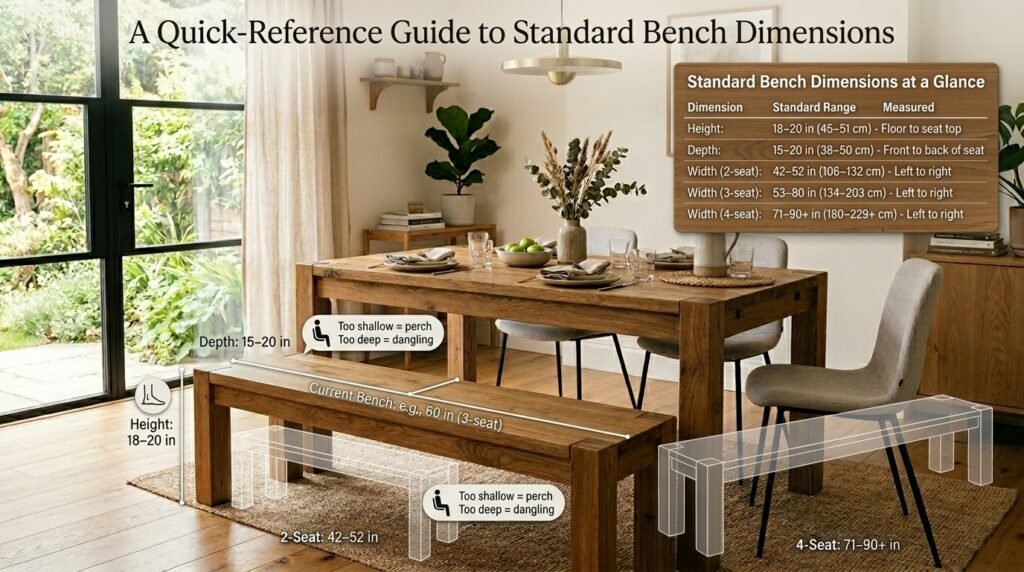
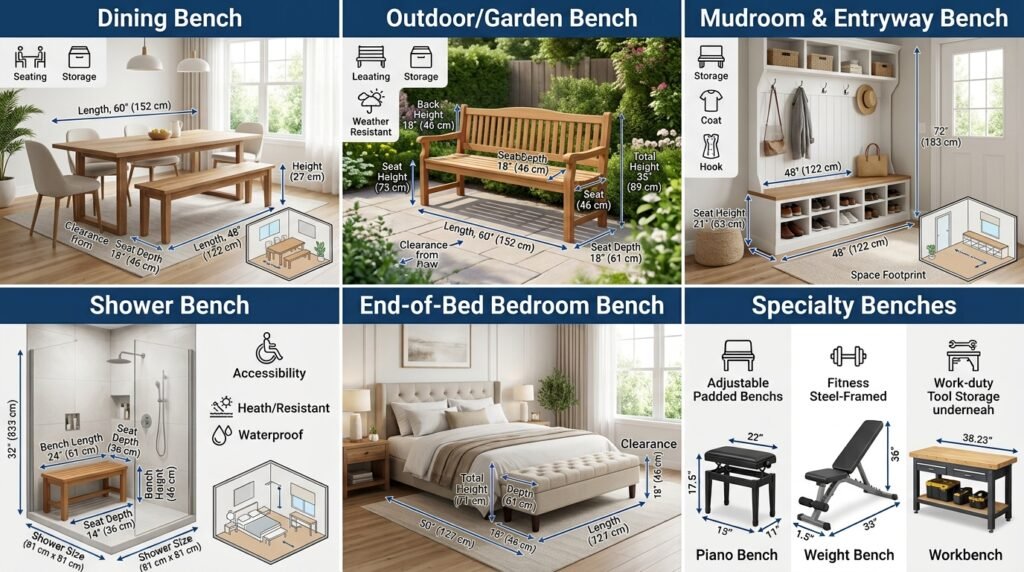
| Bench Type | Location | Length × Depth × Height | Seating Capacity | Best For |
|---|---|---|---|---|
| 🚪 Entryway Bench | Indoor - Foyer | 30-60" × 12-18" × 16-20" | 2-3 people | Shoe storage, putting on shoes |
| 📦 Storage Bench | Indoor - Any room | 30-50" × 15-20" × 18-22" | 2-3 people | Hidden storage for blankets, toys, tools |
| 🛏️ Bedroom Bench | Indoor - Bedroom | 42-60" × 15-20" × 16-20" | 2-3 people | Decorative seating, clothing placement |
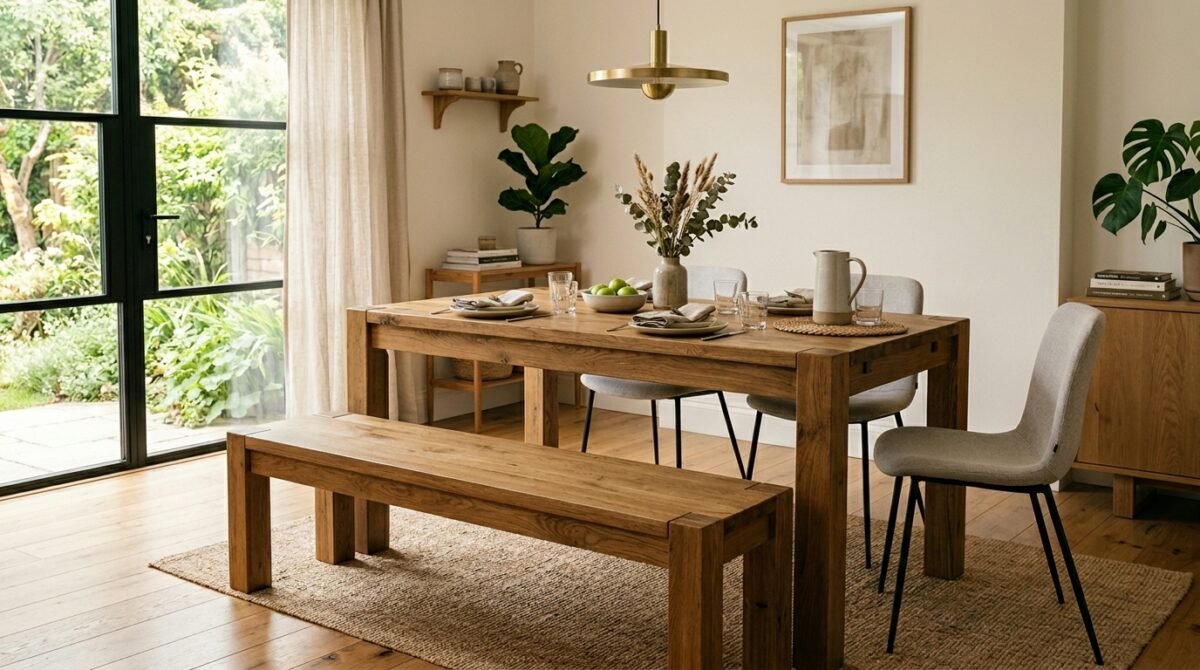
| 🍽️ Dining Bench | Indoor - Dining room | 42-72" × 14-18" × 17-19" | 2-4 people | Dining table seating (one or both sides) |
| 🛋️ Upholstered Bench | Indoor - Living/Bedroom | 36-60" × 15-20" × 18-20" | 2-3 people | Comfortable living room/bedroom seating |
| 👠 Shoe Bench | Indoor - Entryway | 24-48" × 12-16" × 17-19" | 1-2 people | Shoe organization and compact seating |
| 🌳 Garden Bench | Outdoor - Garden | 36-72" × 18-24" × 16-18" | 2-4 people | Garden and patio seating, viewing |
| 🏞️ Park Bench | Outdoor - Public | 48-72" × 20-28" × 17-18" | 3-4 people | Public outdoor seating, durability |
| 🏡 Patio Bench | Outdoor - Patio | 36-60" × 18-24" × 16-18" | 2-3 people | Backyard and terrace seating |
| 🌲 Tree Bench | Outdoor - Garden | Ø 48-120" × - × 16-18" | 4-8 people | Circular seating around trees |
| 🪨 Concrete Bench | Outdoor - Any | 36-72" × 18-24" × 16-18" | 3-4 people | Permanent, durable outdoor seating |
| 🍴 Picnic Bench | Outdoor - Picnic area | 48-96" L, Table 28-30"H | 4-6 people | Outdoor dining with attached table |
Benches Size, Selection & Complete Buying Guide
Indoor · Outdoor · 12 Types · Dimensions · Materials · Price Guide · Mistakes to Avoid
The Complete Homeowner & Shopper Reference — 2025 / 2026 Edition
A bench is one of the most versatile pieces of furniture in any home or garden — serving as seating, storage, a focal point, a room divider, a workout platform, and a statement of style. Yet benches are also among the most commonly mis-purchased items: too wide for the entryway, too low for the dining table, too short to seat the family, or built from materials that fail in their environment within two seasons. This guide provides everything you need to select, size, and purchase the right bench — whether you are shopping for a mudroom shoe bench, a teak garden bench, a dining bench to match your farmhouse table, a concrete park bench, or a circular tree bench. It covers all 12 major bench types across indoor and outdoor categories, with precise dimension guidance, material comparisons, price ranges, placement rules, and a complete buying checklist.
1. How to Use This Guide — 4 Selection Methods
This guide offers four distinct pathways to finding the right bench. Use whichever method matches your current decision stage.
Method | Best When… | Where to Find It |
Method 1: By Location | You know the room/space, but not the bench type | Section 7 — 8 location scenarios with type recommendations |
Method 2: Fit Your Space | You have measurements and need a size match | Section 8 — W × D × H calculator and clearance rules |
Method 3: Compare Benches | You have 2–3 types in mind and need to decide | Section 9 — side-by-side feature comparison table |
Method 4: By Purpose | You know what the bench must do (store, seat, display) | Section 10 — 6 use-case decision guides |
ℹ️ Most buyers will benefit from combining methods: use Method 1 to narrow to a type, Method 2 to confirm dimensions fit, and Method 5 (Materials) to choose quality and budget. The full guide is also a complete reference that rewards reading cover-to-cover before purchasing.
2. Master Bench Dimensions Reference — All 12 Types
Bench Type | Width (W) | Depth (D) | Height (H) | Seat Height | People | Category |
Entryway Bench | 30 – 60″ | 12 – 18″ | 16 – 20″ | 16 – 18″ | 1 – 3 | Indoor |
Storage Bench | 30 – 50″ | 15 – 20″ | 18 – 22″ | 18 – 20″ | 1 – 3 | Indoor |
Bedroom Bench | 42 – 60″ | 15 – 20″ | 16 – 20″ | 16 – 18″ | 2 – 3 | Indoor |
Dining Bench | 42 – 72″ | 14 – 18″ | 17 – 19″ | 17 – 19″ | 2 – 4 | Indoor |
Upholstered Bench | 36 – 60″ | 15 – 20″ | 18 – 20″ | 18 – 20″ | 2 – 3 | Indoor |
Shoe Bench | 24 – 48″ | 12 – 16″ | 17 – 19″ | 17 – 19″ | 1 – 2 | Indoor |
Garden Bench | 36 – 72″ | 18 – 24″ | 16 – 18″ | 16 – 18″ | 2 – 3 | Outdoor |
Park Bench | 48 – 72″ | 20 – 28″ | 17 – 18″ | 17 – 18″ | 2 – 4 | Outdoor |
Patio Bench | 36 – 60″ | 18 – 24″ | 16 – 18″ | 16 – 18″ | 2 – 3 | Outdoor |
Tree Bench (circ.) | Ø 48 – 120″ | N/A | 16 – 18″ | 16 – 18″ | 4 – 8 | Outdoor |
Concrete Bench | 36 – 72″ | 18 – 24″ | 16 – 18″ | 16 – 18″ | 2 – 4 | Outdoor |
Picnic Bench | 48 – 96″ L | Table 28–30″H | Bench 16–18″H | 16 – 18″ | 4 – 8 | Outdoor |
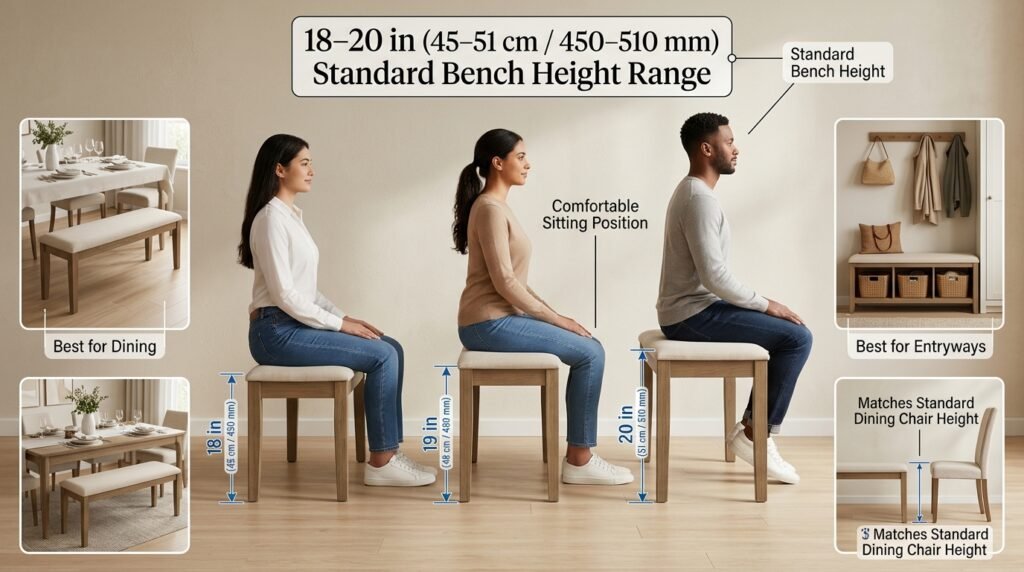
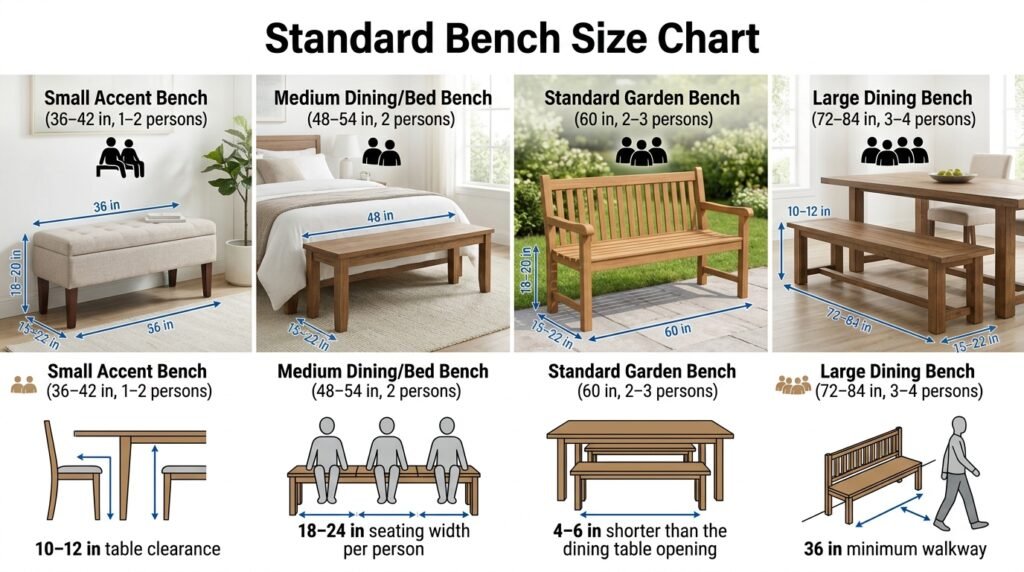
📐 Standard bench seat height rule: 17–19 inches is the universal comfortable seated height for average adults. Dining benches must be 10–12 inches below the table surface — for a 30-inch table, bench height should be 17–18 inches. Entry and bedroom benches may go slightly lower (16 inches) for ease of putting on shoes.
3. Indoor Benches — 6 Types
🚪 Entryway Bench 30–60″ W × 12–18″ D × 16–20″ H
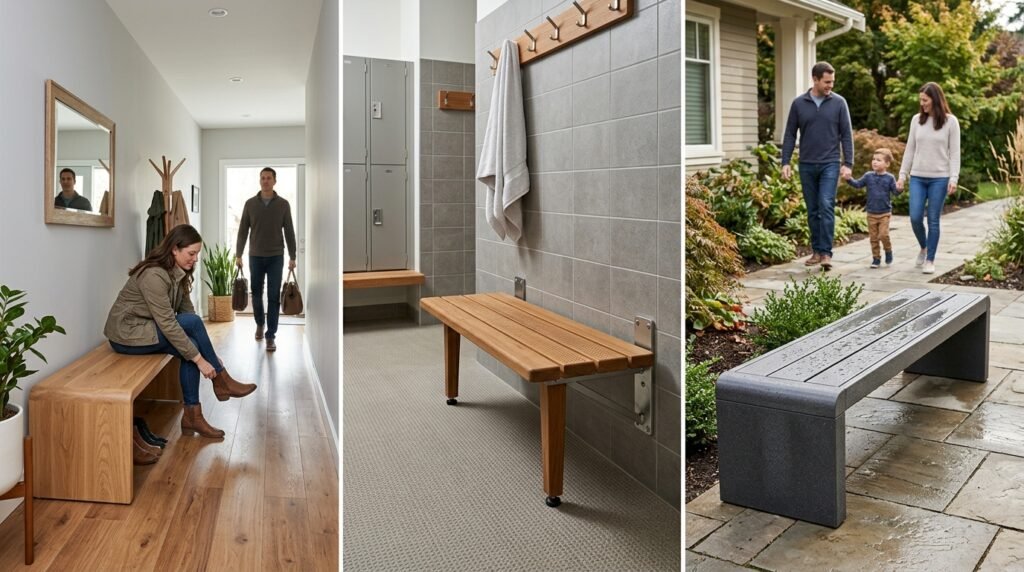
The entryway bench anchors the transition zone between outside and inside. It provides a place to sit while removing shoes, and often supports hooks or shelving above. Entryway benches need to balance compactness (most entries are narrow) with sufficient seat length for practical use.
Spec | Recommendation | Reasoning |
Width | 36–48″ for most entries; 30″ minimum | Enough to sit and set bags down without feeling squeezed |
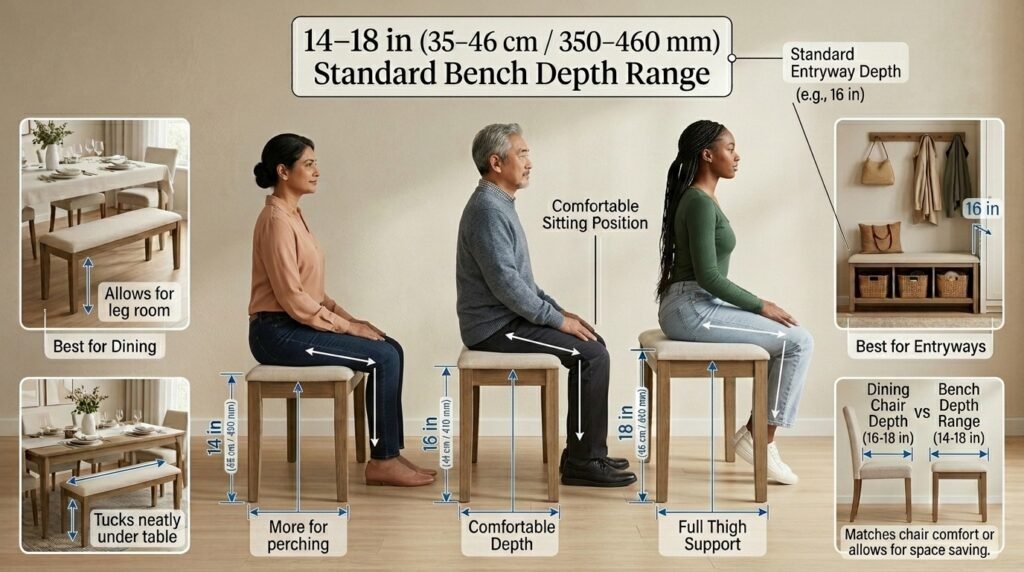
Depth | 12–15″ is ideal | Deep enough to sit on, shallow enough not to block the path |
Height | 16–18″ | Low to mid height — you are sitting briefly to change shoes |
Clearance needed | 18″ walkway minimum past the bench | Ensure the hallway remains passable with the bench in place |
Weight capacity | 300 lbs minimum per adult seat zone | Standard for robust home use |
With storage | Optional cubbies or drawer below | Maximises utility in space-limited entries |
Materials | Solid wood, metal frame, upholstered | All work; avoid fully upholstered in wet-shoes entry environments |
Price range | $150 – $600 | Solid wood or metal + cushion mid-range; premium upholstered upper end |
💡 Measure your entry door’s swing arc before buying — the bench must sit completely outside the door swing range. For doors that swing inward, leave at least 3 inches of clearance between the bench end and the fully open door position.
📦 Storage Bench 30–50″ W × 15–20″ D × 18–22″ H
Storage benches serve double duty — seating and concealed organisation. The interior cavity is typically accessed by lifting the hinged seat top. They are most popular in bedrooms (for extra linen), mudrooms (for out-of-season items), and living rooms (as a coffee table alternative). Height is slightly taller than other bench types because the storage box requires a minimum structural depth.
Spec | Recommendation | Notes |
Width | 36–48″ — the sweet spot | Smaller loses storage benefit; larger becomes a trunk rather than a bench |
Depth | 15–18″ | Thicker sides needed for hinge mechanism — more depth than non-storage benches |
Height | 18–22″ | Extra height accommodates the storage box depth while keeping the seat comfortable |
Interior volume | Look for 20–40 gallon equivalent | Enough for blankets, pillows, or shoes without overwhelming the structure |
Lid mechanism | Soft-close hinge strongly recommended | Prevents lid slam on fingers — critical for child safety |
Weight limit (seat) | 250–400 lbs, depending on construction | Hinged lid designs can be structurally weaker than solid-top benches |
Child safety | Must have ventilation or a safety hinge | Enclosed storage is a suffocation risk if a child can enter — soft-close hinge limits how far it closes |
Price range | $200 – $700 | Budget options use MDF; quality builds use a solid wood or solid hardwood frame |
⚠️ Storage bench child safety: in households with young children, choose storage benches with ventilation holes, soft-close hinges that prevent full closure, or add a child safety strap to limit lid closure angle. Never use a storage bench without one of these safeguards if children can access the space.
🛏 Bedroom Bench 42–60″ W × 15–20″ D × 16–20″ H
The bedroom bench sits at the foot of the bed. It serves as a functional landing zone: sitting while dressing, temporarily laying clothing, and adding visual balance to the bedroom composition. Width should match the bed width or be slightly narrower — a bench wider than the bed looks disproportionate.
Bed Size | Recommended Bench Width | Notes |
Twin (38″) | 36–40″ | Bench at or slightly narrower than the mattress |
Full/Double (54″) | 42–48″ | Mid-size bench; good for solo or couple rooms |
Queen (60″) | 48–54″ | Most popular bedroom bench size range |
King (76″) | 60–72″ | Wide bench or two benches; proportional to a large bed |
California King (72″) | 60–72″ | As King — ensure the bench doesn’t crowd the walking space at the foot |
- Clearance between bench and bed: leave 24–30 inches between the bed frame foot and the bench front — this allows comfortable movement in the bedroom without the bench feeling cramped
- Bedroom bench height: 16–18 inches is optimal — you are sitting to dress, not for extended sitting, so a slightly lower bench is comfortable
- Style matching: the bedroom bench should echo the bed frame style — a slatted wood bench with a slatted wood bed; an upholstered bench with an upholstered headboard
🍽 Dining Bench 42–72″ W × 14–18″ D × 17–19″ H
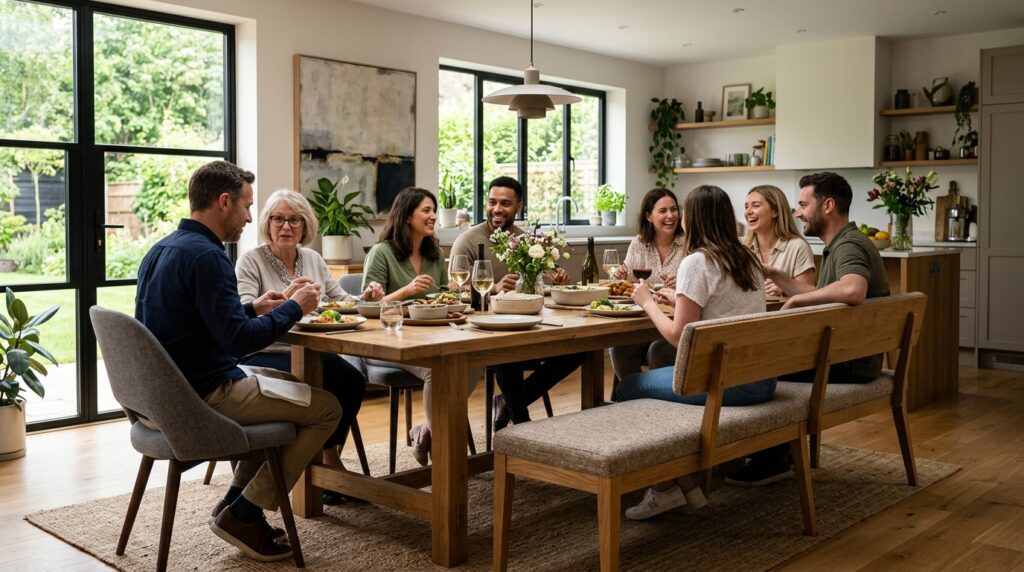
The dining bench replaces one or both chairs at a dining table with a continuous seating surface — increasing seating capacity, enabling a casual aesthetic, and making it easier for children to slide in and out. The critical measurement is the relationship between bench height and table height. The dining bench seat height must sit 10 to 12 inches below the table surface.
Table Height | Required Bench Seat Height | Legroom (seat to table underside) |
28″ table | 16 – 18″ | 10 – 12″ — minimum standard clearance |
30″ table | 17 – 19″ | 11 – 13″ — standard comfortable dining clearance |
32″ table | 18 – 21″ | 11 – 14″ — counter-height; needs taller bench |
36″ counter height | 22 – 26″ | 10 – 14″ — requires bar stool or counter bench height |
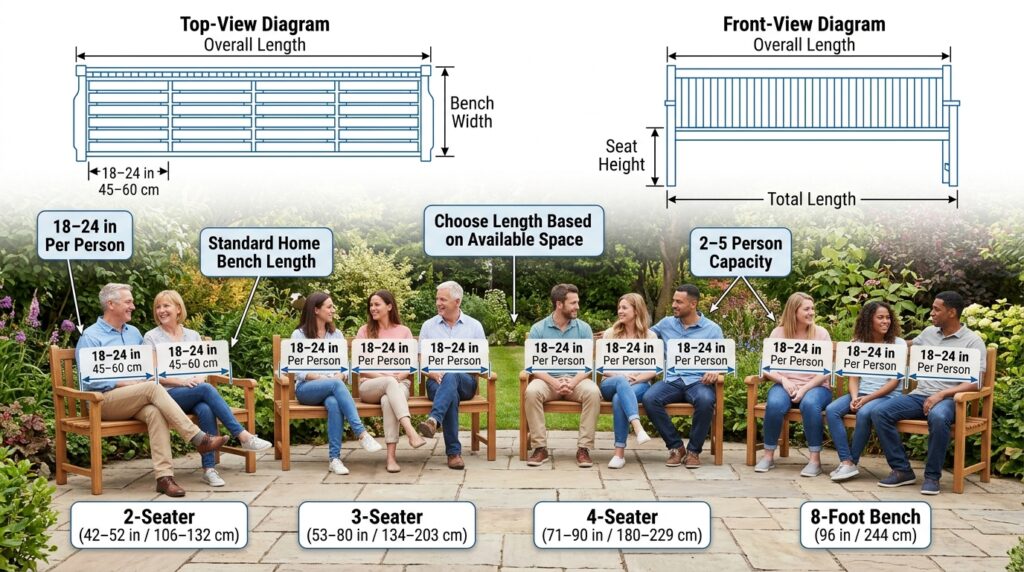
- Dining bench width: allow 18–22 inches of bench width per seated person — a 60-inch bench comfortably seats 3 adults; a 72-inch bench seats 3–4
- Dining bench depth: 14–16 inches is standard, enough seat for comfortable dining without requiring chairs to push back excessively
- Backless vs backed dining bench: backless benches tuck under the table when not in use (saves space); backed benches provide more comfort for extended meals, but cannot be stored under the table
- Dining bench weight capacity. Multiple users, total Capacity must be verified — a 60-inch bench seating 3 adults at 200 lbs each requires a minimum 600 lb rating
🛋 Upholstered Bench 36–60″ W × 15–20″ D × 18–20″ H
Upholstered benches prioritise seating comfort over all other factors — their padded seats and often button-tufted or smooth-fabric surfaces create a luxurious seating experience in bedrooms, living rooms, hallways, and dressing rooms. They are the most stylistically versatile bench type, but require the most maintenance and have specific placement requirements.
Upholstery Type | Durability | Cleaning Ease | Cost Level | Best Environment |
Performance fabric (Crypton, Sunbrella) | Very High | Very Easy — wipe clean | Medium–High | Households with pets or children, high-use areas |
Velvet | Medium | Moderate — shows marks easily | Medium–High | Formal bedrooms; low-traffic areas |
Faux leather / PU leather | High | Easy — wipe clean | Medium | Modern aesthetic; easy maintenance |
Linen blend | Medium | Moderate — spot clean | Medium | Relaxed, natural aesthetic; moderate use |
Cotton | Lower | Machine washable if the cover is removable | Low–Medium | Budget option: a recoverable cushion cover helps |
Leather (genuine) | Very High | Easy — condition regularly | High | Premium rooms; long-term investment |
- Foam density for upholstered bench: a seated bench cushion should use a minimum 1.8 lb/ft³ density foam; 2.0+ lb for daily use; anything below 1.5 lb will compress and flatten within months
- Frame under upholstery: a hardwood frame is essential for longevity — MDF or particleboard frames under upholstery crack along joinery points within 2–3 years of regular use
👟 Shoe Bench 24–48″ W × 12–16″ D × 17–19″ H
The shoe bench is the entryway bench’s more specialised sibling — specifically designed for sitting to put on or take off shoes. It is typically narrower and may include built-in shoe storage on a lower shelf or in cubby slots beneath the seat. Key sizing rule: the bench must be long enough to seat the user and set down a shoe simultaneously.
Config | Width | Storage | Best For |
Minimal seat only | 24–30″ | None | Single-person entry; very tight spaces |
Seat + lower shelf | 30–36″ | 3–4 pairs on shelf | 1–2 person household; small entry |
Seat + 2 cubby rows | 36–48″ | 6–8 pairs in cubbies | Family entry; moderate shoe volume |
Full bench + cabinet below | 42–48″ | 10–16 pairs (double stack) | Large household; organised entryway |
4. Outdoor Benches — 6 Types
🌿 Garden Bench 36–72″ W × 18–24″ D × 16–18″ H
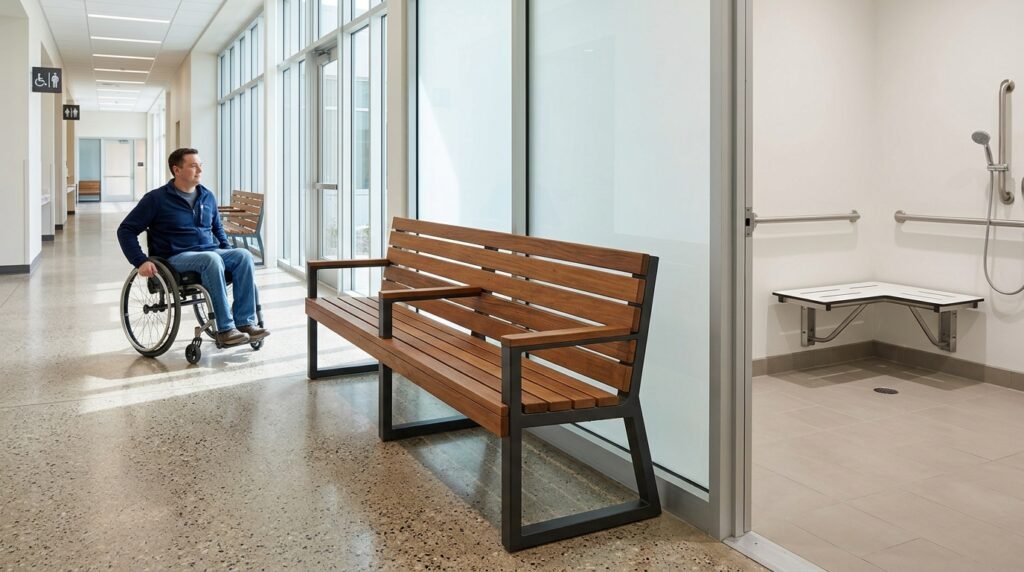
The garden bench is a focal point for outdoor spaces — positioned at the end of a path, beside a planting bed, in a pergola, or overlooking a view. Garden benches are typically 2–to 3-person seats designed for relaxed outdoor sitting, and they must withstand full weather exposure year-round unless brought indoors seasonally.
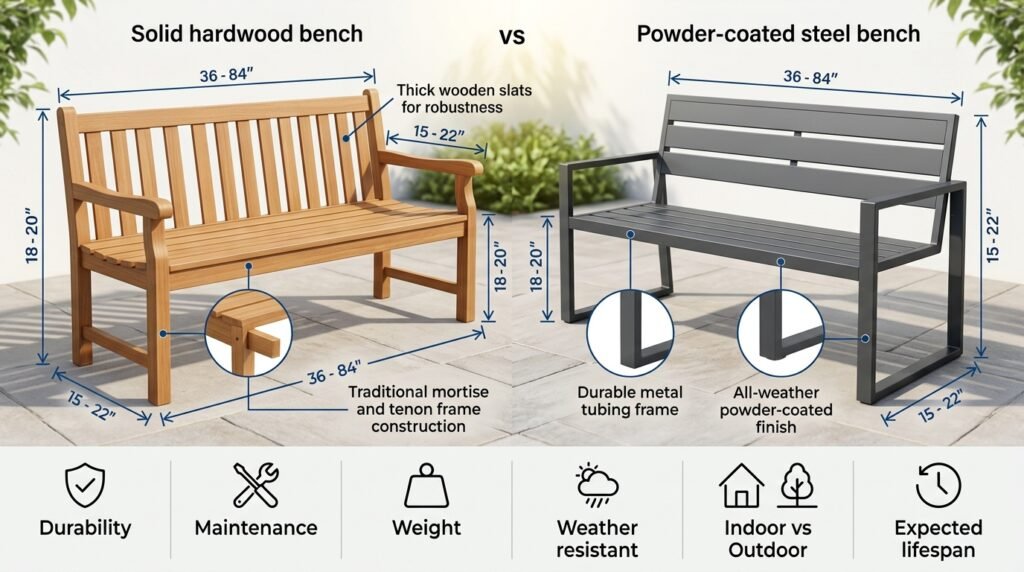
Material | Weather Resistance | Maintenance | Weight | Price Range | Lifespan |
Teak | Excellent | Oil annually or let silver-grey naturally | Heavy (50–80 lbs) | $400 – $1,200+ | 30–50+ years |
Powder-coated steel | Very Good | Clean; touch up chips to prevent rust | Heavy (40–70 lbs) | $200 – $600 | 15–25 years |
Cast iron | Good | Paint every 3–5 years; prevent rust | Very Heavy (80–150 lbs) | $300 – $800 | 30–50 years |
Aluminium | Excellent | Virtually no maintenance | Light (15–30 lbs) | $200 – $700 | 20–30 years |
Hardwood (acacia, eucalyptus) | Good | Oil annually; store or cover in winter | Medium (30–55 lbs) | $150 – $500 | 10–20 years |
Teak (recycled) | Excellent | As virgin teak | Heavy | $300 – $800 | 20–30 years |
HDPE poly lumber | Excellent | Power-wash only — no sealing/staining | Medium (40–60 lbs) | $250 – $700 | 25–50 years |
Cedar (natural) | Good | Oil or stain every 2 years | Light–Medium (20–45 lbs) | $150 – $450 | 10–20 years |
🏛 Park Bench 48–72″ W × 20–28″ D × 17–18″ H
Park benches are public-scale seating — wider, deeper, and more structurally robust than residential garden benches. Used in commercial landscapes, public parks, school campuses, and large private gardens, they are designed for maximum durability and vandal resistance. Park bench dimensions comfortably accommodate 2–4 adults, with back support.
Spec | Standard | Premium |
Width | 48–60″ | 60–72″ |
Depth | 20–24″ | 24–28″ (deeper backrest) |
Seat height | 17–18″ | 17–18″ |
Back height | 14–18″ above the seat | 18–22″ above seat — more lumbar support |
Frame material | Steel, cast iron, concrete | Ductile iron, stainless, premium hardwood |
Slats | Hardwood (cedar, teak, recycled), HDPE | Iroko, ipe, tropical hardwood or powder-coat steel slats |
Mounting | In-ground bolt or surface bolt | Cast-in anchor bolt for permanent installation |
Price range | $300 – $700 | $700 – $1,500+ |
☀️ Patio Bench 36–60″ W × 18–24″ D × 16–18″ H
Patio benches are residential outdoor benches designed for integration with patio furniture sets, outdoor dining areas, or as standalone seating in a defined outdoor living space. They are sized between a garden bench (more decorative) and a park bench (more public). Patio benches are frequently sold as part of a 3 or 5-piece outdoor furniture set.
- As a dining bench (outdoor depth 14–16″; height 17–18″ — must match outdoor dining table height (30″ standard outdoor dining table requires 17–18″ bench)
- As a freestanding lounge bench: deeper at 20–24″; may include arm ends; pairs with outdoor coffee table or fire pit
- With cushion: most patio benches have cushion depth factored into their comfort rating — a 17″ hard teak seat plus a 3″ cushion delivers a 20″ total seat height; account for cushion thickness when matching to table height
- Storage of cushions in off-season: plan for cushion storage in a patio box or bench storage bin to protect from UV and moisture damage
🌳 Tree Bench (Circular) Ø 48–120″ × 16–18″ H
A circular tree bench wraps around a tree trunk, transforming a single landscape tree into a seating destination. Tree bench sizing is determined entirely by the tree trunk diameter — the bench must accommodate not only the current trunk but the expected growth of the tree over 5–10 years.
Trunk Diameter | Minimum Inner Bench Diameter | Total Outer Bench Diameter | Notes |
Up to 12″ | 24″ inner clearance minimum | 48–60″ | Small tree — young or slow-growing species |
12 – 18″ | 30 – 36″ inner clearance | 60 – 72″ | Medium tree — allow growth expansion |
18 – 24″ | 36 – 42″ inner clearance | 72 – 84″ | Mature medium tree — standard size |
24 – 36″ | 48 – 54″ inner clearance | 84 – 100″ | Large mature tree — common oak/maple |
36″+ trunk | 60″+ inner clearance | 100 – 120″+ OD | Very large tree — custom build typically needed |
⚠️ Never attach a tree bench by bolting directly into the tree trunk — this creates entry points for disease and fungal infection. Tree benches should rest on legs that sit in the ground or on the surface around the tree, never penetrating the bark. Allow at least 6 inches of clearance between the inner bench edge and the tree bark for air circulation and growth.
🪨 Concrete Bench 36–72″ W × 18–24″ D × 16–18″ H
Concrete benches are the most permanent bench type — installed as fixed landscape features in gardens, public spaces, courtyards, and institutional settings. Their primary advantages are absolute durability, vandal resistance, and zero maintenance. Their primary challenges are very high weight (requiring installation equipment), inability to reposition, and thermal mass that makes them extremely cold in winter and very hot in direct summer sun.
Spec | Detail |
Weight | 150 – 600 lbs, depending on size — requires mechanical assistance for installation |
Installation | Typically requires ground anchoring or setting in a concrete footing — not DIY for most residential users. |
Maintenance | Virtually zero — power wash as needed; seal exposed aggregate versions every 5–7 years |
Comfort | Hard surface — extremely uncomfortable for extended sitting without a cushion or pad; primarily functional rather than comfort seating |
Heat/Cold | Thermal mass absorbs and releases heat — extremely hot in direct sun; extremely cold in shade/winter |
Lifespan | 50–100+ years — essentially permanent if properly installed |
Cost range | $300 – $1,200 for residential; commercial installations $500 – $3,000+ |
Customisation | Exposed aggregate, coloured concrete, embedded stone or tile, steel inlay accents — significant aesthetic versatility |
🧺 Picnic Bench 48–96″ L, Table 28–30″ H, Bench 16–18″ H
Picnic benches (picnic tables with integral attached benches) are the most familiar outdoor seating system — designed for eating, crafts, and casual outdoor activity. They are available in traditional rectangular form and in modern round and hexagonal configurations. The bench and table are structurally connected and sized as a unit.
Size | Table Length | Seating Capacity | Table Width | Bench Length | Best Setting |
Small (4ft) | 48″ | 4 adults | 28–30″ | 42–46″ | Balcony, small patio, 2 adults + 2 children |
Standard (6ft) | 72″ | 6 adults | 28–30″ | 66–70″ | Standard garden, patio, most residential |
Large (8ft) | 96″ | 8 adults | 28–30″ | 90–94″ | Large gardens, park settings, events |
Round (4ft dia.) | 48″ diameter | 4–6 adults | N/A | Circular perimeter | Small groups; accessible — no end seats |
Round (6ft dia.) | 72″ diameter | 6–8 adults | N/A | Circular perimeter | Group gathering; ADA accessible option |
5. Selection Method 1 — By Location (8 Options)
Location | Best Bench Type | Key Dimension Priority | Avoid |
Entryway / Hallway | Entryway bench or shoe bench | Depth ≤ 15″ — keep hall passable | Wide, deep benches that block movement |
Mudroom | Storage bench or shoe bench | Width for family sitting + storage below | All-upholstered — wet boots destroy fabric |
Bedroom (foot of bed) | Bedroom bench or upholstered bench | Width = 80–90% of bed width | Wider than the bed — looks unbalanced |
Dining room | Dining bench | Height = table height minus 10–12″ | Bench > table length — overhangs look poor |
Living room | Upholstered bench or storage bench | Style match; cushion for comfort | Hardwood without a cushion for extended sitting |
Garden / Lawn | Garden bench or tree bench | Weather-resistant material for the climate | Interior-only materials outdoors |
Patio / Deck | Patio bench or dining bench | UV-resistant material + cushion storage plan | Indoor upholstered benches on an exposed patio |
Public / Landscape | Park bench or concrete bench | Durability + mounting options | Light residential benches in high-traffic areas |
6. Selection Method 2 — Fit Your Space (WidthDepthpth × Height Calculator)
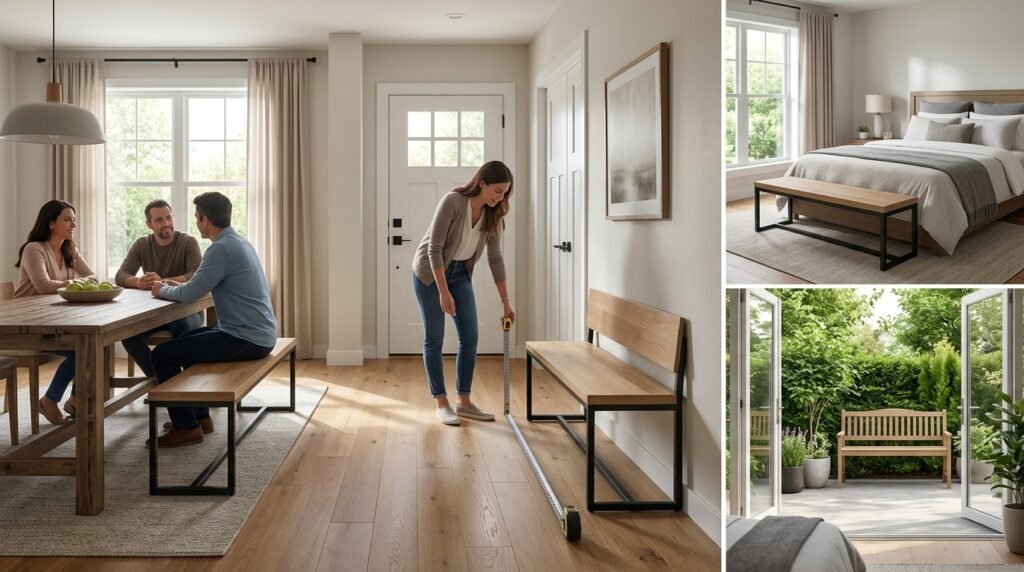
Step 1 — Measure Your Space
Measurement | How to Measure | Target Rule |
Available wall width (W) | Measure the wall from the corner to the nearest obstruction (door, window, furniture) | Bench width = wall width minus 6″ minimum on each side (12″ total) |
Walkway depth (D) | Measure the path depth from the wall to the nearest opposing furniture or wall | Bench depth + 24″ minimum clear walkway remaining after placement |
Clearance height (H) | Measure from the floor to any overhead obstruction (shelf, window sill, light switch) | Bench height = below any obstruction with a minimum of 2 ” clearance |
Table underside height | For dining bench: measure from floor to table underside | Bench seat height = table underside minus 10–12″ |
Door swing arc | Open the door fully; measure from the hinge to the door edge at its farthest point | The bench must be completely outside this arc |
Bed end to opposite wall | Measure from the foot of the bed frame to the wall or dresser | Bench depth + 24″ clearance minimum for movement |
Step 2 — Apply the Size Formula
📐 Bench Width Formula: Available Wall Width — 12 to 24 inches = Maximum Bench Width (12″ buffer for tight spaces; 24″ buffer for comfortable proportions)
📐 Bench Depth Formula: Passable Space — 24 inches minimum clearance — bench depth = maximum bench depth (36″ for hallways; 48″ for open rooms)
📐 Dining Bench Height Formula: Table Height (inches) — 10 to 12 inches = Bench Seat Height (account for any cushion thickness in this calculation)
Space Measurement Examples
Scenario | Space Measurement | Recommended Bench Size |
Narrow entry hall | Wall: 48″; Depth available: 36″ | Bench: 36–40″ W × 12–14″ D — leaves 22–24″ walkway |
End of Queen bed | Bed width: 60″; Space to wall: 60″ | Bench: 50–54″ W × 16–18″ D — leaves 42″ clearance to wall |
Dining table (30″ H) | Table length: 72″; Table height: 30″ | Bench: 60–66″ W × 14–16″ D × 17–18″ H |
Covered patio | Width: 120″; Depth: 96″ | Patio bench: 48–60″ W × 20–24″ D or full dining set |
Mudroom with 3 children | Width: 72″; Depth: 48″ | Storage bench: 48–54″ W × 16–18″ D × 18–20″ H — cubbies below |
7. Selection Method 3 — Side-by-Side Feature Comparison
Indoor Bench Comparison
Feature | Entryway | Storage | Bedroom | Dining | Upholstered | Shoe Bench |
Width range | 30–60″ | 30–50″ | 42–60″ | 42–72″ | 36–60″ | 24–48″ |
Storage built-in | Optional | Yes — primary feature | No | No | Rare | Yes — key feature |
Cushion/padding | Optional | Optional | Usually | Rare | Always | Optional |
Backrest | Rare | No | No | Optional | Rare | No |
Avg. weight cap. | 300 lbs | 250–400 lbs | 300 lbs | 400 lbs+ | 250–350 lbs | 250 lbs |
Typical cost | $150–600 | $200–700 | $200–800 | $150–600 | $250–900 | $80–400 |
Typical material | Wood/metal | Wood/upholstered | Upholstered/wood | Wood/metal | Fabric/frame | Wood/metal |
Move-ability | Easy | Medium (heavy) | Easy–Medium | Easy | Medium | Easy |
Outdoor Bench Comparison
Feature | Garden | Park | Patio | Tree Bench | Concrete | Picnic |
Width range | 36–72″ | 48–72″ | 36–60″ | Ø 48–120″ | 36–72″ | 48–96″ L |
Persons (typical) | 2–3 | 2–4 | 2–3 | 4–8 | 2–4 | 4–8 |
Move-ability | Yes | Fixed/heavy | Yes | Fixed | Permanent | Heavy |
Backrest | Always | Always | Usually | No | Varies | No |
Maintenance | Low–Medium | Low | Low–Medium | Low | None | Low–Medium |
Weather resistance | Good–Excellent | Excellent | Good–Excellent | Excellent | Excellent | Good–Excellent |
Cost range | $150–1,200 | $300–1,500 | $200–800 | $400–1,500 | $300–1,200 | $200–1,000 |
Installation | None/basic | Anchor required | None/basic | Legs in ground | Anchor/footing | Surface placement |
8. Selection Method 4 — By Purpose (6 Primary Use Cases)
Purpose | Primary Bench Type | Secondary Type | Key Features to Require |
Seating — daily comfort (extended sitting) | Upholstered bench with high-density foam | Backed dining bench | Cushion ≥ 3″ foam; 1.8+ lb/ft³ density; back support if sitting >20 min |
Storage — hiding household clutter | Storage bench with soft-close lid | Shoe bench with closed cubbies | Soft-close hinge; min. 20-gallon interior; structural frame not MDF |
Dining — extra table seating | Dining bench (backless or backed) | Patio dining bench | Height = table height − 10″; 18–20″ width per person |
Dressing/shoe area | Shoe bench with lower storage | Entryway bench with hooks above | CompaDepthth: storage for family’s shoe volume; water-resistant top |
Garden focal point/display | Teak or cast-iron garden bench | Patio bench with cushions | Weatherproof material for climate; anchor if exposed to high wind |
Community / high traffic seating | Park bench (bolted) | Concrete bench (permanent) | Anti-vandal fasteners; hardwood or HDPE slats; anchored to the surface |
9. Material Durability & Cost Comparison ($150 – $1,200+)
Material | Indoor Use | Outdoor Use | Maintenance | Typical Lifespan | Cost Range | Notes |
Teak | Excellent | Excellent | Oil annually OR leave to silver | 30–50+ years | $400–1,200+ | Best all-round outdoor wood; natural oils resist moisture |
Ipe/hardwood (tropical) | Excellent | Excellent | Oil annually | 30–50 years | $400–1,000+ | Very hard, heavy, sustainable certification matters |
HDPE poly lumber | Good | Excellent | Power wash only | 25–50 years | $250–700 | Recycled plastic lumber; colour-through; no sealing ever needed |
Cast iron | Good | Good | Paint every 3–5 yr | 30–50 years | $300–800 | Very heavy; beautiful Victorian aesthetic; rusts if paint chips |
Powder-coated steel | Excellent | Very Good | Inspect/touch up chips | 15–25 years | $200–600 | Lightweight vs cast iron; chips rust quickly if untouched |
Aluminium | Excellent | Excellent | Wipe down only | 20–30 years | $200–700 | Lightest metal option; won’t rust; less elegant than iron |
Solid hardwood (oak, maple, walnut) | Excellent | Poor (unsealed) | Oil/seal indoor | 20–40 years | $200–900 | Premium interior bench; not for outdoor use unless sealed and covered |
Solid softwood (pine, cedar) | Good | Moderate | Stain every 2 years | 10–20 years | $150–400 | Budget option: cedar natural oil delays rot; pine needs sealing |
MDF / engineered wood | Poor–Moderate | Never | Wipe only — avoid moisture | 3–8 years | $80–250 | Budget only; swells at joints with humidity; not durable long-term |
Concrete | No | Excellent | Seal every 5–7 years | 50–100 years | $300–1,200 | Permanent; extremely heavy; no repositioning once installed |
Upholstered (frame + fabric) | Excellent | No | Depends on fabric | 5–15 years | $200–900 | Comfort leader; fabric and frame both need consideration for quality |
Recycled teak | Excellent | Excellent | As virgin teak | 20–30 years | $300–800 | Reclaimed from old boats/buildings; sustainable; unique grain pattern |
Price-Quality Guide
Budget | What You Get | Best Choice | Avoid |
$80 – $150 | MDF/particleboard frames, budget pine, basic metal | Painted metal shoe bench or basic pine entryway bench | Storage benches in this range — MDF lids fail quickly |
$150 – $300 | Solid pine, powder-coated steel, basic acacia, budget teak | Metal garden bench; solid pine dining bench; cedar patio bench | Any upholstered bench — fabric quality too low in this range |
$300 – $600 | Solid hardwood (oak, acacia), mid-grade teak, quality steel, upholstered with a solid frame | Solid oak dining bench; mid-grade teak garden bench; quality upholstered bedroom bench | Tree bench at this price — usually insufficient materials |
$600 – $1,000 | Premium teak, solid walnut, heavy cast iron, quality upholstered | Quality teak garden bench; walnut bedroom bench; cast-iron park bench | Concrete bench — installation cost is separate and often exceeds product cost |
$1,000+ | Heirloom-quality teak, ipe, custom upholstered, cast iron, commercial park bench | Premium teak 3-seater; custom upholstered bedroom bench; commercial-grade park bench | Any MDF-framed bench, regardless of upholstery quality — don’t pay a premium for a poor structure |
10. Weight & Seating Capacity Guide (2–8 People)
Bench LenCapacity | Portable Seating | Rated Capacity (min.) | Width per Person | Bench Type Examples |
24 – 30″ | 1 person | 250 lbs | Full width | Shoe bench; compact entry bench |
30 – 42″ | 1–2 people | 350 – 500 lbs | 15–21″ per person | Entry bench; shoe bench with storage |
42 – 54″ | 2–3 people | 500 – 750 lbs | 14–18″ per person | Bedroom bench; dining bench; garden bench (2-seat) |
54 – 66″ | 3 people | 750 – 900 lbs | 18–22″ per person | Queen bedroom bench; dining bench (3-seat); garden bench (3-seat) |
66 – 72″ | 3–4 people | 900 – 1,200 lbs | 16–18″ per person | Dining bench (4-seat); park bench (3–4 seat); patio bench |
72 – 96″ | 4–5 people | 1,200 – 1,500 lbs | 14–19″ per person | Large dining bench; park bench; picnic bench |
96″+ / Circular | 5–8 people | 1,500+ lbs | ~18″ per person | Large picnic bench; tree bench (circular); commercial park bench |
Weight Capacity Verification
- Always add 25% safety margin: if the total expected seated weight is 600 lbs, buy a bench rated for at least 750 lbs.
- Distributedvs. point load: bench ratings assume weight is distributed across the full seat — placing one person at the very end of a long bench creates a lever effect that exceeds the point-load rating
- Frame material matters more than seat material for weight capacity: solid hardwood or steel frames significantly outperform MDF-framed benches, regardless of seat appearance.e
- Outdoor bench capacity in wet conditions: water-saturated upholstery or wood adds significant weight to the bench itself; this reduces the effective load capacity slightly
11. Placement Tips by Room Type
Room / Space | Placement Rule | Clearance Required | Avoid |
Entryway | Against the wall opposite or beside the door — not in the door swing | 18″ walkway past bench minimum; clear door swing completely | Place a bench in the main traffic path, facing the door without wall support |
Mudroom | Along the wall under hooks — bench width should match hook width | 24″ turning space in front of the bench for putting on shoes | Blocking boot storage area; all-fabric bench in a mudroom with wet boots |
Bedroom — foot of bed | Centred on the bed, pushed 24″ from the foot of the frame | 24″ between the bench front and the opposing wall or dresser | Wider than the bed; pushed tight against the bed frame — must be able to walk around it |
Dining room | Along one side of the table (or both for large families) | Chair clearance on the other side: 24″ from chair to wall | Bench overhanging table ends — aesthetically poor and creates a trip hazard |
Living room | Against a wall, behind a sofa as an accent, or as a coffee table alternative | 18″ clearance from any seating it faces | In the middle of the room, floating benches need a design anchor |
Garden path | At the path’s end as a destination,; beside a planting bed, framing a view | No traffic clearance needed — allow lawn mower access around all four sides | In low-drainage areas, feet rot faster in standing water |
Patio | Define zones: one bench alongside dining, one by the fire pit | 36″ minimum walkway around any patio bench | Blocking the main patio egress, placing it under the dripping eave without drainage |
Tree bench | Centred on the tree, the inner ring must not touch the bark | 6″ minimum gap between inner bench edge and tree bark at current size AND projected 10-year growth | Bolting to a tree; placing in low spots that collect water around roots |
12. Assembly & Installation Considerations
Indoor Bench Assembly
- Pre-assembled vs flat-pack: most benches under $400 arrive flat-pack; all benches over $600 typically arrive fully or partially assembled. Factor in assembly time (30–120 min for flat-pack) and space requirement (you need floor space equal to 3× the bench’s footprint to assemble comfortably)
- Tools typically required: a rubber mallet, Phillips and flathead screwdrivers, a hex/Allen key set (usually included), and a spirit level. A cordless drill dramatically speeds assembly.
- Joinery quality check: after assembly, test all joints by applying lateral pressure to the frame — any racking movement indicates loose joinery that will worsen with use. Tighten all fasteners before use; retighten afterthe first 2 weeks.
- Wall anchoring: heavy benches (storage benches, entryway benches) should be anchored to the wall using a furniture strap or L-bracket into a stud — this prevents forward tipping under heavy load or if a child pulls on the bench edge
Outdoor Bench Installation
Bench Type | Installation Method | Tools Required | DIY-able? |
Garden bench (surface placement) | Level ground; set on paving pads or adjustable feet | Spirit level; rubber mallet | Yes — easy |
Park bench (surface bolt) | Drill throughthe base plate into the paving; anchor bolt through | Masonry drill, impact driver, and anchor bolts | Yes — moderate skill |
Park bench (in-ground anchor) | Dig a hole; set the anchor sleeve in concrete; bolt the bench to the sleeve | Post hole digger; concrete mix; level | Yes, with help — 2-person job |
Tree bench (freestanding) | Level legs on the ground; ensure the inner ring clears the bark | Spirit level; adjustable leg wrench if provided | Yes — easy, but heavy |
Concrete bench (footing) | Pour concrete footing; embed anchor bolts; set bench | Concrete form; concrete mix; level; mechanical lift | Professional recommended — very heavy |
Picnic bench (surface placement) | Set on level ground or paving; optional anchor for public settings | Level | Yes — easiest install |
13. Common Mistakes to Avoid
Sizing Mistakes
- Buying a bench wider than the bed for a bedroom bench — a bench should be 80–90% of the bed width. Wider than the bed draws the eye to the mismatch and makes the room feel unbalanced
- Ignoring the door swing when placing an entryway bench — measure the full arc of the door swing and ensure the bench is completely outside it before purchasing.
- Choosing dining bench height without measuring the table — always subtract 10–12 inches from your table height. A 30-inch table needs a 17–18-inch bench; this is not negotiable for comfortable dining.
- Underestimating bench depthvs. available walkway — a 20-inch deep bench in a 36-inch hallway leaves only 16 inches of walkway. Minimum comfortable walkway is 24 inches; 36 inches is preferred.
Material Mistakes
- Using an interior upholstered bench outdoors — even on a covered patio — humidity, dew, and occasional rain can ruin interior-grade upholstery within one season. Use performance outdoor fabric (Sunbrella) for any patio bench cushion.
- Buying an MDF-framed bench for a humid environment (mudroom, bathroom, covered patio) — MDF swells irreversibly when exposed to moisture. Always verify a solid wood or metal frame in humid spaces.
- Choosing teak without understanding the greying process — unwaxed teak naturally turns silver-grey within 6 months outdoors. This is normal and not damaged. If you want the original warm honey colour, commit to oiling 1–2 times per year, or accept the silver-gre.y
- Purchasing cast iron for a coastal or high-humidity environment without an ongoing maintenance plan — cast iron rusts rapidly in salt air; choose marine-grade aluminium or 316 stainless steel for coastal settings.
Purchase Mistakes
- Not verifying weight capacity before purchase — check the manufacturer’s stated weight rating and apply a 25% safety factor. MDF-framed benches often have rated capacities well below what their size suggests
- Buying a storage bench without checking the soft-close hinge feature — a hard-slamming lid on a storage bench in a household with children is a finger-crushing hazard. Verify soft-close before purchase or add aftermarket lid support
- Choosing style over seat height for dining benches — a beautiful bench at the wrong height makes every meal uncomfortable. Seat height is non-negotiable for dining applications
- Ignoring assembly reviews — before buying any flat-pack bench, read assembly reviews specifically (not product reviews). Some flat-pack benches have notoriously poor instructions or missing hardware. This information is in the reviews
14. Space Measurement Checklist
Before You Measure
- Identify the bench location precisely — which wall, which room, which outdoor zone.
- Clear the space so you can measure without obstruction
- Have a tape measure, pencil/pen, and notepad or phone ready for recording
- If buying for a dining table, have the table’s exact height from floor to tabletop underside
- If buying for a bedroom: have the bed’s exact width (mattress size)
Key Measurements to Record
- Wall width available (W): _______ inches
- Space depth available from wall to nearest obstruction (D): _______ inches
- Maximum height allowed (H — to shelf, window sill, or adjacent feature): _______ inches
- Door swing arc clearance required (measure from hinge axis): _______ inches
- Dining table: height from floor to table underside: _______ inches → bench height should be _______ to _______ inches
- Bed end to wall or dresser: _______ inches → bench depth + 24″ clearance minimum
- Tree trunk diameter (for tree bench): _______ inches → inner bench ring minimum: _______ inches
- Existing furniture to coordinate with (colour, material, style): _______
Calculation Summary
- Calculated maximum bench width: _______ inches (wall width minus 12–24″)
- Calculated maximum bench depth: _______ inches (availabDepthpth minus 24″ walkway)
- Required bench seat height: _______ inches (table underside minus 10–12″, or standard 17–18″)
- Confirmed door swing clearance: ✓ / ✗
- Confirmed material appropriate for environment: ✓ / ✗
- Confirmed weight capacity ≥ expected load × 1.25: ✓ / ✗
- Confirmed storage features (if required): ✓ / ✗
- Confirmed cushion/seating comfort level: ✓ / ✗
15. Frequently Asked Questions
Q: What is the standard bench height?
The standard bench seat height is 17 to 19 inches from floor to seat surface — this matches the standard chair seat height and allows comfortable seating for average-height adults. Dining benches should be 17 to 19 inches to pair with a standard 30-inch dining table (leaving 10 to 12 inches of knee clearance). Entry and shoe benches may go to 16 inches for easier shoe-putting-on access. Counter-height benches (for 36-inch counters) sit at 24 to 26 inches.
Q: How wide should a bedroom bench be at the foot of the bed?
A bedroom bench should be approximately 80 to 90% of the bed width — never wider than the mattress. For a queen (60-inch bed), choose a bench 48 to 54 inches wide. For a king (76 inches), choose 60 to 68 inches. A bench that exactly matches the bed width looks awkward; slightly narrower creates a more proportionate visual relationship. The bench should also be centred on the bed — equal overhang on each side.
Q: What size dining bench do I need?
A dining bench should be 2 to 6 inches shorter than the table length for visual balance, and the seat height should be 10 to 12 inches below the underside of the table. For a 72-inch table at 30 inches high, choose a 66- to 68-inch bench at 17- to 18-inch high. Allocate 18 to 20 inches of bench width per person — a 60-inch bench comfortably seats 3 adults. Bench depth should be 14 to 16 inches for dining use.
Q: What is the best material for an outdoor garden bench?
For longevity and minimal maintenance, teak and HDPE poly lumber are the top two choices. Teak is the premium natural option — its natural oils make it resistant to moisture, insects, and rot without treatment; it weathers to silver-grey beautifully or stays honey-brown with annual oiling; lifespan is 30 to 50+ years. HDPE poly lumber is the zero-maintenance alternative — made from recycled plastic, it never rots, fades minimally, requires only power-washing, and lasts 25 to 50 years. For budget outdoor benches, powder-coated steel with hardwood slats is a reliable 15 to 25-year option.
Q: How deep should an entryway bench be?
An entryway bench should be 12 to 16 inches deep for a compact functional entry, or up to 18 inches if space permits. The critical rule is that after the bench depth, you must have at least 24 inches of clear walkway remaining — 36 inches is more comfortable. In a 36-inch-deep hallway, a 12-inch bench leaves 24 inches of walkway — the absolute minimum. In a 48-inch hallway, you can comfortably use a 16 to 18-inch bench.
Q: What size should a tree bench be?
A circular tree bench inner diameter must be at least twice the current trunk diameter, with a minimum of 6 inches of clearance between the inner ring and the bark. For a 12-inch trunk, the inner opening should be at least 24 to 30 inches, giving a total outer diameter of 48 to 72 inches, depending on seat width. Always plan for 5 to 10 years of trunk growth: a tree growing 1 inch per year in diameter needs at least 10 extra inches of inner clearance to avoid constricting the tree within a decade.
Q: What is the weight capacity of a typical bench?
A standard residential bench should be rated for at least 300 lbs for a 2-person bench and 500 lbs for a 3-person bench. Commercially specified benches (park benches, picnic benches) are typically rated for 500 to 1,500 lbs, depending on size. Always apply a 2 Capacity margin to the rated Capacity: if you expect 400 lbs of seated load, buy a bench rated for at least 500 lbs. MDF-framed benches are typically rated lower (200 to 300 lbs) than solid wood or metal-framed equivalents.
Q: Should a storage bench have a soft-close lid?
Yes — soft-close is strongly recommended for any storage bench in a household with children, and is a quality indicator worth seeking in all storage benches. A hard-slamming lid can cause serious finger injuries. Soft-close hinges control the lid’s closing speed and prevent it from slamming shut — they add marginally to cost but are essential for safety and convenience. Look for the term ‘soft-close hinge’, ‘lid support’, or ‘hydraulic hinge’ in the product description.
Q: Can I use an indoor bench outdoors?
Generally, most indoor benches use materials and finishes not designed for outdoor exposure. Solid hardwood benches can go outdoors seasonally if covered and stored in winter, but they will require more maintenance. MDF-framed upholstered benches should never be used outdoors — MDF swells and degrades rapidly with moisture, and indoor-grade fabrics mould within weeks in outdoor humidity. If you want cushions outdoors, use benches with removable cushions in Sunbrella or other outdoor-rated fabric.
Q: What is the best bench for a mudroom with children?
A storage bench with closed cubbies beneath and either a wipeable top surface or a removable/washable cushion cover. A width of 48 to 54 inches allows the family to sit together. A height of 18 to 20 inches is comfortable for children and adults. The top surface should be water-resistant — avoid fully upholstered models without protective covers in a mudroom. Closed cubbies keep boots and shoes organised and out of sight; open shelves accumulate clutter faster. Opt for a solid-wood or metal frame rather than MDF in a mudroom.
16. Disclaimer
The dimensions, prices, weight capacities, and material specifications in this guide are based on general industry standards and typical product data at the time of writing. Actual product measurements and capacities vary by manufacturer and model — always verify the current product specifications with the retailer or manufacturer before purchase.
Weight capacity information is provided as general guidance only. Structural load ratings must be verified directly with the product manufacturer. Never exceed a bench’s stated weight capacity. For commercial or institutional installations, engage a licensed structural engineer or qualified contractor.
Tree bench guidance is general and does not replace the assessment of an arborist for large or protected tree species. Installation of any permanent outdoor fixture (concrete bench, in-ground-anchored park bench) may require local planning permission in some jurisdictions — verify before installation.
Child safety warnings regarding storage benches are based on general consumer product safety guidance. Always supervise children around furniture with enclosed storage spaces. The authors and publishers accept no responsibility for outcomes arising from the use of information in this guide.
Always measure your space before purchasing. For installations requiring structural anchoring, consult a qualified contractor.