Termite Mud Tubes: How to Identify, Treat, and Prevent Them
Remove Termite Mud Tube: 89.7% Stop Termite Tubes Rebuild
Introduction
You’re doing a routine walk around the house and notice a thin, dirt-colored line running up your foundation. It’s not a crack. It’s not a water stain. It’s a termite mud tube — and it’s one of the clearest warning signs your home can give you before serious structural damage sets in.
Termite mud tubes look small and almost harmless, which is exactly why so many homeowners walk right past them. But behind that thin strip of mud is often a mature subterranean termite colony that’s been quietly feeding on your home for months or even years.
This guide covers everything: what termite mud tubes actually look like, the different types you might find, where they tend to show up, how to tell if a tube is still active, and what treatment and prevention actually involve. If you’re also dealing with other pests around the house, our bed bugs guide and smart bed bug repellents cover a different problem entirely, but they’re worth a look if pests have been on your mind lately.

What Are Termite Mud Tubes, Exactly?
Termite mud tubes are narrow tunnels that subterranean termites build to travel safely between their underground colony and the wood they’re feeding on. Termites are soft-bodied and dry out quickly in open air, so these shelter tubes let them stay hidden from predators, sunlight, and dry conditions while they forage.
The tubes themselves are built from a mix of soil, digested wood, and termite saliva, which acts almost like a binding agent. That combination lets termites construct a surprisingly sturdy tunnel that maintains high humidity inside, even when the surrounding air is dry.

What Do Termite Mud Tubes Look Like?
If you’ve never seen one, termite mud tubes are easy to describe but easy to miss if you’re not specifically looking. Most are roughly pencil-width — University of Florida IFAS Extension lists them at about a quarter inch to one inch wide — and appear as thin, raised lines of dried mud. If you search termite mud tubes pictures or images of termite mud tubes online before inspecting your own home, you’ll notice they nearly always look the same: a raised, vein-like trail rather than a smooth stain.
Fresh, active tubes tend to look darker and slightly moist to the touch. Older, abandoned tubes dry out, turn lighter in color, and can crumble more easily when touched. Both active and inactive tubes are worth noting, since termites frequently abandon one tube while building a new one nearby. These tubes are sometimes called termite trails, and alongside visible wood damage and discarded wings, they’re one of the most reliable termite infestation signs a homeowner can spot without professional equipment.
Termite mud tubes are often confused with simple dirt streaks running down a wall after rain, but the difference is texture and structure: mud tubes are raised, tunnel-shaped, and hollow inside, while dirt streaks are flat residue with no internal structure at all.

Types of Termite Mud Tubes
Not all termite tubes serve the same purpose. Pest professionals generally group them into a few categories:
- Exploratory tubes — Built by foraging termites searching for new food sources; these often dead-end if no wood is found.
- Working tubes — Established, actively used tunnels connecting the colony directly to a confirmed food source.
- Drop tubes — Built downward from wood structures back toward the soil, sometimes found hanging from floor joists or subfloor framing.
- Shelter tubes — A broader term covering any protective tunnel termites use for regular travel between soil and wood.
- Swarm tubes — Larger, temporary tubes built specifically to release winged alates (swarmers) during their mating flight season.
Recognizing which type you’re looking at can help a pest professional understand how established the colony actually is.

Where Termite Mud Tubes Commonly Show Up
Termite mud tubes tend to appear anywhere soil meets a wood or masonry structure, which means they can turn up in more places than most homeowners expect. Termite mud tubes on concrete and termite mud tubes on a home wall are the most commonly spotted, simply because they’re visible without any digging or crawling required:
- On exterior walls and concrete foundations
- Inside basements and crawlspaces, including termite mud tubes inside house framing that’s otherwise hidden from view
- Along floor joists and subfloor framing
- Around window frames and door trim
- Behind siding, where they’re often invisible until damage becomes obvious
- On ceilings, in cases of severe or long-standing infestations
- In the yard, especially near tree stumps, woodpiles, or landscape timbers touching soil
One quick note worth mentioning: termite mud tubes after rain can look darker and more obvious simply because moisture makes the mud richer in color, not because the termites suddenly became more active.
If you’ve used landscape timbers anywhere near your home’s foundation, it’s worth checking those areas specifically, since direct wood-to-soil contact is exactly the kind of setup subterranean termites look for.
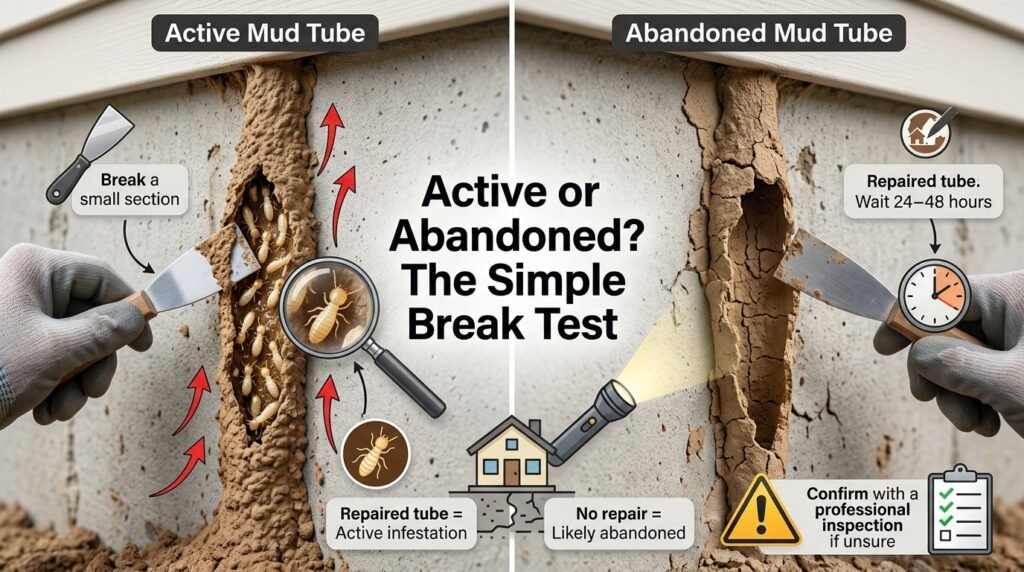
Active or Abandoned? The Simple Break Test
Not every mud tube you find still has termites moving through it. The most reliable way to check is a simple break test: gently break open a one-inch section of the tube and wait a few days. Mississippi State University Extension recommends exactly this approach, noting that a repaired break confirms an active infestation, while also cautioning that old, inactive tubes should still be scraped away so they don’t cause confusion during future inspections.
- If termites are repairing the break within a few days, the tube is active, and you have a live infestation.
- If nothing changes after several days, the tube may be old or abandoned, though this doesn’t rule out termites using a different tunnel elsewhere.
Breaking or removing a tube alone does not solve the problem. It only disconnects that one pathway, and termite mud tube repair after breaking is actually a useful diagnostic sign, not a nuisance — it tells you the colony is still active. Termites remain in the soil and will simply build a new tube to reach the same food source, sometimes resurfacing behind drywall or other finished surfaces where they’re even harder to spot, which is why professional treatment matters more than manual tube removal.

Termite Mud Tubes vs. Look-Alikes
A few other insects create structures that can be mistaken for termite mud tubes at a glance.
- Mud dauber tubes — Built by solitary wasps, these are usually shorter, more organ-pipe shaped, and found under eaves or inside garages rather than climbing a foundation wall.
- Carpenter ant tunnels — Carpenter ants don’t build mud tubes at all; instead, they leave behind smooth, sawdust-like frass rather than an earthen tunnel.
- Simple dirt streaks — As mentioned earlier, these lack the raised, hollow structure of an actual termite tube.
When in doubt, a professional termite inspection is the fastest way to confirm exactly what you’re looking at.

Termite Nests, Mounds, and Colony Basics
Understanding the colony behind the tubes helps explain why mud tubes show up in the first place.
A subterranean termite colony includes a termite queen and king responsible for reproduction, worker termites that forage for food and build tubes, soldier termites that defend the colony, and winged alates, or swarmers, that leave periodically to start new colonies elsewhere.
So what do termite nests look like in practice? A termite nest in house construction is almost always completely hidden underground or within wall voids, which is exactly why the mud tubes leading to it are so important to notice. Termite nests in homes rarely look like anything dramatic from the outside; the nest itself stays buried while only the connecting tubes are visible. Termite nests can occasionally form inside a termite nest tree as well, particularly old stumps or dead root systems near the house.
Termite nests are typically located underground, though large or long-established colonies can sometimes be found in tree stumps or, in warmer climates, as visible termite mounds or termite hills above ground. Mound-building termites are more common in certain regions and climates than others — Australia’s magnetic termite mounds are a striking, well-known example of how dramatic these structures can get in the right climate — and while dramatic aboveground mounds get more attention, the far more common home infestation involves a completely hidden underground nest connected to your house only by the mud tubes you can see.
[Image: Close-up of termite workers and soldiers exposed after breaking open a mud tube, photorealistic macro shot]
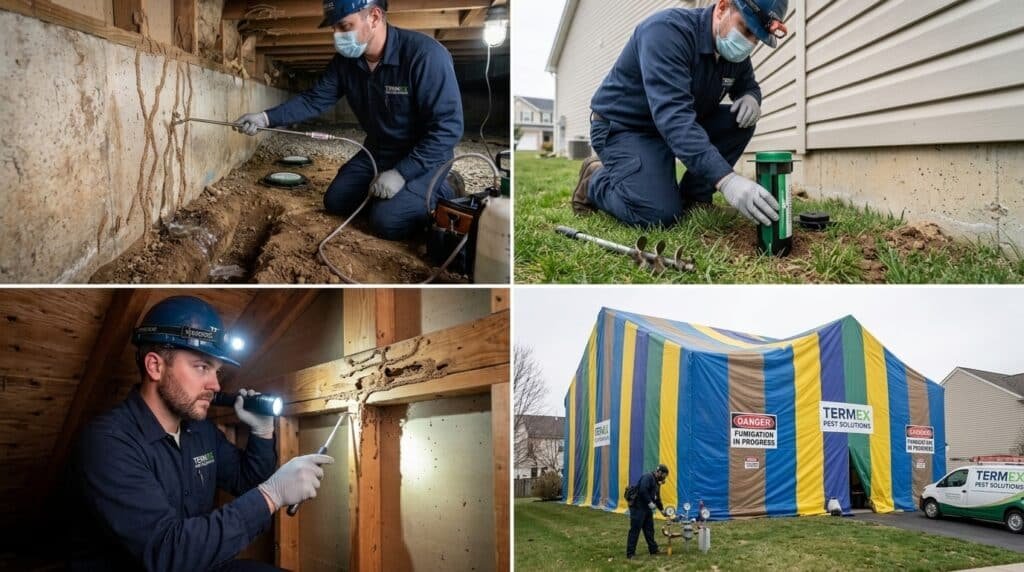
Termite Mud Tube Treatment Options
Once mud tubes are confirmed active, termite control generally falls into a few categories:
- Liquid termiticide — Applied around the foundation soil, creating a termite barrier that termites pass through and unknowingly carry back to the rest of the colony.
- Termite bait stations — Installed in the ground around a property’s perimeter, these attract foraging termites to slow-acting bait that eventually affects the entire colony.
- Professional termite inspection — Confirms the extent of the infestation, locates additional entry points, and identifies which treatment approach fits your specific situation.
- Termite extermination and structural fumigation — Reserved for severe infestations, especially with drywood termites, though subterranean infestations are more commonly treated with soil and bait-based methods instead.
The cost to treat subterranean termites with mud tubes varies widely depending on the size of your home, the extent of the infestation, and whether liquid treatment, bait stations, or a combination of both is recommended, so a proper professional quote is far more useful than a generic number. DIY treatments are rarely effective against an established subterranean colony, since the visible tube is only a small fraction of a much larger underground network.

Preventing Termite Mud Tubes Before They Start
Prevention largely comes down to removing the conditions termites need to thrive, and to actively prevent termite mud tubes from forming in the first place.
- Eliminate wood-to-soil contact — Keep firewood, mulch, and landscape timbers away from direct contact with your home’s foundation. UF/IFAS Extension’s termite prevention guide specifically recommends keeping mulch and vegetation clear of the lower foundation so inspection space stays visible and termites have fewer hidden pathways in.
- Control moisture — Fix leaky pipes, redirect downspouts away from the foundation, and address condensation in crawlspaces, since termites are drawn to consistently damp wood.
- Maintain a vapor barrier — A properly installed vapor barrier in your basement or crawl space reduces the humidity that makes these areas attractive to termites in the first place.
- Seal entry points — Gaps around garage doors are an overlooked entry point; checking your garage door bottom seals closes off one more access route.
- Do a regular foundation inspection — Walk your home’s perimeter every few months looking for new mud tubes, cracks, or soil buildup against the siding.
- Include a crawlspace inspection — Crawlspaces are one of the easiest places for tubes to go unnoticed for months, so make them part of your routine check rather than an afterthought.
- Consider ongoing termite monitoring — Many pest control companies offer termite monitoring stations that give an early warning before tubes ever reach visible parts of your home.
- Schedule annual termite inspections — Yearly professional inspections catch early mud tube activity long before visible structural damage appears.
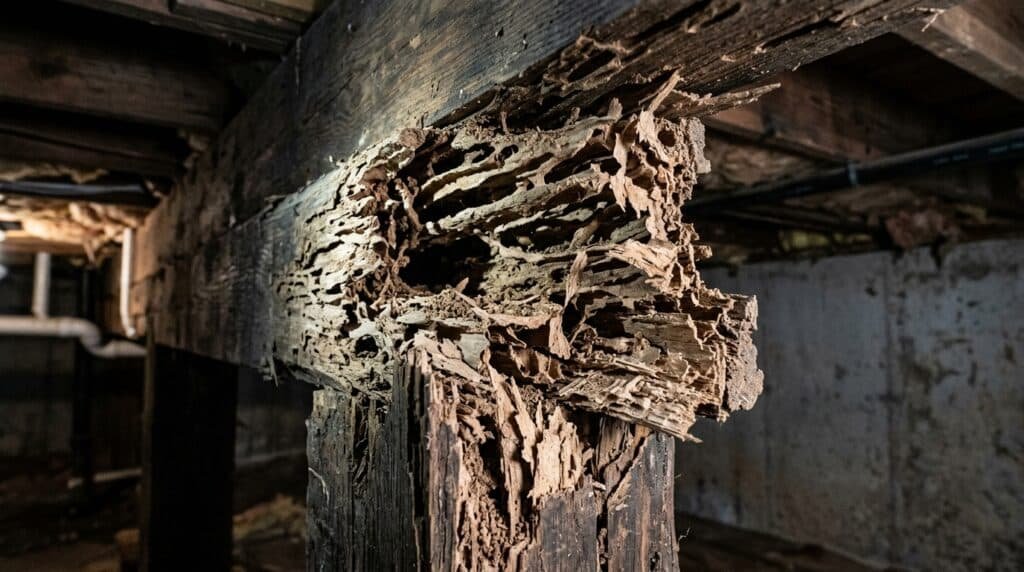
Should You Worry About Existing Damage?
Long-term termite activity can weaken structural wood enough to cause secondary issues, like squeaky or sagging subfloors. If you’ve noticed unexplained sounds underfoot, it’s worth ruling out termite damage alongside more common causes covered in our guide on why wood floors make noise.
It’s also worth checking your homeowner’s policy, since termite damage is frequently excluded from standard coverage. Our home insurance tips guide covers a few details worth understanding before you assume a repair will be covered.
Frequently Asked Questions

Final Thoughts
Termite mud tubes are easy to overlook, but they’re one of the most reliable early warnings your home can give you. Learning what they look like, where to check for them, and how to tell an active tube from an old one puts you in a much stronger position to catch a problem early.
If you spot a mud tube anywhere on your property, don’t just knock it down and move on. Get a professional inspection, address any moisture or wood-to-soil issues nearby, and make annual termite checks part of your regular home maintenance. It’s a small habit that can save you from a very expensive repair down the road.