House Nameplate Guide: How to Choose a Sign That Actually Gets Noticed
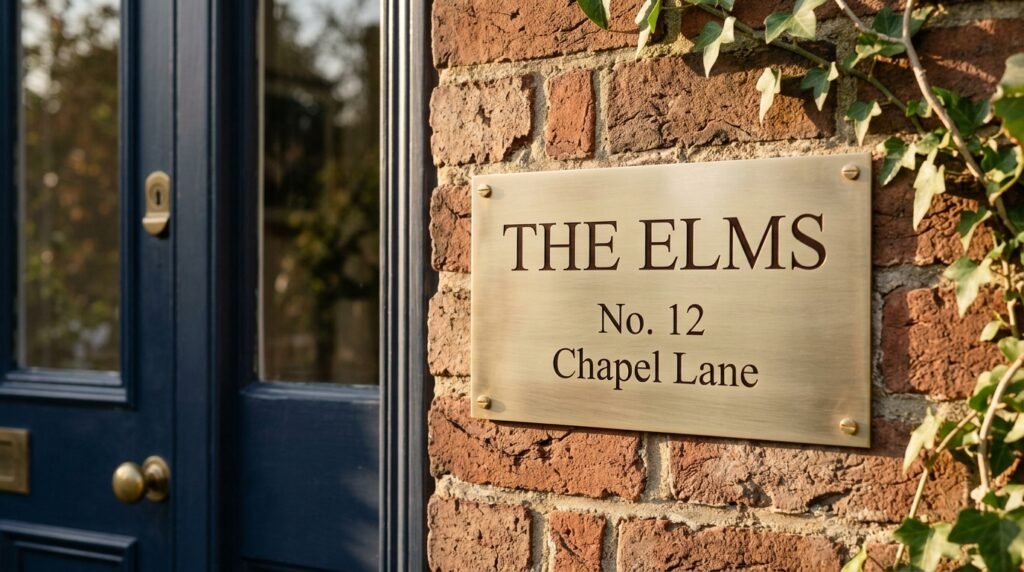
Your house nameplate is one of the smallest design decisions you’ll make for your home, and one of the most overlooked. It’s the first thing a delivery driver, a guest, or a first responder actually reads about your property. Get it wrong — too small, too dim, badly placed — and it fails at the one job it has.
Get it right, and a house nameplate becomes something more than identification. A well-chosen brass, stainless steel, or wooden sign adds genuine character to your entryway, the same way a good front door or porch light does.
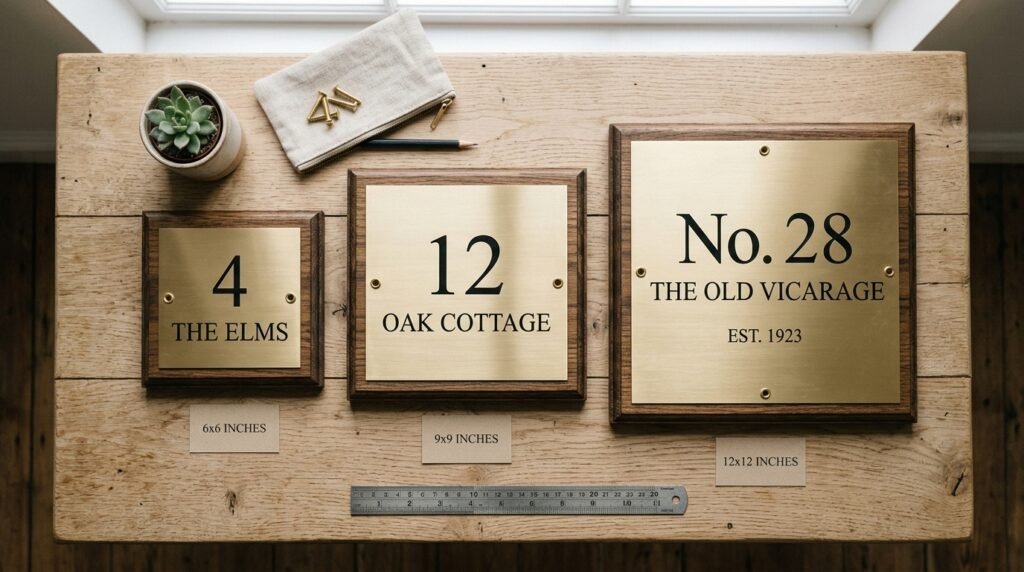
This guide covers everything: sizing (including why 12×12 inches has become such a popular sweet spot), materials, visibility rules, placement, and personalization ideas — so your house nameplate looks great and actually does its job.
Lorem ipsum dolor sit amet, consectetur adipiscing elit. Ut elit tellus, luctus nec ullamcorper mattis, pulvinar dapibus leo.

Why House Nameplate Size Actually Matters
People assume nameplate size is purely aesthetic. It isn’t. Visibility from the street is a real, code-regulated requirement in most of the US, and it exists for a genuinely serious reason: emergency response time.
Most US fire codes, based on the International Fire Code Section 505.1, require house numbers to be at least 4 inches tall with a minimum stroke width of 1/2 inch, mounted on a contrasting background so they’re plainly legible from the road. Some jurisdictions, especially for homes set further back from the street, require 5 or 6-inch numerals instead.
A 12×12 inch nameplate hits a genuinely useful middle ground: large enough to comfortably fit a full house name or number in code-compliant lettering, while still looking proportionate on most front doors, porches, or entryway walls, without overwhelming smaller homes the way an oversized plaque can.
Home Nameplate Calculator
Calculate legibility requirements and print dimensional specification layout sheets
Design Configurations
Proportion Variables
The Real Math Behind Visibility
Here’s a detail most homeowners never think about: each inch of letter height adds roughly 10 feet of readability distance, and at 30 mph, a driver has only about 2.3 seconds to spot an address from 100 feet away. Poor contrast, dim lighting, or overgrown landscaping can cut that detection range nearly in half.
That’s not a small detail if it’s an ambulance or fire truck trying to find your house. The Los Angeles Fire Department even uses a scaling formula: numeral height should be about 2 inches taller than 1/10 of your setback distance in feet. A home set 50 feet back from the road, in other words, may need noticeably larger numbers than the 4-inch minimum.
Practical takeaways:
- Choose high-contrast lettering (dark numbers on a light background, or vice versa)
- Add dedicated lighting or a reflective finish if your home isn’t well lit at night
- Trim landscaping regularly so it doesn’t creep over your sign
- If your home sits far from the street, size up beyond the legal minimum, not just up to it
House Nameplate Materials: Which One Fits Your Home
Material choice affects durability, maintenance, and style just as much as size does. Here’s how the most popular options compare:
- Brass nameplates: classic and long-lasting, developing a warm patina over time unless regularly polished
- Bronze nameplates: similar warmth to brass but with even greater corrosion resistance, popular for formal or heritage-style homes
- Stainless steel nameplates: modern, low-maintenance, and highly resistant to weather and corrosion
- Aluminum nameplates: lightweight, budget-friendly, and naturally corrosion-resistant, making it a practical choice for coastal properties
- Acrylic nameplates: affordable, available in bold colors, and well-suited to contemporary homes, though less durable in extreme heat
- Wooden nameplates: warm, natural, and highly customizable, though they need periodic sealing to resist weathering
- Slate and stone address plaques: extremely durable and naturally weatherproof, ideal for rustic or farmhouse-style homes
- Cast stone and cast iron plaques: heavy, traditional, and built to last decades with minimal upkeep
- Ceramic house number plaques: decorative and colorful, a popular choice for cottage or period-style homes, though more fragile than metal or stone
- Glass and PVC nameplates: lightweight, modern options often paired with backlighting for a distinctive nighttime look
- Illuminated LED house numbers: combine visibility with modern styling, particularly useful for homes with limited exterior lighting
If you’re deciding between two of the most popular options, acrylic wins on affordability and color variety, while stainless steel wins on long-term durability and a cleaner, more modern look. Both hold up well outdoors when properly mounted.
House Nameplate Materials: Which One Fits Your Home
Material choice affects durability, maintenance, and style just as much as size does. Here’s how the most popular options compare:
- Brass nameplates: classic and long-lasting, developing a warm patina over time unless regularly polished
- Bronze nameplates: similar warmth to brass but with even greater corrosion resistance, popular for formal or heritage-style homes
- Stainless steel nameplates: modern, low-maintenance, and highly resistant to weather and corrosion
- Aluminum nameplates: lightweight, budget-friendly, and naturally corrosion-resistant, making it a practical choice for coastal properties
- Acrylic nameplates: affordable, available in bold colors, and well-suited to contemporary homes, though less durable in extreme heat
- Wooden nameplates: warm, natural, and highly customizable, though they need periodic sealing to resist weathering
- Slate and stone address plaques: extremely durable and naturally weatherproof, ideal for rustic or farmhouse-style homes
- Cast stone and cast iron plaques: heavy, traditional, and built to last decades with minimal upkeep
- Ceramic house number plaques: decorative and colorful, a popular choice for cottage or period-style homes, though more fragile than metal or stone
- Glass and PVC nameplates: lightweight, modern options often paired with backlighting for a distinctive nighttime look
- Illuminated LED house numbers: combine visibility with modern styling, particularly useful for homes with limited exterior lighting
If you’re deciding between two of the most popular options, acrylic wins on affordability and color variety, while stainless steel wins on long-term durability and a cleaner, more modern look. Both hold up well outdoors when properly mounted.

Where Nameplates Go Beyond the Front Door
House signage isn’t limited to a single spot beside the entrance. Depending on your property layout, you might use nameplates or number signs in several locations at once:
- Gate nameplates: identify the property before a visitor even reaches the front door, especially useful for homes with a driveway gate — if you’re planning a gated entrance from scratch, our wooden garden gate size guide is a useful companion resource for sizing the gate itself
- Mailbox signs: a practical second location for numbers, particularly helpful when the house itself sits far from the road
- Fence nameplates: a subtle option for properties with a low front fence rather than a gate
- Villa and estate entrance signs: larger, more decorative plaques suited to properties with a formal entryway
- Apartment door signs: smaller-format signage for multi-unit buildings, typically just a unit number rather than a full name
- Lamp post address signs: combine lighting and identification in a single fixture, useful for long driveways.

Where Should House Numbers Be Placed?
Placement affects visibility just as much as size and material. General best practice:
- Mount numbers where they’re visible from the street, not hidden behind porch columns, planters, or overhangs
- If your house isn’t visible from the road (long driveway, set-back property), add a second sign at the driveway entrance or mailbox post
- Position numbers at a height that’s easy to read from a moving vehicle, typically between eye level and just above the front door
- Keep numbers away from areas prone to shadow or glare during common visiting hours
If you’re planning your full entryway layout, including where a nameplate, doorbell, and lighting all sit together, our entryway organizer guide can help you plan a cohesive look rather than adding each piece separately. Coordinating finishes across your entryway, right down to a matching key holder just inside the door, helps a new nameplate feel like part of a deliberate design rather than a standalone add-on.

Installing a House Nameplate: Screws, Adhesive, or Both?
Installation method depends on your wall surface and the weight of your chosen material.
- Adhesive mounting: works well for lightweight acrylic or aluminum signs on smooth surfaces, but isn’t ideal for heavier brass or stone plaques
- Screw-mounted installation: more secure for heavier materials, and essential for brick, stone, or stucco walls
- Wall anchors: required for masonry surfaces to hold screws securely over time
- Drill templates: many manufacturers include these to keep spacing and alignment precise before you commit to drilling
For brick or stone walls specifically, use masonry drill bits and appropriate wall anchors rated for outdoor use, since standard drywall anchors won’t hold up to weather and vibration over time. If you’re comparing hardware for other wall-mounted fixtures around your home at the same time, our wall clock placement guide covers similar principles around mounting height and wall material that apply just as well to a nameplate.

Family Name Signs: Personalizing Beyond the Address
Family name signs have become one of the most popular categories of house signage, moving well beyond simple address numbers into genuine home décor.
Popular styles include:
- Established family signs: featuring the family surname alongside the year a home was purchased or a family was established
- Monogram plaques: using an initial or combined family monogram as the focal design element
- Farmhouse-style wooden signs: rustic lettering paired with natural wood grain, popular for porches and front doors
- Minimalist metal signs: clean sans-serif lettering on brushed metal, suited to modern architecture
These signs typically go on a front porch, beside the entry door, or on an interior entryway wall rather than replacing your legally required street-visible house number, so it’s worth planning for both if personalization is a priority.

Office and Commercial Nameplates: A Related but Different Category
While most of this guide focuses on residential house signage, the same core principles apply to office nameplates, desk nameplates, and reception signage: legibility, appropriate sizing for the viewing distance, and a material that matches the space’s overall design.
- Desk nameplates: typically paired with a small desk nameplate holder, sized for close-range reading across a desk or counter
- Cubicle and employee nameplates: compact signage identifying individual workspaces, often in a uniform material and font across the office
- Office door nameplates: mounted at eye level beside a door, similar in principle to a house nameplate but scaled for indoor viewing distances
- Reception and department signage: larger format signs meant to be read from across a lobby or hallway
- Executive nameplates: often lean toward brass or engraved wood for a traditional, polished look, while modern offices increasingly favor acrylic or brushed aluminum
- Business door signs: frequently combine a company name with hours of operation or a suite number for visitor wayfinding

Industrial Nameplates: A Different Purpose Entirely
It’s worth clearly distinguishing house nameplates from their industrial counterparts, since the terminology overlaps but the purpose is completely different. Industrial nameplates aren’t decorative at all — they’re permanent technical documentation required for safe equipment operation.
- Electric motor nameplates: display voltage, full-load amperage, horsepower, frequency, insulation class, and service factor. Reading these correctly matters for safe operation — for example, a motor’s service factor indicates how much continuous overload it can handle before overheating, information that directly affects equipment longevity
- Transformer nameplates: list voltage ratings, kVA capacity, and impedance, essential for matching equipment safely to an electrical system
- HVAC equipment nameplates: display refrigerant type, electrical ratings, and model information needed for service and code compliance
- Compressor, generator, and pump nameplates: follow similar conventions, listing the technical ratings equipment technicians rely on for safe installation and repair
- UL 969 labels: a recognized industry standard specifically covering marking and labeling materials for equipment nameplates, ensuring legibility and durability under real operating conditions
If your project involves both decorative house signage and functional equipment labeling, it’s worth keeping the two categories mentally separate. One is about curb appeal and visibility from the street; the other is safety-critical documentation that shouldn’t be treated as interchangeable with a decorative sign.

A Quick Home Safety Note Worth Mentioning
Since we’ve spent this whole guide talking about how a visible house number genuinely helps emergency responders find your home faster, it’s worth pairing that with another safety detail that matters just as much once help arrives: working smoke alarms.
Working smoke alarms cut the risk of dying in a home fire by roughly 60 percent, according to the National Fire Protection Association’s smoke alarm research. A clearly visible house number gets responders to your door faster; a working smoke alarm gives your household the critical early warning before they arrive.
If you’re already updating your entryway signage, it’s worth checking your home’s alarm coverage at the same time. Our smoke detector calculator can help you figure out how many alarms your home needs and where they should go, based on your layout and room count.
Bringing It All Together
A house nameplate seems like a small decision, but it sits right at the intersection of style and genuine safety function. Choose a size that meets or exceeds your local code minimum, a material that fits your home’s look and your maintenance tolerance, and a placement that’s actually visible from the street, not just from your own front porch.
Get those three things right, and your house nameplate stops being an afterthought and becomes exactly what it should be: an entryway detail that looks good, welcomes guests, and does its real job of helping the right people find you quickly when it matters most.