UV Light for Bed Bugs: What the Science Actually Says
If you’ve spent a late night crouched over your mattress with a black light, hunting for bed bugs, you’re not alone. It’s one of the most common tricks shared online, and it feels satisfying: flip off the lights, click on the UV flashlight, and wait for glowing proof that you’ve found the enemy. But here’s the honest answer before you buy anything: UV light can help you find evidence of bed bugs, and it can even lure them into a trap, but it will not get rid of an infestation on its own.
This guide breaks down exactly where UV light for bed bugs earns its keep, where it falls flat, and what actually works instead. We’ll also look at how the same black light behaves around mold and fungus, so you know when a UV flashlight is a genuinely useful tool and when it’s just theater. For a full walkthrough of every stage of an infestation, our complete bed bug guide is a good companion to this article.

How UV Light Interacts With Bed Bugs
What Is UV Light, Exactly?
Ultraviolet light sits just past violet on the light spectrum, invisible to our eyes but very real in its effects. It comes in three flavors, and the differences matter a lot for what you can actually do with it:
- UVA (315–400 nm): The gentlest form, and what most consumer UV flashlights and black lights use.
- UVB (280–315 nm): Stronger, and the reason you get sunburned on a cloudy day.
- UVC (100–280 nm): The most intense and germicidal type, capable of damaging DNA on contact.
What Bed Bugs Can Actually See
Bed bugs aren’t blind to light the way people sometimes assume. Studies on bed bug vision show they’re trichromatic, meaning they respond to three separate light wavelengths: ultraviolet (around 380 nm), violet (around 430 nm), and green (around 520 nm). Interestingly, female bed bugs tend to prefer the shorter, UV-leaning wavelengths more than males do, which is one of the few measurable differences in male vs female bed bug behavior.
That single fact explains almost everything in this article. Because bed bugs respond to UV and violet light, it opens the door to using a bug attracting light as a lure. But it says nothing about whether that same light can kill them, which is where a lot of the confusion online comes from.

Can You See Bed Bugs With a UV Light?
Short answer: no. UV light won’t reveal a bed bug’s body, but it can reveal the mess bed bugs leave behind, which is exactly how UV light bed bug detection actually works.
What Actually Glows Under UV Light
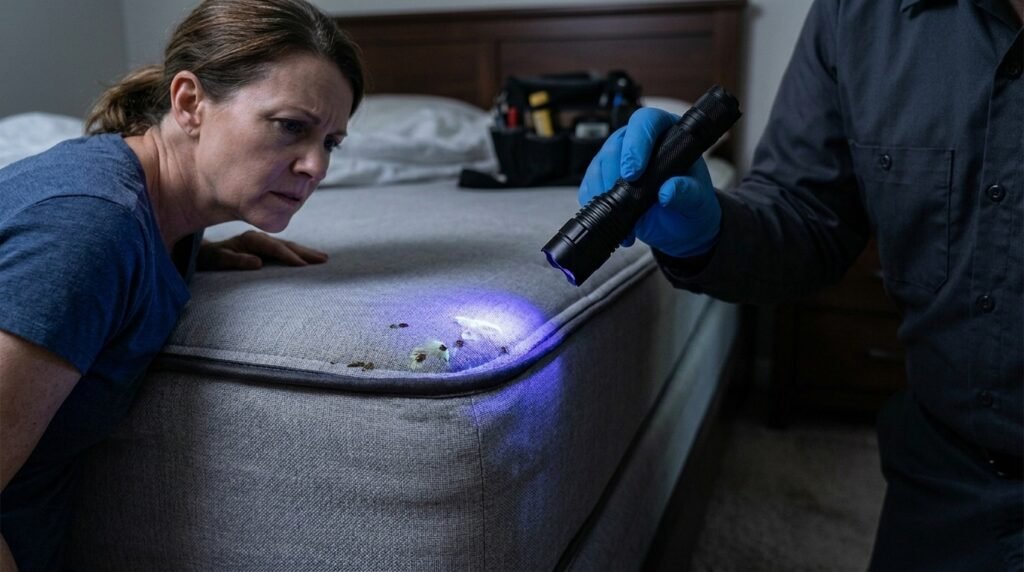
Think of a UV flashlight as a way to spot the crime scene, not the criminal. If you’re wondering what do bed bugs look like under black light, the honest answer is that the bugs themselves look no different. What changes is everything around them:
- Bed bug feces and urine, which turn a pale white under the right wavelength
- Shed skins (exoskeletons) left behind as bed bugs molt and grow, sometimes called bed bug shedding
- Certain blood stains and other biological residue on sheets or mattress fabric
The Myth You Should Drop Today
Bed bugs themselves do not glow under UV light, and neither do their eggs, reliably. So if you’ve been Googling what color are bed bugs under UV light, the real answer is none, they simply don’t fluoresce. If a flashlight ad shows a bug lit up like a firefly, that’s a marketing photo, not biology. What you’re really looking for when scanning bed bugs under black light is the staining and residue they leave in the seams of your mattress and along baseboards.
How to Check for Bed Bugs With a UV Light
Here’s exactly how to use UV light for bed bugs the right way, step by step:
Factor | Recommendation |
Wavelength | 365 nm gives the strongest fluorescence; 395 nm is noticeably weaker |
Room lighting | Turn off every light source; UV traces are easy to miss in a lit room |
Technique | Scan slowly and hold the light close to seams, tufts, and fabric folds |
Surfaces | Light fabrics show stains clearly; dark fabric and raw wood hide them |
Pro tip: Pest control professionals treat UV scanning as a supplement, not a replacement, for a hands-on inspection. So if you’ve asked yourself whether UV lights actually work for bed bugs on their own, the answer is: only alongside a real inspection. Pulling back sheets, checking the mattress and box spring seams, and probing cracks near the headboard still catches far more than a flashlight alone. If you’re also seeing small mud-like tunnels near your foundation, that’s a separate pest entirely, worth ruling out with our termite mud tube identification guide.

UV Light Bed Bug Traps: A Smarter Way to Monitor
This is where UV light genuinely shines (pun intended). Because bed bugs are phototactic, meaning they move toward certain light wavelengths, researchers have tested UV light and other bug attracting light sources as bait for monitoring traps.
UV plus blue light beats either one alone. In controlled trials, combining UV and blue light captured roughly 3.2 times more bed bugs than UV light by itself, and about 6.3 times more than blue light on its own. The combination appears to trigger a stronger attraction response than either wavelength individually.
These light-based traps work differently from an ultraviolet bug zapper you’d use outdoors for flying insects. A bed bug UV light trap doesn’t electrocute anything, it simply draws nocturnal bed bugs toward an LED or UV source, where they land on a glue board and get stuck. It’s a genuinely useful early-warning system, not a fix, and it’s a much gentler tool than a zapper for indoor use around a bed.
The catch: light traps monitor and confirm an infestation, they don’t eliminate one. Think of them the same way you’d think of a smoke detector, a tool that alerts you to a problem early so you can act, not a tool that puts out the fire itself. Speaking of which, if you haven’t checked your home’s fire detection coverage lately, it’s worth a look while you’re already thinking about home monitoring tools, and our smoke detector calculator can help you figure out how many you actually need and where to place them.

Why UV Light Won't Eliminate Bed Bugs
Lab conditions demonstrate high UVC mortality, but real-world bedroom environments present critical barriers.
⚠️ Safety Warning: Surface-level devices only work on direct contact and fail to address hidden bugs or eggs. Additionally, direct UV-C exposure can cause severe harm to human skin and eyes.

Where Do Bed Bugs Come From, and How Fast Do They Multiply?
Before you can solve a bed bug problem, it helps to understand where it started and why it feels like it exploded overnight.
Where Do Bed Bugs Come From?
Bed bugs don’t appear out of nowhere. They almost always hitchhike in on something: a suitcase after a trip, a used couch or mattress, secondhand clothing, or a shared wall in an apartment building. They’re excellent hiders, which is exactly why an infestation can go unnoticed for weeks before anyone spots a bite.
Can One Bed Bug Multiply Into an Infestation?
Yes, and faster than most people expect. A single fertilized female can lay bed bug eggs continuously, often producing one to several eggs a day and hundreds over her lifetime. That’s the real answer to can one bed bug multiply: it absolutely can, which is why acting on the first sign matters so much.
How Fast Do Bed Bugs Multiply, and How Long Before You See Them?
Bed bug eggs typically hatch within one to two weeks, and the young bugs, called nymphs, go through several stages of bed bug shedding, molting their exoskeleton each time they feed, before reaching adulthood in about a month under warm conditions. That’s how fast bed bugs multiply once a female settles in. As for how long does it take to see bed bugs, most people don’t notice anything until the population has already grown for several weeks, since a handful of bugs hiding in a seam produce very few visible signs at first.

UV Light and Mold: A Different Story Entirely
Does Mold Glow Under Black Light?
Yes, and far more reliably than bed bugs do. Many common household molds fluoresce under both 365 nm and 395 nm black light, usually as a bright yellow or chartreuse glow. In testing, black light mold detection correctly identified mold in contaminated samples about 80.8% of the time, a meaningfully higher hit rate than plain white light. If you’re scanning for mold under black light or mold under UV light, look for that yellow-green glow along baseboards, grout lines, and behind furniture.
The catch is the same as before: a UV lamp for mold can’t see through drywall, flooring, or ductwork. It only reveals mold that’s already on an exposed surface. For guidance on where mold tends to hide and how humidity contributes, the EPA’s mold resource center is a solid, unbiased place to start.
Does UV Light Kill Mold, Black Mold, or Fungus?
This is where people ask a cluster of very similar questions: does UV light kill mold, will UV light kill mold, can UV light kill mold, does UV light kill mold spores, and specifically, will UV light kill black mold. The answer to all of them is the same qualified yes:
Germicidal UVC (254 nm) can destroy biological pollutants, including some mold and mold spores, on exposed surfaces like HVAC coils. UVB has shown strong effectiveness against mold spores even at low doses, and both UVA and UVC irradiation may help control fungal growth depending on the wavelength used. That includes black mold species, though they respond the same way ordinary mold does, not any faster or slower.
Two important limits: mature mold spores contain melanin, which makes them noticeably more UV-resistant than young spores, and UV light only affects what it can directly reach. It can’t penetrate porous materials like drywall, wood, or fabric, so hidden or deep-rooted mold still needs physical removal.
Does UV Light Kill Fungus, Including on Skin?
Does ultraviolet light kill fungus in general? Yes, to a degree, UV light for fungus has shown real antifungal effects in controlled testing. But does UV light kill fungus on skin, or does sunlight and UV kill mold spores on human skin specifically? That’s a different, more delicate question, and it belongs to your dermatologist rather than a household flashlight. Some UV wavelengths show promise against skin fungal infections in lab settings (more on that below), but uncontrolled UV exposure on skin, from sunlight or a consumer device, carries burn and skin-damage risks that outweigh any DIY benefit.

What About Dust Mites, Skin Fungus, Lice, and Scabies?
Dust Mites
UV light to kill dust mites does work under lab conditions. UVC radiation can kill dust mites at every life stage, including eggs, by damaging their nucleic acids. In testing, the highest mortality rate (100%) occurred with direct irradiation from just 10 cm away, held for a full 60 minutes. That’s not a practical routine for a mattress or carpet in daily life, which is why UV isn’t considered a real-world dust mite solution yet.
Fungus on Skin
This is one of the more promising frontiers for UV research, and it’s the clearest answer yet to does UV light kill fungus on skin under controlled, clinical conditions. Far-UVC at 222 nm has shown strong results sterilizing the fungi behind common skin infections, and 275 nm UVC-LED inactivated both bacteria and fungi quickly without causing DNA damage or skin lesions in testing. Far-UVC at 233 nm has also shown yeasticidal effects against Candida while remaining gentle on skin. None of this is available in a consumer flashlight, so don’t try to replicate it at home.
Does UV Light Kill Lice or Scabies?
People frequently ask whether UV light can kill lice or UV light can kill scabies the same way it affects dust mites. The research here is much thinner. UVC can kill a broad range of organisms in general, and far-UVC has proven effective against many bacteria, fungi, and viruses, but there isn’t solid, specific evidence for lice or scabies yet. If you suspect either one, talk to a doctor rather than reaching for a UV wand.

How Actually Gets Rid of Bed Bugs
Proven mechanical, thermal, and chemical methods for eliminating active infestations and eggs.
🧪 Chemical Selection Note: Pest control professionals rely on rotating pyrethroid-based sprays, desiccant dusts (such as diatomaceous earth), and insect growth regulators (IGRs). Because many populations have developed chemical resistance, these treatments are most effective when combined with heat treatments.

Simple Prevention Habits That Actually Help
- Encase your mattress and box spring in a bed bug proof bed cover to block nesting spots
- Carry a UV flashlight for hotel room checks, alongside a visual inspection of the headboard and mattress seams
- Pack a travel bed bug spray when staying anywhere unfamiliar
- Inspect second-hand furniture closely before it comes through your front door
Bed bugs at 46°C (115°F) and above die within a short window, which is exactly why heat treatment, whether professional or via a portable heating chamber, is the gold standard for full elimination.

How to Check Bed Bugs In Hotel Room and Travel Safely
Hotel bed bugs are one of the most common ways an infestation makes it into a home in the first place, so a two-minute check when you arrive is worth the effort.
How to Avoid Bed Bugs in Hotels
- Keep luggage on a rack or in the bathtub, never on the bed or floor, until you’ve inspected the room
- Pull back the sheets and check the mattress seams, headboard, and the piping along the edge of the mattress
- Use a bed bug flashlight (a 365 nm UV light) to scan for the tell-tale staining described earlier in this guide
- Check the room next door too, since bed bugs travel through shared walls and adjoining furniture
If anything looks suspicious, ask for a room on a different floor rather than next door, and consider packing a smart bed bug repellent or travel spray as a precaution. When you get home, inspect your luggage and wash travel clothing on high heat before it touches your own bed.

Bed Bug Kits, Detectors, and Zappers: What's Worth Buying
Evaluating popular detection tools, UV lights, lure traps, and zapper products.
💡 Buyer's Tip: If you just want basic UV light for home use, a rechargeable 365 nm flashlight covers detection, hotel checks, and even a quick scan for mold in bathrooms or basements. That single tool delivers far more utility than most bundled kits.

Choosing a UV Flashlight for Bed Bug Detection
Essential specs and feature criteria for picking an effective detection tool.
⚠️ A Note on UVC Wands and "Sanitizer" Devices: These can kill some organisms on direct contact, but they carry zero field evidence for clearing bed bug infestations. Unshielded UVC exposure can genuinely harm your skin and eyes. If a product markets itself as a stand-alone bed bug "cure," that's your cue to keep researching before buying.

Quick Reference: What UV Light Can and Can't Do
A realistic evaluation of UV light across pest detection, mold treatment, and medical applications.
💡 Key Takeaway: UV light shines as an inspection and monitoring tool (detecting fecal spots, trace mold, or driving blue-light traps), but should not be relied upon as a primary eradication method for deep-seated pests or hidden mold.
UV Light, Mold And Pest Safety
Answers to common questions about UV-C effectiveness, mold detection, dust mites, and bed bug behaviors
The Bottom Line
UV light isn’t useless against bed bugs, it’s just misunderstood. Used correctly, a 365 nm flashlight helps you spot the evidence bed bugs leave behind, and combined with blue light, it can lure them into a monitoring trap. What it can’t do is replace real treatment. For that, heat, steam, and encasements remain the tools that actually work.
If you’re dealing with an active infestation, start with our full bed bug guide for a step-by-step plan, and keep a UV flashlight in your travel bag for hotel checks. And while you’re auditing your home for hidden hazards, don’t overlook the basics: working smoke alarms lower your risk of dying in a home fire by roughly 60%, according to NFPA research, yet nearly three out of five home fire deaths still happen in houses with no working alarm. Our smoke detector calculator can help you check whether your coverage is where it should be.