Demising Walls Selector | 12 Types • Fire Ratings • Complete Guide

🏗️ Demising Walls Selector

12 Types • 30+ Variations • Fire Ratings • Complete Specifications

12 Types of Demising Walls
1️⃣ GYPSUM BOARD DEMISING WALL (Drywall Partition)
Composition: Metal studs + gypsum boards
Characteristics:
✓ Lightweight and cost-effective
✓ Easy to install and modify
✓ Standard construction method
✓ Limited sound insulation

Best For: Offices, apartments, commercial interiors
Fire Rating: 1-2 hours (with proper board)
Sound Rating (STC): 33-45
Cost: $8–$15/sq ft
2️⃣ CONCRETE DEMISING WALL
Composition: Solid poured concrete or precast panels
Characteristics:
✓ Very strong and fire-resistant
✓ Excellent sound insulation
✓ Permanent installation
✓ Heavy and requires structural support

Best For: High-rise buildings, condos
Fire Rating: 4 hours+
Sound Rating (STC): 50+
Cost: $25–$50/sq ft
3️⃣ CONCRETE BLOCK (CMU) WALL
Composition: Concrete masonry units (blocks)
Characteristics:
✓ Durable and fire-rated
✓ Good acoustic performance
✓ Modular construction
✓ Requires mortar and skilled labor

Best For: Commercial and industrial buildings
Fire Rating: 2-4 hours
Sound Rating (STC): 45-50
Cost: $15–$30/sq ft
4️⃣ BRICK DEMISING WALL
Composition: Traditional clay brick construction
Characteristics:
✓ Strong and long-lasting
✓ Natural sound insulation
✓ Aesthetic appearance
✓ Difficult to modify

Best For: Residential and heritage buildings
Fire Rating: 4 hours+
Sound Rating (STC): 48-52
Cost: $20–$40/sq ft
5️⃣ DOUBLE STUD WALL SYSTEM
Composition: Two separate stud frames with gap
Characteristics:
✓ Superior soundproofing
✓ Reduces vibration transfer
✓ Thicker wall assembly
✓ More expensive

Best For: Apartments, hotels, recording studios
Fire Rating: 1-2 hours
Sound Rating (STC): 55-65
Cost: $18–$30/sq ft
6️⃣ STAGGERED STUD WALL
Composition: Single frame with alternating studs
Characteristics:
✓ Better sound control than standard
✓ More affordable than double stud
✓ Moderate thickness increase
✓ Good noise reduction

Best For: Residential units, apartments
Fire Rating: 1-2 hours
Sound Rating (STC): 48-55
Cost: $12–$22/sq ft
7️⃣ SHAFT WALL SYSTEM
Composition: Fire-rated gypsum system
Characteristics:
✓ Used around elevators/service shafts
✓ Installed from one side
✓ High fire protection
✓ Specialized assembly

Best For: High-rise buildings
Fire Rating: 2-4 hours
Sound Rating (STC): 40-50
Cost: $12–$25/sq ft
8️⃣ METAL STUD DEMISING WALL
Composition: Steel framing with drywall layers
Characteristics:
✓ Lightweight and strong
✓ Fire-rated options available
✓ Non-combustible
✓ Cost-effective

Best For: Offices, retail spaces, commercial
Fire Rating: 1-2 hours
Sound Rating (STC): 35-48
Cost: $10–$18/sq ft
9️⃣ GLASS DEMISING WALL
Composition: Tempered or laminated glass panels
Characteristics:
✓ Modern and aesthetic
✓ Limited sound/privacy unless treated
✓ Transparent or frosted options
✓ Requires framing system

Best For: Offices, conference rooms, modern design
Fire Rating: 1-2 hours (with framings)
Sound Rating (STC): 30-40 (standard), 45+ (special)
Cost: $30–$60/sq ft
🔟 FIRE-RATED DEMISING WALL
Composition: Specially designed for fire resistance
Characteristics:
✓ 1–4 hours fire rating
✓ Uses gypsum, concrete, or CMU
✓ Required by building codes
✓ Meets fire safety standards

Best For: Apartments, commercial buildings, code-required
Fire Rating: 1-4 hours (varies by design)
Sound Rating (STC): 40-55
Cost: $12–$30/sq ft
1️⃣1️⃣ ACOUSTIC (SOUNDPROOF) DEMISING WALL
Composition: Insulation + resilient channels + drywall
Characteristics:
✓ Reduces noise transfer
✓ Double-layer drywall
✓ Sound-rated materials
✓ Professional installation recommended

Best For: Studios, hotels, apartments
Fire Rating: 1-2 hours
Sound Rating (STC): 55-70
Cost: $20–$35/sq ft
1️⃣2️⃣ PREFABRICATED DEMISING WALL PANELS
Composition: Factory-made panel assemblies
Characteristics:
✓ Quick installation
✓ Consistent quality
✓ Various configurations available
✓ Modular design

Best For: Modular buildings, quick buildouts, offices
Fire Rating: 1-2 hours (design dependent)
Sound Rating (STC): 35-50
Cost: $15–$28/sq ft
Find Your Perfect Demising Wall
Demising Wall Specifications & Standards
📏 STANDARD THICKNESS & DIMENSIONS
Gypsum Board Walls: 3.625"–4.625" (3.5"–4.5" studs + drywall)
Double Stud Walls: 8–10" (2×4 or 2×6 studs with 1–2" gap)
Concrete Walls: 4–8" thick, various widths
CMU Blocks: 8", 10", or 12" nominal (7.625", 9.625", 11.625" actual)
Brick Walls: 4–8" minimum (single wythe: 3.625")
Glass Walls: Variable (typically 1–2" with framing)
Metal Stud Walls: 2.5"–6" (varies with stud size)
🔥 FIRE RATING CHART
1-HOUR FIRE RATING:
• Single layer Type X drywall + studs
• Gypsum or metal stud systems
• Most common for apartments
• Code requirement for many buildings

2-HOUR FIRE RATING:
• Double layer Type X drywall
• Concrete or CMU blocks
• Shaft walls
• Required for some commercial/high-rise

3-4 HOUR FIRE RATING:
• Concrete walls (4"+ thickness)
• Brick/clay tile construction
• Fire-rated concrete systems
• High-security or specialty buildings
Wall Type Typical Thickness Fire Rating STC Rating Installation Time Modifiability
Gypsum Board 3.625–4.625" 1–2 hr 33–45 2–4 weeks Very easy
Concrete 4–8" 4+ hr 50+ 4–8 weeks Difficult
CMU Block 7.625–11.625" 2–4 hr 45–50 3–6 weeks Difficult
Brick 4–8" 4+ hr 48–52 4–8 weeks Very difficult
Double Stud 8–10" 1–2 hr 55–65 3–5 weeks Easy
Glass 1–2" 1–2 hr 30–45 2–3 weeks Moderate
Acoustic 5–6" 1–2 hr 55–70 3–5 weeks Easy
📊 STC (SOUND TRANSMISSION CLASS) EXPLANATION
STC 30–35: Light sound control, conversations clearly audible | Glass walls
STC 35–45: Basic sound control, speech intelligible | Standard drywall walls
STC 45–55: Good sound control, speech muffled | Concrete, CMU, staggered studs
STC 55–65: Excellent sound control, speech barely audible | Double stud, acoustic
STC 65+: Superior sound control, sound isolation | Specialized acoustic systems

Higher STC = Better sound insulation
Cost & Performance Comparison
Wall Type Cost/Sq Ft Fire Rating Sound (STC) Durability Best For
Gypsum Board $8–$15 1–2 hr 33–45 Good Budget offices
Metal Stud $10–$18 1–2 hr 35–48 Excellent Commercial
Staggered Stud $12–$22 1–2 hr 48–55 Good Apartments
CMU Block $15–$30 2–4 hr 45–50 Excellent Commercial
Shaft Wall $12–$25 2–4 hr 40–50 Excellent Elevator cores
Double Stud $18–$30 1–2 hr 55–65 Good Sound control
Acoustic $20–$35 1–2 hr 55–70 Good Studios/hotels
Concrete $25–$50 4+ hr 50+ Superior High-rise
Brick $20–$40 4+ hr 48–52 Superior Heritage
Glass $30–$60 1–2 hr 30–45 Excellent Modern offices
Prefab Panels $15–$28 1–2 hr 35–50 Good Quick build
🎯 QUICK SELECTION GUIDE
BEST FOR SOUNDPROOFING: Double stud (STC 55–65) or Acoustic walls (STC 55–70)
BEST FOR FIRE SAFETY: Concrete (4+ hr) or Brick (4+ hr)
BEST FOR BUDGET: Gypsum board ($8–$15) or Metal stud ($10–$18)
BEST FOR MODERN DESIGN: Glass walls ($30–$60)
BEST FOR DURABILITY: Concrete, brick, or CMU block
BEST FOR QUICK INSTALLATION: Prefab panels or gypsum board
BEST FOR APARTMENTS: Staggered stud (good sound + affordable)
BEST FOR COMMERCIAL: Metal stud or CMU block

© 2026 Demising Walls Selector | 12 Types • 30+ Variations • Complete Specifications

Complete Demising Walls Selector Guide: 12 Types, Specifications, Fire Ratings & Costs

Choose the Right Demising Wall: Comprehensive Guide to Partition Wall Systems

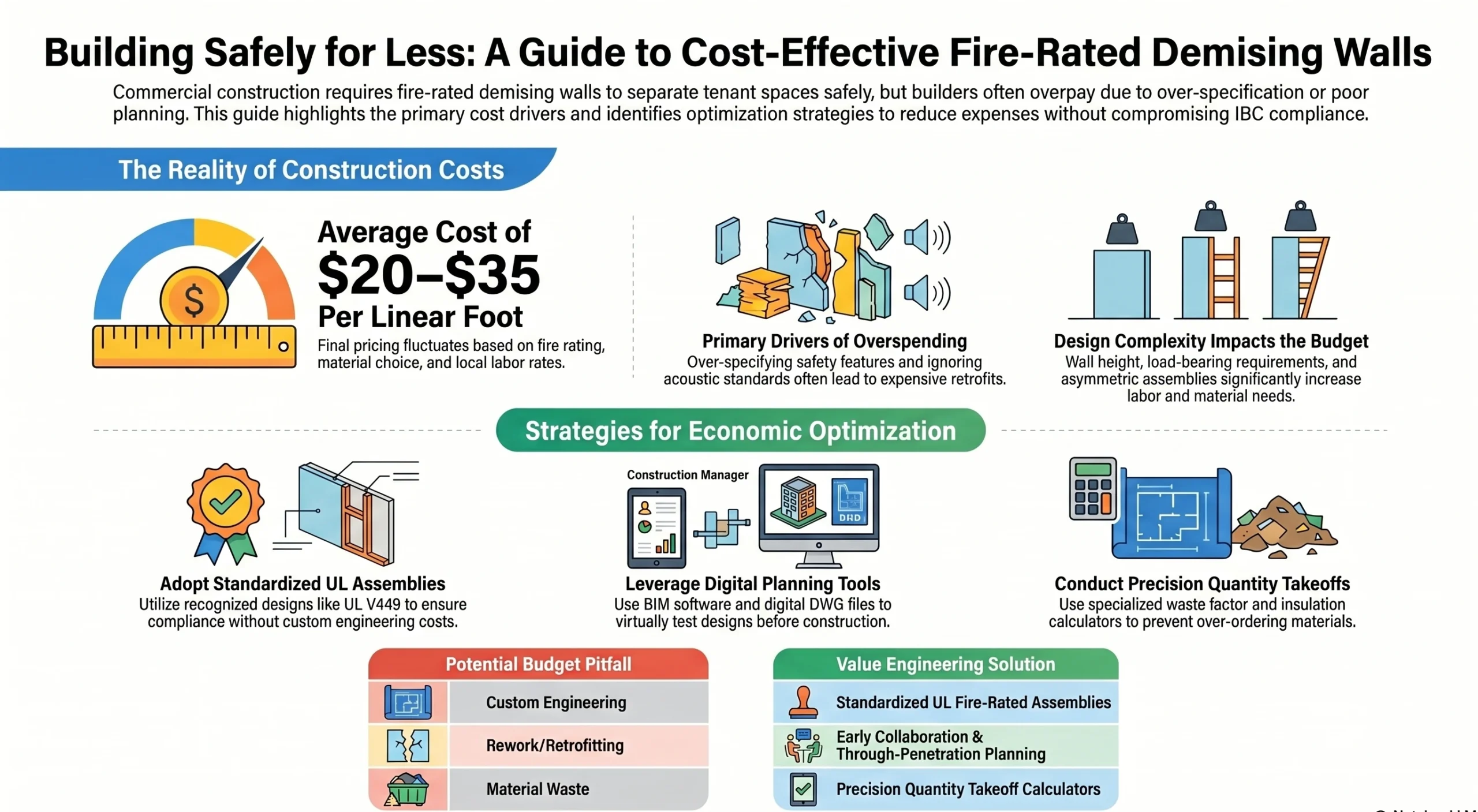
Demising walls partition building spaces while providing critical fire separation, sound insulation, and structural integrity. This comprehensive guide covers all major demising wall types: gypsum board, concrete, CMU blocks, brick, double-stud, staggered-stud, shaft walls, metal-stud, glass, fire-rated, acoustic, and prefabricated systems, including complete specifications, fire ratings, thicknesses, and costs.

Whether you’re designing apartments, offices, or commercial buildings, this guide helps you select the perfect demising wall system for your project, building codes, and budget.


PART 1: ALL DEMISING WALL TYPES EXPLAINED (EQUAL COVERAGE)

1. GYPSUM BOARD DEMISING WALL (DRYWALL PARTITION)

Material Composition: Metal studs (steel framing) with gypsum board (drywall) facing, creating lightweight fire-resistant partitions.

Physical Specifications:

SpecificationStandard Details
Stud MaterialSteel (cold-formed)
Stud Sizes3-5/8″ or 5-5/8″ wide
Stud Spacing16″ or 24″ on center
Gypsum Board Thickness1/2″ or 5/8″
Total Wall Thickness3.5-6″ (including finishes)
HeightFloor-to-floor (8-14 feet typical)
Weight5-8 lbs per sq ft
Fire Rating1-2 hours (STC 40-55)
Sound Transmission ClassSTC 40-55
Acoustic PerformanceModerate (basic)

Characteristics:

  • Lightweight and cost-effective
  • Easy to install and modify
  • Metal studs resist fire and pests
  • Excellent for reconfiguration
  • Professional appearance
  • Standard construction method

How It Works: Steel studs spaced 16-24″ on center. Gypsum boards are screwed to studs on both sides. Typically single or double-layer boards. Taped and finished for a smooth surface.

Best For:

  • Offices
  • Apartments
  • Commercial interiors
  • Interior demising walls
  • Easy reconfiguration needed
  • Budget-conscious projects

Installation Method:

  • Fastening: Screws to steel studs
  • Finishing: Taping, mudding, painting
  • Time: 2-4 days per 1,000 sq ft
  • Labor: Standard drywall crews

Typical Cost Range:

  • Material: $3-6 per sq ft
  • Labor: $4-8 per sq ft
  • Total installed: $7-14 per sq ft
  • Fire-rated options: +$2-4 per sq ft

Advantages:

  • Affordable
  • Fast installation
  • Easy to modify
  • Lightweight (easy handling)
  • Recyclable materials
  • Sounds decent for the cost
  • Professional appearance
  • Standard building experience

Disadvantages:

  • Lower sound insulation than alternatives
  • Durability is less than that of concrete/brick
  • Requires finishing (tape/mud/paint)
  • Not suitable for wet areas
  • Moisture sensitive
  • Vibration transfer possible
  • Damaged easily

Lifespan: 50-75 years (with proper maintenance)


2. CONCRETE DEMISING WALL

Material Composition: Solid poured concrete or precast concrete panels, providing mass-based sound and fire protection.

Physical Specifications:

SpecificationStandard Details
Material TypeCast-in-place or precast
Thickness4-8 inches typical
Strength Ratingf’c 3,000-4,000 PSI
HeightFloor-to-floor (8-14 feet)
Weight45-60 lbs per sq ft
Fire Rating2-4 hours (STC 60-75)
Sound Transmission ClassSTC 60-75 (excellent)
Acoustic PerformanceExcellent
Fire ResistanceExcellent

Characteristics:

  • Solid poured concrete
  • Very strong and fire-resistant
  • Excellent sound insulation
  • Permanent and long-lasting
  • Heavy mass blocks sound
  • Professional appearance possible

How It Works: Concrete is poured into forms or precast panels, which are set in place. Solid mass provides exceptional sound and fire protection. No studs needed (load-bearing possible).

Best For:

  • High-rise buildings
  • Condominiums
  • Luxury residences
  • Spaces requiring fire separation
  • Sound-critical applications
  • Permanent construction

Installation Method:

  • Placement: Cast-in-place or precast set
  • Curing: 28 days for cast-in-place
  • Finishing: Surface treatment, finishes
  • Time: 5-10 days (cast) or 1-2 days (precast)
  • Labor: Concrete specialists needed

Typical Cost Range:

  • Material: $8-15 per sq ft
  • Labor: $8-12 per sq ft
  • Total installed: $16-27 per sq ft
  • Precast premium: +$3-5 per sq ft

Advantages:

  • Excellent sound insulation
  • Excellent fire resistance
  • Very durable (permanent)
  • Load-bearing possible
  • Minimal maintenance
  • Superior acoustic performance
  • Premium appearance
  • Resists moisture

Disadvantages:

  • Very expensive
  • Heavy (structural support needed)
  • Difficult to modify
  • Requires concrete expertise
  • Slower installation (cast)
  • Environmental impact
  • Overkill for many applications
  • Moisture concerns (pre-finishing)

Lifespan: 100-150+ years (essentially permanent)


3. CONCRETE BLOCK (CMU) WALL

Material Composition: Concrete masonry units (CMU blocks) stacked with mortar, creating durable fire-rated walls.

Physical Specifications:

SpecificationStandard Details
Block Size8″×8″×16″ standard
Block TypesStandard, lightweight, high-density
Wall Thickness8″ or 12″ typical
HeightFloor-to-floor (8-14 feet)
Weight40-50 lbs per sq ft (8″)
Fire Rating2-4 hours (STC 50-65)
Sound Transmission ClassSTC 50-65
Acoustic PerformanceGood to excellent
Mortar TypeType S or N

Characteristics:

  • Concrete masonry blocks (CMU)
  • Durable and fire-rated
  • Good acoustic performance
  • Solid construction
  • Moisture resistant
  • Professional appearance

How It Works: CMU blocks are stacked and mortared together. Cores can be filled with concrete/grout for strength and painted or left with an exposed brick finish.

Best For:

  • Commercial buildings
  • Industrial buildings
  • Spaces requiring durability
  • High-traffic areas
  • Fire-rated construction
  • Permanent walls

Installation Method:

  • Laying: Masonry workers
  • Mortar: Type S or N mortar
  • Filling: Cores filled if needed
  • Finishing: Paint or finish
  • Time: 3-6 days per 1,000 sq ft
  • Labor: Masonry specialists

Typical Cost Range:

  • Material: $4-8 per sq ft
  • Labor: $6-10 per sq ft
  • Total installed: $10-18 per sq ft
  • Grouting premium: +$2-3 per sq ft

Advantages:

  • Very durable
  • Excellent fire rating
  • Good sound insulation
  • Professional appearance
  • Moisture resistant
  • Low maintenance
  • Load-bearing possible
  • Long lifespan

Disadvantages:

  • Slower installation
  • Requires masonry expertise
  • Difficult to modify
  • Heavy (structural support)
  • More expensive than drywall
  • Not DIY-friendly
  • Permanent installation
  • Requires finishing

Lifespan: 75-150+ years (extremely durable)


4. BRICK DEMISING WALL

Material Composition: Traditional clay brick construction with mortar, providing timeless durability and aesthetic appeal.

Physical Specifications:

SpecificationStandard Details
Brick TypeClay brick (various grades)
Brick Size2.25″×3.75″×7.625″ standard
Wall Thickness8″ (single wythe) to 12″+ (double)
HeightFloor-to-floor (8-14 feet)
Weight50-60 lbs per sq ft
Fire Rating2-4 hours (STC 50-60)
Sound Transmission ClassSTC 50-60
Acoustic PerformanceGood
Mortar TypeType N or S

Characteristics:

  • Traditional clay brick
  • Strong and long-lasting
  • Natural sound insulation
  • Aesthetic appeal
  • Moisture resistant
  • Requires finishing usually

How It Works: Bricks laid in running bond pattern with mortar. Single or double wythe (thickness). Can be left exposed or finished.

Best For:

  • Residential buildings
  • Heritage/traditional buildings
  • Spaces requiring aesthetic value
  • Long-term investments
  • Premium appearance desired
  • Historic properties

Installation Method:

  • Laying: Skilled bricklayers required
  • Mortar: Type N or S
  • Pattern: Running bond typical
  • Finishing: Exposed or finished
  • Time: 4-8 days per 1,000 sq ft
  • Labor: Highly skilled bricklayers

Typical Cost Range:

  • Material: $6-12 per sq ft
  • Labor: $8-15 per sq ft
  • Total installed: $14-27 per sq ft
  • Premium brick: +$3-6 per sq ft

Advantages:

  • Very durable
  • Timeless aesthetic
  • Good fire rating
  • Natural sound insulation
  • Moisture resistant
  • Character and charm
  • Premium appearance
  • Extremely long lifespan

Disadvantages:

  • Very expensive
  • Requires skilled labor
  • Difficult to modify
  • Heavy (structural support)
  • Slow installation
  • Not DIY-friendly
  • Permanent installation
  • Mortar maintenance needed

Lifespan: 100+ years (extremely durable)


5. DOUBLE STUD WALL SYSTEM

Material Composition: Two separate stud frames with airspace and insulation, providing superior soundproofing.

Physical Specifications:

SpecificationStandard Details
Frame TypeTwo separate stud frames
Stud Spacing16″ or 24″ on center each
Cavity Width1-2 inches (airspace)
InsulationRockwool, fiberglass, foam
Total Thickness10-12 inches
HeightFloor-to-floor (8-14 feet)
Weight8-12 lbs per sq ft
Fire Rating1-2 hours (STC 65-75)
Sound Transmission ClassSTC 65-75 (excellent)
Acoustic PerformanceExcellent

Characteristics:

  • Two separate stud frames
  • Superior soundproofing
  • Decoupled design reduces vibration
  • Insulation in both cavities
  • More complex installation
  • Premium acoustic performance

How It Works: Two stud frames built independently, 1-2″ apart. Insulation fills both cavities. Gypsum boards on each frame. No contact between frames (decoupling).

Best For:

  • Apartments
  • Hotels
  • Music studios
  • Sound-sensitive spaces
  • Premium construction
  • High-end residential

Installation Method:

  • Framing: Two separate frames
  • Spacing: 1-2″ gap critical
  • Insulation: Both cavities filled
  • Finishing: Drywall, tape, mud, paint
  • Time: 4-6 days per 1,000 sq ft
  • Labor: Skilled framers and drywall crews

Typical Cost Range:

  • Material: $6-12 per sq ft
  • Labor: $8-12 per sq ft
  • Total installed: $14-24 per sq ft
  • Insulation premium: +$2-3 per sq ft

Advantages:

  • Excellent sound insulation
  • Superior acoustic performance
  • Vibration decoupled
  • Flexible design options
  • Good fire rating
  • Professional quality
  • Customizable insulation
  • Long lifespan

Disadvantages:

  • More expensive than a single stud
  • Thicker wall (lost space)
  • More complex framing
  • Requires skilled labor
  • Takes longer to install
  • Not DIY-friendly
  • Quality is dependent on installation
  • May need bracing for lateral loads

Lifespan: 50-75 years


6. STAGGERED STUD WALL

Material Composition: Single frame with alternating studs on different sides, providing better sound control than standard walls.

Physical Specifications:

SpecificationStandard Details
Frame TypeSingle frame with offset studs
Stud SpacingStaggered 16″ or 24.”
Frame Thickness6″ (3.5″ + 2.5″ offset)
InsulationRockwool or fiberglass
Total Thickness6-8 inches
HeightFloor-to-floor (8-14 feet)
Weight6-10 lbs per sq ft
Fire Rating1-2 hours (STC 55-65)
Sound Transmission ClassSTC 55-65 (good)
Acoustic PerformanceGood

Characteristics:

  • Single frame with offset studs
  • Better sound control than standard
  • More affordable than double stud
  • Less space loss than double stud
  • Good acoustic performance
  • Standard-compatible installation

How It Works: Single top and bottom plate. Studs staggered so each side has different studs. Insulation between studs. Gypsum boards on each side contact only insulation.

Best For:

  • Residential units
  • Moderate sound control needed
  • Budget-conscious projects
  • Apartments
  • Hotels
  • Cost-effective soundproofing

Installation Method:

  • Framing: Single frame, staggered studs
  • Spacing: Alternating pattern critical
  • Insulation: Full cavity fill
  • Finishing: Drywall, tape, mud, paint
  • Time: 2-4 days per 1,000 sq ft
  • Labor: Standard framing crews

Typical Cost Range:

  • Material: $4-8 per sq ft
  • Labor: $5-9 per sq ft
  • Total installed: $9-17 per sq ft
  • Insulation premium: +$1-2 per sq ft

Advantages:

  • Better sound than standard
  • More affordable than double stud
  • Less space loss
  • Good acoustic performance
  • Standard installation methods
  • Flexible design
  • Professional quality
  • Good value

Disadvantages:

  • More complex than a standard stud
  • Slightly thicker than standard
  • Not as good as a double stud
  • Requires skilled framing
  • Takes longer than a single stud
  • Not DIY-friendly
  • Performance is dependent on execution
  • May require temporary bracing

Lifespan: 50-75 years


7. SHAFT WALL SYSTEM

Material Composition: Fire-rated gypsum system with special brackets, designed for elevator shafts and service penetrations.

Physical Specifications:

SpecificationStandard Details
System TypeProprietary fire-rated system
Gypsum LayersDouble to triple layer
Gypsum Thickness5/8″ fire-rated boards
Metal SupportSteel studs and brackets
Thickness3.5-4.5 inches
HeightFloor-to-floor (8-14 feet)
Weight6-8 lbs per sq ft
Fire Rating2-4 hours (STC 50-60)
Sound Transmission ClassSTC 50-60
InstallationOne-side only

Characteristics:

  • Fire-rated gypsum system
  • Installed from one side only
  • Special brackets and fastening
  • Used around critical penetrations
  • Allows service access
  • Professional-grade system

How It Works: Steel studs support thick gypsum boards, which are fastened with special brackets. Allows installation from one side only (critical for shaft walls). Fire-rated materials throughout.

Best For:

  • High-rise buildings
  • Elevator shafts
  • Service shaft enclosures
  • Stairwell enclosures
  • Building code requirements
  • Critical fire separation

Installation Method:

  • System: Proprietary system required
  • Installation: One-sided access only
  • Fastening: Special brackets and screws
  • Finishing: Minimal (fire-rated exposed)
  • Time: 2-3 days per 1,000 sq ft
  • Labor: Trained specialists required

Typical Cost Range:

  • Material: $6-10 per sq ft
  • Labor: $6-10 per sq ft
  • Total installed: $12-20 per sq ft
  • System premium: +$4-6 per sq ft

Advantages:

  • Excellent fire rating
  • One-side installation
  • Professional-grade system
  • Building code compliance
  • Tested and certified
  • Service access possible
  • Reliable performance
  • Code-approved

Disadvantages:

  • Expensive
  • Proprietary system required
  • Requires specialist installation
  • Limited customization
  • Not DIY-friendly
  • Lower sound insulation
  • Specialized knowledge needed
  • May require certification

Lifespan: 50+ years (fire-rated system)


8. METAL STUD DEMISING WALL

Material Composition: Steel framing with drywall layers, providing lightweight fire-rated construction.

Physical Specifications:

SpecificationStandard Details
Stud MaterialCold-formed steel
Stud Sizes3-5/8″, 5-5/8″, 8″
Stud Spacing16″ or 24″ on center
Drywall Thickness1/2″ or 5/8″
LayersSingle to triple
Total Thickness3.5-8 inches
HeightFloor-to-floor (8-14 feet)
Weight5-10 lbs per sq ft
Fire Rating1-2 hours (STC 40-55)
Sound Transmission ClassSTC 40-55
Acoustic PerformanceModerate

Characteristics:

  • Steel framing (cold-formed)
  • Drywall layers (1-3)
  • Lightweight and strong
  • Fire-rated options available
  • Professional appearance
  • Standard construction method

How It Works: Steel studs spaced 16-24″ on center. Drywall boards screwed to studs. Single, double, or triple-layer drywall. Taped, mudded, and finished.

Best For:

  • Offices
  • Retail spaces
  • Commercial buildings
  • Moderate-rise buildings
  • Standard commercial interiors
  • Budget-conscious commercial

Installation Method:

  • Fastening: Screws to steel studs
  • Layers: Single to triple drywall
  • Finishing: Taping, mudding, painting
  • Time: 2-4 days per 1,000 sq ft
  • Labor: Standard drywall crews

Typical Cost Range:

  • Material: $3-7 per sq ft
  • Labor: $4-8 per sq ft
  • Total installed: $7-15 per sq ft
  • Fire-rated premium: +$2-4 per sq ft

Advantages:

  • Lightweight
  • Strong steel frame
  • Fire-rated options
  • Easy to install
  • Professional appearance
  • Recyclable materials
  • Standard methods
  • Good value

Disadvantages:

  • Lower sound insulation
  • Not suitable for heavy loading
  • Requires finishing
  • Moisture sensitive
  • Thermal bridging (cold studs)
  • Limited customization
  • Standard appearance
  • Easier to damage

Lifespan: 50-75 years


9. GLASS DEMISING WALL

Material Composition: Tempered or laminated glass panels with framing systems, providing a modern aesthetic appearance.

Physical Specifications:

SpecificationStandard Details
Glass TypeTempered or laminated
Glass Thickness1/2″ to 1″ typical
Framing MaterialAluminum or steel
HeightFloor-to-floor or partial
Panel Width24-48″ typical
Weight5-15 lbs per sq ft
Fire Rating0-2 hours (varies)
Sound Transmission ClassSTC 30-50 (limited)
Acoustic PerformancePoor to moderate
Light Transmission85-90%

Characteristics:

  • Tempered or laminated glass
  • Modern and aesthetic
  • Limited sound/privacy
  • Light transmitting
  • Safety glass properties
  • Professional appearance

How It Works: Glass panels set in aluminum or steel frames. Frames fastened to structural supports. Transparent or frosted options. Optional acoustic treatment.

Best For:

  • Offices
  • Conference rooms
  • Modern design spaces
  • Light-filled interiors
  • Collaborative areas
  • Contemporary buildings

Installation Method:

  • Framing: Aluminum or steel system
  • Glass: Set in frames (wet or dry)
  • Sealing: Silicone or gaskets
  • Finishing: Minimal
  • Time: 2-3 days per 1,000 sq ft
  • Labor: Glass specialists required

Typical Cost Range:

  • Material: $8-20 per sq ft
  • Labor: $6-12 per sq ft
  • Total installed: $14-32 per sq ft
  • Acoustic treatment: +$3-8 per sq ft

Advantages:

  • Modern aesthetic
  • Light transmitting
  • Professional appearance
  • Flexible design options
  • Clean look
  • Contemporary design
  • Customizable finishes
  • Design statement

Disadvantages:

  • Poor sound insulation
  • Limited privacy
  • Expensive
  • Requires specialist installation
  • Cleaning/maintenance needed
  • Safety concerns (tempered/laminated)
  • Not for sound-critical
  • Requires acoustic treatment

Lifespan: 50-75 years (glass is very durable)


10. FIRE-RATED DEMISING WALL

Material Composition: Specially designed walls using gypsum, concrete, or CMU rated for 1-4 hour fire resistance.

Physical Specifications:

SpecificationStandard Details
Core MaterialGypsum, concrete, or CMU
Fire Rating1, 2, or 4 hours
Gypsum Thickness5/8″ type X fire-rated
Total Wall Thickness4-8 inches
HeightFloor-to-floor (8-14 feet)
Weight6-15 lbs per sq ft
Sound Transmission ClassSTC 40-75 (varies)
Acoustic PerformanceModerate to excellent
Tested AssemblyUL or other rating

Characteristics:

  • Fire-rated materials throughout
  • UL-tested assembly
  • 1-4 hour rating options
  • Building code required
  • Specialized installation
  • Professional-grade system

How It Works: Fire-rated gypsum boards (Type X, Type C) or concrete/CMU construction. Special fastening and sealing. All penetrations sealed. Meets building code fire separation requirements.

Best For:

  • Apartments
  • Commercial buildings
  • Fire separation required
  • Building code compliance
  • High-rise buildings
  • Multi-family residential

Installation Method:

  • Materials: Fire-rated materials only
  • Assembly: Per UL rating specs
  • Fastening: Per fire-rating requirements
  • Sealing: Critical (all penetrations)
  • Time: 3-5 days per 1,000 sq ft
  • Labor: Fire-rated wall specialists

Typical Cost Range:

  • Material: $4-15 per sq ft
  • Labor: $5-10 per sq ft
  • Total installed: $9-25 per sq ft
  • Testing/certification: +$1-3 per sq ft

Advantages:

  • Building code compliance
  • Fire safety critical
  • Tested and certified
  • Multiple rating options
  • Professional-grade
  • Inspectable/verifiable
  • Documented performance
  • Code-approved assemblies

Disadvantages:

  • More expensive than non-rated
  • Requires specialist knowledge
  • Strict installation requirements
  • Limited customization
  • Penetration restrictions
  • Professional inspection needed
  • Documentation required
  • Not DIY-friendly

Lifespan: 50-75 years


11. ACOUSTIC (SOUNDPROOF) DEMISING WALL

Material Composition: Insulation with resilient channels and layered drywall, designed to minimize noise transfer.

Physical Specifications:

SpecificationStandard Details
Frame TypeMetal studs with channels
InsulationRockwool, fiberglass, foam
Drywall LayersDouble to triple
Resilient ChannelsHat-channel or resilient clips
Total Thickness6-10 inches
HeightFloor-to-floor (8-14 feet)
Weight8-12 lbs per sq ft
Fire Rating1-2 hours (STC 60-75)
Sound Transmission ClassSTC 60-75 (excellent)
Acoustic PerformanceExcellent

Characteristics:

  • Insulation + resilient channels
  • Reduces noise transfer
  • Often double-layer drywall
  • Decoupled design
  • Professional acoustic design
  • Excellent soundproofing

How It Works: Studs with an insulation-filled cavity. Resilient channels decouple drywall from studs—typically with double- or triple-layer drywall. Taped seams are critical. All gaps sealed.

Best For:

  • Recording studios
  • Music rooms
  • Hotels
  • Apartments
  • Sound-sensitive spaces
  • Premium construction

Installation Method:

  • Framing: Studs with channels
  • Insulation: Full cavity fill
  • Drywall: Multiple layers critical
  • Sealing: All gaps sealed
  • Finishing: Professional taping
  • Time: 4-6 days per 1,000 sq ft
  • Labor: Acoustic specialists

Typical Cost Range:

  • Material: $6-12 per sq ft
  • Labor: $8-12 per sq ft
  • Total installed: $14-24 per sq ft
  • Specialty materials: +$2-4 per sq ft

Advantages:

  • Excellent acoustic performance
  • Professional soundproofing
  • Multiple drywall layers
  • Customizable insulation
  • Good fire rating
  • Professional quality
  • Flexible design
  • Superior noise reduction

Disadvantages:

  • Expensive
  • Thicker wall (lost space)
  • Complex installation
  • Requires acoustic specialists
  • Not DIY-friendly
  • Professional sealing critical
  • Quality is dependent on execution
  • Takes longer to install

Lifespan: 50-75 years


12. PREFABRICATED DEMISING WALL PANELS

Material Composition: Factory-made panels combining framing and finishes, designed for quick on-site assembly.

Physical Specifications:

SpecificationStandard Details
Panel MaterialSteel studs + drywall
Panel Dimensions4’W × 8-14’H typical
Thickness3.5-6 inches
Pre-finishingPartial to complete
Weight8-15 lbs per sq ft
Fire Rating1-2 hours (STC 40-55)
Sound Transmission ClassSTC 40-55
Acoustic PerformanceModerate
Assembly TimeOn-site assembly only

Characteristics:

  • Factory-made panels
  • Quick installation
  • Consistent quality
  • Pre-finished options
  • Standardized components
  • Modular system

How It Works: Panels are manufactured off-site and delivered ready for assembly. Panels stack/connect on site. Minimal finishing on-site. Reduces construction time significantly.

Best For:

  • Modular buildings
  • Offices
  • Rapid construction
  • Standardized spaces
  • Reconfigurable layouts
  • Time-critical projects

Installation Method:

  • Delivery: Pre-made panels
  • Assembly: On-site connection
  • Finishing: Minimal (pre-finished)
  • Sealing: Between-panel joints
  • Time: 1-2 days per 1,000 sq ft
  • Labor: Standard assembly crews

Typical Cost Range:

  • Material: $8-15 per sq ft
  • Labor: $3-6 per sq ft
  • Total installed: $11-21 per sq ft
  • Custom options: +$2-5 per sq ft

Advantages:

  • Quick installation
  • Consistent quality (factory)
  • Predictable schedule
  • Less on-site labor
  • Reduced construction time
  • Customization possible
  • Professional quality
  • Reconfigurable systems

Disadvantages:

  • More expensive per sq ft
  • Requires factory ordering
  • Limited customization
  • Shipping costs
  • Damage during transport
  • Standardized sizing
  • Less flexibility in dimensions
  • Assembly requires training

Lifespan: 50-75 years


PART 2: COMPREHENSIVE COMPARISON TABLES

TABLE 1: QUICK COMPARISON – ALL 12 DEMISING WALL TYPES

TypeMaterialThicknessWeight/sq ftCost/sq ftFire RatingSTCInstallationBest For
Gypsum BoardMetal studs + drywall3.5-6″5-8$7-141-2 hr40-55EasyOffices, apartments
ConcretePoured/precast4-8″45-60$16-272-4 hr60-75ComplexHigh-rise, condos
CMU BlockConcrete blocks8-12″40-50$10-182-4 hr50-65ComplexCommercial, industrial
BrickClay brick8-12″50-60$14-272-4 hr50-60ComplexResidential, heritage
Double StudTwo stud frames10-12″8-12$14-241-2 hr65-75ModerateApartments, hotels
Staggered StudSingle frame, offset6-8″6-10$9-171-2 hr55-65ModerateResidential, apartments
Shaft WallFire-rated gypsum3.5-4.5″6-8$12-202-4 hr50-60ComplexElevator shafts, stairs
Metal StudSteel studs + drywall3.5-8″5-10$7-151-2 hr40-55EasyOffices, retail
GlassTempered/laminated0.5-1″5-15$14-320-2 hr30-50ModerateConference rooms
Fire-RatedGypsum/concrete/CMU4-8″6-15$9-251-4 hr40-75ComplexApartments, code-req
AcousticInsulation + channels6-10″8-12$14-241-2 hr60-75ComplexStudios, hotels
PrefabricatedSteel + drywall panels3.5-6″8-15$11-211-2 hr40-55EasyModular, offices

TABLE 2: STANDARD THICKNESS & DIMENSIONS BY TYPE

GYPSUM BOARD DEMISING WALL

ConfigurationStud SizeStud SpacingDrywall LayersTotal Thickness
Standard Single3-5/8″16″ O.C.1/2″ single3.75″
Standard Double3-5/8″16″ O.C.1/2″ each side3.75″
Fire-Rated 1 Hour3-5/8″16″ O.C.5/8″ Type X single3.75″
Fire-Rated 2 Hour3-5/8″16″ O.C.5/8″ Type X double4.0″
Enhanced 2 Hour5-5/8″16″ O.C.5/8″ Type X double5.0″

CONCRETE DEMISING WALL

TypeThicknessReinforcementWeight/sq ftFire Rating
Cast-in-Place4″#4 rebar each way50 lbs2 hours
Cast-in-Place6″#4 rebar each way75 lbs3 hours
Cast-in-Place8″#4 rebar each way100 lbs4 hours
Precast Panel4″Steel reinforced48 lbs2 hours
Precast Panel6″Steel reinforced72 lbs3 hours

CONCRETE BLOCK (CMU)

ConfigurationBlock SizeWall ThicknessWeight/sq ftFire Rating
Single Wythe8″×8″×16″8″42 lbs2 hours
Single Wythe Grouted8″×8″×16″8″ grouted50 lbs3 hours
Double Wythe8″×8″×16″12″84 lbs3 hours
Double Wythe Grouted8″×8″×16″12″ grouted100 lbs4 hours

DOUBLE STUD WALL

ConfigurationStud SizeCavity FillTotal ThicknessSTC Rating
Standard3-5/8″×3-5/8″1″ air gap10.5″65
Enhanced3-5/8″×3-5/8″Insulation both11″68
Premium3-5/8″×3-5/8″Rockwool both12″72

STAGGERED STUD WALL

ConfigurationStud SizeSpacingInsulationTotal Thickness
Standard3-5/8″16″ offsetNone6″
Insulated3-5/8″16″ offsetFiberglass6.5″
Enhanced3-5/8″16″ offsetRockwool7″

PREFABRICATED PANELS

Panel TypeDimensionsThicknessWeight/sq ftPre-finish
Standard4’W × 8’H3.75″8 lbsPrimed
Large Format4’W × 12’H4″9 lbsPrimed
High-Performance4’W × 14’H5″11 lbsFinished

TABLE 3: FIRE RATING CHART (1, 2, 4 HOUR)

1-HOUR FIRE-RATED WALLS

Wall TypeAssemblyCost/sq ftSTCInstallation
Gypsum Type X5/8″ Type X single layer$8-1040-45Easy
Double Drywall1/2″ + 1/2″ standard$9-1142-48Easy
Metal Stud3-5/8″ stud + 5/8″ Type X$8-1240-50Easy
Staggered StudStaggered + 5/8″ Type X$10-1455-60Moderate

2-HOUR FIRE-RATED WALLS

Wall TypeAssemblyCost/sq ftSTCInstallation
Double Type X5/8″ Type X each side$12-1445-50Easy
CMU Block8″ grouted + filled$12-1850-60Complex
Concrete 4″Solid 4″ concrete$14-1855-65Complex
Shaft WallProprietary system$14-2050-55Complex

4-HOUR FIRE-RATED WALLS

Wall TypeAssemblyCost/sq ftSTCInstallation
Concrete 8″Solid 8″ concrete$18-2565-75Complex
Double Wythe CMU12″ double wythe grouted$16-2460-70Complex
Brick 12″Double wythe + fill$18-2755-65Complex
Special AssemblyUL-rated 4-hour system$20-3060-75Complex

TABLE 4: SOUND TRANSMISSION CLASS (STC) COMPARISON

STC RatingWall TypePerformanceCost ImpactApplication
30-35Single drywall, no insulationPoor$-Temporary, open space
40-45Standard gypsum boardFairBaselineOffices, standard
50-55Double drywall + insulationGood+20%Better acoustic
60-65Staggered stud + channelsExcellent+50%Apartments, studios
70-75Double stud + channelsSuperior+80%Music rooms, premium

TABLE 5: COST BREAKDOWN – MATERIAL VS LABOR

TOTAL INSTALLED COST FOR 1,000 SQ FT

Wall TypeMaterial CostLabor CostTotal CostCost/sq ft
Gypsum Board$3,000-6,000$4,000-8,000$7,000-14,000$7-14
Concrete 4″$8,000-15,000$8,000-12,000$16,000-27,000$16-27
CMU Block$4,000-8,000$6,000-10,000$10,000-18,000$10-18
Brick$6,000-12,000$8,000-15,000$14,000-27,000$14-27
Double Stud$6,000-12,000$8,000-12,000$14,000-24,000$14-24
Staggered Stud$4,000-8,000$5,000-9,000$9,000-17,000$9-17
Shaft Wall$6,000-10,000$6,000-10,000$12,000-20,000$12-20
Metal Stud$3,000-7,000$4,000-8,000$7,000-15,000$7-15
Glass$8,000-20,000$6,000-12,000$14,000-32,000$14-32
Fire-Rated$4,000-15,000$5,000-10,000$9,000-25,000$9-25
Acoustic$6,000-12,000$8,000-12,000$14,000-24,000$14-24
Prefabricated$8,000-15,000$3,000-6,000$11,000-21,000$11-21

TABLE 6: SELECTION BY APPLICATION & BUILDING TYPE

RESIDENTIAL APARTMENTS

Wall TypePriorityCostSTCInstallation
Double Stud⭐⭐⭐⭐⭐High65-75Moderate
Staggered Stud⭐⭐⭐⭐Medium55-65Moderate
Concrete⭐⭐⭐⭐High60-75Complex
Gypsum 2-Hour⭐⭐⭐Medium40-55Easy

COMMERCIAL OFFICES

Wall TypePriorityCostSTCInstallation
Metal Stud⭐⭐⭐⭐⭐Low-Medium40-55Easy
Gypsum Board⭐⭐⭐⭐Low-Medium40-55Easy
Glass⭐⭐⭐⭐High30-50Moderate
Prefabricated⭐⭐⭐Medium40-55Easy

HIGH-RISE BUILDINGS

Wall TypePriorityCostSTCInstallation
Concrete⭐⭐⭐⭐⭐High60-75Complex
CMU Block⭐⭐⭐⭐High50-65Complex
Shaft Wall⭐⭐⭐⭐High50-60Complex
Metal Stud⭐⭐⭐Medium40-55Easy

SOUND-CRITICAL SPACES

Wall TypePriorityCostSTCInstallation
Acoustic Wall⭐⭐⭐⭐⭐High60-75Complex
Double Stud⭐⭐⭐⭐⭐High65-75Moderate
Concrete⭐⭐⭐⭐High60-75Complex
Staggered Stud⭐⭐⭐Medium55-65Moderate

PART 3: INSTALLATION METHODS BY WALL TYPE

GYPSUM BOARD INSTALLATION (Step-by-Step)

  1. Framing Setup

    • Install the top and bottom tracks
    • Install vertical studs 16″ or 24″ O.C.
    • Ensure plumb and level
  2. Drywall Installation

    • Screw 1/2″ or 5/8″ boards to studs
    • Studs 12-16″ apart for board spans
    • Stagger board joints on each side
  3. Fire-Rated (If Required)

    • Use 5/8″ Type X boards
    • Double-layer each side for 2 hours
    • All joints taped and mudded
  4. Finishing

    • Tape all joints with mesh tape
    • Three coats of joint compound
    • Sand smooth between coats
    • Prime and paint

CONCRETE WALL INSTALLATION (Step-by-Step)

  1. Formwork Setup

    • Build forms to size
    • Reinforcement installed (#4 rebar each way)
    • Forms sealed and braced
  2. Concrete Pour

    • Concrete delivered and poured
    • Vibrated to remove air
    • Finished the top surface
    • Cured 28 days (typical)
  3. Form Removal

    • Forms removed at 7-14 days
    • Surface cleaned and inspected
    • Any repairs made
  4. Finishing

    • Surface treatment applied
    • Paint or finish as desired
    • Joints sealed if needed

FIRE-RATED WALL INSTALLATION (Step-by-Step)

  1. Code Verification

    • Use UL-tested assembly
    • Follow specifications exactly
    • Document all materials
  2. Installation

    • Install per assembly requirements
    • All fastening per spec
    • Fire-rated materials throughout
  3. Penetration Sealing

    • All penetrations sealed
    • Fire-rated caulk used
    • No air leaks permitted
  4. Inspection

    • Building official inspection
    • Documentation provided
    • Certificate of compliance

PART 4: FREQUENTLY ASKED QUESTIONS

Q: What’s the difference between a 1-hour and a 2-hour fire-rated wall?

A: 1-hour walls resist fire for 60 minutes before failure. 2-hour walls resist 120 minutes. Typically requires thicker materials or additional layers.


Q: How much does a demising wall cost per square foot?

A: Range: $7-32+ per sq ft installed (gypsum cheapest, glass/concrete most expensive). Most typical: $10-20 per sq ft.


Q: Can demising walls be easily modified or removed?

A: Gypsum/metal stud: Yes, relatively easy. Concrete/CMU/brick: Very difficult. Glass: Moderate (depends on frame). Planning for permanence is critical.


Q: What STC rating do I need for soundproofing?

A: STC 50-55: Good sound control. STC 60+: Excellent. STC 70+: Superior. Most apartments require STC 55-65 per code.


Q: Are prefabricated walls as durable as site-built?

A: Yes, when properly assembled. Factory quality control ensures consistency—installation quality is the most critical factor.


Q: Do demising walls need insulation?

A: For sound control: Yes (important). For fire rating: Depends on assembly. For thermal: Yes, helps with comfort.


Q: What’s the cheapest demising wall?

A: Gypsum board with metal studs: $7-14 per sq ft installed. Requires finishing, but it is the most affordable option.


Q: Can I install a demising wall myself?

A: Gypsum/metal stud: Possible for experienced DIY. Most others: Professional installation required (code, complexity).


Q: How long does installation take?

A: Gypsum: 2-4 days per 1,000 sq ft. Concrete/CMU: 5-10 days. Prefabricated: 1-2 days. Fire-rated: Add inspection time.


Q: What building codes apply to demising walls?

A: Fire ratings required. STC ratings are recommended (some jurisdictions mandate). Structural requirements. Plumbing/electrical restrictions. Building official approval is needed.


BOTTOM LINE: DEMISING WALL SELECTION CHECKLIST

For Budget-Conscious Projects:

  • ✅ Gypsum Board (metal studs)
  • ✅ Metal Stud
  • ✅ Prefabricated panels

For Soundproofing (STC 60+):

  • ✅ Double Stud
  • ✅ Acoustic Wall
  • ✅ Staggered Stud

For Fire Safety (2-4 Hours):

  • ✅ concrete
  • ✅ CMU Block
  • ✅ Fire-Rated Gypsum

For High-Rise Buildings:

  • ✅ concrete
  • ✅ CMU Block
  • ✅ Shaft Walls

For Modern Aesthetics:

  • ✅ Glass Demising
  • ✅ Prefabricated
  • ✅ Metal Stud (clean finish)

For Historic/Traditional:

  • ✅ brick
  • ✅ concrete
  • ✅ CMU Block

LEGAL NOTICE

IF YOU CANNOT ACCEPT THESE TERMS AND DISCLAIMERS, DO NOT USE THESE GUIDES.

By continuing to use any of these guides, you acknowledge that you have read, understood, and agree to all terms and disclaimers contained herein.

Nothing in these disclaimers limits or excludes liability for:

  • Death or personal injury due to negligence
  • Fraud or misrepresentation
  • Breach of contract (where applicable)
  • Any other liability that cannot be excluded by law

FINAL DISCLAIMER

THESE GUIDES ARE PROVIDED FOR EDUCATIONAL PURPOSES ONLY. THEY DO NOT SUBSTITUTE FOR PROFESSIONAL ADVICE, DESIGN SERVICES, ENGINEERING ANALYSIS, LEGAL COUNSEL, OR SKILLED LABOR. YOU MUST CONSULT QUALIFIED PROFESSIONALS BEFORE MAKING ANY DECISIONS OR UNDERTAKING ANY PROJECTS BASED ON INFORMATION IN THESE GUIDES. YOUR USE OF THESE GUIDES IS AT YOUR OWN RISK. THE CREATORS ASSUME NO RESPONSIBILITY FOR ANY CONSEQUENCES OF YOUR USE OR MISUSE OF THIS INFORMATION.