🌬️ Air Curtain Sizing Calculator
Determine Correct Size • Sizing Chart • Cost Estimator • Selection Guide
Air Curtain Types & Standard Sizes
| Air Curtain Type | Width Range | Typical Height | CFM Range | Best For | Price Range |
|---|---|---|---|---|---|
| Slim/Compact | 18"–36" | 3"–4" | 500–1,500 | Small windows, tight spaces | $150–400 |
| Standard | 36"–60" | 4"–6" | 1,500–3,000 | Most residential doors | $300–800 |
| Heavy-Duty | 60"–96" | 6"–8" | 3,000–6,000 | Commercial doors, high traffic | $600–1,500 |
| Industrial | 96"–144"+ | 8"–12"+ | 6,000–15,000+ | Loading docks, warehouses | $1,500–5,000+ |
| Recessed/Under-Frame | 12"–48" | 2"–3" (recessed) | 800–2,000 | Under door openings | $200–600 |
| Corner/Vertical | Varies | Up to 12' | 2,000–8,000 | Side-opening protection | $400–1,200 |
| Hidden/Architectural | Varies | Concealed | 1,500–5,000 | Premium aesthetic design | $800–2,500 |
📏 AIR CURTAIN SIZING QUICK REFERENCE
FOR RESIDENTIAL DOORS:
• Door width 24–36": Size 24–36" unit (1,000–1,500 CFM)
• Door width 36–48": Size 36–48" unit (1,500–2,500 CFM)
• Door width 48–60": Size 48–60" unit (2,500–3,500 CFM)
FOR COMMERCIAL DOORS:
• Standard entrance: 48–60" unit (3,000–4,000 CFM)
• Double doors: Dual units or 60–72" unit (4,000–5,000 CFM)
• Large entrance: 72–96" unit (5,000–7,000 CFM)
FOR LOADING DOCKS:
• Single overhead: 96"–144" unit (7,000–12,000 CFM)
• Wide dock: 144"+ unit (12,000–18,000 CFM)
CFM (Cubic Feet per Minute):
• Lower CFM (500–1,500): Light residential, small offices
• Medium CFM (1,500–4,000): Standard commercial, restaurants
• High CFM (4,000–10,000): Heavy traffic, loading areas
• Very High CFM (10,000+): Industrial, warehouse-scale doors
• Door width 24–36": Size 24–36" unit (1,000–1,500 CFM)
• Door width 36–48": Size 36–48" unit (1,500–2,500 CFM)
• Door width 48–60": Size 48–60" unit (2,500–3,500 CFM)
FOR COMMERCIAL DOORS:
• Standard entrance: 48–60" unit (3,000–4,000 CFM)
• Double doors: Dual units or 60–72" unit (4,000–5,000 CFM)
• Large entrance: 72–96" unit (5,000–7,000 CFM)
FOR LOADING DOCKS:
• Single overhead: 96"–144" unit (7,000–12,000 CFM)
• Wide dock: 144"+ unit (12,000–18,000 CFM)
CFM (Cubic Feet per Minute):
• Lower CFM (500–1,500): Light residential, small offices
• Medium CFM (1,500–4,000): Standard commercial, restaurants
• High CFM (4,000–10,000): Heavy traffic, loading areas
• Very High CFM (10,000+): Industrial, warehouse-scale doors
🌡️ TEMPERATURE RATING OPTIONS
STANDARD MODELS: -10°F to 120°F (most common)
COLD CLIMATE MODELS: -30°F to 120°F (freezers, loading docks)
HIGH-TEMP MODELS: Room temp to 200°F+ (ovens, industrial kitchens)
MARINE-GRADE: Corrosion-resistant for salt air environments
COLD CLIMATE MODELS: -30°F to 120°F (freezers, loading docks)
HIGH-TEMP MODELS: Room temp to 200°F+ (ovens, industrial kitchens)
MARINE-GRADE: Corrosion-resistant for salt air environments
Air Curtain Sizing Calculator
Air Curtain Selection & Installation Guide
🏠 RESIDENTIAL APPLICATIONS
ENTRY DOORS (Front/Back):
• Door size: 36"–48" wide
• Recommended unit: 36–48" air curtain
• CFM needed: 1,500–2,500 CFM
• Features: Standard models, adjustable thermostat
• Installation: Above door or recessed in frame
• Cost: $300–700
PATIO SLIDING DOORS:
• Door size: 60"–72" wide
• Recommended unit: 60"+ air curtain
• CFM needed: 2,500–3,500 CFM
• Features: Wide coverage, remote control
• Installation: Above sliding door opening
• Cost: $500–1,000
GARAGE/UTILITY DOORS:
• Door size: 72"–96" wide
• Recommended unit: 72–96" heavy-duty
• CFM needed: 3,500–5,000 CFM
• Features: Durable motor, continuous duty
• Installation: Above door opening
• Cost: $600–1,500
• Door size: 36"–48" wide
• Recommended unit: 36–48" air curtain
• CFM needed: 1,500–2,500 CFM
• Features: Standard models, adjustable thermostat
• Installation: Above door or recessed in frame
• Cost: $300–700
PATIO SLIDING DOORS:
• Door size: 60"–72" wide
• Recommended unit: 60"+ air curtain
• CFM needed: 2,500–3,500 CFM
• Features: Wide coverage, remote control
• Installation: Above sliding door opening
• Cost: $500–1,000
GARAGE/UTILITY DOORS:
• Door size: 72"–96" wide
• Recommended unit: 72–96" heavy-duty
• CFM needed: 3,500–5,000 CFM
• Features: Durable motor, continuous duty
• Installation: Above door opening
• Cost: $600–1,500
🏢 COMMERCIAL APPLICATIONS
RETAIL STORE ENTRANCES:
• Door size: 42"–60" wide
• Recommended unit: 48–60" standard/heavy-duty
• CFM needed: 2,500–4,000 CFM
• Features: Aesthetic design, quiet operation
• Installation: Above entrance or recessed
• Cost: $400–1,000
RESTAURANT/KITCHEN EXITS:
• Door size: 36"–48" wide
• Recommended unit: 42–54" heavy-duty
• CFM needed: 3,000–5,000 CFM (higher power)
• Features: Grease filter trap, stainless steel
• Installation: Above door, ducted exhaust
• Cost: $800–2,000
OFFICE/HALLWAY DOORS:
• Door size: 32"–42" wide
• Recommended unit: 36–42" standard
• CFM needed: 1,500–2,500 CFM
• Features: Quiet motor, adjustable speed
• Installation: Above door
• Cost: $300–600
BANK/PHARMACY ENTRANCES:
• Door size: 48"–72" wide
• Recommended unit: 60–72" heavy-duty
• CFM needed: 3,500–5,500 CFM
• Features: High-reliability, emergency backup
• Installation: Above door, professional install
• Cost: $1,000–2,000
• Door size: 42"–60" wide
• Recommended unit: 48–60" standard/heavy-duty
• CFM needed: 2,500–4,000 CFM
• Features: Aesthetic design, quiet operation
• Installation: Above entrance or recessed
• Cost: $400–1,000
RESTAURANT/KITCHEN EXITS:
• Door size: 36"–48" wide
• Recommended unit: 42–54" heavy-duty
• CFM needed: 3,000–5,000 CFM (higher power)
• Features: Grease filter trap, stainless steel
• Installation: Above door, ducted exhaust
• Cost: $800–2,000
OFFICE/HALLWAY DOORS:
• Door size: 32"–42" wide
• Recommended unit: 36–42" standard
• CFM needed: 1,500–2,500 CFM
• Features: Quiet motor, adjustable speed
• Installation: Above door
• Cost: $300–600
BANK/PHARMACY ENTRANCES:
• Door size: 48"–72" wide
• Recommended unit: 60–72" heavy-duty
• CFM needed: 3,500–5,500 CFM
• Features: High-reliability, emergency backup
• Installation: Above door, professional install
• Cost: $1,000–2,000
🏭 INDUSTRIAL/SPECIALIZED
LOADING DOCKS:
• Door size: 96"–144"+ wide
• Recommended unit: 96–144"+ industrial
• CFM needed: 6,000–15,000+ CFM
• Features: Heavy-duty motor, continuous duty
• Installation: Ceiling or wall-mounted
• Cost: $2,000–5,000+
FREEZER/COOLER DOORS:
• Door size: Variable
• Recommended unit: Cold-climate model
• CFM needed: 2,000–5,000 CFM
• Features: Low-temperature rated, durable
• Installation: Above door, insulated housing
• Cost: $800–2,500
CLEAN ROOM ENTRANCES:
• Door size: 36"–48" wide
• Recommended unit: 42–54" standard
• CFM needed: 2,000–3,500 CFM
• Features: Washable filters, sealed motor
• Installation: Above door, ducted exhaust
• Cost: $900–2,200
• Door size: 96"–144"+ wide
• Recommended unit: 96–144"+ industrial
• CFM needed: 6,000–15,000+ CFM
• Features: Heavy-duty motor, continuous duty
• Installation: Ceiling or wall-mounted
• Cost: $2,000–5,000+
FREEZER/COOLER DOORS:
• Door size: Variable
• Recommended unit: Cold-climate model
• CFM needed: 2,000–5,000 CFM
• Features: Low-temperature rated, durable
• Installation: Above door, insulated housing
• Cost: $800–2,500
CLEAN ROOM ENTRANCES:
• Door size: 36"–48" wide
• Recommended unit: 42–54" standard
• CFM needed: 2,000–3,500 CFM
• Features: Washable filters, sealed motor
• Installation: Above door, ducted exhaust
• Cost: $900–2,200
✅ KEY SELECTION FACTORS
1. MATCH THE WIDTH: Air curtain width should match door width (or slightly wider)
2. CONSIDER CFM: Higher traffic = higher CFM needed
• Residential: 1,000–2,000 CFM
• Commercial: 2,000–5,000 CFM
• Industrial: 5,000–15,000+ CFM
3. MOUNTING HEIGHT: Typically installed directly above door frame
• Under-frame models: Installed below door opening
• Recessed models: Installed inside frame
4. THROW DISTANCE: How far air extends into room
• Standard: 3–6 feet
• Heavy-duty: 6–10 feet
• Industrial: 10–15+ feet
5. NOISE LEVEL: Important for residential/offices
• Quiet models: 70–75 dB
• Standard: 75–80 dB
• Industrial: 80–85+ dB
6. CONTROL OPTIONS:
• Manual on/off switch
• Thermostat control (temperature-activated)
• Motion sensor (door-activated)
• Remote control (convenient operation)
2. CONSIDER CFM: Higher traffic = higher CFM needed
• Residential: 1,000–2,000 CFM
• Commercial: 2,000–5,000 CFM
• Industrial: 5,000–15,000+ CFM
3. MOUNTING HEIGHT: Typically installed directly above door frame
• Under-frame models: Installed below door opening
• Recessed models: Installed inside frame
4. THROW DISTANCE: How far air extends into room
• Standard: 3–6 feet
• Heavy-duty: 6–10 feet
• Industrial: 10–15+ feet
5. NOISE LEVEL: Important for residential/offices
• Quiet models: 70–75 dB
• Standard: 75–80 dB
• Industrial: 80–85+ dB
6. CONTROL OPTIONS:
• Manual on/off switch
• Thermostat control (temperature-activated)
• Motion sensor (door-activated)
• Remote control (convenient operation)
Installation & Technical Specifications
⚙️ INSTALLATION REQUIREMENTS
ELECTRICAL:
• Voltage: 110V or 220V (residential/commercial)
• Power consumption: 500W–3,000W depending on size
• Circuit: Dedicated 15–20 amp circuit recommended
• Hardwired or plugged installation options
MOUNTING HEIGHT:
• Standard: Mounted directly above door frame
• Minimum clearance above door: 1–2 inches
• Recessed models: Can fit inside door frame
• Wall mounting: For side protection (special models)
SPACING/CLEARANCE:
• Distance from wall: 2–4 inches (standard installation)
• Distance from obstacles: Minimum 6 inches
• Allow room for servicing: 12 inches behind unit
• Adequate ventilation: No blocking of intake/outlet
DUCTWORK (Optional):
• Return air duct: Recommended for efficiency
• Duct diameter: 4–8 inches typically
• Routing: Usually routed above ceiling/walls
• Not required but improves performance
INSTALLATION TIME:
• Residential: 1–2 hours (professional install)
• Commercial: 2–4 hours
• Industrial: 4–8 hours (may require structural work)
• Voltage: 110V or 220V (residential/commercial)
• Power consumption: 500W–3,000W depending on size
• Circuit: Dedicated 15–20 amp circuit recommended
• Hardwired or plugged installation options
MOUNTING HEIGHT:
• Standard: Mounted directly above door frame
• Minimum clearance above door: 1–2 inches
• Recessed models: Can fit inside door frame
• Wall mounting: For side protection (special models)
SPACING/CLEARANCE:
• Distance from wall: 2–4 inches (standard installation)
• Distance from obstacles: Minimum 6 inches
• Allow room for servicing: 12 inches behind unit
• Adequate ventilation: No blocking of intake/outlet
DUCTWORK (Optional):
• Return air duct: Recommended for efficiency
• Duct diameter: 4–8 inches typically
• Routing: Usually routed above ceiling/walls
• Not required but improves performance
INSTALLATION TIME:
• Residential: 1–2 hours (professional install)
• Commercial: 2–4 hours
• Industrial: 4–8 hours (may require structural work)
📊 TECHNICAL SPECIFICATIONS
AIR CURTAIN PARAMETERS:
CFM (Cubic Feet per Minute):
• Measure of air volume moving
• Higher CFM = stronger barrier
• Typical range: 500–15,000 CFM
Throw Distance:
• How far air stream extends
• Standard: 3–6 feet
• Heavy-duty: 6–10 feet
• Industrial: 10–20+ feet
Noise Level:
• Residential preference: ≤75 dB
• Commercial acceptable: 75–80 dB
• Industrial: 80–85 dB
• Quieter models available (premium price)
Motor Type:
• AC motor: Standard, reliable
• EC motor: Energy-efficient, variable speed
• DC motor: Premium efficiency, quiet
Filter Options:
• Aluminum mesh: Washable, reusable
• Disposable filters: Change as needed
• HEPA filters: For clean rooms
• Grease traps: For kitchen environments
Control Systems:
• Manual switch: Basic on/off
• Thermostat control: Activates when temp drops
• Motion sensor: Activates when door opens
• Timer control: Scheduled operation
• Remote control: Wireless convenience
• Smart controls: WiFi-enabled, app control
CFM (Cubic Feet per Minute):
• Measure of air volume moving
• Higher CFM = stronger barrier
• Typical range: 500–15,000 CFM
Throw Distance:
• How far air stream extends
• Standard: 3–6 feet
• Heavy-duty: 6–10 feet
• Industrial: 10–20+ feet
Noise Level:
• Residential preference: ≤75 dB
• Commercial acceptable: 75–80 dB
• Industrial: 80–85 dB
• Quieter models available (premium price)
Motor Type:
• AC motor: Standard, reliable
• EC motor: Energy-efficient, variable speed
• DC motor: Premium efficiency, quiet
Filter Options:
• Aluminum mesh: Washable, reusable
• Disposable filters: Change as needed
• HEPA filters: For clean rooms
• Grease traps: For kitchen environments
Control Systems:
• Manual switch: Basic on/off
• Thermostat control: Activates when temp drops
• Motion sensor: Activates when door opens
• Timer control: Scheduled operation
• Remote control: Wireless convenience
• Smart controls: WiFi-enabled, app control
💰 COST BREAKDOWN & INSTALLATION
RESIDENTIAL AIR CURTAIN:
• Unit cost: $200–800
• Installation: $150–300
• Total: $350–1,100
COMMERCIAL AIR CURTAIN:
• Unit cost: $400–2,000
• Installation: $300–800
• Ductwork (optional): $200–500
• Total: $700–3,300
INDUSTRIAL AIR CURTAIN:
• Unit cost: $1,500–5,000+
• Installation: $500–2,000
• Ductwork: $500–1,500
• Structural work: $500–2,000
• Total: $3,000–10,500+
OPERATING COSTS (Annual):
• Residential (24/7 operation): $200–400/year
• Commercial (12 hrs/day): $300–600/year
• Industrial (continuous): $1,000–2,000/year
• Filter replacement: $50–200/year
• Maintenance: $100–300/year
• Unit cost: $200–800
• Installation: $150–300
• Total: $350–1,100
COMMERCIAL AIR CURTAIN:
• Unit cost: $400–2,000
• Installation: $300–800
• Ductwork (optional): $200–500
• Total: $700–3,300
INDUSTRIAL AIR CURTAIN:
• Unit cost: $1,500–5,000+
• Installation: $500–2,000
• Ductwork: $500–1,500
• Structural work: $500–2,000
• Total: $3,000–10,500+
OPERATING COSTS (Annual):
• Residential (24/7 operation): $200–400/year
• Commercial (12 hrs/day): $300–600/year
• Industrial (continuous): $1,000–2,000/year
• Filter replacement: $50–200/year
• Maintenance: $100–300/year
🔧 MAINTENANCE CHECKLIST
MONTHLY:
□ Inspect filter (visual check)
□ Listen for unusual noises
□ Check air discharge force
□ Clean visible dust/debris
QUARTERLY:
□ Clean/replace filter as needed
□ Inspect for loose components
□ Test all controls
□ Check for water accumulation
ANNUALLY:
□ Professional inspection recommended
□ Replace disposable filters
□ Deep clean motor area
□ Test emergency shutoff
□ Verify electrical connections
AS NEEDED:
□ Replace damaged filters immediately
□ Repair/replace worn components
□ Upgrade controls for better efficiency
□ Clean ductwork if installed
□ Inspect filter (visual check)
□ Listen for unusual noises
□ Check air discharge force
□ Clean visible dust/debris
QUARTERLY:
□ Clean/replace filter as needed
□ Inspect for loose components
□ Test all controls
□ Check for water accumulation
ANNUALLY:
□ Professional inspection recommended
□ Replace disposable filters
□ Deep clean motor area
□ Test emergency shutoff
□ Verify electrical connections
AS NEEDED:
□ Replace damaged filters immediately
□ Repair/replace worn components
□ Upgrade controls for better efficiency
□ Clean ductwork if installed
Air Curtain Complete Guide: Sizing, Selection, and Installation for All Applications
Choose the Right Air Curtain Size and Type for Your Doors and Openings
Air curtains are often misunderstood, leading to incorrect sizing that wastes energy and limits performance. Some owners don’t recognize their need for air curtains, leading to unnecessary heating or cooling as unconditioned air enters through open doors.
A retail store owner in Chicago installed a properly sized heated air curtain above the main entrance after years of customer complaints about cold drafts. Within a year, customer comfort improved, and heating costs dropped by 20% during the busy season, allowing the store to recoup its investment faster than expected.
A properly sized air curtain forms an invisible barrier, blocking outside air while allowing passage. It saves 10-30% on climate control costs, enhances comfort, and keeps pests out.
This guide explains the basics of air curtains, including their function, sizing, selection, and real-world uses. First, let’s clarify the basics and why air curtains matter before exploring technical details. Then, once the fundamentals are clear, we’ll walk through the options and practical information step by step to help you make the right choice.
AIR CURTAIN BASICS
What is an Air Curtain?
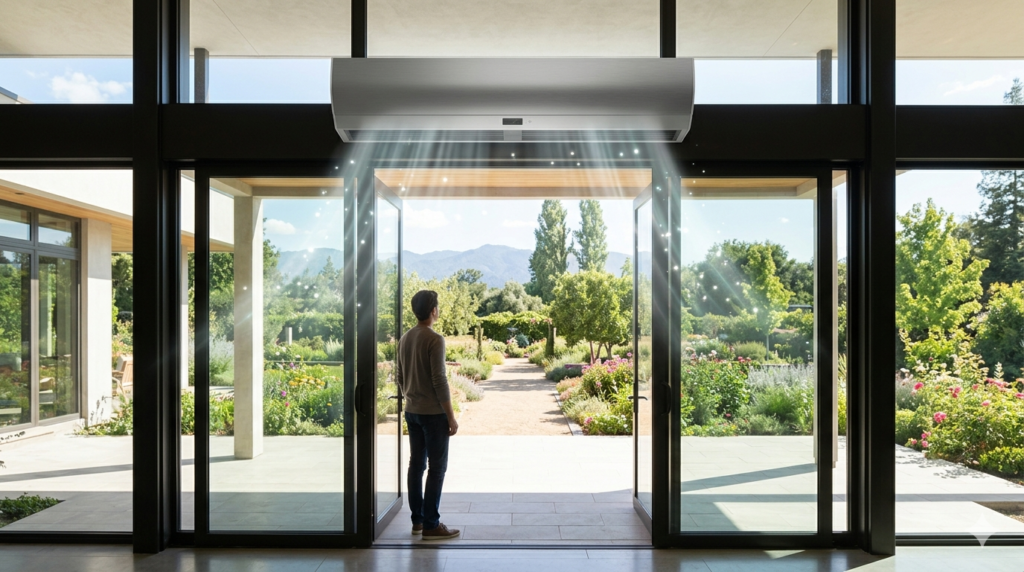
An air curtain is a device that projects a high-speed stream of air across a doorway or opening, creating an invisible barrier. Here, high velocity means the air moves quickly, and the barrier is formed by moving air rather than a physical object. This device:
- Blocks outside air from entering the conditioned space
- Prevents conditioned air from escaping outside
- Allows people and vehicles to pass freely
- Maintains comfort in the space
- Reduces energy costs
How air curtains work:
The unit uses a fan to draw in air, optionally heating or cooling it, and then forces it out at high speed (20-60 miles per hour, abbreviated as mph) across the opening. This fast-moving air creates a pressure differential (the difference in air pressure on either side of the barrier) that blocks outside air from entering while still allowing people to pass through.
Why Air Curtains Matter
Energy savings:
- Prevents 10-30% air infiltration through doors
- Reduces HVAC load significantly
- Payback period: 1-3 years, typical
- Annual savings: $500-5,000+ depending on application
Comfort improvement:
- No cold/hot drafts near doors
- Consistent temperature throughout space
- Employees more productive
- Customers more comfortable
Pest and contaminant control:
- Prevents insects from entering
- Reduces dust infiltration
- Maintains clean room standards
- Important for food service, healthcare, and manufacturing
Cost considerations:
- Modest initial cost ($500-5,000 depending on size)
- Installation cost ($200-2,000)
- Minimal maintenance costs
- Lifespan: 10-15 years, typical
Air Curtain Applications
Commercial applications:
- Retail storefronts (prevent heat loss, insect entry)
- Restaurants (food safety, energy)
- Banks and offices (automatic door systems)
- Hospital/healthcare (contamination control)
- Clean rooms (maintain positive pressure)
Industrial applications:
- Warehouse loading docks (prevent heat loss during loading)
- Manufacturing facilities (process protection)
- Cold storage/freezer doors
- Spray booths and paint areas.
- Truck bay doors
Residential applications:
- Exterior doors (entryways, patios)
- Garage doors (maintain temperature)
- Patio/sliding glass doors
- Mudroom systems
- Less common but increasingly popular
Now that you know where air curtains are used, it is important to match the right type to your specific application. In the following section, we’ll compare air curtain types and help you determine which models align best with your environmental and operational requirements.
- Mounted above the doorway in the soffit or suspended ceiling
- Hidden from view (aesthetic advantage)
- Requires structural preparation
- Higher installation cost
- Cost: $800-3,000+ installed
- Best for: Retail, high-end commercial, new construction
Surface-Mounted Air Curtains
- Mounted on the wall above the door or window
- Visible but compact appearance
- Easier installation (retrofit-friendly)
- Lower installation cost
- Cost: $600-2,500+ installed
- Best for: Most applications, easier retrofit
Pedestal/Floor-Standing Air Curtains
- Standalone unit on the floor beside the opening
- Most portable option
- Easiest installation
- Lower cost
- Cost: $400-1,500+
- Best for: Temporary, rental, flexible positioning
Based on Air Handling
Non-Heated Air Curtains
- Uses ambient room air
- No heating element
- Lowest cost
- Best when only blocking infiltration is needed.
- Cost: $400-1,500
- Drawback: Doesn’t warm the entering air (comfort issue in winter)
Heated Air Curtains
- Incorporates a heating element
- Can warm incoming air
- Prevents cold draft sensation
- Significantly higher cost
- Cost: $1,000-4,000+
- Best for: Exterior doors in cold climates
Cooled/Air-Conditioned Units
- Rare, specialized units
- Uses refrigerated cooling
- Very high cost
- Best for: Extremely specialized applications (clean rooms, server rooms)
- Cost: $3,000-8,000+
Heat Recovery Air Curtains
- Captures waste heat from the building
- Recovers energy from departing air
- Uses heat to warm incoming air
- Very efficient
- Highest cost
- Cost: $2,000-6,000+
- Best for: Green buildings, high-efficiency focus
Based on Opening Type
Vertical Air Curtains
- Standard for vertical openings (doors, windows)
- Most common type
- Blows air horizontally
- Cost: Baseline pricing
Horizontal Air Curtains
- For horizontal openings (loading docks, truck bays)
- Blows air downward or upward
- Prevents air infiltration from underneath
- Often paired with vertical units.
- Cost: Similar to vertical
Circular Air Curtains
- For round openings or skylights
- Rare application
- Specialized design
- Higher cost
Double-Sided Air Curtains
- Serves two doorways back-to-back
- Space-efficient
- One unit serves two openings.
- Cost: Slightly more than single-sided
AIR CURTAIN SIZING FUNDAMENTALS
Key Sizing Parameters
1. Doorway/Opening Width (W)
- Measure the width in feet of the doorway.
- Critical parameter for sizing
- Determines the air curtain length needed
2. Doorway/Opening Height (H)
- Measure the full height of the opening.
- For standard doors: 6.5-9 feet typical
- For loading docks: 8-14+ feet
- For windows: Varies, typically 3-6 feet
3. Opening Area (A)
- Area = Width × Height
- Example: 3-foot-wide × 7-foot-tall door = 21 square feet
- Used in some sizing formulas
4. Air Velocity (V)
- Speed air exits the air curtain.
- Measured in feet per minute (FPM)
- Typical range: 20-60 FPM depending on application
- Higher velocity = stronger barrier, more noise, higher energy use
5. Air Volume (CFM)
- Cubic feet per minute airflow
- Determines sizing needs
- Typical ranges: 400-6,000 CFM, depending on opening size
- Calculated from velocity and nozzle area 1. Measure the width and height of your opening. Formulas, here are the key steps to size an air curtain:
1. Measure the width and height of your opening.
2. Decide what type of air curtain fits your needs (heated or non-heated, surface-mounted or recessed, etc).
3. Calculate the basic airflow (CFM) required for your opening size.
4. Adjust the airflow based on your specific conditions: local climate, wind exposure, and how often the door is opened.
5. Match your requirements to the right air curtain size and model.
6. Make sure installation is feasible for your selected location and that power or ductwork is available.
Following these steps simplifies the process and helps you select the most effective air curtain for your space.
Basic Sizing Formula:
CFM (minimum) = Width (feet) × Height (feet) × 1.2
This provides basic blocking capability. More sophisticated calculations adjust for:
- Climate (colder = higher CFM needed)
- Wind conditions (higher wind = higher CFM needed)
- Occupancy patterns (high traffic = higher CFM needed)
- Desired air velocity (comfort vs. effectiveness trade-off)
Example calculations:
Standard office entry door:
- Width: 3 feet
- Height: 7 feet
- Basic CFM = 3 × 7 × 1.2 = 25.2 (minimum)
- Practical recommendation: 1,000-1,500 CFM
Warehouse loading dock:
- Width: 10 feet
- Height: 10 feet
- Basic CFM = 10 × 10 × 1.2 = 120 (minimum)
- Practical recommendation: 3,000-6,000 CFM
Retail storefront:
- Width: 6 feet
- Height: 9 feet
- Basic CFM = 6 × 9 × 1.2 = 64.8 (minimum)
- Practical recommendation: 2,000-3,000 CFM
Factors Affecting Sizing Needs
Climate/Temperature Differential:
- Larger temperature difference = higher CFM needed
- Cold climates require 20-30% higher CFM
- Mild climates require lower CFM
- The temperature difference in the heating season is most critical.
Wind Conditions:
- High-wind areas need 15-25% higher CFM
- Exposed locations need more air velocity.
- Protected locations can use lower CFM
- Wind pressure can overcome weak air curtains.
Traffic Volume:
- High-traffic doors need higher CFM (reopen more frequently)
- Continuous traffic requires a consistent air velocity.
- Low-traffic doors can use minimum sizing.
- Varies from 1-2 times per day to 100+ times per day
Air Leakage in Buildings:
- Well-sealed buildings: minimum sizing sufficient
- Leaky buildings: need 10-20% higher CFM
- Gaps around the door frame increase infiltration
- Poor seals increase the load on the air curtain.
Door Type:
- Single sliding doors: standard sizing
- Double sliding doors: larger opening, higher CFM
- Swinging doors: may need lower CFM (door closes quickly)
- Automatic vs. manual: automatic needs higher CFM (door open longer)
Application Type:
- Conditioned entry (retail): standard sizing
- Warehouse loading: higher CFM needed (large temperature difference)
- Freezer/cold storage: highest CFM needed (large temperature differential)
- Clean rooms: higher CFM needed (positive pressure to maintain)
AIR CURTAIN SIZE CHARTS
Standard Door Sizes and Recommended Air Curtain CFM
Residential Entry Doors
Single-Entry Door (Standard):
- Width: 2.5-3 feet
- Height: 6.5-7 feet
- Recommended CFM: 800-1,200
- Typical Model: Mid-range commercial unit
- Cost: $600-1,200
Double Entry Doors (Pair):
- Width: 5-6 feet
- Height: 6.5-7 feet
- Recommended CFM: 1,500-2,500
- Typical Model: Higher-capacity unit
- Cost: $1,000-1,800
Sliding Glass Door (Patio):
- Width: 4-6 feet
- Height: 6-7 feet
- Recommended CFM: 1,000-1,800
- Typical Model: Standard unit
- Cost: $700-1,400
Garage Door:
- Width: 8-9 feet
- Height: 7-8 feet
- Recommended CFM: 2,000-3,000
- Typical Model: Industrial-grade unit
- Cost: $1,200-2,000
Commercial Applications
Retail Storefront (Single):
- Width: 3-4 feet
- Height: 8-9 feet
- Recommended CFM: 1,200-1,800
- Typical Model: Commercial standard
- Cost: $800-1,400
Retail Storefront (Double):
- Width: 6-8 feet
- Height: 8-9 feet
- Recommended CFM: 2,500-4,000
- Typical Model: High-capacity commercial
- Cost: $1,400-2,500
Restaurant Entry:
- Width: 3-4 feet
- Height: 7-8 feet
- Recommended CFM: 1,500-2,500
- Typical Model: Commercial with food safety features
- Cost: $900-1,600
Bank Entry:
- Width: 4-5 feet
- Height: 8-9 feet
- Recommended CFM: 1,800-2,800
- Typical Model: Commercial standard
- Cost: $1,000-1,700
Industrial Applications
Warehouse Loading Dock (Single Door):
- Width: 8-10 feet
- Height: 9-10 feet
- Recommended CFM: 3,000-5,000
- Typical Model: Heavy-duty industrial
- Cost: $1,500-3,000
Warehouse Loading Dock (Large):
- Width: 10-12 feet
- Height: 10-12 feet
- Recommended CFM: 4,500-7,000
- Typical Model: Extra-heavy-duty industrial
- Cost: $2,000-4,000
Cold Storage/Freezer Door:
- Width: 4-6 feet
- Height: 7-8 feet
- Recommended CFM: 2,500-4,000 (higher due to temperature difference)
- Typical Model: Heavy-duty with heating
- Cost: $1,500-3,000
Truck Bay Door:
- Width: 12-14 feet
- Height: 12-14 feet
- Recommended CFM: 6,000-10,000+
- Typical Model: Industrial extra-heavy-duty
- Cost: $3,000-6,000
Manufacturing Facility Door:
- Width: 8-10 feet
- Height: 10-12 feet
- Recommended CFM: 3,500-6,000
- Typical Model: Industrial-grade
- Cost: $1,800-3,500
Clean Room/Specialized Applications
Clean Room Entry:
- Width: 3-4 feet
- Height: 7-8 feet
- Recommended CFM: 1,500-2,500 (positive pressure)
- Typical Model: Specialized clean room unit
- Cost: $1,500-3,000
Operating Room Entry:
- Width: 3-4 feet
- Height: 8-9 feet
- Recommended CFM: 2,000-3,500 (high CFM for contamination control)
- Typical Model: Medical-grade
- Cost: $2,000-4,000
Server Room Entry:
- Width: 3 feet
- Height: 7 feet
- Recommended CFM: 1,000-1,500 (humidity/temperature control)
- Typical Model: Commercial with monitoring
- Cost: $1,200-2,000
Typical Air Curtain Sizes Available
Compact Units (1,000-1,500 CFM)
- For: Small residential doors, narrow openings
- Width: 24-36 inches
- Mounting: Wall-mounted or recessed
- Cost: $400-900
- Energy use: 0.5-1 kW
Standard Units (1,500-3,000 CFM)
- For: Standard commercial doors, retail
- Width: 36-48 inches
- Mounting: Wall-mounted or recessed
- Cost: $700-1,600
- Energy use: 0.75-1.5 kW
Heavy-Duty Units (3,000-5,000 CFM)
- For: Large commercial doors, warehouse
- Width: 48-72 inches
- Mounting: Wall-mounted or recessed
- Cost: $1,200-2,500
- Energy use: 1.5-2.5 kW
Industrial Units (5,000-10,000 CFM)
- For: Loading docks, truck bays, large industrial
- Width: 60-120 inches
- Mounting: Recessed or overhead
- Cost: $2,000-5,000+
- Energy use: 2.5-5 kW
Extra-Heavy-Duty Units (10,000+ CFM)
- For: Very large openings, extreme conditions
- Width: 120+ inches
- Mounting: Recessed, overhead, or custom
- Cost: $4,000-8,000+
- Energy use: 5+ kW
HOW TO SIZE AN AIR CURTAIN – PRACTICAL GUIDE
Step-by-Step Sizing Process
Step 1: Measure Your Opening
Tools needed:
- Measuring tape (25+ feet)
- Notepad
- Calculator
Measurements to take:
- Width of doorway opening (measure at multiple heights if uneven)
- Height of doorway opening (full opening height)
- Depth of door frame (how far the frame protrudes from the wall)
- Surrounding wall construction (recessed vs. flush)
Record measurements:
- Width: _____ feet
- Height: _____ feet
- Opening area: _____ × _____ = _____ sq feet
Step 2: Determine Air Curtain Type Needed
Ask yourself:
- Is heating needed? (Cold climate = yes, mild climate = maybe)
- Is this retrofit or new construction? (Retrofit = wall-mounted easier)
- What mounting location is preferred? (Recessed, surface, pedestal)
- Budget constraints? (Affects type selection)
Step 3: Calculate Baseline CFM Need
Use formula: CFM = Width (feet) × Height (feet) × 1.2
Example: 3 ft × 7 ft × 1.2 = 25.2 minimum CFM
Practical baseline (add 20-30% buffer):
- Small doors (< 20 sq ft): 800-1,200 CFM
- Medium doors (20-40 sq ft): 1,500-2,500 CFM
- Large doors (40-80 sq ft): 2,500-4,500 CFM
- Extra-large openings (> 80 sq ft): 4,500-8,000+ CFM
Step 4: Adjust for Conditions
Apply adjustment factors:
Temperature differential:
- Mild climate (10-20°F difference): baseline × 1.0
- Cool climate (20-40°F difference): baseline × 1.2
- Cold climate (40°F+ difference): baseline × 1.3-1.5
Wind exposure:
- Protected location: baseline × 1.0
- Moderate wind: baseline × 1.1-1.2
- High wind/exposed: baseline × 1.3
Traffic:
- Low (few openings daily): baseline × 1.0
- Moderate: baseline × 1.1-1.2
- High (frequent opening): baseline × 1.2-1.3
Step 5: Select Unit from Size Chart
Find the opening size in the chart, select the recommended CFM range, and choose the unit that fits:
- CFM ≥ adjusted requirement
- Physical size fits the opening.
- Budget acceptable
- Features needed (heating, etc.)
Step 6: Verify Installation Compatibility
Check:
- Mounting location feasible
- Electrical connection available
- Ductwork needed (recessed units)
- Professional installation required
Step 7: Calculate Operating Costs
Annual energy cost:
- Unit power: _____ kW
- Operating hours/year: _____ hours
- Electricity rate: $_____ per kWh
- Annual cost = kW × hours × rate
- Example: 1 kW × 2,000 hours × $0.12 = $240/year
Potential savings:
- Heating/cooling savings: 10-30% of HVAC cost
- Typical building: $500-2,000/year savings
- Payback period: Cost ÷ Annual savings
PART 6: INSTALLATION GUIDANCE
Professional Installation vs. DIY
When to hire a professional:
- Recessed installation in the ceiling (structural work)
- Ductwork required (HVAC knowledge needed)
- Electrical work (code compliance)
- Complex mounting situations
- Most commercial installations
When DIY is possible:
- Simple surface-mounted units
- Existing electrical outlet nearby
- Straightforward wall mounting
- Small residential applications
Installation Process Overview
Surface-Mounted Installation:
Step 1: Preparation
- Turn off the power in the area.
- Mount the bracket above the door frame.
- Ensure the bracket level is secure.
Step 2: Unit Mounting
- Securely attach the unit to the bracket.
- Check alignment with the opening.
- Ensure clearance for air discharge.
Step 3: Electrical
- Connect to a nearby outlet or have an electrician install a dedicated circuit.
- Verify ground connection
- Test safety features (thermal overload)
Step 4: Startup
- Turn on the unit
- Check air velocity and direction.
- Adjust thermostat/controls if applicable.
- Verify operation
Recessed Installation:
Step 1: Planning
- Verify the soffit/ceiling structure can support the unit.
- Plan ductwork routing
- Confirm electrical source
- Mark the installation location.
Step 2: Framing (May require structural)
- Create an opening in the ceiling for the unit.
- Install support framing
- Ensure proper access for maintenance.
Step 3: Ductwork
- Connect the discharge duct to the unit.
- Route the duct to the opening above the door.
- Insulate the duct if needed.
- Connect the return air path.
Step 4: Unit Installation
- Mount the unit in the opening.
- Secure ductwork
- Seal joints and penetrations.
Step 5: Electrical
- Install a dedicated circuit if required.
- Connect thermostat/controls.
- Test safety systems
Step 6: Finishing
- Complete ceiling work
- Install the return air grille.
- Test full system operation.
Common Installation Mistakes to Avoid
- Installing the unit too high (air doesn’t reach the bottom of the opening)
- Insufficient clearance above the unit (blocks return air)
- Poor ductwork (leaks, restrictions)
- Wrong electrical circuit (voltage mismatch, inadequate)
- No return air path (unit can’t function properly)
- Missing thermal protection (overheating risk)
- Inadequate CFM (unit won’t block infiltration)
MAINTENANCE AND OPERATION
Regular Maintenance Requirements
Monthly:
- Check unit operation (runs smoothly, no noise)
- Inspect air discharge (clear, unobstructed)
- Verify no visible damage.
Quarterly:
- Clean air intake (remove dust, lint)
- Inspect filter (if equipped)
- Check the thermostat if applicable.
- Verify no vibration
Annually:
- Professional inspection recommended
- Clean internal components
- Check electrical connections
- Test all safety controls.
- Replace filters if equipped.
- Lubricate bearings if needed
As-Needed:
- Clean discharge area (removes accumulated dust)
- Repair or replace damaged components
- Recalibrate the thermostat if it is drifting.
- Address any noise or vibration issues.
Operational Considerations
Temperature Control:
- Non-heated units: No temperature control
- Heated units: Adjustable thermostat
- Set to a warmth sufficient to prevent draft (typically 65-70°F air)
- Too high = energy waste, too low = discomfort
Velocity Adjustment:
- Many units have variable speed/CFM.
- Higher velocity = stronger barrier, but more noise and energy use
- Typical operating range: 80% of maximum CFM works in most conditions
Continuous vs. Intermittent Operation:
- Continuous: Best for frequently opened doors
- Intermittent: Saves energy in low-traffic areas
- Timer controls are available for intermittent operation.
- Motion sensors can activate units automatically.
Seasonal Operation:
- Winter (heating season): Run continuously
- Summer (cooling season): Run continuously
- Shoulder seasons: May reduce to intermittent
- Climate determines seasonal patterns.
Troubleshooting Common Issues
Unit not turning on:
- Check the electrical connection.
- Verify the circuit breaker is not tripped.
- Check the power switch/thermostat.
- Test the outlet with another device.
Weak air discharge:
- Check filter (clogged = reduced flow)
- Inspect intake (blocked air source)
- Verify ductwork is not crushed or blocked.
- Check fan operation (listen for motor)
Excessive noise:
- Check motor bearing (may need lubrication)
- Verify secure mounting (vibration transmission)
- Check for debris in the discharge.
- Possible motor wear (replacement needed)
Insufficient infiltration blocking:
- Unit CFM may be too low (undersized)
- Check mounting height (should be above doorway)
- Verify there is no airflow blockage.
- Assess environmental conditions (extreme wind)
Thermostat not maintaining temperature:
- Check heating element operation.
- Verify thermostat calibration
- Check electrical connections
- May indicate heating element failure
PRACTICAL SELECTION GUIDE
Residential Air Curtain Selection
Best options:
- Standard commercial units sized for your opening
- Wall-mounted or surface installation
- The 1,000-2,500 CFM range is typical. On-heated is adequate for mild climates, and heated is preferred for cold climates.
- Cost: $600-1,500 installed
Popular residential brands:
- Mars Air Systems (commercial-grade)
- Berner International (reliability)
- Powered Aire (affordable options)
- Daikin (high-end)
Typical installation:
- Above exterior doors
- Professional installation: $300-800
- DIY surface-mount is possible if you are comfortable with basic installation
Commercial Air Curtain Selection
Standard retail selection:
- 1,500-3,000 CFM depending on door width
- Wall-mounted or recessed options
- Commercial-grade quality
- Heated unit for any area in winter
- Cost: $900-2,000 installed
High-traffic retail:
- 2,500-4,000 CFM
- Heavy-duty construction
- Thermostat control
- Professional installation required
- Cost: $1,500-2,800
Restaurant/food service:
- Special attention to positive pressure
- Food-safe materials
- Heat recovery preferred
- Cost: $1,500-3,000
Industrial Air Curtain Selection
Warehouse loading dock:
- 3,000-6,000 CFM depending on door size
- Heavy-duty industrial construction
- Heated for climate protection
- Often paired with a horizontal unit for the dock edge.
- Professional installation required
- Cost: $2,000-5,000
Cold storage/freezer:
- 2,500-4,000 CFM
- A heated air curtain is essential.
- High-efficiency motor
- Robust construction
- Cost: $1,800-3,500
Large truck bay:
- 6,000-10,000+ CFM
- Extra-heavy-duty construction
- Typically recessed installation
- Professional design and installation
- Cost: $3,500-8,000+
Specialized Application Selection
Clean room:
- 1,500-2,500 CFM
- Medical/pharmaceutical-grade unit
- Positive pressure capability
- Regular certification required
- Cost: $1,500-3,000
Operating room:
- 2,000-3,500 CFM
- Medical-grade construction
- HEPA filtration on return air
- Validation/certification included
- Cost: $2,000-4,000
PRACTICAL CHECKLISTS
Air Curtain Selection Checklist
When selecting an air curtain, verify:
☐ Opening width measured accurately
☐ Opening height measured accurately
☐ Climate conditions documented (temperature difference)
☐ Wind exposure assessed
☐ Traffic patterns considered
☐ Application type identified (retail, warehouse, etc.)
☐ Heating requirement determined (cold climate = yes)
☐ Mounting location feasible
☐ Electrical source available
☐ Budget established
☐ CFM requirement calculated
☐ Unit size selected from the chart
☐ Features verified (thermostat, filtration, etc.)
☐ Installation method determined (professional vs. DIY)
☐ Maintenance plan established
☐ Operating cost estimated
Installation Checklist
☐ Power shut off during installation ☐ Mounting brackets level and secure ☐ Unit properly aligned with opening ☐ Electrical connections per code ☐ Thermal overload protection tested ☐ Return air path clear ☐ Discharge direction correct ☐ No obstructions in air path ☐ Unit runs smoothly without vibration ☐ Air discharge at proper velocity ☐ All controls tested and functioning ☐ Documentation/warranty registered
FAQs: Air Curtain Sizing Calculator
Q: What size air curtain do I need for my door?
A: Measure width × height of opening, multiply by 1.2 for basic CFM. Adjust upward 20-50% based on climate, wind, and traffic. See the standard door size chart.
Q: How much will an air curtain cost?
A: Residential: $600-1,500 installed. Commercial standard: $900-$2,000. Industrial/large: $2,000-8,000+. Cost depends on size, heating, and installation complexity.
Q: Will an air curtain save money on my heating bill?
A: Yes, typically 10-30% savings on HVAC costs at that opening. Payback period: 1-3 years. Potential annual savings: $500-2,000, depending on climate and usage.
Q: Do air curtains work in windy conditions?
A: Effective in moderate wind. High wind (20+ mph) can overcome weak units. Use higher CFM in wind-exposed locations.
Q: Can I install an air curtain myself?
A: Surface-mounted units are possible for DIY if there is a simple electrical connection. Recessed, ductwork, or complex installations require a professional.
Q: What’s the difference between commercial and residential air curtains?
A: Commercially built heavier-duty for constant use. Residential lighter-duty for occasional use. Sizing is similar, but construction quality differs.
Q: How often do I need to maintain an air curtain?
A: Monthly inspection recommended. Quarterly filter cleaning. Annual professional service. Minimal ongoing maintenance if well-installed.
Q: Can I use an air curtain in a freezer?
A: Yes, with high CFM and heated discharge air. Cold storage requires a 2,500-4,000 CFM heated unit. The temperature differential is significant, so a higher CFM is needed.
The Bottom Line: Right-Sized Air Curtain Saves Energy and Improves Comfort
A properly sized air curtain is one of the best HVAC investments you can make. It prevents significant energy loss, improves comfort, and typically pays for itself in 1-3 years.
Key to success: accurate sizing based on your specific opening and conditions, proper installation, and regular maintenance. Too-small unit won’t block infiltration. Too-large wastes energy. Perfect sizing delivers both effectiveness and efficiency.
Resources
For comprehensive air curtain information:
Air Curtain Manufacturers Association: Sizing Guide Professional sizing methodology, technical specifications, and application guidelines from industry leaders.
ASHRAE: HVAC Design Standards. Engineering standards for air curtain placement, effectiveness, and integration with building HVAC systems.
Disclaimer
Purpose: This article is educational about air curtain sizing and selection.
Professional Design: Complex installations (recessed units, ductwork, industrial applications) should use professional design services.
Electrical Work: Electrical connections must meet local codes. Hire a licensed electrician if you are unfamiliar with electrical work.
Installation: While some installations are DIY-capable, professional installation is recommended for most applications.
Building Codes: All installations must comply with local building codes and energy codes.
This article is informative only and not a substitute for professional air curtain design or installation services.