🔧 Brackets Selector & Load Capacity Calculator
Find the right bracket • Calculate load capacity • 15+ types & applications
| Bracket Type | Common Sizes | Load Capacity | Best For | Material Options |
|---|---|---|---|---|
| 1️⃣ L-Brackets | 1×1", 2×2", 3×3", 4×4", 6×6" | 50-500 lbs (depends on size) | Shelf support, furniture corners, wood framing | Steel, stainless, aluminum |
| 2️⃣ Shelf Brackets | 6", 8", 10", 12", 16", 20" | 100-300 lbs per pair | Floating/mounted shelves, kitchen/garage storage | Steel, aluminum, stainless |
| 3️⃣ Heavy-Duty Brackets | 8-24" length | 100-1000+ lbs | Industrial shelving, workshop, heavy cabinets | Steel, cast iron, galvanized |
| 4️⃣ Corner Brackets | 1-2", 3-4", 6+" | 50-500 lbs | Strengthening joints, cabinets, frames | Steel, stainless, aluminum |
| 5️⃣ Floating Brackets | 6", 8", 10", 12" | 100-300 lbs (hidden support) | Modern floating shelves, clean look | Steel, stainless |
| 6️⃣ T-Brackets | 2-8" height | 100-400 lbs | Joint reinforcement, table legs, framing | Steel, aluminum |
| 7️⃣ U-Brackets | 1-6" width | 50-400 lbs | Pipe support, beam support, handrails | Steel, stainless, galvanized |
| 8️⃣ Decorative Brackets | 6-24" length | 50-300 lbs | Mantels, porches, countertops, visual appeal | Wrought iron, cast iron, aluminum, brass |
| 9️⃣ Cabinet Brackets | 4-12" depth | 100-400 lbs | Wall cabinet mounting, counter support | Steel, aluminum, galvanized |
| 🔟 Joist Hangers | 2×4, 2×6, 2×8, 2×10 | 1000+ lbs (structural) | Deck/floor framing, roof support, structural | Galvanized steel, stainless (exterior) |
| 1️⃣1️⃣ TV Mount | 14-75"+ TVs | 50-200 lbs | Wall-mounted TV, fixed/articulating | Steel, aluminum |
| 1️⃣2️⃣ Folding Brackets | 8-20" length | 100-300 lbs per pair | Folding tables, wall desks, space-saving | Steel, aluminum |
| 1️⃣3️⃣ Pipe Brackets | ½", ¾", 1", 2" diameter | 50-400 lbs (diameter-dependent) | Plumbing, curtain rods, industrial shelving | Steel, galvanized, stainless |
| 1️⃣4️⃣ Adjustable Brackets | Variable lengths | 50-300 lbs | Adjustable shelving, modular furniture | Steel, aluminum |
| 1️⃣5️⃣ Specialty Brackets | Glass, corner, stainless, various | Varies by type | Glass shelves, corners, specialty applications | Multiple (specialty materials) |
| Bracket Type | Typical Capacity (Per Bracket) | For 2 Brackets | Recommended Safety Factor | Common Application Weight |
|---|---|---|---|---|
| L-Bracket 1×1" | 50-100 lbs | 100-200 lbs | 3-4x recommended | 25-50 lbs (safe) |
| L-Bracket 2×2" | 100-200 lbs | 200-400 lbs | 3-4x recommended | 50-100 lbs (safe) |
| Shelf Bracket 6" | 50-100 lbs | 100-200 lbs | 3x recommended | 30-60 lbs (safe) |
| Shelf Bracket 12" | 100-150 lbs | 200-300 lbs | 3x recommended | 60-100 lbs (safe) |
| Heavy-Duty 16" | 300-500 lbs | 600-1000 lbs | 3-4x recommended | 150-250 lbs (safe) |
| Joist Hanger 2×6 | 1000+ lbs | 2000+ lbs | Building code approved | 500-1000 lbs (structural) |
| TV Mount Bracket | 50-200 lbs (TV weight) | 100-400 lbs (TV weight) | 3x recommended | 32-75" TV (50-80 lbs) |
| Folding Bracket Pair | 100-150 lbs per bracket | 200-300 lbs (table) | 3-4x recommended | 60-100 lbs (safe) |
Types of Brackets
Uses, Benefits & Complete Buying Guide
15 Bracket Types · Sizes · Load Capacity · Materials · Applications · Low-Competition Keywords
The Complete Homeowner, Builder & Blogger Reference — 2025 / 2026 Edition
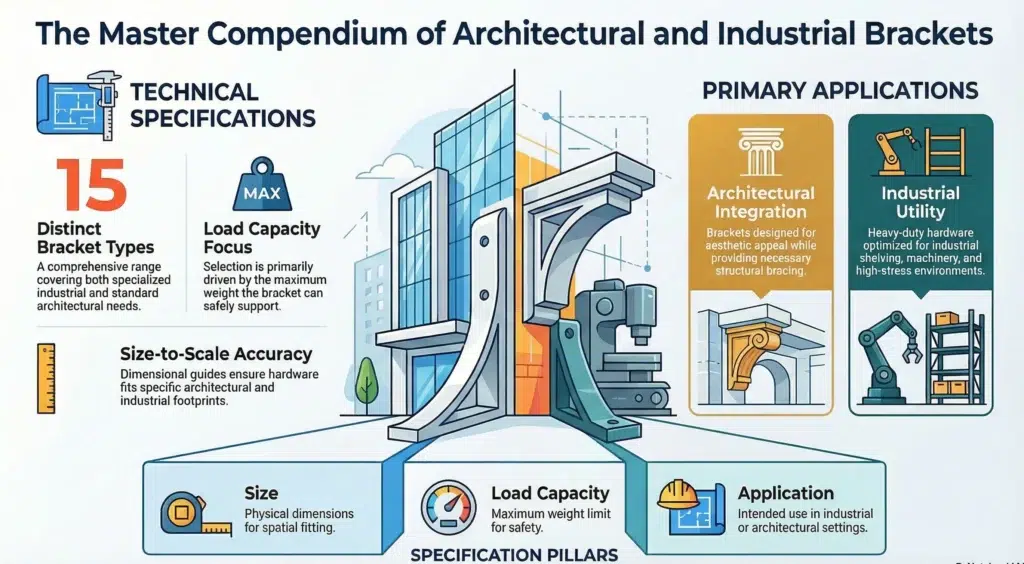
Brackets are among the most versatile and underappreciated Hardware items in construction, furniture-making, interior design, and home improvement. The right bracket — correctly sized, correctly rated, and correctly installed — is invisible: it does its job silently, holding weight, strengthening joints, and enabling the spaces and surfaces we depend on every day. This guide covers all 15 major bracket types, their standard sizes, load capacities, materials, applications, and everything a buyer needs to make the right choice.
The 15 Main Types of Brackets — Overview
Brackets are structural or supportive hardware devices that connect, reinforce, or suspend two or more building elements. They range from the smallest furniture corner brace to the heavy structural joist hanger used in deck construction. Understanding the full range of bracket types is the foundation of smart purchasing decisions.
# | Bracket Type | Primary Function | Typical Load Range | Common Material |
1 | L-Bracket (Angle Bracket) | Right-angle support for shelves, furniture, and framing | 5 – 200 lbs | Steel, aluminum, stainless |
2 | Shelf Bracket | Shelf support from the wall | 20 – 150 lbs | Steel, iron, aluminum |
3 | Heavy-Duty Bracket | Industrial and heavy storage support | 100 – 1,000+ lbs | Heavy gauge steel |
4 | Corner Bracket | Strengthening joints and corners | 5 – 100 lbs | Steel, brass, aluminum |
5 | Floating Shelf Bracket | Hidden shelf support (no visible hardware) | 20 – 100 lbs | Steel rod/plate |
6 | T-Bracket | Reinforcing wood and metal joints | 10 – 150 lbs | Steel, stainless |
7 | U-Bracket | Pipe, beam, and handrail clamping support | Varies by pipe load | Steel, galvanized |
8 | Decorative Bracket | Countertop, mantel, and porch aesthetic support | 50 – 300 lbs | Iron, wood, brass |
9 | Cabinet Bracket | Wall-mounting kitchen and bathroom cabinets | 50 – 200 lbs | Steel, zinc alloy |
10 | Joist Hanger | Structural floor, deck, and roof framing | 500 – 2,000+ lbs | Galvanised steel |
11 | TV Mount Bracket | Wall-mounting televisions | Up to 150 lbs | Steel, powder-coated |
12 | Folding Bracket | Collapsible support for fold-down surfaces | 50 – 300 lbs | Steel, aluminum |
13 | Pipe Bracket | Securing pipes, rods, and conduit to surfaces | Light to medium | Steel, plastic, brass |
14 | Adjustable Bracket | Variable-position shelving and modular furniture | 20 – 150 lbs | Steel, aluminum |
15 | Specialty Bracket | Glass shelves, stainless displays, custom installs | Varies by type | Stainless, glass-rated |
L-Brackets (Angle Brackets)
L-brackets — also called angle brackets — are the most widely used bracket type in home improvement, furniture assembly, and construction. Their 90-degree profile makes them ideal for joining two surfaces at a right angle, and they are sold in more size variants than any other bracket category.
Common Sizes
Size | Leg Dimensions | Typical Thickness | Load Capacity (pair) |
Extra small | 1″ × 1″ | 1.5 mm | Up to 10 lbs |
Small | 2″ × 2″ | 2 mm | Up to 30 lbs |
Medium | 3″ × 3″ | 3 mm | Up to 60 lbs |
Large | 4″ × 4″ | 3.5 mm | Up to 100 lbs |
Extra large | 6″ × 6″ | 4 mm | Up to 150 lbs |
Heavy | 8″ × 8″ + | 5+ mm | 200 lbs+ |
Uses and Benefits
- Shelf support: the most common residential application — two L-brackets mounted to a stud wall support a wooden plank shelf
- Furniture corner reinforcement: joins table aprons to legs, cabinet sides to bases, and chair frames at seat joints
- Wood framing: used in stud walls, partition framing, and light timber construction
- Wall mounting: attaches brackets to walls for hanging objects, tools, or equipment
- Benefits: inexpensive, widely available, simple to install, and suitable for virtually any material, including wood, metal, concrete, and masonry
🔩 L-brackets are sold individually but always work in pairs or groups — use a minimum of two per shelf, spaced evenly along the shelf length.
Shelf Brackets
Shelf brackets are purpose-designed for supporting horizontal shelving surfaces from a vertical wall. They differ from general L-brackets in having one longer arm (the wall-mounted side) and one shorter arm (the shelf support), optimized for shelf depth rather than equal-leg applications.
Common Shelf Bracket Sizes
Bracket Size | Suitable Shelf Depth | Max Recommended Load Per Pair | Best Use |
6 inch | 4 – 5 inches | 40 – 60 lbs | Spice shelves, small display shelves |
8 inch | 6 – 7 inches | 50 – 80 lbs | Bookshelves, bathroom shelves |
10 inch | 8 – 9 inches | 60 – 100 lbs | Kitchen shelves, office shelves |
12 inch | 10 – 11 inches | 80 – 120 lbs | Standard shelving, workshop storage |
16 inch | 14 – 15 inches | 100 – 150 lbs | Deep storage shelves, garage shelves |
20 inch | 18 inches | 120 – 200 lbs | Large kitchen shelves, heavy storage |
Uses and Benefits
- Floating shelf-style display shelves for living rooms and entryways
- Kitchen shelves for spices, plates, and cookware — where style and load capacity must both be considered
- Garage storage shelving — use heavy-duty variants rated for power tool and paint can storage
- Display shelves for books, trophies, and collectables
- Benefits: enormous range of styles from plain steel to decorative wrought iron; sized to match standard shelf depths; available in matching sets for uniform visual presentation
Heavy-Duty Brackets
Heavy-duty brackets are engineered for applications where standard shelf brackets would flex, bend, or fail under load. They are built from thicker-gauge steel, use more and larger fixing points, and are rated for loads of 100 lbs to 1,000 lbs or more per bracket when correctly anchored to structural studs or masonry.
Heavy-Duty Bracket Sizes and Load Ratings
Bracket Length | Steel Gauge | Load Capacity (per bracket, stud-mounted) | Typical Application |
8 inches | 10 gauge (3.4 mm) | 100 – 200 lbs | Heavy kitchen shelves, workshop storage |
12 inches | 10 gauge | 150 – 300 lbs | Tool storage, heavy book collections |
16 inches | 8 gauge (4 mm) | 200 – 400 lbs | Garage shelving, server equipment |
20 inches | 8 gauge | 300 – 600 lbs | Industrial storage, machinery platforms |
24 inches | 6 gauge (5 mm) | 500 – 1,000+ lbs | Workshop benches, structural platforms |
- Always mount heavy-duty brackets directly into wall studs or masonry anchors — drywall anchors alone are insufficient for loads over 50 lbs.
- Pair bracket capacity with the strength of the shelving material — a bracket rated for 300 lbs is limited by the shelf it supports
- Used in: industrial shelving, garage workshop storage, server rack mounting, kitchen island support, and retail display systems
Corner Brackets
Corner brackets reinforce the junctions between two pieces of material — primarily wood — at corners and joints. They are internal strengtheners, used wherever a joint needs to resist racking, twisting, or load-induced separation.
Corner Bracket Sizes and Uses
Size | Dimensions | Use Case |
Extra small | 1″ × 1″ per leg | Picture frames, light furniture, craft projects |
Small | 2″ × 2″ per leg | Chair and table joints, drawer frames, light cabinets |
Medium | 3″ × 3″ per leg | Wardrobe and cabinet corners, bed frame joints |
Large | 4″ × 4″ per leg | Heavy furniture, workbenches, and large cabinet carcasses |
Heavy | 6″+ per leg | Structural framing corners, shed, and outbuilding construction |
- Used internally on furniture: hidden inside corners of cabinet carcasses, bed frames, and upholstered furniture frames
- Used externally on sheds and outdoor structures where the joint is exposed to weather loading
- Often sold in packs of 4 or 8 for furniture assembly projects
Floating Shelf Brackets
Floating shelf brackets are designed to be completely hidden inside the shelf, giving the appearance of a shelf somehow suspended from the wall with no visible hardware. They consist of a wall-mounted steel plate or threaded rod system that slides inside a hollow-core or routed shelf, with the bracket entirely concealed by the shelf material.
Floating Shelf Bracket Sizes
Bracket Size | Max Shelf Depth | Load Rating (per bracket set) | Notes |
6-inch rod system | 8 – 10 inches | 20 – 40 lbs | Lightweight display shelves |
8-inch rod system | 10 – 12 inches | 30 – 60 lbs | Standard floating shelves |
10-inch plate type | 12 – 14 inches | 50 – 80 lbs | Heavier floating shelves |
12-inch plate type | 14 – 16 inches | 60 – 100 lbs | Kitchen floating shelves |
- Used in modern minimalist interior design, where exposed brackets would interrupt the clean visual line
- Popular for bedroom floating bedside shelves, bathroom shelves, and living room display niches
- Must be mounted into structural studs or masonry — the hidden nature of the bracket makes stud location critical before installation
💡 For floating shelf brackets, always use a stud finder before marking positions. A bracket that pulls away from the drywall under load without a visible warning is a safety risk.
T-Brackets
T-brackets are shaped like the letter T, with a central spine and two perpendicular arms. They are used primarily to reinforce wood and metal joints, particularly in applications where a straight surface needs to be joined to a perpendicular member at a central rather than an edge position.
T-Bracket Sizes and Applications
Size | Application | Notes |
2 inch | Cabinet shelf center support, light framing joints | Furniture assembly |
3 inch | Table apron-to-leg center joints, door frame reinforcement | Residential joinery |
4 inch | Workbench reinforcement, heavy furniture frame joints | Medium construction |
6 inch | Timber framing, stud partition junctions | Light construction |
8 inch | Structural timber connections, workshop bench framing | Heavy construction |
- T-brackets used in table leg reinforcement are typically installed on the inner face of the table apron, invisible from outside, and provide critical resistance against leg wobble.
- In timber framing, T-shaped metal connectors — sometimes called T-plates — are used to join wall plates to intermediate studs.
U-Brackets
U-brackets (also called U-bolts or channel brackets, depending on the configuration) cradle a cylindrical or rectangular member — a pipe, beam, or handrail — and bolt through to a mounting surface. They are the primary means of securing pipes, conduits, and railings to walls, ceilings, and structural members.
U-Bracket Sizes and Uses
Width | Pipe / Beam Size | Typical Application |
1 inch | ¾” pipe | Plumbing lines, conduit |
1.5 inch | 1″ pipe | Water supply, gas lines (with appropriate fittings) |
2 inch | 1.5″ pipe | Drain pipes, compressed air lines |
3 inch | 2″ pipe or beam | Industrial piping, structural beam clamping |
4 inch | 3″ beam | Handrail mounting, large conduit bundles |
6 inch | 4″+ beam | Structural beam support, heavy industrial applications |
- Handrail U-brackets secure the handrail pipe or bar to wall-mounted posts or directly to masonry — load rating is critical for safety compliance.
- Plumbing U-brackets prevent pipes from vibrating, sagging, or shifting — spacing is governed by pipe size and material (typically every 4 to 8 feet for copper; every 6 to 10 feet for PVC)
Decorative Brackets
Decorative brackets serve a dual purpose: they provide genuine structural support while enhancing aesthetics. to the space they occupy. Found on kitchen countertops, fireplace mantels, porch ceilings, and outdoor pergolas, decorative brackets are typically larger and more visually prominent than functional-only brackets.
Decorative Bracket Sizes and Applications
Size | Load Rating | Primary Application | Common Style |
6 inch | 50 – 100 lbs | Small countertop overhangs, bar tops | Scroll, simple corbel |
8 inch | 75 – 150 lbs | Kitchen peninsula overhangs | Victorian scroll, geometric |
12 inch | 100 – 200 lbs | Mantel shelf support, outdoor post brackets | Heavy scroll, vine pattern |
16 inch | 150 – 300 lbs | Large countertop extensions, pergola support | Farmhouse, craftsman |
20 inch | 200 – 400 lbs | Structural porch columns, heavy mantel support | Large corbel, mission style |
24 inch | 300 – 600 lbs | Outdoor beam support, architectural column bases | Timber frame, heavy craftsman |
Cast iron decorative brackets offer the highest load rating combined with traditional aesthetics — well-suited to farmhouse, Victorian, and craftsman interiors.
- Wooden decorative brackets are popular for porch and pergola applications, where the material matches the surrounding timber construction.
- Stainless steel decorative brackets suit modern and industrial interior styles — highly resistant to moisture and suited to outdoor kitchen applications
Cabinet Brackets
Cabinet brackets are specifically designed for wall-mounting kitchen cabinets, bathroom vanity cabinets, and wall-mounted storage units. They must combine ease of leveling adjustment with sufficient load rating to support the cabinet weight plus its contents.
Cabinet Bracket Sizes
Bracket Size | Cabinet Weight Rating | Type | Notes |
4 inch | Up to 30 lbs cabinet weight | Fixed angle | Light bathroom cabinets |
6 inch | Up to 60 lbs | Fixed/adjustable | Standard upper kitchen cabinets (empty) |
8 inch | Up to 100 lbs | Adjustable with a locking screw | Full kitchen cabinet with dishes |
10 inch | Up to 150 lbs | Heavy-duty adjustable | Heavy upper cabinets, double-door units |
12 inch | Up to 200 lbs | Industrial fixed | Commercial kitchen cabinets, server racks |
Always locate wall studs before installing cabinet brackets — the bracket rating is irrelevant if the fasteners are only in drywall.
- Adjustable cabinet brackets allow fine-tuning of cabinet level after initial installation — valuable when dealing with slightly uneven walls.
- Cabinet French cleats (a type of angled bracket system) are an alternative to individual brackets for a heavy upper cabinet run.s
Joist Hangers (Structural Brackets)
Joist hangers are galvanized steel structural connectors that support the ends of floor joists, roof rafters, or deck joists where they meet a header beam or ledger board. They are engineered structural components — their load ratings are tested and certified, not estimated — and their correct installation is governed by building codes in most jurisdictions.
Joist Hanger Sizes and Load Ratings
Joist Size | Common Hanger Model | Rated Uplift Load | Rated Download Load | Application |
2×4 | LUS24 (Simpson Strong-Tie style) | 240 lbs | 1,220 lbs | Light framing, small decks |
2×6 | LUS26 | 390 lbs | 1,725 lbs | Standard floor joists, deck joists |
2×8 | LUS28 | 390 lbs | 2,200 lbs | Deck construction, residential floors |
2×10 | LUS210 | 390 lbs | 2,200 lbs | Heavy floor framing, long spans |
2×12 | LUS212 | 390 lbs | 2,465 lbs | Maximum span floor joists |
Double 2×8 | LSSU28 | 570 lbs | 3,715 lbs | Heavy-load headers, beam supports |
ℹ️ Joist hangers must be installed with the manufacturer-specified nails or screws. Using different fasteners invalidates the load rating and may violate building code. Always use joist hanger nails (short, thick, 10d or 16d as specified).
- Deck construction: joist hangers at every joist-to-ledger connection are required by most building codes in the United States, Canada, and the UK
- Floor framing: allows joists to be set at the same height as the beam face (flush framing) rather than resting on top, reducing floor-to-ceiling height loss
- Roof framing: hip and valley rafters use specific angled joist hanger variants designed for the required slope
TV Mount Brackets
TV mount brackets secure flat-screen televisions to walls, eliminating the need for a TV stand and improving viewing angles. They come in fixed, tilting, and full-motion (articulating arm) versions, each suited to different room configurations.
TV Bracket Size Guide
TV Size | VESA Pattern (mm) | Max TV Weight | Bracket Type Recommended |
14″ – 32″ | 75×75 to 200×100 | Up to 35 lbs | Fixed flat bracket or tilt |
32″ – 49″ | 200×200 to 400×400 | Up to 80 lbs | Fixed, tilt, or full-motion |
50″ – 65″ | 400×400 to 600×400 | Up to 120 lbs | Tilt or full-motion (heavy duty) |
65″ – 75″ | 600×400 to 700×400 | Up to 150 lbs | Full-motion or fixed heavy-duty |
75″ + | 800×400+ | 150 lbs+ | Fixed heavy-duty with multiple stud anchors |
- VESA (Video Electronics Standards Association) pattern is the hole spacing on the back of the TV — always check your TV’s VESA pattern before purchasing a mount bracket
- Fixed brackets place the TV flush against the wall — lowest profile, most stable, cannot adjust viewing angle once mounted.
- Tilting brackets allow the screen to tilt downward — useful for mounting higher than eye level, such as above a fireplace.e
- Full-motion (articulating) brackets extend, swivel, and tilt — maximum flexibility, highest cost, most complex installation.
- Always mount the TV bracket into at least two wall studs — the load must be distributed across structural framing, not just drywall.l
Folding Brackets
Folding brackets — also called collapsible brackets or drop-down brackets — provide support for surfaces that fold flat against a wall when not in use. They are the hardware enabling fold-down desks, Murphy-style dining tables, laundry folding stations, and garage workbenches.
Folding Bracket Sizes
Bracket Size | Load Rating (per pair) | Typical Application |
8 inch | 50 – 100 lbs | Small fold-down desk, bar shelf |
12 inch | 75 – 150 lbs | Laundry folding station, narrow wall desk |
16 inch | 100 – 200 lbs | Standard fold-down dining table leaf |
20 inch | 150 – 300 lbs | Garage workbench, large fold-down table |
- The locking mechanism is the most important functional feature of a folding bracket — look for positive-lock steel mechanisms that do not require a tool to release.
- Folding brackets must always be mounted into structural studs — the dynamic load of someone pressing or leaning on a fold-down surface creates a significant leverage force on the wall fixings.
Pipe Brackets
Pipe brackets secure pipes, conduits, curtain rods, and tube-shaped elements to wall, ceiling, or floor surfaces. They prevent vibration, sag, and movement, and protect connections from stress.
Pipe Bracket Sizes
Pipe Size | Bracket Type | Common Application | Material |
½ inch | Single pipe clip | Copper water supply, small conduit | Plastic or steel |
¾ inch | Single or double clip | Domestic water supply, gas (certified) | Steel, brass |
1 inch | Heavy pipe clip | Larger water supply, compressed air | Steel |
1.5 inch | Pipe strap or U-bolt | Drain pipes, large conduit | Steel, galvanized |
2 inch | Heavy U-bolt or channel | Soil pipes, industrial conduit | Galvanised steel |
3″ – 4″ | Large U-bolt / riser clamp | Soil stacks, industrial pipework | Heavy galvanized |
- Curtain rod brackets are a domestic application of the pipe bracket principle — sized for the rod diameter and rated to support the rod, rings, and fabric weight.t
- Industrial shelving systems often use pipe and flange fittings (pipe brackets and floor flanges) to create scaffolding-style storage racks.
Adjustable & Specialty Brackets
Adjustable Brackets
Adjustable brackets allow the position of shelves or surfaces to be changed without tools by slotting into pre-drilled hole patterns or track systems. They are the foundation of modular shelving systems used in retail, office, and home storage applications.
- Pilaster strip brackets: small metal clips that slot into vertical pilaster strips at set intervals — allow shelves to be repositioned at any height
- Track and bracket systems: horizontal brackets clip onto vertical wall-mounted tracks (e.g., Elfa, ClosetMaid) — entire systems can be reconfigured without tools
- Load ratings for adjustable bracket systems depend on the bracket itself AND the track’s anchoring to the wall — always anchor tracks to studs.
Specialty Brackets
Specialty Type | Material | Application | Key Feature |
Glass shelf bracket | Stainless or chrome | Supporting glass shelves in bathrooms, display units | Rubber-lined to grip glass safely without cracking |
Corner brace | Steel, brass | 90-degree internal corner reinforcement for frames | Flat L-shape for flush fitting inside frame corners |
Stainless steel bracket | Marine-grade SS | Outdoor kitchens, marine, coastal environments | Fully rust-proof; premium cost |
Galvanised Bracket | Zinc-coated steel | Outdoor, humid, or agricultural environments | Long rust resistance; lower cost than stainless steel |
Aluminum bracket | Aluminum alloy | Light-duty applications where weight matters | Rust-proof, lightweight, lower load rating |
Brass bracket | Solid brass | Period-style bathroom, decorative applications | Corrosion-resistant; high aesthetic value |
Bracket Materials — Comparison Guide
Material | Strength | Rust Resistance | Weight | Cost | Best For |
Carbon Steel | Very High | Low — needs coating | Heavy | Low | Indoor heavy-duty: workshop, garage, structural |
Galvanised Steel | Very High | High | Heavy | Medium | Outdoor, damp environments, agricultural, decks |
Stainless Steel | High | Excellent | Medium | High | Marine, coastal, outdoor kitchens, and premium indoor |
Aluminium | Medium | Excellent | Very Light | Medium | Lightweight applications, balconies, RVs, and aerospace |
Cast Iron | Very High | Moderate (paint) | Very Heavy | Medium | Decorative heavy-duty, Victorian/farmhouse style |
Brass | Medium | Excellent | Medium | High | Decorative, period-style, bathroom fittings |
Zinc Alloy / Die-cast | Medium | Good | Medium | Low | Cabinet hardware, light indoor furniture |
Plastic (Nylon/PVC) | Low | Excellent | Very Light | Very Low | Pipe clips, light electrical conduit, temporary use |
Bracket Load Capacity Calculator & Formulas
Understanding load capacity is the single most important safety consideration when selecting brackets. The formulas below help you determine whether a bracket setup is adequate for your intended load.
Key Load Capacity Formula
📐 Safe Working Load = (Rated Capacity per Bracket × Number of Brackets) ÷ Safety Factor
Standard safety factor for residential applications: 3-4 (meaning the hardware is rated at 3–4× the maximum intended load).
📐 Actual Load Per Bracket = Total Load ÷ Number of Brackets
📐 Minimum Bracket Rating Required = (Total Load × Safety Factor) ÷ Number of Brackets
Worked Examples
Scenario | Calculation | Result |
2 shelf brackets supporting a 120 lb load (books + shelf board) | Required per bracket = (120 × 3) ÷ 2 = 180 lbs | Each bracket must be rated for at least 180 lbs |
4 L-brackets on a 60 lb cabinet | Load per bracket = 60 ÷ 4 = 15 lbs. With safety factor: 15 × 3 = 45 lbs required | Each bracket must be rated for at least 45 lbs |
1 heavy-duty bracket for a 50 lb TV on an arm mount | 50 × 4 (safety factor for dynamic/moving load) = 200 lbs required | The bracket must be rated for 200+ lbs |
Floating shelf bracket: 60 lb shelf + 40 lb load = 100 lbs total across 2 bracket sets | (100 × 3) ÷ 2 = 150 lbs required per Bracket set | Each hidden bracket system must be rated for 150+ lbs |
Understanding Bracket Load Ratings
- Static load: the weight of a fixed, non-moving object. Most bracket ratings assume static load.
- Dynamic load: forces from movement, vibration, or impact — multiply static load by 1.5 to 4× for dynamic load calculations (e.g., TV arms, fold-down tables, motorcycle stands)
- Point load vs. distributed load: a bracket supporting the full weight of a shelf at two points creates higher stress at those points than the same weight spread evenly — most residential shelf bracket ratings assume a central point load.
- Fastener strength: The bracket’s metal rating is only part of the equation. The fastener holding the bracket to the wall is often the weakest link. Lag screws into structural studs can support 100+ lbs per screw. Drywall anchors vary from 10 to 60 lbs, depending on type.
Fastener Load Reference
Fastener Type | Substrate | Typical Pull-Out Strength | Notes |
3-inch wood screw | Pine stud (2×4) | 300 – 500 lbs | Primary bracket anchor method |
¼” lag screw | Pine stud | 500 – 800 lbs | Heavy-duty bracket mounting |
Toggle bolt (large) | Drywall only | 50 – 100 lbs | Last resort only — use studs instead |
Drywall anchor | Drywall only | 10 – 50 lbs | Light-duty only; brand and type vary widely |
Masonry anchor (M8) | Concrete/brick | 500 – 1,500 lbs | Excellent for heavy loads in solid walls |
Hilti / chemical anchor | Concrete | 2,000 lbs+ | Structural/commercial applications |
Standard Bracket Size Guide
Brackets are measured by the length of their arms (or diameter of their opening for U-brackets and pipe clips), the thickness of the metal, and their load rating. Here is a universal sizing reference.
Bracket Category | Size Range | Measured By | Thickness Guide |
L-Bracket / Angle | 1″ to 12″ per leg | Leg length (each arm) | Light: 1–2 mm · Medium: 3–4 mm · Heavy: 5+ mm |
Shelf Bracket | 6″ to 20.” | Long arm length | Light: 2 mm · Medium: 3–4 mm · Heavy: 5+ mm |
Floating Shelf Bracket | 6″ to 14.” | Rod/plate length | Rod: 10–16 mm diameter |
Corner Bracket | 1″ to 6″ per leg | Leg length | 1.5 mm to 4 mm |
Joist Hanger | Lumber size (2×4, etc.) | Interior width | 16 gauge to 7 gauge galvanised |
U-Bracket / Pipe Clip | ½” to 6.” | Interior pipe diameter | Plastic or 2–5 mm steel |
TV Mount | By TV size / VESA | VESA hole pattern (mm) | 3–5 mm steel plate |
Folding Bracket | 8″ to 20.” | Extended arm length | 3–5 mm steel |
Bracket Buying Guide — What to Look For
Whether you are buying for a single home project or stocking an affiliate review blog with reliable product recommendations, this buying guide covers every factor that matters in a bracket purchase decision.
Step 1 — Calculate Your Load Requirement
- Weigh or estimate the total load the bracket must support, including the shelf or surface itself
- Multiply by your safety factor (3× for static loads; 4× for dynamic or moving loads)
- Divide by the number of brackets to find the minimum rated capacity per bracket
- Always buy brackets rated at or above this figure — never at exactly the minimum
Step 2 — Choose the Right Material
Environment | Recommended Material | Why |
Indoor dry | Standard steel or zinc alloy | Cost-effective; no corrosion risk indoors |
Indoor high-humidity (bathroom, laundry) | Stainless steel or chrome-plated | Prevents rust staining and bracket degradation |
Outdoor covered (porch, shed) | Galvanized steel or aluminum | Resists rain and humidity without premium cost |
Outdoor exposed / coastal | Marine-grade stainless steel | Essential for salt air environments |
Decorative / period home | Cast iron or brass | Matches aesthetic; adequate load capacity |
Agricultural / farm | Hot-dip galvanized steel | Maximum weather and abrasion resistance |
Step 3 — Verify Fastener Compatibility
- Check whether the bracket’s fixing holes suit the screws or bolts you will use — undersized holes mean a weaker fastener
- Count the number of fixing holes — a bracket with two fixing holes per wall arm is more stable than one with a single central hole
- For heavy loads, confirm the hole size is large enough to accept a lag screw, not just a standard wood screw.
Step 4 — Consider Finish and Aesthetics
- Powder-coated black or white brackets are the most popular finish for modern residential shelving — match to your wall color or go contrasting for an industrial look
- Brushed stainless steel suits contemporary and Scandinavian interior styles
- Antique bronze and oil-rubbed bronze are popular for farmhouse, traditional, and period-style interiors
- Satin nickel and chrome suit bathroom and kitchen hardware aesthetics
Step 5 — Check Certification and Ratings
- Structural brackets (joist hangers, beam connectors) should be ICC-ES (International Code Council) or equivalent, approved for the jurisdiction where they will be used
- TV mount brackets should meet VESA compliance and carry a UL listing for the intended TV weight
- Look for independently tested load ratings rather than manufacturer-only claims — particularly for anything supporting significant weight
Price Guide by Category
Bracket Type | Budget Range (Per Unit / Set) | Mid-Range | Premium |
L-Bracket (small) | $0.50 – $2 | $2 – $5 | $5 – $15 (stainless) |
Shelf Bracket (6–12″) | $2 – $6 | $6 – $20 | $20 – $60 (decorative) |
Heavy-Duty Bracket | $8 – $20 | $20 – $50 | $50 – $150 |
Floating Shelf Bracket | $10 – $25 (set) | $25 – $60 | $60 – $150 |
Decorative Bracket | $10 – $30 | $30 – $80 | $80 – $250+ |
Joist Hanger | $1.50 – $4 | $4 – $10 | $10 – $30 (heavy) |
TV Mount Bracket | $20 – $40 | $40 – $120 | $120 – $400+ |
Folding bracket (pair) | $15 – $30 | $30 – $70 | $70 – $150+ |
Brackets by Application — Quick Reference
Application | Best Bracket Type | Key Consideration |
Kitchen floating shelves | Floating shelf bracket | Must anchor into studs; load-rate for dishes + shelf board |
Garage workshop storage | Heavy-duty shelf bracket | Minimum 200 lb rating; lag screws into studs |
Living room display shelf | Decorative bracket or floating | Match interior style; lighter load acceptable |
Bathroom glass shelf | Glass shelf bracket (stainless) | Rubber lining essential; moisture-resistant material |
Deck construction | Joist hanger (galvanized) | Use specified nails; follow building code spacing |
Wall-mounted TV | TV mount bracket (VESA-matched) | Verify VESA pattern; anchor into 2 studs minimum |
Fold-down Murphy table | Folding bracket (heavy pair) | Positive locking mechanism; 200 lb+ rated pair |
Outdoor pergola beam | Decorative post bracket (HD) | Hot-dip galvanized or stainless; post base required |
Furniture corner reinforcement | Corner bracket or L-bracket | Hidden inside the joint, the size of the joint dimensions |
Industrial shelving | Heavy-duty bracket or pallet rack | Load-rate entire system; floor-anchor uprights |
Curtain rod | Pipe bracket/curtain bracket | Rated for rod + fabric weight; style-match rod finish |
Kitchen island countertop | Heavy decorative or heavy-duty | 300 lb+ rated; consider overhang vs. bracket length ratio |
Plumbing pipe support | U-bracket / pipe clip | Size to pipe OD; spacing per code for pipe material |
Modular home office storage | Adjustable track bracket system | Anchor tracks to studs; verify per-bracket load rating |
Proven Tips for Choosing and Installing Brackets
Selection Tips
- Never select a bracket based on minimum rated capacity — always buy at least 25% above your calculated need to allow for dynamic loading, uneven load distribution, and future additions to the shelf.
- When in doubt between two sizes, always choose the larger — a slightly oversized bracket costs marginally more but dramatically improves safety margin
- For shelf brackets specifically, the bracket length should be no more than 2 inches shorter than the shelf depth — a bracket that is significantly shorter than the shelf depth creates excessive leverage and increases the risk of failure.e
- Match bracket material to the environment before considering aesthetics — a beautifully finished carbon steel bracket will rust in a bathroom within months
- Buy brackets in sets when possible — matched brackets from the same manufacturing batch have consistent tolerances and finishes.
Installation Tips
- Always use a stud finder before installing heavy brackets — the difference in holding strength between a stud-anchored screw and a drywall anchor is 10× or more.
- Pre-drill pilot holes for wood screws to prevent splitting, particularly in hardwood stud walls and in the bracket’s own metal holes, where over-torquing can strip threads.
- Use a spirit level for every bracket installation — a shelf that appears level by eye is rarely truly level, and even a 1-degree off-level causes items to slide over time.
- For bracket pairs on a shelf, mark and drill both bracket positions before installing either one — this ensures correct spacing and prevents having to patch and re-drill if the first position is off
- Apply a small amount of thread-locking compound (such as Loctite) to screws in high-vibration locations (garage, workshop, near heavy appliances) — vibration progressively loosens standard screws over time
- Check all bracket fixings annually, particularly in high-load applications such as garage storage, kitchen cabinets, and outdoor structures — screws and bolts settle and loosen with seasonal temperature and humidity cycling
Safety Tips
- Never exceed the rated load capacity of any bracket, including temporary overloading — the failure mode of an overloaded metal bracket is typically sudden and without warning.
- For shelves accessible to children, always use brackets rated well above the actual load — children hanging, climbing, or swinging on shelves create forces many times the static load.
- Inspect decorative cast iron brackets for cracks annually — cast iron is brittle, and hairline cracks from impact or overloading may not be visible until failure.
- When installing structural joist hangers or beam connectors, have the installation inspected by a qualified building inspector if the work is part of a permitted deck, addition, or structural modification.
Frequently Asked Questions
Q: What are the different types of brackets used in construction?
The primary bracket types used in construction are joist hangers (for floor, deck, and roof framing), heavy-duty angle brackets (for timber framing connections), U-brackets and pipe brackets (for plumbing and conduit), post bases (for securing structural posts to foundations), and ridge plate connectors (for roof peak connections). All structural brackets used in permitted construction should carry third-party load certification,n such as ICC-ES approval.
Q: What size shelf bracket do I need for a 12-inch deep shelf?
For a 12-inch-deep shelf, use a bracket with a long arm measuring 10 to 12 inches — the bracket should extend to within 1 to 2 inches of the shelf’s back edge. A bracket that is significantly shorter than the shelf depth creates a leverage disadvantage, reducing effective load capacity. Pair two brackets spaced at roughly one-third and two-thirds of the shelf length for a standard shelf, or add a third bracket for shelves over 48 inches wide.
Q: How much weight can a shelf bracket hold?
A standard medium-duty shelf bracket (3 to 4 mm thick, 10 to 12 inches, anchored into a wall stud) typically holds 80 to 150 lbs per bracket at a safety factor of 3×. A pair of such brackets can safely support a total load of 160 to 300 lbs. Heavy-duty brackets anchored into studs can support 300 to 600 lbs per bracket. Always check the manufacturer’s rated capacity, confirm the anchor type, and apply an appropriate safety factor for the load type.
Q: What is the difference between an L-bracket and a shelf bracket?
An L-bracket has two equal-length arms meeting at 90 degrees — suitable for connecting two surfaces where both arms need to carry load equally, such as furniture joints and framing connections. A shelf bracket has one longer arm (the wall-mounted arm) and one shorter arm (the shelf support), optimized for a cantilever shelf support where the weight acts downward on the horizontal arm.
Q: What type of bracket is used for floating shelves?
Floating shelves use concealed, hidden shelf brackets — typically a system of steel rods or a steel plate that mounts to the wall and inserts into a pre-drilled or hollow shelf, leaving no visible hardware. These are sometimes called blind shelf supports or invisible shelf brackets. They must be anchored to wall studs, and the shelf must be deep enough to conceal the bracket system fully.
Q: How do I calculate how many shelf brackets I need?
For standard shelf brackets, space them no more than 24 to 32 inches apart along the shelf length. A 36-inch shelf needs two brackets (one near each end, set in about 4 inches from the edge). A 48-inch shelf typically needs two brackets at most spans, or three if the shelf material is thin and the load is heavy. A 72-inch shelf needs a minimum of three brackets. Always add one bracket for every additional 24-inch span when handling heavy loads.
Q: What is the strongest type of bracket?
For pure load capacity, structural joist hangers and engineered timber connectors are the strongest bracket category — rated for thousands of pounds per connector in tested, certified configurations. For shelf and surface support, weld-fabricated heavy-duty steel shelf brackets anchored into structural masonry with chemical anchors achieve the highest practical load capacities in a residential context, reaching 1,000 lbs or more per bracket in some configurations.
Q: What is the difference between galvanized and stainless steel brackets?
Galvanized steel brackets are coated with a zinc layer that provides excellent rust protection at a lower cost than stainless steel — suitable for outdoor, damp, and agricultural applications. Stainless steel brackets (particularly 304 and 316 grade) are made from a corrosion-resistant alloy throughout — not just coated — making them superior in coastal, marine, and chemically exposed environments where the zinc coating of galvanized steel can degrade over time.
Q: Can I use plastic brackets for shelves?
Plastic shelf brackets are suitable for light-duty applications only — typically up to 10-20 lbs per bracket. They are used for light display shelves, children’s bedroom shelves with lightweight items, and temporary installations. For any application involving books, kitchen items, tools, or other heavy objects, use steel brackets. Plastic brackets can fail suddenly, without warning, when overloaded.
Q: What size joist hanger do I need for deck construction?
Match the joist hanger to the lumber size. For 2×6 deck joists — the most common residential deck joist size — use a 2×6 joist hanger (such as the Simpson Strong-Tie LUS26 or equivalent). For 2×8 joists, use a 2×8 hanger. Always check the hanger’s listed download load against your calculated joist load from your deck design, and use only the manufacturer-specified nails or structural screws.
Disclaimer
The information in this guide is for general educational, informational, and content creation purposes only. Load capacity figures, size recommendations, and installation guidance are based on general industry standards and publicly available technical data, and are provided as approximate reference values only.
Structural applications — including joist hangers, beam connectors, deck construction, and load-bearing shelf installations — must comply with applicable local building codes. They should be designed or reviewed by a qualified structural engineer or licensed contractor where code compliance or life safety is involved.
The load capacity calculations in this guide use general safety factors appropriate for common residential applications. Actual load ratings for specific products must be verified with the manufacturer’s current technical data sheet. Product specifications change, and the figures in this guide may not reflect current product versions.
This guide does not constitute professional engineering, architectural, or construction advice. The authors and publishers accept no responsibility for any outcomes, injuries, structural failures, or property damage arising from the use of information in this guide.
For structural, load-bearing, or code-governed installations, always consult a licensed contractor, structural engineer, or local building authority.