
9 Best Privacy Trees for Every Yard Size and Budget
A living fence of evergreen trees is one of the most effective, most beautiful ways to buy back your backyard. A wooden fence rots, leans, and needs replacing every decade or two. A well-chosen tree screen just keeps getting thicker, taller, and more valuable with every year that passes.
The trick isn’t picking the fastest grower on the shelf at the garden center. It’s matching the right tree to your space, your climate, and how much privacy you actually need. Below, you’ll find the trees worth planting, the ones worth skipping, and exactly how far apart to put them so you’re not staring at gaps five years from now.
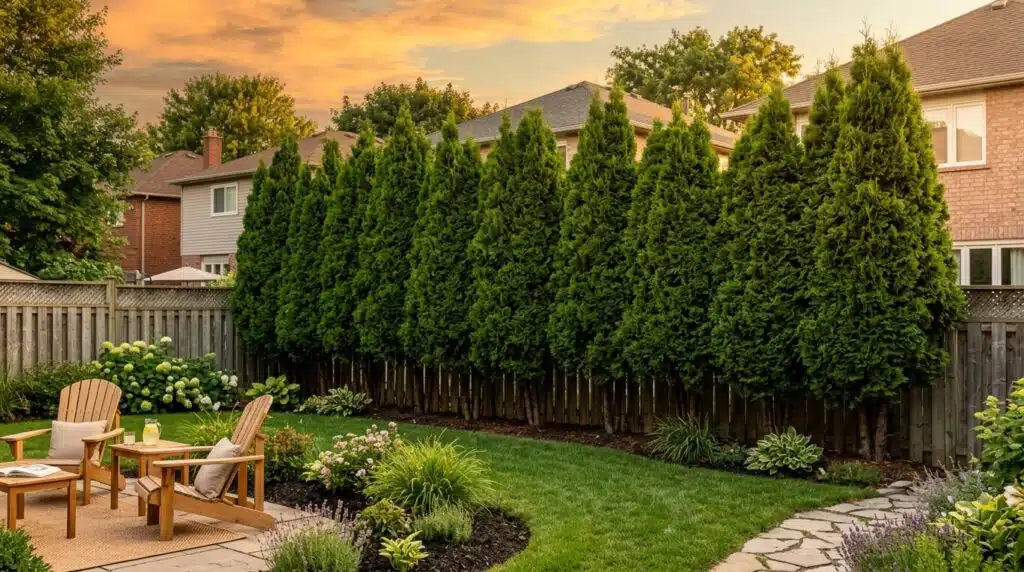
The Top Privacy Fence Trees, Compared
Before you fall for the tree with the prettiest photo online, look at how it actually performs over a lifetime. Growth rate matters less than most people think — a fast grower that dies of disease in year 18 isn’t a bargain.
| Feature | Thuja Green Giant | Leyland Cypress | Emerald Green Arborvitae | Italian Cypress | Nellie Stevens Holly |
|---|---|---|---|---|---|
| Growth Rate | 3-5 ft/yr | 3-5 ft/yr | 1-2 ft/yr | Moderate | 2-3 ft/yr |
| Mature Height | 40-60 ft | 60-70 ft | 12-15 ft | 40-70 ft | 15-30 ft |
| Mature Width | 12-18 ft | 15-25 ft | 3-4 ft | 3-6 ft | 8-25 ft |
| Hardiness Zones | 5-8 | 6-10 | 3-7 | 7-10 | 6-9 |
| Spacing (Screen) | 5-6 ft | 5+ ft | 3-4 ft | 3-4 ft | 5-6 ft |
| Lifespan | 50-150+ yrs | 15-25 yrs | 50+ yrs | 50+ yrs | 50+ yrs |
| Deer Resistance | Good | Moderate | Poor (heavily browsed) | Moderate | Good |
| Best For | Large lots, fast privacy | Quick fix, big budget | Narrow spaces | Tight, dry spots | Year-round screen |

Best Privacy Trees, One by One
Here’s the honest rundown on each variety — what it’s genuinely good at, and where it falls short.
Growth rates, mature sizes, and hardiness zones below are typical ranges drawn from nursery and university extension descriptions. Real results vary with your climate, soil, sun, and the specific cultivar, so it’s worth confirming top picks with your local cooperative extension office or a nursery that grows for your area.
1. Thuja Green Giant Arborvitae — The Gold Standard
Green Giant is one of the most widely planted privacy trees in the U.S., and for good reason. This hybrid of Western Red Cedar and Japanese arborvitae grows 3 to 5 feet a year, topping out at 40 to 60 feet with a 12 to 18 foot spread. It stays dense from the ground up, so you don’t get that leggy, bare-bottom look older hedges suffer from.
Green Giant is pest-resistant, deer-resistant, and comfortable in zones 5 through 8, which covers much of the Mid-Atlantic, Midwest, and upper South. Plant them 5 to 6 feet apart for a solid wall of green — you can work out how many trees your row needs with our plant spacing calculator before you order saplings. Its thick, layered foliage can also help soften road noise, although any single row of trees reduces sound only modestly — a wide, multi-row planting does noticeably more.
2. Leyland Cypress — Fastest Growth, With a Real Warning
Leyland Cypress is the sprinter of this list, shooting up 3 to 5 feet a year and reaching 60 to 70 feet. But there’s a catch worth knowing before you buy: it’s a sterile hybrid that, in many home landscapes, lasts only 15 to 25 years, and it’s prone to incurable diseases like Seiridium canker. If you’ve driven past a patchy, half-dead Leyland hedge planted back in the 1990s, that canker is usually why. You can read how the disease actually spreads and what symptoms to watch for from the University of Maryland Extension’s canker guide.
Leyland still earns its spot on large properties where you need coverage fast and you’re fine replacing the row in fifteen to twenty years. Just go in with your eyes open.

3. Emerald Green Arborvitae — The Narrow-Space Champion
For small yards and tight side strips, Emerald Green is the one to plant. It tops out at 12 to 15 feet tall but stays a narrow 3 to 4 feet wide, growing a slow, tidy 1 to 2 feet a year, which means far less trimming. Space them 3 to 4 feet apart for a dense hedge. One catch: deer love this variety, so if you’ve got browsing pressure, check our animal-resistant plants finder before committing a whole property line to it. Hardy in zones 3 through 7.
4. Italian Cypress — Dramatic and Narrow
Soaring 40 to 70 feet tall on a footprint of just 3 to 6 feet, Italian Cypress is the tree behind that classic Mediterranean-villa look. It’s a striking accent as much as a screen. It wants a dry, sunny spot — pair it with a look at our drought-resistant garden calculator if your yard runs hot and dry. Best in zones 7 through 10.
5. Nellie Stevens Holly — Berries and Year-Round Screening
This self-pollinating holly produces bright red winter berries alongside dense, glossy leaves that hold their color all year. It grows 2 to 3 feet annually and reaches 15 to 30 feet. It’s deer-resistant, tolerates clay soil, and thrives in zones 6 through 9. Plant 5 to 6 feet apart, and expect a pyramidal shape that works beautifully as a formal hedge.

6. Eastern Red Cedar — The Tough Native
A true North American native, Eastern Red Cedar shrugs off drought and adapts to almost any soil. It grows 40 to 50 feet tall and feeds local wildlife with red-orange berries. Its columnar cousin, Taylor Juniper, tops out at 25 to 30 feet but stays just 2 to 3 feet wide — a genuinely tall, skinny option for narrow property lines. Zones 3 through 9.
7. Skip Laurel — The Broadleaf Alternative
If arborvitae feels overplanted in your neighborhood, Skip Laurel is a glossy-leafed evergreen shrub-tree that grows 10 to 20 feet tall with fragrant white spring flowers. It handles Southeastern heat better than most conifers and grows 2 to 3 feet a year. Space at 5 to 6 feet. Zones 6 through 9.
8. Brodie Juniper (Juniperus virginiana 'Brodie') — Columnar and Manageable
A narrow, columnar evergreen that’s a strong fit for colder regions and smaller properties. It reaches 15 to 20 feet with a 4 to 6 foot spread, offering dense blue-green foliage that holds its screen year-round. Hardy zones 5 through 9.
9. Blue Arrow Juniper — Sleek and Modern
For a striking, modern look, Blue Arrow’s intense blue foliage holds its color through every season. It’s a moderate grower, adding 12 to 18 inches a year, reaching 12 to 15 feet tall on a footprint of just 1 to 2 feet wide — about as skinny as privacy trees get. Zones 4 through 9.

A Note on Bamboo and Shrub Alternatives
If a tall, narrow evergreen doesn’t fit your budget or timeline, clumping bamboo and dense evergreen shrubs are worth a look too. Just be careful with running bamboo varieties — they spread aggressively through underground rhizomes and can invade a neighbor’s yard within a couple of seasons if left uncontained. Clumping types stay put and are the safer bet near a shared fence line.
Planting and Care Essentials
Get the Spacing Right
Spacing is where most privacy screens fail. Plant too far apart and you’ll be staring at gaps for years; plant too close and you’re setting up a fight for light, water, and root space down the road.
- Mature width matters most: if a tree matures at 10 feet wide, space them 6 to 7.5 feet apart to close gaps without overcrowding.
- For Green Giant, 5 to 6 feet apart closes up the base within 3 to 5 years. At 7 feet, you’ll wait longer.
- Keep the row 3 to 6 feet inside your property line, not right up against the fence itself.
To estimate how many trees a row needs, divide the length of the row by your spacing and add one — so a 60-foot line at 6-foot spacing takes 11 trees. Our plant spacing calculator can do the math for a whole line, including staggered double rows.
Design a Staggered, Mixed Screen
A single row of one species is convenient, but a staggered, mixed screen is more resilient — if disease or pests hit one variety, you’re not left with a bare wall. Use a double row offset by 4 to 6 feet, with tall evergreens like Green Giant at the back, mid-height trees like holly or juniper in the middle, and low shrubs up front. Combining two or three species, say Green Giant, Nellie Stevens Holly, and Blue Arrow Juniper, gives you texture as well as backup.

Soil, Water, and the First Season
Before you dig anything, call your local utility line-marking service — it’s free and it saves you from an expensive mistake. Amend your planting holes with organic matter, since most privacy trees establish faster in loose, well-draining soil. Check our soil type guide if you’re not sure what you’re working with. Newly planted trees need consistent watering through their first growing season — this is the single biggest factor separating a thriving screen from a struggling one. Mulch 2 to 3 inches deep around the base, keeping it a few inches clear of the trunk to avoid rot.

Match the Tree to Your Actual Goal
- Year-round privacy: stick with evergreens that hold their needles through snow and frost.
- Summer-only privacy: a mix of deciduous trees and tall flowering shrubs can be enough, and cheaper.
- Noise and wind: broad, leafy varieties like holly absorb more sound than a single thin row of conifers.
For homeowners planning a screen that will genuinely outlive the fence next to it, our long-life plants selector and broader woody plants guide are good starting points before you buy a single sapling.
Cost Guide: What Privacy Trees Actually Run in 2026
| Tree Size | Cost Range | Notes |
|---|---|---|
| Small saplings (2-4 ft) | $10-$30 each | Budget-friendly, but takes years to establish |
| Mid-sized (4-6 ft) | $30-$75 each | The most common size for full-row planting projects |
| Large specimens (8-9 ft) | $175-$250 each | Near-instant privacy, at a real price premium |
| Installation (per tree) | $100-$425 | Varies with size, access, and soil conditions |
A quick money-saving note: Leyland Cypress may look cheaper on the price tag today, but factor in the cost of removing and replacing it in 15 to 25 years. Arborvitae, at a slightly higher upfront cost, is usually the better long-term value once you run the full lifetime math.
These are typical ranges, not quotes. Prices vary widely by region, nursery, tree size, and season, so get two or three local quotes before you budget a full row.
Frequently Asked Questions
Quick answer: Leyland Cypress and Thuja Green Giant both grow 3 to 5 feet a year.
Leyland edges out Green Giant on raw speed in some conditions, but it comes with a much shorter lifespan and a real disease risk, while Green Giant can live 50 to 150-plus years with far fewer problems.
Quick answer: Emerald Green Arborvitae, Italian Cypress, Blue Arrow Juniper, or Taylor Juniper.
These stay 1 to 6 feet wide at maturity, which makes them the right call for a tight side yard or a strip along a shared property line.
Quick answer: It depends on the variety, but 5 to 6 feet is the standard spacing for most full-size screening trees.
Green Giant and Nellie Stevens Holly both do well at 5 to 6 feet apart. Emerald Green Arborvitae wants 3 to 4 feet, and skinny columnar junipers can go as tight as 2 to 4 feet depending on the cultivar.
Quick answer: Around 3 to 5 years with a fast-growing variety like Green Giant.
Slower growers like Emerald Green Arborvitae, at 1 to 2 feet a year, can take closer to 6 to 8 years to fully close in, so factor your patience level into which tree you choose.
Quick answer: Yes, but leave 3 to 6 feet of room inside your property line.
That gap gives roots and branches space to mature without damaging the fence itself or creeping onto a neighbor’s side.
Quick answer: Lifespan and disease resistance, mainly.
Green Giant Arborvitae can live 50 to 150-plus years with excellent disease resistance and cold hardiness to zone 5. Leyland Cypress typically lives only 15 to 25 years and is prone to incurable canker diseases, which is the trade-off for its faster early growth.
Quick answer: Yes — Green Giant Arborvitae and Nellie Stevens Holly are both solid deer-resistant choices.
Emerald Green Arborvitae, on the other hand, is heavily browsed by deer, so skip it if you’ve got a lot of deer traffic on your property.
Quick answer: Only during their first growing season — after that, most varieties are fairly drought-tolerant.
Water new plantings consistently for the first year while roots establish. After that, Italian Cypress, Eastern Red Cedar, and most junipers handle dry spells well.
Quick answer: Expect roughly $30 to $75 per tree for mid-sized 4 to 6 foot saplings, plus $100 to $425 per tree for installation.
Large 8 to 9 foot specimens for near-instant privacy run $175 to $250 each before installation. For a tree count, divide the length of your fence line by your spacing distance and add one — for example, 60 feet at 6-foot spacing is 11 trees.
