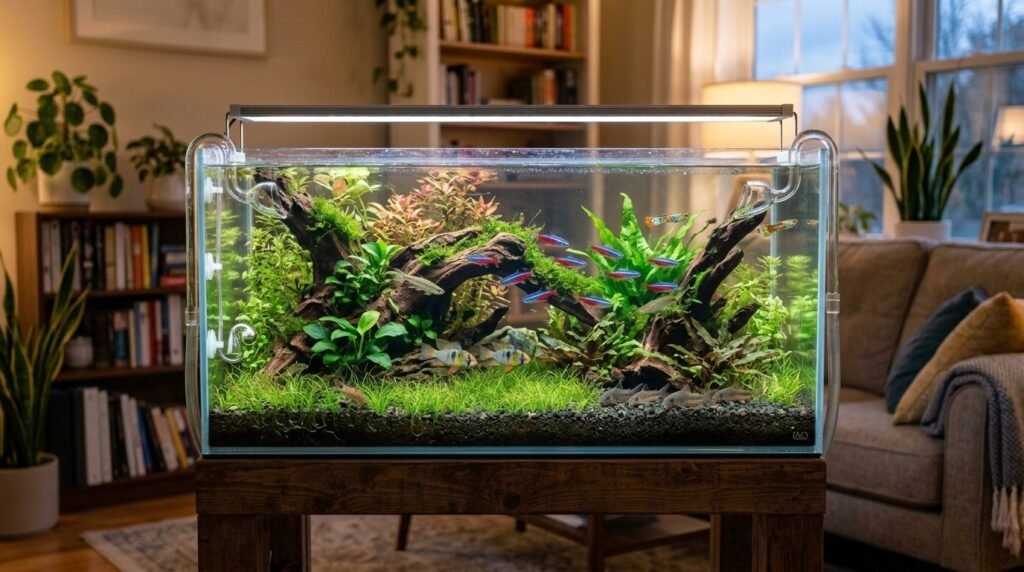
Fish Aquarium Size: How to Choose the Right Fish Tank Size
Walk into any pet store and you’ll see rows of tanks in every size imaginable — tiny desktop bowls, mid-size community tanks, and towering show tanks that take up half a wall. It’s exciting, but it’s also where most beginners make their first mistake: picking a tank size based on what looks nice, rather than what actually works.
Aquarium size isn’t just about how much water your tank holds. It’s about stability, floor weight, fish welfare, and how much daily maintenance you’re signing up for. Get the size right from the start, and fishkeeping becomes genuinely relaxing. Get it wrong, and you’ll spend your first year fighting cloudy water and stressed fish.
This guide breaks down everything: standard aquarium sizes, dimensions, weight, glass thickness, stocking levels, and exactly which tank size fits which fish — so you can set up your first aquarium with confidence instead of guesswork.
Why “Bigger Is Actually Easier” Surprises Most Beginners
It seems backwards at first. Wouldn’t a small tank be simpler to manage? In practice, the opposite is true. Small aquariums have less water volume to dilute waste, which means ammonia and nitrite spikes happen fast, and small mistakes turn into dead fish quickly.
Larger aquariums, generally in the 20 to 40 gallon range, offer far more stable water parameters. Temperature swings less, pH holds steadier, and there’s simply more room for error while you’re learning the ropes. This is exactly why most experienced aquarists point beginners toward a 20-gallon long as a genuinely forgiving starter aquarium size, rather than the smaller tanks that look easier on the shelf.

🐠 Standard Aquarium Sizes and Dimensions Chart
A reference checklist for tank dimensions, volume ratings, and estimated floor load weights
Standard aquarium sizes follow fairly consistent dimensions across most major manufacturers, though it is always recommended to verify your physical tank before procuring custom stands or custom screen lids.
| Tank Volume | Dimensions (L × W × H, inches) | Approx. Filled Weight |
|---|---|---|
| 5.5 Gallon | 16 × 8 × 10 | ~62 lbs |
| 10 Gallon | 20 × 10 × 12 | ~111 lbs |
| 20 Gallon High | 24 × 12 × 16 | ~225 lbs |
| 20 Gallon Long | 30 × 12 × 12 | ~225 lbs |
| 29 Gallon | 30 × 12 × 18 | ~330 lbs |
| 40 Gallon Breeder | 36 × 18 × 16 | ~458 lbs |
| 55 Gallon | 48 × 13 × 21 | ~625 lbs |
| 75 Gallon | 48 × 18 × 21 | ~850 lbs |
| 125 Gallon | 72 × 18 × 22 | ~1,400 lbs |

⚖️ Aquarium Weight Chart & Structural Guide
Calculate exact floor load support requirements before setting up large aquariums
As a simple practical planning rule, it is smart to round up to about 10 pounds per gallon. This leaves a safe engineering buffer once heavy gravel beds, decorative structures, and sump filters are accounted for. Under this metric, a fully dressed 55-gallon configuration can easily scale past 700 pounds total.
- Verify your custom aquarium stand is explicitly structural and rated for the tank's full filled weight, not merely its horizontal outer framing dimensions.
- Always arrange larger display setups (55 gallons and up) flush against load-bearing walls or positioned perpendicular across structural floor joists whenever possible.
- Avoid locating high-capacity tanks on upper-level floors without verified evaluation of the underlying residential framework or architectural joist support first.
If you are currently evaluating room structural limits or mapping floor load configurations as part of a home update, our companion home renovation guide outlines planning principles that adapt cleanly well beyond aquarium placements.

🐠 Aquarium Volume Calculator
Calculate water capacity and filled weights based on inner tank dimensions
Choosing the Right Aquarium Size for Beginners
If you’re setting up your first tank, aim for the 20 to 40 gallon range. It’s large enough to stay chemically stable, but not so large that it becomes intimidating or expensive to maintain.
- Under 15 gallons (nano aquariums): best suited to experienced keepers, bettas, or small shrimp tanks, since water parameters swing fast
- 20 to 40 gallons: the sweet spot for most beginners and community fish setups
- 55 gallons and up: ideal once you’re ready for larger community fish, cichlids, or a serious planted aquarium
A 20-gallon long is often singled out as the best all-around beginner aquarium size because its wider footprint gives fish more horizontal swimming room than a taller tank of the same volume, while still fitting comfortably on standard furniture.

🐠 Master Aquarium Dimensions & Weight Reference
Comprehensive sizing matrices, engineering load weights, and footprint specifications
| Tank Size / Tier | Dimensions (L × W × H, inches) | Empty Tank Weight | Approx. Filled Weight |
|---|---|---|---|
| 1 Gallon | 10 × 6 × 8 | ~2 lbs | ~11 lbs |
| 5 Gallon | 14 × 8 × 10 | ~7 lbs | ~50 lbs |
| 10 Gallon | 20 × 10 × 12 | ~11 lbs | ~111 lbs |
| 20 Gallon Long | 30 × 12 × 12 | ~25 lbs | ~225 lbs |
| 29 Gallon | 30 × 12 × 18 | ~40 lbs | ~330 lbs |
| 36 Gallon Bowfront | 30 × 15 × 21 | ~48 lbs | ~410 lbs |
| 40 Gallon Regular | 36 × 13 × 20 | ~58 lbs | ~455 lbs |
| 40 Gallon Breeder | 36 × 18 × 16 | ~58 lbs | ~458 lbs |
| 50 Gallon | 36 × 18 × 19 | ~80 lbs | ~570 lbs |
| 55 Gallon Standard | 48 × 13 × 21 | ~78 lbs | ~625 lbs |
| 55 Gallon Corner | 32 × 32 × 24 (Front radius) | ~85 lbs | ~635 lbs |
| 60 Gallon | 48 × 13 × 24 | ~90 lbs | ~690 lbs |
| 75 Gallon | 48 × 18 × 21 | ~90 lbs | ~850 lbs |
| 80 Gallon | 48 × 24 × 16 | ~110 lbs | ~910 lbs |
| 120 Gallon | 48 × 24 × 24 | ~150 lbs | ~1,400 lbs |
| 125 Gallon | 72 × 18 × 22 | ~206 lbs | ~1,400 lbs |
| 200 Gallon | 72 × 24 × 27 | ~330 lbs | ~2,200 lbs |
| 220 Gallon | 72 × 24 × 30 | ~350 lbs | ~2,400 lbs |
| 400 Gallon | 96 × 36 × 27 | ~650 lbs | ~4,500 lbs |
| Target Fluid Volume | Pure Liquid Weight (Freshwater) | Total Estimated Load Safe Limit (Dressed) |
|---|---|---|
| 10 Gallons | 83.4 lbs | ~100 lbs |
| 40 Gallons | 333.6 lbs | ~400 lbs |
| 55 Gallons | 458.7 lbs | ~550 lbs |
🐠 Aquarium Stocking & Bioload Guide
Go beyond outdated sizing rules to establish a balanced, thriving ecosystem
A more reliable management approach is evaluating total bioload—the physical volume of organic waste a fish populates relative to the dynamic water capacity available to dilute it—rather than simple tip-to-tail length.
- Adult Development Size: Always plan around the full maturity profile of the species, never the juvenile footprint found in store display units.
- Locomotion & Swimming Style: Highly active swimmers require expanded open horizontal lane dimensions, regardless of their small biological mass.
- Filtration Mechanical Turn: Your filtration turnover capacity must match or exceed the total waste density generated within the specific water volume.
- Social Schooling Dependencies: Check whether the target species requires tight group numbers to mitigate stress indicators and keep optimal behaviors.
Balancing these structural factors alongside routine water parameter checks guarantees a stable nitrogen cycle and keeps your aquatic community vibrant long-term.
🐠 Fish Species Tank Size Guide
Match individual species behavior and biological demands to appropriate volume limits
Different fish profiles require completely unique vertical and horizontal layout dynamics. Planning around minimum requirements early avoids keeping a species that will quickly outgrow its enclosure within a matter of months.
| Fish Type / Profile | Recommended Minimum Size | Crucial Dimension Factors & Behaviors |
|---|---|---|
| Betta Fish | 5 – 10 Gallons | 5 gallons serves as an absolute baseline limit; 10 gallons offers substantially better water chemistry parameter stability. |
| Goldfish (Fancy Varieties) | 20 Gallon Long | Adults can reach lengths of 8 inches; long footprint footprints offer ample space to swim and execute turns easily. |
| Angelfish | 29 Gallon (Taller profiles) | These fish scale vertically as much as horizontally; a deeper setup featuring roughly 18 inches of clearance height suits their geometry. |
| Oscar Cichlids | 75 – 125+ Gallons | Fast growth trajectories and heavy biological waste loads require 75 gallons minimum for a single adult, or 125+ gallons for paired arrangements. |
| Territorial Cichlids | 40 – 55 Gallons | Varies significantly by exact variant, but territorial options require robust footprints to establish distinct boundaries safely. |
| Livebearers & Nano Schools (Guppies, Mollies, etc.) |
10 – 20 Gallons | Provides highly reliable swim lanes and balanced space margins for small, peaceful community groups. |
Acrylic vs Glass Aquarium: Which Should You Choose?
Both materials work well, but they suit different priorities.
- Glass aquariums are more scratch-resistant, generally more affordable, and hold their clarity for years without yellowing
- Acrylic aquariums are significantly lighter, allow for more creative shapes like bow fronts and cube tanks, and offer better insulation, but scratch more easily and can discolor slightly over time
Aquarium glass thickness matters more as tank size increases; larger tanks need thicker panes to safely handle the increased water pressure at the base. This is one area where it’s worth trusting manufacturer specifications rather than estimating on your own.

Aquarium Lighting and Equipment Sizing
Once your tank size is settled, lighting, filtration, and heating all need to scale to match. Undersized filtration is one of the most common setup mistakes, since a filter rated for a smaller tank simply can’t keep up with the bioload of a larger one.
LED aquarium lighting has become the standard choice for most home setups, since it runs cooler and more efficiently than older lighting styles while still supporting live plants. If you’re comparing lighting options for your aquarium stand area or the surrounding room, our guide on efficient, safe LED lighting walks through the same efficiency principles that apply to aquarium hoods and fixtures.
A Quick Home Safety Note Worth Mentioning
Since aquarium setups often involve electrical equipment running around the clock — heaters, filters, and lighting, all near water — it’s worth pairing your tank setup with a broader look at home safety, particularly smoke alarm coverage in the room where your equipment runs continuously.
Working smoke alarms cut the risk of dying in a home fire by roughly 60 percent, according to the National Fire Protection Association, and electrical malfunctions are a well-documented contributor to house fires overall. If you’re already setting up new equipment near an outlet, it costs nothing to double-check nearby alarm coverage at the same time.
Our smoke detector calculator can help you work out how many alarms your home actually needs and where they’re best placed, based on your layout and room count.
Bringing It All Together
Choosing the right aquarium size really comes down to three questions: how much floor and structural support you have, what fish you actually want to keep long-term, and how much stability you want built into the system from day one. For most first-time fishkeepers, a tank in the 20 to 40 gallon range strikes that balance — big enough to stay stable, small enough to stay manageable.
Get the size right at the start, and everything downstream — filtration, stocking, maintenance — gets significantly easier. Take the time to measure your space, check your floor’s capacity, and match your tank to the fish you actually plan to keep, and you’ll set yourself up for a genuinely enjoyable hobby instead of a constant string of water-quality headaches.
Here are the external links used in the fish aquarium size guide article, with the anchor text and why each was included:
- Petco Aquarium Sizes, Weights & Dimensions Guide
https://www.petco.com/content/content-hub/home/articlePages/product-guides/aquarium-sizes-weights-and-dimensions.html
→ Used for the weight-per-gallon and “round up to 10 lbs/gallon” safety buffer fact. - Aquarium Co-op — How Many Fish Can I Put in a Fish Tank?
https://www.aquariumcoop.com/blogs/aquarium/how-many-fish
→ Used for the stocking/bioload explanation and the goldfish 20-gallon-long minimum. - Oscar Fish Lover — Best Tank Size for Oscar Fish
https://oscarfishlover.com/oscar-fish-tank-size/
→ Used for the 75-gallon single-oscar / 125-gallon pair minimums. - National Fire Protection Association — Smoke Alarms
https://www.nfpa.org/education-and-research/home-fire-safety/smoke-alarms
→ Used for the “60% reduced risk of dying in a home fire” statistic in the safety note.