Soil Calculator for Raised Garden Beds and Containers (Free)
Free Garden Tool
Soil Calculator for Raised Garden Beds and Containers
Stop guessing. Get the exact cubic feet, cubic yards, and bag count you need — for raised beds, round planters, and containers — backed by the soil mix our family has used for 25 years.
By Muhammad Jaweed · Founder & Lead Gardener · The Muhammad Family
Last updated: May 2026
Calculate Your Soil
Choose a shape, enter your measurements, and see results instantly
Units:
1
in feet
in feet
in inches
in inches
in inches
Choose container type
in inches
in inches
in inches
You will need
32.0cubic feet of soil
1.19
Cubic Yards
0.91
Cubic Meters
896
Quarts (Liters)
≈ 16 bags of 2-cubic-foot soil
★ Our Family's 60/30/10 Recipe
Quality Soil Mix for Raised Beds
60%
Topsoil
19.2 cu ft
30%
Compost
9.6 cu ft
10%
Soilless Mix
3.2 cu ft
MJ
Muhammad Jaweed
FOUNDER & LEAD GARDENER
Retired and gardening since the 1990s, Muhammad has tested countless soil mixes across 25+ years of family vegetable beds. The 60/30/10 recipe in this calculator is the formula his family has settled on through real-world results.
How to Use This Soil Calculator
Whether you are filling your first raised bed or topping up a container collection on the patio, the goal is the same: order the right amount of soil the first time. Too little and you make multiple trips to the garden centre; too much and you have leftover bags taking up space all season. Here is the four-step process we use ourselves.
Measure inside the bed or container.Always measure inside dimensions — not outside — because the wood, plastic, or fabric walls take up real space. Use a tape measure for length and width, then measure depth from the soil-line you actually want (not always all the way to the bottom).
Choose the right shape tab.Use "Raised Bed (Rectangular)" for any 4-sided bed, "Round Planter" for galvanized rings or whisky barrels, and "Container / Pot" for individual pots. The math changes for each, but this calculator handles it for you.
Enter your numbers — keep an eye on units.If you measure in inches, the calculator handles the conversion. If you have a metric tape measure, click the metric toggle. Multiple beds of the same size? Use the counter to multiply the result instantly.
Order with the 10% buffer applied.Soil settles dramatically after the first few waterings — sometimes by 2–3 inches in a 12-inch bed. The 10% buffer (already on by default) covers this so you are not adding more soil two weeks later.
★ Family tip
For deep beds (18 inches or more), bump the buffer to 15%. The deeper the bed, the more dramatic the settling. We learned this the hard way on our first 24-inch tomato beds in 2012.
The Best Soil Mix for Raised Beds
Our family has tested commercial "raised bed mixes," straight topsoil, and homemade blends across more than two decades. The mix that consistently produces the best vegetables — without breaking the budget — is a simple 60/30/10 blend. Here is exactly what goes into it and why.
The 60/30/10 Recipe
60% quality topsoil — the bulk ingredient. Good topsoil holds moisture, supplies minerals, and gives roots a stable medium to grow in. Buy by the cubic yard from a reputable landscape supplier if you are filling more than one bed; bagged topsoil works fine for one or two small beds.
30% finished compost — the engine of the mix. Compost feeds soil biology, slowly releases nutrients, and improves the texture of heavy topsoil. Our family makes our own from kitchen scraps, but bagged compost from a reputable brand works too.
10% soilless growing mix — the lightener. A small amount of peat-based or coco-coir-based potting mix loosens the blend and improves drainage. We never go above 10% for raised beds because too much makes the soil dry out too quickly in summer.
What We Avoid
We do not recommend filling raised beds with pure landscape "topsoil" alone — it is often heavy, salty, and short on organic matter. We also do not use peat moss as more than 20% of any mix; it is naturally acidic and can lock out nutrients for vegetables that prefer neutral soil. Finally, we never use chemically treated wood mulches as a soil component.
For a deeper dive into soil chemistry and amendments, the University Extension network is the most reliable free source. The USDA Cooperative Extension also publishes excellent regional guidance for soil testing and amendment.
Quick Reference: Common Bed Sizes
Already know your bed size? Here are the most common dimensions and the soil they need at 12-inch depth, with a 10% settling buffer applied.
Bed Size
Cubic Feet
Cubic Yards
2-cu-ft Bags
2 × 4 ft (12 in deep)
8.8
0.33
5
3 × 6 ft (10 in deep)
16.5
0.61
9
4 × 4 ft (12 in deep)
17.6
0.65
9
4 × 6 ft (12 in deep)
26.4
0.98
14
4 × 8 ft (12 in deep)
35.2
1.30
18
4 × 8 ft (18 in deep)
52.8
1.96
27
5 × 10 ft (12 in deep)
55.0
2.04
28
14 in round pot (12 in deep)
1.06
0.04
1
36 in round planter (12 in deep)
7.0
0.26
4
Calculating Soil for Containers and Pots
Containers behave differently from raised beds in two important ways. First, they hold much less soil, so even small measurement errors cost you. Second, container plants depend entirely on the soil you give them — there is no native ground beneath them to fall back on.
Soil for Round Pots
For a round pot, the math is straightforward: multiply π (3.14) by the radius squared by the depth. The calculator does this automatically — just enter the inside diameter and the depth. For a quick rule of thumb, a 14-inch round pot at 12 inches deep needs about 1 cubic foot of mix, or roughly 16 quarts.
Soil for Rectangular Planters
Long rectangular planters — the kind you sit on a balcony rail or a porch — are calculated the same way as a raised bed: length × width × depth. Use the "Container / Pot" tab and choose "Rectangular Planter" from the shape menu.
Container Mix vs Raised Bed Mix
Containers need a much lighter mix than raised beds because they drain through small holes and the entire root zone is above ground. For pots, our family uses a 50/50 blend of quality potting mix and finished compost, with no added topsoil. The 60/30/10 raised-bed recipe is too heavy for most containers.
★ Family tip
Never reuse last year's container soil straight — it has lost most of its nutrients and structure. Empty it onto a tarp, mix in 30% fresh compost and a handful of organic granular fertilizer, then put it back. Free refresh every spring.
FAQs: Soil Calculator for Raised Garden Beds and Containers
How much soil do I need for a 4x8 raised garden bed? +
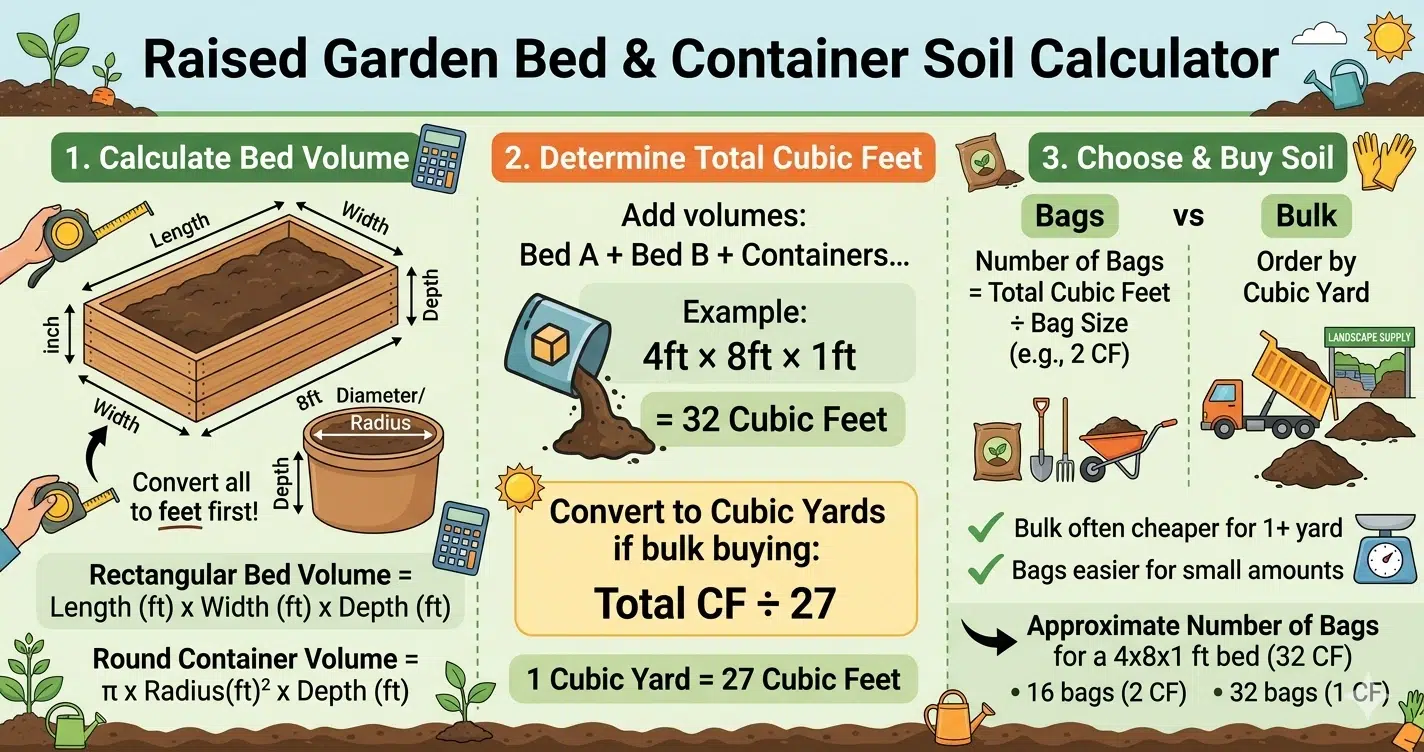
A standard 4×8-foot raised bed with 12 inches of soil depth needs 32 cubic feet of soil — that is approximately 1.2 cubic yards or about 16 bags of 2-cubic-foot soil. Add 10% extra to account for settling after the first few waterings, which brings it closer to 35 cubic feet.
How do I calculate soil for a raised garden bed by hand? +
Multiply length by width by depth — all in feet — to get cubic feet. If your measurements are in inches, divide each one by 12 first. To convert cubic feet to cubic yards, divide by 27. To convert to liters, multiply cubic feet by about 28.3. The calculator above does all of this automatically.
What is the best soil mix for raised garden beds? +
Our family's tested 60/30/10 mix uses 60% quality topsoil, 30% finished compost, and 10% soilless growing mix (peat or coco coir). This balanced blend holds moisture but drains well, and supplies enough organic matter to feed plants for an entire season. For containers, we switch to a lighter 50/50 mix of potting soil and compost.
How much soil do I need for a container or pot? +
For round pots, multiply π (3.14) by the radius squared by the depth, all measured in feet. For example, a 12-inch round pot 10 inches deep needs about 0.65 cubic feet of soil. The calculator on this page handles round, rectangular, and any shape automatically — just choose "Container / Pot."
How many bags of soil do I need for a 3x6 raised bed? +
A 3×6-foot bed with 10 inches of depth needs 15 cubic feet of soil — that is about 8 bags of 2-cubic-foot soil, 15 bags of 1-cubic-foot soil, or 20 bags of 20-quart soil. Add 10% for settling, so order one extra bag of whichever size you choose.
Is it cheaper to buy soil in bulk or in bags? +
If you need more than 1 cubic yard (about 13 bags of 2-cubic-foot soil), bulk delivery is almost always cheaper per cubic foot — sometimes by 40 to 60 percent. For one or two small beds, bagged soil is more practical, easier to handle, and usually more consistent in quality. Get a bulk delivery quote before deciding.
Can I reuse old soil from last year's raised bed? +
Yes — old soil can be reused if you refresh it. Top up to within an inch of the rim with fresh planting mix, work in 1 to 2 inches of compost across the top, and add a granular organic fertilizer at the rate listed on the bag. After 3 to 4 seasons, do a soil test (your local extension office will do this cheaply) and rebuild the mix if nutrient levels have dropped significantly.
How deep should soil be in a raised garden bed? +
For most vegetables, 10 to 12 inches of soil depth is enough. Deep-rooted crops like tomatoes, carrots, and potatoes prefer 18 inches. If your raised bed sits on quality native soil that you have loosened with a garden fork to a depth of 6 to 10 inches, even a 5-inch tall raised bed will give plants effectively 12 to 18 inches of rooting depth — plenty for almost any vegetable.
Why does my soil settle so much after watering? +
Fresh soil mixes contain a lot of air pockets that compact under gravity and water. A 12-inch deep bed can drop 1 to 2 inches in the first month — that is normal. The 10% buffer in this calculator accounts for it. After the initial settle, the bed should hold its level for the rest of the season.
What is the difference between topsoil, garden soil, and potting mix? +
Topsoil is the mineral layer of natural soil, often heavy and not always nutrient-rich. Garden soil is topsoil that has been amended with organic matter and fertilizers — meant to be mixed into existing ground. Potting mix (also called soilless mix) contains no real soil at all — usually peat or coco coir, perlite, and a starter fertilizer — and is designed to drain well in containers. Use the right one for the job.
Related Garden Guides
Soil is just the start. Here are other family-tested guides to help your raised bed thrive:
A friendly note from the family
This calculator gives volume estimates based on the dimensions you enter. Actual soil volume can vary by 5 to 10% depending on supplier, moisture content, and how tightly you pack the bed. For large bulk orders, always confirm cubic yardage with your supplier before delivery. We are hobbyist gardeners with 25+ years of experience — for serious commercial growing or projects involving structural retaining walls, please consult a qualified local landscape professional.
Jaweed is the founder of Prime Home and Garden. A retired electronics engineer with decades of hands-on experience in home repairs, DIY projects, and garden care, he writes practical, tested guides to help homeowners take on projects with confidence.