UV Light And Bed Bugs – Find 89.45% Hidden Infestations

What Are Bed Bugs? Biology, Behaviour, and Why They Are So Hard to Find
- Extreme concealment: Bed bugs spend up to 90% of their lives hiding in mattress seams, box spring interiors, bed frame joints, and cracks and crevices in walls and furniture. They only emerge briefly to feed.
- Nocturnal feeding: By the time you wake up with itchy bites and skin irritation, the bug has retreated back into hiding.
- Slow-developing bite reactions: Symptoms — red welts, itchy bites, skin irritation — can take 24 to 72 hours to appear. Many people mistakenly attribute bites to mosquitoes, acne, or other household pests.
- Silent spread: A bed bug infestation can establish itself from a single pregnant female introduced via luggage, secondhand furniture, or shared laundry facilities before any infestation signs become obvious.
The Three Roles of UV Light With Bed Bugs: Detection, Trapping, Elimination
UV light is not a single tool. The ultraviolet spectrum spans three distinct bands, and each interacts with bed bugs in a completely different way. Understanding this before you buy anything could save you significant money and frustration.
| UV Type | Wavelength | Role | Practical Use |
|---|---|---|---|
| UV-A (Long-wave) | 320–400 nm | Detection — reveals fluorescent evidence | 395nm blacklight flashlight |
| UV-A/B (Mid-wave) | 280–380 nm | Trapping — attracts phototactic insects | UV + blue light trap combos |
| UV-C (Short-wave) | 100–280 nm | Elimination — germicidal DNA damage | Lab use only; impractical in homes |

UV Light for Bed Bug Detection: What It Reveals and What It Does Not
- Bed bug feces and droppings: Bed bug poop appears as small dark rust or black spots under normal light — they look like ink dots from a ballpoint pen. Under UV (385–395nm), these bed bug droppings fluoresce whitish, yellow, or blue-green. Fecal stains along mattress seams are often the first confirmed infestation sign.
- What do bed bug feces look like? Dark brown to black smears or clusters of tiny dots on fabric. Under UV, they glow distinctly against the background fabric.
- Shed skins (cast skins / casings): After each moult, a bed bug nymph leaves behind a hollow, translucent bed bug shell — also called cast skin or casing. These pale exoskeletons become more visible under UV, especially in seam corners and joints.
- What does bed bug shed skin look like? It is a ghost of the insect — same shape, translucent, yellow-white to pale brown, flat. You will find these in clusters where bugs moult repeatedly.
- Urine traces: Invisible under normal lighting, bed bug urine fluoresces faintly under UV, contributing to the overall stain pattern.
- Bed bug blood stains: Reddish-brown smear marks left by crushed bugs or from post-feeding movement on sheets and pillowcases. These bed bug black spots and blood stains also respond to UV contrast.
- 385–395nm produces the strongest fluorescence response in organic compounds found in bed bug feces and urine.
- 365nm (common in cheaper flashlights) is less effective — produces bluer light that lacks the specific excitation energy needed.
- Above 400nm crosses into visible violet and loses UV effectiveness entirely.
- Darken the room completely. UV contrast is nearly useless in ambient daylight.
- Wait 10–15 minutes for your eyes to adjust to low-light conditions.
- Hold the UV flashlight 2–4 inches from the sleeping area surface and move slowly.
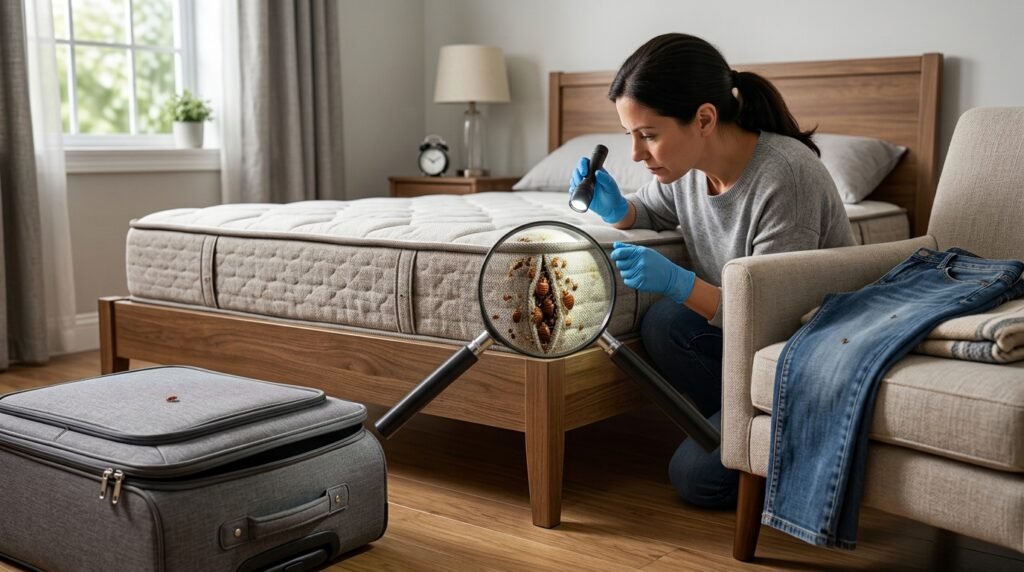
- Inspect mattress seams, stitching, handles, labels, and all tufts first.
- Move to the box spring exterior and interior, bed frame joints, screw holes, and headboard.
- Check baseboards, carpet edges, behind picture frames, and inside electrical outlet plates.
- Mark any glowing areas with masking tape, then reinspect in full light with a magnifying glass.

UV Light as a Bed Bug Trap: Phototactic Attraction and Monitoring
- UV and blue light combination traps captured 3.2 times more bed bugs than UV light alone in controlled studies.
- The combination outperformed blue light alone by 6.3 times.
- Commercial UV/blue LED bed bug interceptors and sticky traps exploit this attraction to passively monitor and reduce populations without chemical sprays.

UV-C Light and Bed Bug Elimination: Why It Fails in Real Homes
- Never be directed at eyes or skin.
- Only be used in unoccupied rooms.
- Always follow manufacturer instructions precisely.

Identifying Bed Bugs: Every Life Stage, Every Evidence Type
- Bed bug eggs: About 1mm long, pearl-white. Bed bug eggs on mattress seams, bed bug eggs on furniture joints, and even bed bug eggs on clothes that have been near an infested sleeping area all appear as tiny white specks with a visible eye spot after five days. They are laid in sticky batches in crevices.
- Baby bed bugs / bed bug nymphs: There are five nymph stages (instars) ranging from 1.5mm to 4.5mm. A baby bed bug in early instars is translucent yellow-white before its first blood meal and becomes reddish after feeding. Nymphs must complete a blood meal to moult and advance to the next stage.
- Adult bed bugs: 5–7mm, flat, oval, reddish-brown. After feeding, an adult bed bug becomes engorged, elongated, and darker red. Under a magnifying glass you can see six legs, two antennae, and segmented mouthparts.
- Bed bug droppings / bed bug poop / fecal spots: Ink-dot-sized dark specks clustered at seams, headboards, and baseboards. This is the most reliable infestation sign. They fluoresce under 395nm UV.
- Bed bug blood stains: Rust-coloured smears on sheets, pillowcases, and mattress fabric from crushed bugs or post-feeding movement. Also called bed bug black spots when dried.
- Bed bug shed skin / cast skin / casings: Hollow, translucent exoskeleton shells left after each moult. A mature adult has moulted five times. Established infestations contain many bed bug casings in seams and corners.
- Bed bug nest clusters: An active bed bug nest is not a single nest like a wasp colony — it is a tight aggregation of bugs, eggs, shed skins, and fecal matter at a preferred harborage site, typically inside a box spring or behind a headboard.
- Live or dead bugs: Small reddish-brown ovals in seams, joints, and cracks.
- Musty odour: Large infestations release a sweet, musty pheromone scent — described as coriander or almonds — from alarm glands.

Where Bed Bugs Hide: The Complete Location Hierarchy
- Mattress seams, tufts, handles, labels, and piping — the first place to check.
- Box spring interior — the single most common location for a mature infestation colony.
- Bed frame joints, screw holes, hollow legs, and slot channels.
- Headboard — especially upholstered headboards with staple-attached fabric backing.
- Nightstand drawers, drawer track channels, and the back panel.
- Baseboard joints and carpet edges at room corners.
- Behind and inside picture frames and mirrors mounted near the bed.
- Inside electrical outlet boxes and switch plate covers.
- Behind loose wallpaper edges and inside wall panel seams.
- Upholstered furniture seam junctions — especially in couches and armchairs.
- Bed bugs in pillows: Pillow seams and inner filling are a known harborage for bugs and insect eggs, especially where pillowcases are infrequently changed.
- Bed bugs in carpets: Pile carpet under and around the bed is a secondary harborage, particularly along the edge where carpet meets baseboard.
- Bed bugs in couches: Any upholstered furniture in the sleeping area is a risk. Check seam junctions, under cushion covers, and inside frame joints.
- Bed bugs in hair: Bed bugs do not live in hair the way lice do — they are not adapted for it. However, they may briefly crawl through hair to access skin for feeding. They cannot survive there long-term.
- Bed bugs in cars: If infested clothing, luggage, or furniture has been in a vehicle, bugs can establish in seat seams, under floor mats, and in door panel gaps.
- Bed bugs in storage units: Furniture and clothing stored in shared facilities are a transmission risk. Infested items from a storage unit have triggered many home infestations.
- Bed bugs in stuffed animals: Fabric toys kept on or near the bed can harbour bugs and eggs in seam stitching.
- Bed bugs in books: Specifically inside spine bindings of books stored on shelves beside the bed.
- Bed bugs in shoes: Shoes stored under or near the bed — especially with thick sole cavities — are an underappreciated hiding spot.
- Bed bugs in electronics: The warmth of clocks, gaming controllers, laptops, and televisions near sleeping areas makes them attractive harborage for eggs and nymphs.

Bed Bug Bites: Symptoms, Identification, and Comparisons
- Clusters, lines, or zigzag patterns — because a single bug feeds multiple times, moving slightly between each bite.
- Intensely itchy bites with a flat or mildly raised red weal.
- Skin irritation that may worsen into a broader allergic reaction in sensitive individuals.
- Delayed onset — bite symptoms appear hours to days after the actual bite, not immediately.
- Concentration on exposed skin — arms, neck, shoulders, and legs in the sleeping position.
- Bed bug blood stains: Small rust-coloured smear marks on sheets are a common secondary confirmation from crushed bugs or post-feeding movement.
| Condition / Insect | Primary Location & Pattern | Distinguishing Characteristics |
|---|---|---|
| Bed Bug Bites | Upper body, arms, neck, shoulders in sleeping position | Linear/zigzag clusters, delayed onset, no clothing relation |
| Flea Bites | Ankles, feet, and lower legs | Small red dots with halo; fleas jump from floor level |
| Chigger Bites | Waistbands, sock lines, armpits, tight clothing zones | Intensely itchy, hardened papules bound by elastic friction points |
| Spider Bites | Isolated single spots anywhere on body | Almost always single-occurrence events; non-linear |
| Dust Mites | Diffuse skin rash & respiratory reaction | Dust mites do not bite humans; allergic reaction to waste |
| Acne / Folliculitis | Face, chest, back, shoulders | Contains central comedones (whiteheads/blackheads); non-welted |

Bed Bugs and Pets: Dogs, Cats, and Your Animals
- Can dogs get bed bugs? Dogs can be bitten by bed bugs and can carry them passively on their fur. However, bed bugs cannot live on dogs the way fleas do. Bed bugs are not adapted for hair navigation and cannot cling to a mobile, grooming animal long-term. Dogs do not become infested — they become transport hosts.
- Can cats get bed bugs? The same applies to cats. Bed bugs cannot live on cats as a primary host. Cats can be bitten, especially if they sleep on an infested surface, and may carry bugs from room to room on their fur — but they do not sustain an infestation themselves.
- Do bed bugs bite pets? Yes, bed bugs bite dogs and cats when no human host is available. Bites on pets typically appear on the belly and inner legs where fur is thinner.
- Do pets carry bed bugs? Yes, pets can carry bed bugs passively. A dog that sleeps on an infested mattress can carry bugs to other rooms, contributing to infestation spread throughout the home.
- Do bed bugs travel on pets? Yes — this is one of the ways infestations spread between rooms in the same household. However, pets should never be treated with pesticides intended for bed bug control. Always consult a veterinarian.
Bed Bug Behaviour: Movement, Survival, and How Spread
- Do Bed Bugs Jump or Fly? No. Bed bugs cannot jump or fly. They move exclusively by crawling, at a speed of roughly 1 to 1.2 metres per minute on a flat surface — comparable to an ant. The question of do bed bugs jump is a common misconception, likely confused with fleas.
- Do Bed Bugs Come Out During the Day? Bed bugs are primarily nocturnal, but do bed bugs come out during the day if they are hungry and no human host has been present for several days? Yes. Starvation overrides their nocturnal instinct. In a heavily infested room, daytime sightings are common.
- Do Bed Bugs Travel Through Walls? Yes. Bed bugs crawl through wall voids, electrical conduits, plumbing channels, and gaps around pipes to move between rooms and units in multi-dwelling buildings. This is why a neighbour's infestation can become yours without any direct contact.
- Do Bed Bugs Move Room to Room? Yes — through wall voids, actively crawling under doors, and passively via clothing, bags, and pets. Once an infestation establishes in one bedroom, satellite colonies in adjacent rooms develop within weeks.
- How Fast Do Bed Bugs Move and Multiply? They move at about 1 metre per minute crawling speed. A female lays 1–5 eggs per day after a blood meal and up to 500 eggs in her lifetime. Nymphs develop to adults in as little as 5 weeks under warm conditions — so do bed bugs multiply fast? Fast enough that a single pregnant female can produce a full infestation within a month or two.
- Can Bed Bugs Climb Metal? Yes. Bed bugs can climb most vertical surfaces including metal bed frames, metal furniture legs, and metal wall surfaces. The only surfaces that slow them down are extremely smooth, polished glass or plastic — which is why bed bug interceptors are designed with smooth interior cups to trap climbing bugs.
- Can Bed Bugs Survive Water? They can survive brief submersion in cool water. However, washing machines kill bed bugs effectively when water temperature exceeds 49°C (120°F). Standard cold wash cycles may not kill them. A high-temperature dryer is more reliable — 30 minutes on high heat kills all life stages.
- Can Bed Bugs Survive Winter? Indoors, yes — easily. Central heating keeps homes at temperatures comfortable for bed bugs year-round. They cannot survive sustained temperatures below -17°C (0°F) held for at least four days, but normal winter indoor conditions never approach this. Can bed bugs survive in cold weather outdoors? No. They are not adapted for outdoor survival in cold climates.
- Can Bed Bugs Live Outside? No. Bed bugs are obligate indoor parasites. They cannot establish outdoor populations. Can bed bugs survive outside in the rain? Briefly, but they cannot sustain a population, find hosts, or withstand predation outdoors.

Bed Bug Treatment: What Actually Works — Ranked by Effectiveness
- 1. Professional Heat Treatment — The Gold Standard: A certified bed bug exterminator using heat treatment raises the entire room to 49–57°C (120–135°F) and maintains that temperature for 90 minutes to several hours. This kills every life stage — eggs, nymphs, and adults — in every concealed location. According to the US EPA, this is among the most effective methods available. How long does bed bug heat treatment take? A full room treatment typically takes 6 to 8 hours including setup and cooldown.
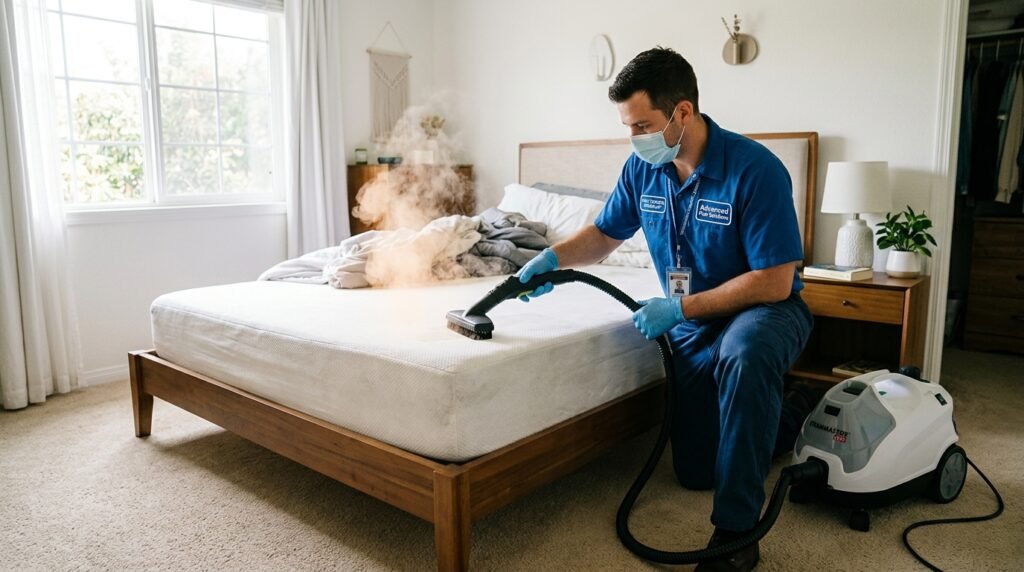
- 2. Steam Treatment — Effective DIY for Surfaces: A steam cleaner operating above 120°C (250°F) surface temperature kills bed bugs and eggs on direct contact. Can steam kill bed bug eggs? Yes — steam at this temperature kills eggs as well as all mobile stages. Move the nozzle no faster than 30cm per 10 seconds for adequate penetration. Never steam electrical outlets.
- 3. Dryer Kill — The Most Underused Method: The dryer is the single most effective household appliance for bed bug removal from laundry. Dryer kill bed bugs at any life stage when run on high heat for 30 minutes. The washing machine plays a supporting role — washing machine kill bed bugs is possible in a hot-water cycle (above 49°C), but vacuum bed bugs from seams before treating fabrics.
- 4. Vacuuming: Vacuum all mattress seams, bed frame joints, baseboards, and carpet edges with a strong-suction vacuum and crevice attachment. Immediately seal and dispose of the vacuum bag outside. Vacuuming alone does not eliminate an infestation but reduces population significantly and removes eggs and shed skins.
- 5. Mattress Encasements: Install a quality, bite-proof bed bug mattress encasement on both the mattress and box spring. Bugs already inside are trapped (and eventually die from starvation — up to 18 months for some). New bugs cannot establish. Our memory foam and hybrid mattress guide covers which mattress types are easiest to encase effectively.
- 6. Fumigation and Chemical Treatment: Professional fumigation and residual insecticide applications are used when heat treatment is impractical. Chemical resistance is a growing issue with some pyrethroids. A qualified bed bug exterminator will assess which chemical approach is appropriate and use extermination services that comply with integrated pest management protocols. The National Pest Management Association maintains a directory of certified professionals.
Preventing Bed Bugs: 12 Evidence-Based Steps
- Check hotel rooms before unpacking: This is how to check a hotel room for bed bugs: strip the sheets, inspect all four mattress corners and seams, and look behind the headboard. Keep your luggage on the metal luggage rack throughout the stay.
- Use UV inspection after travel: Run a 395nm UV flashlight over your luggage seams and inside pockets before bringing bags into your bedroom.
- Be cautious with Airbnb and holiday rentals: Bed bugs from Airbnb properties are a documented problem. Perform a full mattress and furniture inspection before sleeping, regardless of property condition.
- Never bring secondhand upholstered furniture indoors uninspected: Sofas, mattresses, and bed frames from thrift stores are a primary infestation vector. Bed bugs from thrift stores arrive hidden in seams and frame joints.
- Treat laundromat items immediately: Bed bugs from laundromats travel in shared dryers and folding tables. Transfer directly from a fresh dryer into a sealed bag without setting laundry down on shared surfaces.
- Check items from storage: Bed bugs from storage units are common. Inspect all furniture and soft goods thoroughly before returning them to your home. Can bed bugs survive in storage units? Yes — for months, even without a host.
- Install a bed bug mattress encasement: Encase both mattress and box spring immediately after an inspection confirms they are clean. Inspect and replace annually.
- Install bed bug interceptors: Place interceptor cups under all four bed legs. These smooth-sided traps catch bugs both ascending and descending, acting as both prevention and an early-warning monitoring system.
- Seal wall cracks and baseboard gaps: Caulk any gaps in baseboards, around electrical outlets, and at wall-floor junctions to block the wall void travel routes bed bugs use.
- Reduce bedroom clutter: Every item under the bed is a potential hiding place. Maintain a minimal sleeping area.
- Wash and dry all bedding weekly on high heat: This eliminates any eggs or early nymphs before they establish.
- Inspect guest rooms after visitors leave: Check mattress seams and wash all bedding on high heat regardless of whether you suspect an issue.
Bed Bugs vs Other Household Pests: Complete Comparison Guide
Misidentification leads to wasted treatment and ongoing bites. Here is a complete comparison of bed bugs against the household pests most frequently confused with them.
| Feature | Bed Bugs | Fleas | Carpet Beetles | Lice |
|---|---|---|---|---|
| Size | 5–7 mm | 1–4 mm | 1–4 mm | 2–4 mm |
| Bites humans | Yes — upper body | Yes — ankles/legs | No — eats fabric | Yes — scalp/skin |
| Jumps | No | Yes | No | No |
| Lives on host | No — feeds then hides | Yes (on pets) | No | Yes (on scalp) |
| Evidence | Feces, shed skins, stains | Flea dirt (pepper specks) | Damaged fabric/fibres | Nits on hair shafts |
The table above covers the most common comparisons. For additional comparisons — bed bugs vs ticks, bed bugs vs bird mites, bed bugs vs dust mites, bed bugs vs termites, bed bugs vs cockroaches, bed bugs vs bat bugs, and bed bugs vs stink bugs — the distinguishing features are: feeding behaviour (do they bite?), body structure (flat vs round, segmented vs unsegmented), and whether they infest bedding and furniture or other parts of the home. If you are genuinely uncertain, a pest inspection by a certified professional is the fastest resolution.
FAQ: UV Light And Bed Bugs
Does UV light kill bed bugs?
Do bed bugs glow under UV light?
What wavelength UV light is best for detecting bed bugs?
What does bed bug shed skin look like?
What do bed bug feces look like?
Do bed bugs jump?
Can bed bugs crawl?
How fast do bed bugs move?
Do bed bugs come out during the day?
Do bed bugs travel through walls?
Do bed bugs move room to room?
Do bed bugs multiply fast?
Can bed bugs climb metal?
Can bed bugs survive water?
Can bed bugs survive winter?
Can bed bugs survive in cold weather?
Can bed bugs live outside?
Can bed bugs survive outside in the rain?
Can you have only one bed bug?
How long can bed bugs live in a plastic bag?
How long can bed bugs live on clothes?
Can bed bugs follow you home?
Can bed bugs be transferred by clothes?
Can bed bugs survive in storage units?
Why do bed bugs bite only me?
Can bed bugs bite through clothes?
Can bed bugs bite through socks?
Do bed bugs leave blood stains?
Can dogs get bed bugs?
Can cats get bed bugs?
Do bed bugs bite pets?
Do pets carry bed bugs?
Do bed bugs travel on pets?

Final Verdict: Using UV Light Correctly Against Bed Bugs
- Buy a 395nm UV flashlight for detection: Use it regularly after travel, when buying secondhand furniture, and at hotel check-in. It will not show you live bugs, but it will reveal fecal stains, shed skins, and urine traces — the definitive evidence of a bed bug infestation.
- Use UV + blue light traps for passive monitoring: Place interceptors and UV/blue sticky traps under bed legs and in corners. They provide ongoing population data and reduce active insects without chemicals.
- Skip UV-C wands for treatment: They are dangerous, they cannot reach hidden bugs, and they represent a significant waste of money compared to proven alternatives.