
🌳 Landscape Timbers Selector
6 Types • Sizes • Cost • Installation • Durability • Complete Guide
• Chemically treated for durability
• Resistant to rot, insects, moisture
• Most common type available
• Affordable option
SPECIFICATIONS:
• Lifespan: 15–25 years
• Treatment: CCA, ACQ, or CA preservative
• Colors: Greenish to brownish tint
• Weight: Standard density
COST:
• 4×4: $2.50–$4.00 per foot
• 6×6: $4.00–$6.00 per foot
• Installation: $1–$2 per foot
BEST FOR:
✓ Retaining walls
✓ Raised beds
✓ Heavy-duty applications
✓ Budget-conscious projects
PROS:
✓ Affordable
✓ Readily available
✓ Easy to work with
✓ Long lifespan
CONS:
✗ Chemical treatment concerns
✗ May splinter
✗ Color fades/changes over time
✗ Not eco-friendly
• No chemical treatment
• Eco-friendly and natural
• Shorter lifespan
• Premium woods available
COMMON WOOD TYPES:
• Cedar: Most popular, naturally rot-resistant
• Redwood: Durable, attractive appearance
• Pine: Affordable untreated option
• Oak: Heavy and durable
COST:
• Cedar 4×4: $3.00–$6.00 per foot
• Redwood 4×4: $4.00–$8.00 per foot
• Pine 4×4: $1.50–$3.00 per foot
BEST FOR:
✓ Decorative borders
✓ Organic gardens
✓ Eco-conscious projects
✓ Premium aesthetics
PROS:
✓ Eco-friendly
✓ Attractive appearance
✓ No chemicals
✓ Natural aging patina
CONS:
✗ Shorter lifespan (5–15 years)
✗ More expensive per foot
✗ Requires more maintenance
✗ Splinters easily
• Made from plastic or wood-fiber composite
• Rot-proof and low-maintenance
• Modern appearance
• Eco-conscious option
SPECIFICATIONS:
• Lifespan: 25–30+ years
• Material: Recycled plastic/wood fibers
• Colors: Many options (brown, gray, black)
• Weight: Lighter than wood
COST:
• 4×4 equivalent: $6.00–$12.00 per foot
• Premium brands: $8.00–$15.00 per foot
• Installation: $1–$2 per foot
BEST FOR:
✓ Modern landscaping
✓ Wet areas/high moisture
✓ Low-maintenance projects
✓ Long-term investment
PROS:
✓ Rot-proof
✓ Low maintenance
✓ Long lifespan
✓ Many color options
✓ Recyclable
CONS:
✗ Higher initial cost
✗ Can feel plastic-like
✗ May fade in sun
✗ Not all recyclable
• Made from recycled rubber (tires)
• Flexible and impact-resistant
• Unique aesthetic options
• Safety-focused applications
SPECIFICATIONS:
• Lifespan: 20–30 years
• Material: Recycled rubber
• Colors: Black, colored options
• Weight: Moderate
COST:
• 4×4 equivalent: $4.00–$8.00 per foot
• Colored options: $6.00–$10.00 per foot
BEST FOR:
✓ Playgrounds
✓ Curved edging
✓ Safety applications
✓ High-traffic areas
PROS:
✓ Flexible
✓ Impact-resistant
✓ Eco-friendly (recycled)
✓ Safe for children
CONS:
✗ Rubber smell
✗ Heat absorption
✗ Not for all aesthetics
✗ Can stain clothes
• Heavy and extremely durable
• Designed to look like wood
• Permanent installation
• Maximum structural strength
SPECIFICATIONS:
• Lifespan: 50+ years
• Material: Reinforced concrete
• Colors: Gray, colored options
• Weight: 100–150 lbs per piece
COST:
• 4×4 equivalent: $3.00–$6.00 per foot
• 6×6 equivalent: $5.00–$8.00 per foot
• Installation: $2–$3 per foot (heavy)
BEST FOR:
✓ Retaining walls
✓ Structural landscaping
✓ Permanent installations
✓ Heavy-load applications
PROS:
✓ Extremely durable
✓ Permanent
✓ No maintenance
✓ Affordable
CONS:
✗ Very heavy
✗ Difficult to remove
✗ Less aesthetic variety
✗ Can look industrial
• Wood combined with metal supports
• Strong and long-lasting
• Modern, clean-edge designs
• Premium aesthetic
SPECIFICATIONS:
• Lifespan: 20–30+ years
• Material: Wood + steel/aluminum
• Colors: Many wood options
• Weight: Moderate to heavy
COST:
• 4×4 equivalent: $8.00–$15.00 per foot
• Premium options: $12.00–$20.00 per foot
• Installation: $2–$4 per foot
BEST FOR:
✓ Modern landscapes
✓ Premium projects
✓ Clean-edge designs
✓ High-end installations
PROS:
✓ Very strong
✓ Modern appearance
✓ Long lifespan
✓ Premium aesthetics
CONS:
✗ Most expensive option
✗ Specialized installation
✗ Limited availability
✗ Maintenance varies by wood
| Type | Cost/Foot | Lifespan | Maintenance | Best Use |
|---|---|---|---|---|
| Pressure-Treated | $2.50–$4 | 15–25 yrs | Low-Moderate | Retaining walls |
| Untreated/Natural | $1.50–$8 | 5–15 yrs | High | Decorative |
| Composite | $6–$15 | 25–30+ yrs | Very Low | Modern design |
| Rubber | $4–$10 | 20–30 yrs | Low | Playgrounds |
| Concrete | $3–$8 | 50+ yrs | None | Structural |
| Metal-Hybrid | $8–$20 | 20–30+ yrs | Moderate | Premium design |
2" × 4"
• Use: Light edging, borders
• Load capacity: Low
• Cost: $1.00–$2.00 per foot
• Best for: Flower beds, decorative
2" × 6"
• Use: Garden borders, light edging
• Load capacity: Low-Medium
• Cost: $1.50–$3.00 per foot
• Best for: Vegetable gardens
3" × 3"
• Use: Light-duty edging
• Load capacity: Low-Medium
• Cost: $1.50–$3.00 per foot
• Best for: Decorative accents
4" × 4" (MOST POPULAR)
• Use: Raised beds, edging, walls
• Load capacity: Medium-High
• Cost: $2.50–$6.00 per foot
• Best for: Most applications
5" × 5"
• Use: Medium-duty structures
• Load capacity: High
• Cost: $4.00–$8.00 per foot
• Best for: Tall raised beds
6" × 6" (HEAVY-DUTY)
• Use: Structural landscaping
• Load capacity: Very High
• Cost: $4.00–$9.00 per foot
• Best for: Large retaining walls
RAILROAD TIES
• Dimensions: 7" × 9" × 8.5 ft
• Use: Heavy-duty applications
• Load capacity: Very High
• Cost: $8.00–$15.00 each
• Best for: Large walls
6 Feet (1.8 m)
• Use: Small projects
• Common: Less popular
• Cost: $15–$35 per piece
8 Feet (2.4 m) - MOST POPULAR
• Use: Most standard applications
• Common: Readily available
• Cost: $20–$50 per piece
• Best for: Flexibility in layout
10 Feet (3 m)
• Use: Longer runs
• Common: Good availability
• Cost: $25–$60 per piece
• Best for: Fewer joints
12 Feet (3.6 m)
• Use: Large projects
• Common: Less readily available
• Cost: $30–$75 per piece
• Best for: Continuous sections
CUSTOM LENGTHS:
• Available from specialty suppliers
• Cost: Premium pricing
• Lead time: 2–4 weeks
• Best for: Specific projects
• Use: 2"×4" or 2"×6"
• Height: 2–4 inches above ground
• Cost: Most economical
FOR RAISED GARDEN BEDS:
• Use: 4"×4" or 5"×5"
• Height: 12–18 inches recommended
• Load: Medium (soil + water)
FOR RETAINING WALLS (Low):
• Use: 4"×4" single course
• Height: 12–24 inches
• Load: Medium (soil pressure)
FOR RETAINING WALLS (High):
• Use: 6"×6" or railroad ties
• Height: 24–48+ inches
• Load: High (significant pressure)
• Professional installation required
FOR DECORATIVE LANDSCAPING:
• Use: 3"×3" or 4"×4"
• Aesthetic priority
• Various heights acceptable
FOR WET AREAS/PONDS:
• Use: Composite or concrete
• Wood not recommended
• Specialty sizes available
1. Mark layout with string
2. Dig shallow trench (optional)
3. Place timbers
4. Secure with stakes (every 4–6 feet)
5. Backfill with soil
Time: 2–4 hours for 20 feet
Cost: Labor + materials
RAISED GARDEN BEDS:
1. Level ground area
2. Assemble timbers (corner braces/brackets)
3. Place in position
4. Add landscape fabric (optional)
5. Fill with soil
Time: 2–3 hours per bed
Cost: Moderate
RETAINING WALLS (Professional recommended):
1. Excavate base (compacted)
2. Install first course
3. Backfill behind timbers
4. Add landscape fabric for drainage
5. Stack additional courses
6. Add tie-backs for stability
Time: Professional installation
Cost: $20–$50 per linear foot (labor)
PROPER DRAINAGE INSTALLATION:
• Use landscape fabric behind wall
• Install drainage pipe if needed
• Slope backfill away from structure
• Critical for longevity
• Timbers (4×4): $40–$80
• Hardware/anchors: $10–$20
• Installation: $20–$40 (DIY)
• Total: $70–$140
MEDIUM RETAINING WALL (30 linear feet, 2 ft high):
• Timbers (6×6): $180–$360
• Hardware/fabric: $30–$60
• Installation: $300–$600 (professional)
• Total: $510–$1020
DECORATIVE BORDER (50 linear feet):
• Timbers (4×4): $125–$250
• Stakes/anchors: $20–$40
• Installation: $50–$100 (DIY)
• Total: $195–$390
COST FACTORS:
✓ Material type (biggest factor)
✓ Size/dimensions
✓ Length of project
✓ Installation complexity
✓ Local availability
✓ Delivery costs
• Inspect annually
• Seal every 2–3 years
• Remove debris/leaves
• Cost: $0.50–$1.00 per sq ft (sealing)
NATURAL WOOD:
• Inspect quarterly
• Oil/seal every 1–2 years
• More frequent maintenance
• Cost: $1.00–$2.00 per sq ft (sealing)
COMPOSITE TIMBERS:
• Clean 1–2 times per year
• No sealing needed
• Remove mold/algae if present
• Cost: Minimal
CONCRETE/RUBBER:
• Annual cleaning
• No treatment needed
• Very low maintenance
• Cost: Cleaning only
→ 3"×3" or 2"×4" Pressure-treated
→ Cost: $1–3 per foot
FLOWER BEDS (Decorative):
→ Cedar/Redwood 2"×6" or 4"×4"
→ Cost: $2–$8 per foot
VEGETABLE GARDEN RAISED BED:
→ Pressure-treated or Composite 4"×4"
→ Cost: $3–$10 per foot
LOW RETAINING WALL (1–2 ft):
→ Pressure-treated 4"×4" or 6"×6"
→ Cost: $3–$6 per foot
TALL RETAINING WALL (3+ ft):
→ Concrete or 6"×6" pressure-treated
→ Professional installation required
→ Cost: $20–$50 per foot (installed)
MODERN AESTHETIC:
→ Composite or Metal-Hybrid system
→ Cost: $6–$20 per foot
WET AREA/POND EDGE:
→ Composite or Concrete
→ Cost: $5–$12 per foot
• Higher walls need professional design
• Failure risk with improper installation
• Check local building codes
• Drainage critical for longevity
CHEMICAL SAFETY (Pressure-Treated):
• Modern treatments generally safe
• Older treatments (CCA) may contain arsenic
• Wash hands after handling
• Don't use in vegetable gardens (debate ongoing)
ENVIRONMENTAL IMPACT:
• Natural wood: Most eco-friendly
• Composite: Good for recycled content
• Pressure-treated: Chemicals considered
• Consider long-term vs short-term
LOCAL CODES:
• Some areas restrict certain materials
• Height limitations may apply
• Retaining walls may require permits
• Check before purchasing
Complete Landscape Timbers Selector Guide: 6 Types, Sizes, Costs, Installation & Complete Selection Solutions
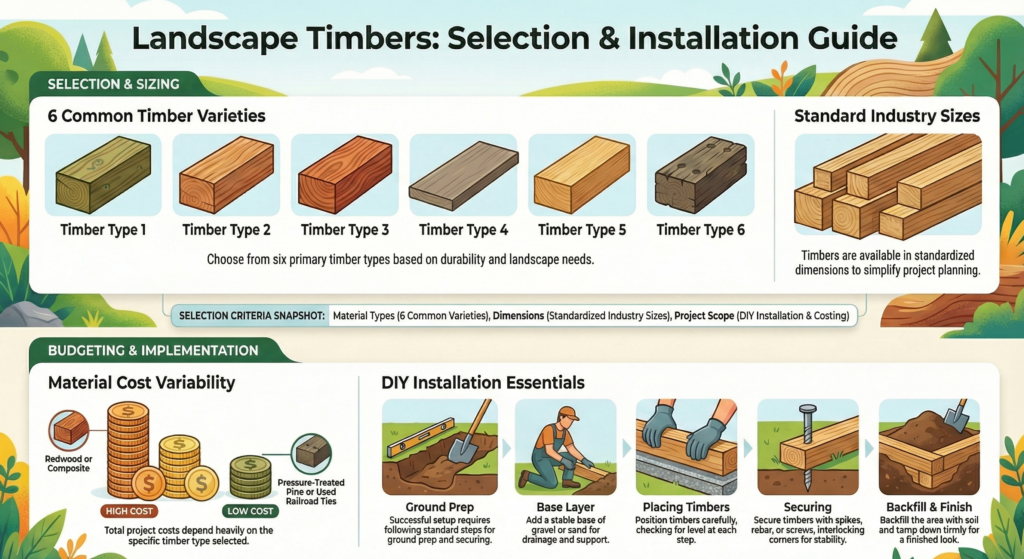
How to Choose and Install Landscape Timbers
Landscape timbers are structural edging and border materials used in landscaping for raised beds, retaining walls, decorative borders, and garden edging. Understanding timber types—whether you need pressure-treated wood for durability, untreated natural wood for eco-friendly projects, recycled plastic composites for low-maintenance modern landscaping, rubber timbers for flexible applications, concrete for permanent structures, or metal-reinforced hybrid systems for clean-edge designs—determines a project’s success, longevity, and maintenance requirements. This comprehensive guide covers all 6 major landscape timber types with detailed specifications, standard sizes (3″×3″ through 6″×6″, lengths 6–12 feet), material comparisons, cost analysis, installation methods, maintenance protocols, environmental considerations, and complete selection guidance for every landscaping application.
⚡ Get Started in 60 Seconds
CHOOSING LANDSCAPE TIMBERS? ANSWER 3 QUESTIONS:
Q1: What’s your application?
- Light edging → 3″×3″ or 4″×4″ untreated wood
- Raised beds → 4″×4″ or 5″×5″ pressure-treated
- Retaining walls → 6″×6″ pressure-treated or concrete
- Wet areas → Recycled plastic composite
- Decorative borders → Natural wood (cedar/redwood)
- Curved edging → Rubber timbers
- Playgrounds → Rubber timbers
- Modern design → Composite or metal-reinforced
Q2: How long do you need it to last?
- 5–10 years → Untreated natural wood
- 15–25 years → Pressure-treated wood
- 30+ years → Concrete, recycled plastic, or composite
- Permanent → Concrete or metal-reinforced
- Maintenance-free → Recycled plastic or composite
Q3: What’s your budget?
- Minimal → Untreated wood ($0.50–1.50/LF)
- Moderate → Pressure-treated ($1.00–3.00/LF)
- Higher → Composite/plastic ($3.00–8.00/LF)
- Premium → Concrete/metal-reinforced ($4.00–15.00/LF)
☑️ First Step: Determine application and location
📏 Size Selection: Choose appropriate dimensions
💰 Budget: Calculate total linear feet × cost
✅ Installation: Plan installation method
🎯 NEXT STEP: Find your timber type below

⚡ The 5-Minute Decision Tree
QUESTION 1: What’s your main purpose?
🌳 Raised Bed → 4″×4″ or 5″×5″ pressure-treated
🌳 Garden Border/Edging → 3″×3″ or 4″×4″ untreated
🌳 Retaining Wall → 6″×6″ pressure-treated or concrete
🌳 Decorative Border → Natural wood (cedar/redwood)
🌳 Wet Area/Near Water → Recycled plastic or composite
🌳 Curved/Flexible Edge → Rubber timbers
🌳 Playground → Rubber timbers
🌳 Modern Design → Composite or metal-reinforced
QUESTION 2: What’s your climate?
☀️ Dry/Arid → Natural wood acceptable
🌧️ Wet/Humid → Pressure-treated or composite (NOT untreated)
❄️ Cold/Snow → Pressure-treated or composite
🌴 Tropical/Humid → Composite or plastic (rot risk with wood)
☁️ Temperate → Any type works
QUESTION 3: How much maintenance?
⏰ None Preferred → Composite, plastic, or concrete
⏰ Minimal → Pressure-treated (occasional inspection)
⏰ Regular → Natural wood (annual sealing)
⏰ Professional → Consider concrete for walls

Understanding Landscape Timbers
What Are Landscape Timbers?
Definition: Large rectangular wood or composite materials used for edging, borders, retaining walls, raised beds, and other structural landscaping applications.
Key Characteristics:
- Large cross-sections (3″–6″ typical)
- Long lengths (6–12 feet typical)
- Designed for outdoor durability
- Support significant weight/pressure
- Create defined edges and structures
Primary Uses:
- Garden edging and borders
- Raised garden beds
- Retaining walls
- Decorative landscaping features
- Stacked structures
- Curved landscape elements
Load Requirements:
- Light edging: Minimal structural load
- Raised beds: Moderate containment pressure
- Retaining walls: High structural load (soil pressure)
- Playground borders: Impact and flex requirements
6 Common Types of Landscape Timber

TYPE 1: Pressure-Treated Wood Timbers And Ground Contact Solutions
Description: Chemically treated wood landscape timbers offer exceptional durability and resistance to rot, insects, and moisture—making them ideal for ground contact landscape timber applications. These pressure-treated landscape timber options are best for constructing retaining walls, building raised beds, and heavy outdoor use. Whether you’re installing treated wood landscape timbers for permanent structures or seeking ground contact solutions that withstand direct soil exposure, pressure-treated timber delivers proven longevity for demanding landscaping applications.
How It Works:
- Wood treated with preservative chemicals
- Chemicals prevent rot and insect damage
- Pressure forces chemicals deep into wood
- Creates long-lasting protection
Chemical Options:
Copper-Based Preservative (Modern Standard)
- CCA (Copper Chromium Arsenic) — largely phased out
- ACQ (Alkaline Copper Quaternary) — current standard
- CA (Copper Azole) — newer option
- Least toxic modern option
Key Advantage:
- Safer than older arsenic-based treatments
- Still extremely durable
- Best for food gardens (ACQ/CA considered safe)
Specifications:
Standard Sizes
- 3″×3″ (light-duty)
- 4″×4″ (most common)
- 5″×5″ (medium-duty)
- 6″×6″ (heavy-duty, structural)
Common Lengths
- 6 feet
- 8 feet (most popular)
- 10 feet
- 12 feet
Thickness After Treatment
- Actual: ~1/4″–1/2″ smaller than nominal
- Example: Nominal 4″×4″ = actual ~3.5″×3.5″
Weight (Approximate)
- 4″×4″×8′: 30–40 lbs (varies by moisture)
- 6″×6″×8′: 50–70 lbs
- Very heavy when wet
Durability & Lifespan
- Ground contact: 15–25 years
- Above ground: 25–40+ years
- Depends on climate and drainage
- Generally, the longest-lived wood option
Cost Range
- 4″×4″: $3–6 per linear foot
- 6″×6″: $4–8 per linear foot
- 8′ lengths are a typical reference
- Bulk discounts available for large projects
Best Applications
- Retaining walls
- Raised garden beds (food-safe option)
- Heavy-duty edging
- Stacked structures
- Long-term installations (15+ years)
Advantages
- Extremely durable
- Handles weight/soil pressure
- Long lifespan
- Affordable
- Widely available
- Can be stacked for height
Disadvantages
- Requires occasional maintenance
- Splinters over time
- Chemicals are still present (safer but present)
- Becomes gray/weathered
- Heavy to handle/install
- Eventual replacement needed
Lorem ipsum dolor sit amet, consectetur adipiscing elit. Ut elit tellus, luctus nec ullamcorper mattis, pulvinar dapibus leo.

TYPE 2: Untreated (Natural) Wood Timbers for Organic Landscaping
Description: Natural, untreated landscape timbers offer eco-friendly solutions without chemical treatments. Common woods like cedar, redwood, and pine provide beautiful wood landscape timbers ideal for decorative borders and organic garden applications. These untreated landscape timbers work wonderfully for projects where you want to avoid treated-wood chemicals while maintaining aesthetic appeal.
Wood Species Options:
Cedar Untreated Landscape Timbers
- Durability: 10–15 years
- Natural resistance: Good (tannins)
- Cost: $2–5 per linear foot
- Appearance: Attractive, reddish tone
- Best for: Above-ground applications, showcasing natural wood aesthetic
Redwood Untreated Options
- Durability: 15–20 years
- Natural resistance: Excellent (contains tannins)
- Cost: $3–7 per linear foot
- Appearance: Beautiful, warm tone
- Best for: Premium aesthetic landscaping with wood landscape timbers
Douglas Fir Landscape Timber Solutions
- Durability: 5–10 years (lower resistance, alternative to treated)
- Natural resistance: Low (needs sealing)
- Cost: $0.50–2 per linear foot
- Appearance: Tan/golden
- Best for: Budget applications, choosing untreated alternatives
Pine Wood Timbers
- Durability: 3–8 years (poorest resistance among untreated landscape timbers)
- Natural resistance: Very low
- Cost: $0.50–1.50 per linear foot
- Appearance: Light/pale
- Best for: Temporary applications, ornamental use, decorative borders
Specifications:
Common Sizes
- 2″×4″ (light edging)
- 2″×6″ (garden borders)
- 3″×3″ (light-duty edging)
- 4″×4″ (decorative use, shorter spans)
Typical Lengths
- 6 feet
- 8 feet
- 10 feet
Moisture Content at Delivery
- Green (high moisture): 30–50% MC
- Kiln-dried: 12–20% MC
- Affects weight and shrinkage
Weight Considerations
- Green (wet): Extremely heavy
- Kiln-dried: Much lighter, easier to handle
- Cedar/redwood is lighter than pine/fir
Durability & Lifespan
- Cedar/redwood untreated: 10–20 years
- Douglas fir: 5–10 years
- Pine: 3–8 years
- Highly dependent on climate and drainage
- Can be extended with sealing (annual)
Cost Range
- Cedar 4″×4″: $2–4 per linear foot
- Redwood 4″×4″: $3–6 per linear foot
- Douglas fir 4″×4″: $0.75–2 per linear foot
- Price varies significantly by availability
Best Applications
- Decorative borders
- Raised beds (organic gardens—no chemicals)
- Above-ground edging
- Aesthetic landscaping
- Short-term installations (5–15 years)
- Regions with lower moisture
Advantages
- Eco-friendly (no chemicals)
- Beautiful natural appearance
- No chemical concerns for food gardens
- Lighter than pressure-treated (easier install)
- Aesthetic appeal
- Lower cost (some species)
Disadvantages
- Shorter lifespan than pressure-treated
- Requires sealing/maintenance (annual typical)
- Prone to rot in wet areas
- Not suitable for ground contact long-term
- Insect susceptibility (without treatment)
- Eventually, it must be replaced
- More expensive species (cedar/redwood) cost more initially

TYPE 3: Recycled Plastic & Composite Landscape Timber Systems
Description: Composite landscape timbers and recycled plastic landscape timber solutions combine plastic or wood-fiber blends to deliver rot-proof, low-maintenance performance. These synthetic landscape timbers eliminate wood-replacement concerns, making them ideal for modern landscaping in wet areas and for maintenance-free projects. Whether you choose composite landscape timber options or pure recycled plastic landscape timber products, these alternatives deliver 25-50-year lifespans without the traditional wood drawbacks.
Material Composition:
Plastic-Based Composite Solutions
- 50–100% recycled plastic landscape timber content
- Plastic lumber (HDPE, LDPE options)
- Wood fibers are sometimes added to recycled plastic landscape timber formulas
- Very durable, rot-proof synthetic landscape timber option
Wood-Plastic Composite (WPC) Landscape Timber Blend
- Mix: Plastic + wood fibers in recycled plastic composite timber (typically 50/50)
- Combined durability benefits in a composite landscape timber structure
- More “wood-like” appearance than pure plastic landscape timbers
- Often brown/gray tones mimicking traditional wood landscape timbers
Specifications:
Sizes Available
- 3″×3″ (light edging)
- 4″×4″ (most common)
- 5″×5″
- 6″×6″ (heavier composite)
- Non-standard sizes are sometimes available
Lengths
- 6 feet
- 8 feet (most common)
- 10 feet
- 12 feet
- Custom lengths are sometimes available
Weight
- Lighter than wood (easier to install)
- 4″×4″ composite: ~25–35 lbs (vs. 30–40 lbs pressure-treated)
- Varies by composite formula
Durability & Lifespan
- Ground contact: 25–40+ years
- Above ground: 30–50+ years
- No rot, no insect damage
- UV fading possible (darkens or lightens)
- Color changes are common, but structural integrity is maintained
Appearance Changes
- Plastic darkens over time
- Can fade with UV exposure
- Develops weathered patina
- Usually considered an acceptable aesthetic
Cost Range
- 4″×4″: $4–8 per linear foot
- 5″×5″: $6–10 per linear foot
- 6″×6″: $7–12 per linear foot
- 2–3× cost of pressure-treated
Best Applications
- Raised beds (wet areas, food-safe)
- Retaining walls (maintenance-free)
- Near water/wet areas
- Areas with high moisture
- Playground borders
- Modern landscape designs
- Long-term installations (25–40+ years)
Advantages
- Extremely long lifespan
- Rot-proof (no replacement)
- Maintenance-free (no sealing)
- No splinters
- Won’t attract insects
- Food-safe (no chemicals)
- Better for the environment (recycled materials)
- Consistent appearance
Disadvantages
- Higher initial cost
- Less “authentic” appearance (varies by product)
- Can feel plastic-like
- Limited color options
- Thermal expansion/contraction (can loosen connections)
- Some products are less rigid than wood
- Color fading/UV changes are visible

TYPE 4: Rubber Landscape Timbers
Description: Made from recycled rubber (tires). Flexible and impact-resistant. Best for playgrounds, curved edging, and areas requiring flexibility.
Material Composition:
- Recycled rubber (typically tire rubber)
- Binding agents/polymers
- Formed into timber-like shapes
- 100% recycled content is often available
Specifications:
Sizes Available
- 3″×3″ (typical)
- 4″×4″ (common)
- 5″×5″ (less common)
- Non-standard dimensions are sometimes offered
Lengths
- 6 feet
- 8 feet
- Custom lengths available
Flexibility
- Bends and flexes (unlike wood/concrete)
- Allows curved installations
- Impact-absorbing
- Spring-like underfoot (playgrounds)
Weight
- Lighter than wood/concrete
- Easy to handle
- Example: 4″×4″×8′ rubber ~ 20–30 lbs
Durability & Lifespan
- Long lifespan (25–40+ years)
- UV resistant
- Won’t rot or deteriorate
- Color may fade slightly
- Rubber may harden/crack in extreme cold
- Flexibility decreases over time
Cost Range
- 4″×4″: $3–6 per linear foot
- More expensive than pressure-treated
- Less expensive than some composites
Best Applications
- Playground borders/safety edging
- Curved garden edging
- Flexible landscape features
- Areas requiring impact resistance
- Athletic fields
- Dog run borders
- Decorative curved installations
Advantages
- Flexible (curves easily)
- Durable (25–40+ years)
- Impact-absorbing (safety)
- Lightweight (easy install)
- Recycled material (eco-friendly)
- Won’t rot
- No splinters
- Colorful options available
Disadvantages
- Less aesthetic appeal (plastic-like)
- Not suitable for structural walls
- Limited availability
- Rubber smell (fresh rubber—dissipates)
- May harden in cold climates
- Less rigid than wood
- Not load-bearing for walls
- Limited structural applications

TYPE 5: Concrete Landscape Timbers
Description: Heavy and extremely durable. Often designed to look like wood. Best for retaining walls, structural landscaping, and permanent installations.
Material Composition:
- Portland cement, aggregate, water
- Sometimes includes wood-grain texture
- Reinforcing (sometimes internal rebar)
- Solid, monolithic structure
Finishes Available:
Wood-Grain Texture
- Mimics wood appearance
- Aesthetic appeal
- Cost premium
- Darkens over time (visually similar to wood)
Smooth/Plain Finish
- Industrial appearance
- Lower cost
- More contemporary look
- Less disguise of concrete nature
Color Options
- Gray (natural concrete)
- Brown/tan (colorants)
- Varied colors are possible with colorants
Specifications:
Sizes Available
- 4″×4″ (less common, difficult to produce)
- 6″×6″ (standard for walls)
- 8″×8″ (large walls)
- 4″×6″ (sometimes available)
- 6″×8″ (specialized applications)
Lengths
- 6 feet (typical)
- 8 feet (common)
- 10 feet (large installations)
- Custom available but expensive
Weight (Very Heavy)
- 6″×6″×8′: 200–250 lbs
- Requires equipment/machinery for installation
- Example: Professional installation recommended
Durability & Lifespan
- 50–100+ years
- Permanent installation
- Will not rot, decay, or deteriorate
- Weather resistant
- Freeze-thaw resistant (if properly made)
- May develop minor surface cracks (normal)
Cost Range
- 6″×6″: $8–15 per linear foot
- 8″×8″: $12–20 per linear foot
- Installed cost: Often 2–3× material cost (heavy equipment)
- Bulk projects may negotiate pricing
Best Applications
- Retaining walls (permanent)
- Structural landscaping
- Heavy-load applications
- Long-term installations (50+ years)
- Commercial properties
- Applications where rot/replacement is unacceptable
Advantages
- Extremely durable (50–100+ years)
- Won’t rot, decay, or deteriorate
- Permanent solution (no replacement)
- Low maintenance
- Professional appearance
- Load-bearing (suitable for walls)
- Available in a wood-like appearance
- Cost-effective over the long term
Disadvantages
- Very heavy (requires equipment)
- High installation cost (usually professional)
- Difficult to modify/relocate
- Permanent placement (not flexible)
- Higher initial material cost
- Concrete appearance (even with texture)
- May develop surface cracks
- Limited customization
- Overkill for small projects

TYPE 6: Metal-Reinforced Timber Systems (Hybrid)
Description: Wood combined with metal supports. Strong and long-lasting. Best for modern, clean-edge designs. Premium hybrid option.
System Types:
Steel-Framed Wood Composite
- Wood composite facing
- Galvanized/stainless steel frame
- Combines aesthetic with durability
Metal Bracket-Reinforced Timber
- Pressure-treated wood boards
- Metal corner brackets and supports
- Metal tension straps/cables
- Allows taller walls with a wood appearance
Specifications:
Typical Configuration
- Wood facing boards (pressure-treated or composite)
- Metal frame/supports (steel or aluminum)
- Metal bracket reinforcement (visible or hidden)
- Modular stacking possible
Sizes
- Variable (custom to design)
- 4″ board typical
- 6″ board common for walls
- Custom dimensions possible
Lengths
- 6–12 feet (depends on metal support system)
- Custom lengths with fabrication
Weight
- Heavier than wood alone
- Metal components add significant weight
- Professional installation is typically needed
Durability & Lifespan
- Very long (25–50+ years)
- Metal corrosion resistance is critical
- Galvanized or stainless steel recommended
- Regular inspection of connections
Cost Range
- Higher than standard wood ($6–15/LF)
- Installation costs are high (specialized)
- Custom fabrication can increase cost
- Prices vary widely based on design
Best Applications
- Modern landscape designs
- High walls requiring structural support
- Areas combining aesthetics with durability
- Contemporary residential projects
- Premium installations
- Custom landscape features
Advantages
- Combines wood appearance with durability
- Very strong (handles tall walls)
- Modern aesthetic
- Long lifespan
- Professional appearance
- Structural integrity for height
Disadvantages
- High cost (materials + specialized installation)
- Requires professional installation
- Limited availability (custom systems)
- Maintenance of metal components
- Corrosion risk if not properly galvanized
- Specialized expertise needed
- Overkill for simple applications
Find Your Perfect Fit
Standard Cross-Sections Explained
3″×3″ Timbers
Use: Light edging, decorative borders, small raised beds
Specifications:
- Actual size: ~2.5″×2.5″ (pressure-treated)
- Untreated: Varies by species
- Weight (4″ treated): 5–8 lbs
- Weight (8′ treated): 10–15 lbs
Applications:
- Decorative borders
- Flower bed edges
- Small raised beds
- Low structural requirements
Cost: $1.50–3 per linear foot
4″×4″ Timbers (Most Common)
Use: General-purpose edging, raised beds, medium walls
Specifications:
- Actual size: ~3.5″×3.5″ (pressure-treated)
- Height for walls: 12″ = 3 high, 24″ = 6 high
- Weight (8′ treated): 30–40 lbs
- Weight (8′ composite): 25–35 lbs
- Weight (8′ untreated): 25–35 lbs
Applications:
- Raised garden beds (most common use)
- Retaining walls (under 3 feet)
- Garden borders
- Decorative edging
- General landscaping
Cost Range:
- Pressure-treated: $2–4 per linear foot
- Untreated (cedar): $2–5 per linear foot
- Composite: $4–8 per linear foot
- Rubber: $3–6 per linear foot
Capacity/Span:
- Unsupported span: 8–10 feet typical
- With stakes: Can span further
- Wall height: 3–4 feet max (single row 4×4s)
5″×5″ Timbers
Use: Medium-duty applications, taller walls, storage.
Specifications:
- Actual size: ~4.5″×4.5″ (pressure-treated)
- Height for walls: 12″ = 2.67 high
- Weight (8′ treated): 45–55 lbs
- Less common than 4×4
Applications:
- Taller walls (4–5 feet with multiple rows)
- Heavy-duty raised beds
- Storage boxes
- Decorative stacked designs
Cost: $3–6 per linear foot (moderate premium over 4×4)
6″×6″ Timbers
Use: Heavy-duty retaining walls and structural applications.s
Specifications:
- Actual size: ~5.5″×5.5″ (pressure-treated)
- Wall height: 12″ = 2 high
- Weight (8′ treated): 50–70 lbs
- Professional installations are typically needed
Applications:
- Retaining walls (5–8 feet)
- Structural landscaping
- Heavy-load applications
- Permanent installations
- Composite/concrete alternative to stacked 4×4s
Cost: $4–8 per linear foot (pressure-treated)
Other Common Sizes:
2″×4″ Timbers
- Light edging only
- Cost: $0.50–2 per linear foot
- Not for structural use
2″×6″ Timbers
- Garden borders
- Light raised beds
- Cost: $1–3 per linear foot
- More common than 2″×4″
Railroad Ties
- Approx. 7″×9″×8.5 feet
- Heavy-duty (can be creosote-treated)
- Very durable but heavy
- Cost: $10–25 per tie
- Heavy machinery is needed for installation
- Environmental concerns (older ties may have toxins)
Choose your length
Standard Length Options
6 Feet (1.8 m)
- Shortest standard Length
- Good for small projects
- More pieces needed for long runs
- Easier to transport
- Cost: Slightly premium length foot
- Use: Small gardens, curves, tight spaces
8 Feet (2.4 m) — Most Popular
- Standard Length (most common offering)
- Good balance of span and number of pieces
- Cost: Mid-range per linear foot
- Availability: Excellent
- Use: Most projects, best economics
10 Feet (3 m)
- Less common, harder to find
- Longer spans (fewer connections)
- Cost: Slight premium over 8′
- Availability: Vlengthe by supplier
- Use: Large-area projects, fewer seams
12 Feet (3.6 m)
- Longest standaLengthgth
- Rare (special order usually)
- Cost: Premium
- Requires special transport
- Use: Vlengthrge project length commercial work
How to Calculate Linear Feet Needed
Formula: PerimetLengthgth ÷ TimbLengthgth = Number of Pieces
Example:
- 4″×4″ raised bed, 24 feet perimeter
- Using 8-foot timbers: 24 ÷ 8 = 3 timbers needed
- Corner overlap: Plan 2–4 inches extra per corner
Corner Considerations:
- Cut joints reduce the timber length available
- Add 10% extra for waste/corners
- Example: Calculate 1.1× the theoretical need
Comparing Materials: A Side-by-Side Chart
Quick Comparison (By Key Factors)
Pressure-Treated Wood
- Cost: $$
- Durability: 15–25 years
- Maintenance: Minimal (inspect)
- Appearance: Natural wood (grays over time)
- Weight: Heavy
- Best for: Raised beds, general use
- Difficulty to install: Easy
Untreated Natural Wood
- Cost: $ to $$$
- Durability: 5–20 years (species-dependent)
- Maintenance: Annual sealing recommended
- Appearance: Beautiful natural wood
- Weight: Light to moderate
- Best for: Decorative, organic gardens
- Difficulty to install: Easy
Recycled Plastic/Composite
- Cost: $$$
- Durability: 25–40+ years
- Maintenance: None (no sealing)
- Appearance: Plastic-like (mimics wood)
- Weight: Light
- Best for: Modern design, wet areas
- Difficulty to install: Easy
Rubber Landscape Timbers
- Cost: $$
- Durability: 25–40+ years
- Maintenance: None
- Appearance: Plastic-like, rubbery
- Weight: Light
- Best for: Curved edging, playgrounds
- Difficulty to install: Easy
Concrete Landscape Timbers
- Cost: $$$
- Durability: 50–100+ years
- Maintenance: Minimal
- Appearance: Concrete (gray, textured options)
- Weight: Very heavy
- Best for: Permanent walls, heavy-duty
- Difficulty to install: Hard (professional recommended)
Metal-Reinforced Hybrid
- Cost: $$$$ (premium)
- Durability: 25–50+ years
- Maintenance: Metal inspection needed
- Appearance: Modern, clean-edge design
- Weight: Heavy
- Best for: Modern design, tall structures
- Difficulty to install: Hard (professional recommended)
How to Install Landscape Timbers
Method 1: Simple, Stake-Free Edging Installation
Best For: Light landscape timber edging, shallow borders, decorative landscape timber applications
Tools Needed:
- Shovel
- Level
- Gloves
- Optional: Landscape fabric
How to Install Landscape Timbers for Simple Edging:
Step 1: Prepare ground (15 min per 100 LF)
- Clear vegetation from the area
- Rough level ground
- Remove large rocks/roots from the timber installation area
Step 2: Layout Timber (10 min per 100 LF)
- Place timber on prepared ground
- Check the level with a spirit level
- Adjust as needed for installing landscape timbers
Step 3: Level Ground Under Timber (15 min per 100 LF)
- Ensure timber sits flat for proper landscape timber edging
- Add/remove soil as needed
- Pack soil firmly to anchor landscape timber edges
Step 4: Complete Installation (10 min)
- Final level check for landscape timber placement
- Install landscape fabric if needed (optional for landscape timber borders)
Total Installation Time: 50 min per 100 LF
Cost: Materials only (no special equipment for landscape timber edging installation)
Method 2: Installing Landscape Timbers with Stakes
Best For: Raised beds using landscape timbers, garden borders, moderate-height retaining walls with landscape timbers
Tools Needed:
- Shovel or post-hole digger
- Mallet or sledgehammer
- Level
- Tape measure
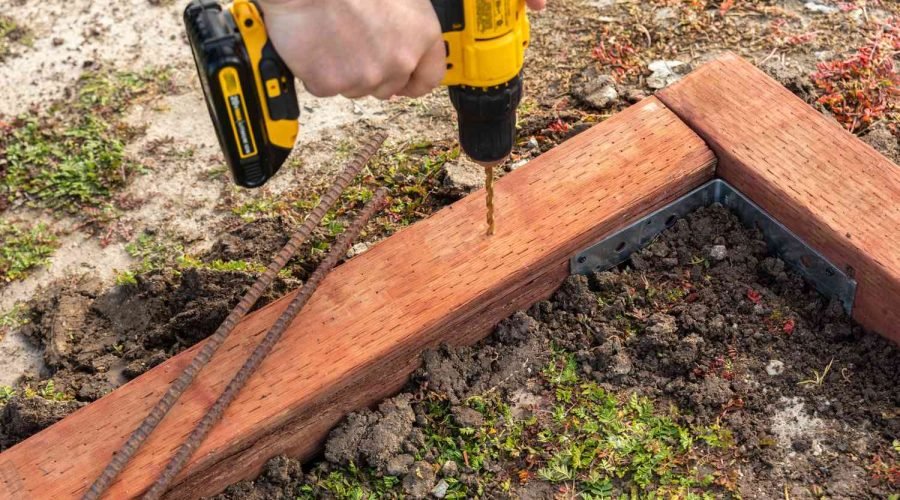
- Drill (for fastening bolts/screws when attaching landscape timbers)
Stake Options for Securing Landscape Timbers:
- Wooden stakes (2″×2″) for staking landscape timbers
- Steel posts (rebar or T-posts) for anchoring landscape timbers
- Metal brackets for connecting landscape timbers
How Do You Install Landscape Timbers Using Stakes:
Step 1: Prepare ground (15 min per 100 LF)
- Clear area for landscape timber installation
- Level roughly for installing landscape timbers
Step 2: Mark Stake Locations (10 min per 100 LF)
- Mark every 4–6 feet for landscape timber spacing
- Mark corners for turning landscape timber sections
- Use chalk/spray paint for marking landscape timber stake locations
Step 3: Drive Stakes (20 min per 100 LF)
- Drive stakes 12–18″ into the ground when installing landscape timbers
- Leave 6–8″ above ground for connecting landscape timbers
- Use a mallet/sledgehammer for staking landscape timber posts
- Ensure stakes are vertical (use level) when securing landscape timbers
Step 4: Position Timber (15 min per 100 LF)
- Place timber against stakes when attaching landscape timbers
- Ensure the level for proper landscape timber installation
- Adjust the ground as needed when installing landscape timbers
Step 5: Fasten Timber to Stakes (15 min per 100 LF)
- Drill holes if needed (prevent splitting when attaching landscape timbers)
- Use bolts, screws, or nails for connecting landscape timbers
- Fasteners every 12–16″ along the timber when attaching landscape timber sections
- Ensure tight connections when securing landscape timbers to stakes
Step 6: Final Inspection (10 min)
- Check all connections when installing landscape timbers
- Verify the level after the landscape timber installation
- Ensure no gaps in landscape timber installation
How to Connect Landscape Timbers Properly:
- Overlap joints by 6-12 inches
- Use bolts or heavy-duty screws for connecting landscape timber sections
- Ensure landscape timber connections are secure and level
How to Secure Landscape Timbers to the Ground:
- Proper stake depth critical (12-18 inches minimum)
- Close stake spacing ensures landscape timber stability
- Backfill compaction helps anchor landscape timbers
Total Installation Time: 85 min per 100 LF
Cost: Materials + labor (tools you may own)
Method 3: Professional Installation for Retaining Walls and Heavy-Duty Timber Projects
Best For: Retaining walls using landscape timbers, tall structures, concrete timbers, and how to build retaining walls with landscape timbers
Equipment Needed for Installing Landscape Timbers Professionally:
- Excavator or heavy equipment for landscape timber installation
- Professional crew for installing landscape timbers
- Landscape contractors experienced in landscape timber installation
How to Build a Retaining Wall with Landscape Timbers – Professional Method:
Step 1: Site Preparation (varies)
- Excavate base (level foundation critical for landscape timber walls)
- Backfill material Preparation for landscape timber retaining walls
- Drainage planning for landscape timber walls
Step 2: Foundation Preparation (1+ day)
- Compact the base soil before installing landscape timbers
- May include a gravel base under landscape timber walls
- Level to within 1″ for landscape timber installation
Step 3: Timber Placement & Stacking (1–2 days)
- Position the first row when installing landscape timbers
- Use equipment to place heavy landscape timber sections
- Backfill behind landscape timber rows
- Compact backfill after placing landscape timbers
- Stack subsequent landscape timber rows
Step 4: Drainage & Backfill (1+ days)
- Install a drainage system behind landscape timber walls
- Backfill compaction is critical for landscape timber stability
- Proper compaction prevents landscape timber wall failure
Step 5: Final Inspection (varies)
- Check levels of landscape timber installation
- Verify backfill compaction under landscape timber walls
- Ensure drainage function behind landscape timber structures
How to Install Landscape Timbers on a Slope:
- Slope-specific installation requires proper grading
- Landscape timber placement must account for grade
- Professional assessment recommended for slope landscape timber installation
Total Installation Time: 2–5 days typical (depends on retaining wall size with landscape timbers)
Cost: Professional landscape timber installation $1,000–5,000+ (depends on project scale)
Care and Maintenance Guide
Regular Maintenance by Type
Pressure-Treated Wood
- Frequency: Quarterly inspection
- Tasks: Check for splinters, loose connections
- Cost: Minimal (occasional seal coat optional)
- Lifespan extension: Seal coat every 2–3 years ($0.50–1/LF annually)
Untreated Natural Wood
- Frequency: Annual (before winter)
- Tasks: Apply seal/stain
- Cost: $0.50–1.50/LF for sealing
- Lifespan extension: Essential (doubles lifespan without sealing)
Recycled Plastic/Composite
- Frequency: Annual inspection
- Tasks: Check for damage
- Cost: None (maintenance-free)
- Notes: Clean if heavily soiled
Rubber Timbers
- Frequency: Annual inspection
- Tasks: Check for hardening/cracks
- Cost: None
- Notes: May need UV treatment if desired (not necessary)
Concrete
- Frequency: Annual inspection
- Tasks: Clean surface, check for cracks
- Cost: Minimal (power wash $0.10–0.25/LF)
- Notes: Seal every 5–7 years ($0.25–0.50/LF)
Metal-Reinforced Hybrid
- Frequency: Bi-annual inspection
- Tasks: Check metal for corrosion, connections secure
- Cost: Varies (repair as needed)
- Notes: Critical to catch corrosion early
Troubleshooting Common Issues
Problem 1: Wood Rot (Pressure-Treated or Untreated)
- Cause: Moisture, inadequate drainage
- Solution: Improve drainage, replace the rotted section
- Prevention: Better drainage design, regular sealing
Problem 2: Splinters (All Wood Types)
- Cause: Weathering, wood drying
- Solution: Sand or a plane surface
- Prevention: Seal regularly, replace aged wood
Problem 3: Loose Connections
- Cause: Movement, fastener loosening
- Solution: Retighten bolts/screws
- Prevention: Check connections quarterly
Problem 4: Uneven Settlement
- Cause: Poor base preparation, backfill settlement
- Solution: Add shims, releveling (complex for walls)
- Prevention: Proper base preparation, adequate compaction
Problem 5: Cracking (Concrete)
- Cause: Freeze-thaw, settling, shrinkage
- Solution: Seal cracks to prevent water penetration
- Prevention: Proper concrete mix, curing
Problem 6: Fading/Color Change (Composite)
- Cause: UV exposure, weathering
- Solution: Accept as normal (purely aesthetic)
- Prevention: None (normal process)
Cost Breakdown and Budget Allocation
Material Costs Per Linear Foot
Pressure-Treated wood (4″×4″)
- Cost range: $2–4 per linear foot
- 8-foot timber: $16–32
- 100 linear feet: $200–400
Untreated wood (4″×4″)
- Cedar: $2–5 per linear foot
- Redwood: $3–7 per linear foot
- Douglas Fir: $0.75–2 per linear foot
Recycled Plastic/Composite (4″×4″)
- Cost range: $4–8 per linear foot
- Premium over pressure-treated: 100–200%
Rubber Timbers (4″×4″)
- Cost range: $3–6 per linear foot
- Mid-range option
Concrete Timbers (6″×6″)
- Cost range: $8–15 per linear foot
- Material only (installation additional)
Metal-Reinforced Hybrid
- Cost range: $6–15 per linear foot
- Highly variable by design
Estimated Installation Costs
Simple Edging (DIY)
- Labor: Minimal (you)
- Equipment: Tools you own
- Cost per LF: $0–1 (labor only)
Staked Installation (DIY)
- Labor: 2–3 hours per 100 LF
- Equipment: Basic tools
- Cost per LF: $0–2 (labor only)
Professional Installation (Contractor)
- Typical cost: $2–5 per linear foot (labor)
- Varies by complexity and location
- Retaining walls (tall): More complex, higher cost
Heavy-Duty Retaining Wall
- Material: $1,000–3,000+
- Installation: $2,000–8,000+
- Total: $3,000–11,000+ (depending on height/length)
Project Portfolio Examples
Small Raised Bed (4’×8′ = 24 LF)
- Pressure-treated 4″×4″: 24 LF × $2.50 = $60
- Stakes/hardware: $20
- Installation (DIY): Free
- Total: $80
Medium Raised Bed (8’×16′ = 48 LF)
- Pressure-treated 4″×4″: 48 LF × $2.50 = $120
- Stakes/hardware: $40
- Installation (DIY): Free
- Total: $160
Retaining Wall (50 feet × 3 feet high = 150 LF)
- Material (pressure-treated 4″×4″): 150 LF × $2.50 = $375
- Stakes/hardware: $150
- Professional installation: 150 LF × $3 = $450
- Total: $975
Premium Project (Composite, Professional Install)
- Material (composite 4″×4″): 150 LF × $6 = $900
- Stakes/hardware: $200
- Professional installation: 150 LF × $4 = $600
- Total: $1,700
The Environmental Footprint
Environmental Impact
Pressure-Treated Wood
- Environmental impact: Moderate
- Chemicals: Present (safer modern versions)
- Lifespan benefit: Very long (less replacement)
- Sustainability: Moderate (less frequent replacement)
- Food safety: ACQ/CA treatments considered safe
- Concern: Older CCA-treated timber (arsenic risk)
Untreated Natural Wood
- Environmental impact: Low (biodegradable)
- Chemicals: None
- Lifespan: Shorter (more replacements)
- Sustainability: Depends on source (certified forestry is best)
- Food safety: Excellent (no chemicals)
- Concern: Deforestation if not certified sustainable
Recycled Plastic/Composite
- Environmental impact: Moderate to low
- Chemicals: Some binding agents (check product)
- Lifespan: Very long (minimal replacement)
- Sustainability: High (uses recycled materials)
- Food safety: Excellent (no chemicals)
- Concern: Plastic production impact; eventual landfill
Rubber Timbers
- Environmental impact: Low to moderate
- Chemicals: Minimal (binding agents)
- Lifespan: Very long
- Sustainability: High (uses recycled tire rubber)
- Food safety: Check product (some additives present)
- Benefit: Diverts tires from landfills
Concrete
- Environmental impact: Moderate (cement production)
- Chemicals: None
- Lifespan: Permanent (no replacement)
- Sustainability: High (permanent installation)
- Food safety: Excellent
- Concern: High embodied energy (cement production)
Frequently Asked Questions
Selection Questions
Q: What size timber for a raised garden bed?
A: 4″×4″ is the most popular choice. Provides good depth (adequate for vegetables), is strong enough for soil pressure, is readily available, and is reasonably priced. For larger beds, 6″ deep, use 2 rows of 4″×4″ or a single 6″×6″. For smaller decorative beds, 3″×3″ works.
Q: Should I use pressure-treated or untreated wood?
A: For permanent installation with food crops: Untreated cedar/redwood (costs more but has no chemicals). For temporary installations or decorative use, Untreated is acceptable. For heavy-duty use (walls, high water exposure), pressure-treated wood is more durable (15–25 years vs. 5–15 years for untreated). The cost difference is modest; the lifespan difference is significant.
Q: How long will my landscape timbers last?
A: Depends on material and conditions. Pressure-treated wood: 15–25 years typical. Untreated wood: 5–15 years (species-dependent). Composite/plastic: 25–40+ years. Concrete: 50–100+ years. Climate, drainage, and maintenance significantly affect lifespan. Wet climates reduce wood lifespan by 30–50%.
Q: Is it worth buying composite timbers instead of pressure-treated?
A: Composite costs 2–3× more initially but lasts 1.5–2× longer. Over 40 years: Composite = one purchase; pressure-treated = 2–3 replacements. Long-term: Composite can be more cost-effective. Short-term (5–10 years): Pressure-treated is cheaper. Choose composite for: low-maintenance preference, wet areas, long-term planning. Choose pressure-treated for: budget-conscious, shorter planning horizon.
Installation Questions
Q: Do I need stakes for edging?
A: Depends on the application. Shallow edging (2–4 inches high): Can go without stakes if the ground is firm and the timber is supported. Raised beds (8–12 inches high): Stakes strongly recommended (prevents wood from bowing). Retaining walls: Stakes are essential (hold back soil pressure). General rule: If height exceeds 6 inches, use stakes.
Q: Can I install landscape timbers myself?
A: Yes, if not load-bearing walls. Simple edging and raised beds: DIY-friendly (basic tools needed). Requires: Shovel, level, mallet, drill. Physical demands: Moderate. Time: 2–3 hours per 100 linear feet. Retaining walls (tall): Professional recommended (complex soil engineering, risk of failure).
Q: How deep should I bury landscape timbers?
A: At least 6–8 inches for standard edging. For retaining walls: Bury 12–18 inches minimum (half of wall height is best practice). Deep burial prevents: Undercutting (water eroding soil beneath timber), tipping forward (especially for walls), and shifting due to frost heave.
Maintenance Questions
Q: Do I need to seal pressure-treated wood timbers?
A: Optional but recommended. Sealing extends lifespan, prevents graying, reduces splinters, and helps with water resistance. Without sealing, Timbers last 15–25 years. With sealing every 2–3 years, it can extend to 25–40 years. The cost of sealing is minor compared to the replacement cost.
Q: How often should I replace landscape timber?
A: Pressure-treated: 15–25 years typical before replacement. Untreated: 5–15 years (depends on species and climate). Composite: 25–40+ years (minimal replacement). Concrete: 50–100+ years (permanent). When to replace: Visible rot, softness to pressure, severe splinters, or significant structural failure.
Q: What can I do about timbers that are rotting?
A: For partial rot: Remove rotted section, replace with new timber/splice. For extensive rot: Replace the entire timber—prevention: Better drainage, sealing, adequate burial depth, pand roper backfill compaction.
Environmental Questions
Q: Is pressure-treated wood safe for vegetable gardens?
A: Modern pressure-treated wood (ACQ/CA treated) is considered safe for food gardens by the EPA. Older CCA-treated timber (with arsenic) should be avoided. If in doubt, choose untreated cedar/redwood or composite (guaranteed safe). For maximum safety: Untreated wood or composite.
Q: What’s the most eco-friendly landscape timber option?
A: Untreated sustainably harvested wood (certified FSC/SFI): Biodegradable, no chemicals, supports sustainable forestry. Challenge: Shorter lifespan (needs more frequent replacement). Composite: Uses recycled materials, has a very long lifespan (less waste). Trade-off: Plastic/petroleum-based. Concrete: Permanent (no replacement), but cement production has high embodied energy. Best overall: Composite (balance of durability, sustainability, recycled content).
A Quick Look at Our Pricing
Budget Options
- Pressure-treated 4″×4″, DIY install
- Cost: $2–3/LF material + minimal labor
- Total for 100 LF: $250–400
Mid-Range Options
- Composite 4″×4″, professional install
- Cost: $6–8/LF material + $3/LF labor
- Total for 100 LF: $900–1,100
Premium Options
- Concrete 6″×6″ or metal-reinforced
- Cost: $12–20/LF material + $4–5/LF labor
- Total for 100 LF: $1,600–2,500
Resources
Landscape Timber Information & Specifications
- https://www.gardenmyths.com – Complete timber selection and installation guides
Installation Videos & Tutorials
- https://www.youtube.com – DIY installation videos and professional techniques
Materials & Supplies
- https://www.lowes.com – Landscape timbers, hardware, and tools
Professional Contractors & Design
- https://www.houzz.com – Landscape contractors and professional installation services
Disclaimer
This landscape timber selection and installation guide is educational and provides general information on timber types, specifications, and installation methods.
Always consult local building codes, zoning regulations, and professional guidelines for specific applications in your area.
Retaining walls and tall structures may have structural engineering requirements that vary by jurisdiction and height. Consult a licensed structural engineer for walls exceeding 4 feet in height or in areas with soil stability concerns.
Material specifications, availability, and pricing vary by location and supplier. Always verify current product specifications and prices with local suppliers before purchasing.
Professional installation is strongly recommended for retaining walls, heavy structures, and applications involving significant soil pressure or slope stability concerns. Improper installation can result in structural failure and safety hazards.
Cost estimates are approximate and vary based on location, labor rates, material availability, and site conditions. Always obtain local quotes before budgeting.
Pressure-treated wood safety information reflects modern ACQ/CA treatments. Older CCA-treated timber (containing arsenic) should not be used for food gardens. When in doubt, consult the supplier or choose alternatives (untreated or composite).
This guide does not replace professional consultation for complex projects, soil stability assessments, or regulatory compliance questions. When in doubt, consult a licensed landscape architect or structural engineer.


