Kitchen Island Size Pro Guide: The Complete Guide to Getting Your Dimensions Right
You’ve seen the photos. A gorgeous island sitting in the middle of a bright, open kitchen, with pendant lights hanging low and a couple of stools tucked underneath. You want that. But here’s the part nobody warns you about: get the size wrong, and that dream island turns into the thing you’re squeezing past every single day.
Kitchen island sizing isn’t just a “nice to have” detail — it’s the difference between a kitchen that flows and one that feels like an obstacle course. And it’s one of the most common regrets homeowners have after a remodel. Too small, and it feels like an afterthought. Too big, and you can’t open the fridge door without bumping into it.
This guide walks you through everything: standard kitchen island dimensions, how to use a kitchen island size calculator, clearance rules, seating math, and what actually works for small versus large kitchens. No fluff, no guesswork — just the numbers and reasoning you need to get it right the first time.

Why Kitchen Island Size Is the Make-or-Break Decision
Think of your island as the anchor of the whole room. Everything else — your walkways, your seating, your workflow — gets built around it. That’s why kitchen island dimensions matter so much more than people expect going in.
A well-sized island does three jobs at once: it gives you extra countertop space, it can hold seating for casual meals, and it often houses a sink, cooktop, or storage. Ask it to do too much in too little space, and something has to give — usually your elbow room.
This is exactly why a kitchen island size calculator is so useful. Instead of eyeballing it, you’re working from real measurements: your kitchen’s footprint, your walkway needs, and how many people you actually want sitting at the island.

Kitchen Island Size Calculator: How to Use One Properly
A kitchen island size calculator works by combining three inputs:
- Your kitchen’s total width and length
- The clearance you need on each side (36–48 inches, based on how many people cook)
- Your seating goals (number of stools, if any)
Plug those in, and the calculator subtracts your required clearance from your total floor space, leaving you with the maximum island footprint that still lets people move freely. It’s a much more reliable method than measuring by eye, especially in oddly shaped kitchens or open-concept layouts where the island has to share space with a dining area.
If you’re planning a larger renovation alongside your island, it’s worth looking at the bigger picture too — our home renovation resource covers budgeting and planning for projects that go beyond just the island itself.

🏠 Kitchen Island Calculator
Determine spacing profiles, seat capacities, and footprint areas instantly

Standard Kitchen Island Size: What “Average” Actually Looks Like
Let’s start with the numbers people search for most: the standard kitchen island size.
- Length: typically 6 to 10 feet, though smaller kitchens may work with 4 feet
- Width (depth): 24 to 42 inches is the typical range
- Height: 36 inches for standard counter-height seating, 42 inches for bar-height seating
Most professionally designed islands land in the 36-inch depth, 6-foot length range because it comfortably fits a sink or cooktop and still leaves room to walk on both sides. That said, “standard” is really a starting point, not a rule. Your actual kitchen island measurements should flex based on your room size and how you plan to use the space.
Minimum Kitchen Island Size You Shouldn’t Go Below
If your kitchen is tight, you might be tempted to shrink the island down as far as possible. There is a floor, though. Most designers agree the minimum kitchen island size for functional use is around 40 inches long by 24 to 26 inches deep — <cite index=”9-1″>islands should be at least 24 to 36 inches wide by 26 to 30 inches deep</cite> to actually be useful for prep work.
Go smaller than that, and the island stops earning its keep. You’ll have just enough counters for a cutting board, but not enough for a cutting board and a sink, or a cutting board and two stools.

Kitchen Island Clearance: The Rule Everyone Skips (And Regrets)
This is the number that gets ignored the most — and causes the most frustration later. Clearance is the walking space between your island and the surrounding counters, cabinets, or appliances.
According to <cite index=”6-1″>the National Kitchen and Bath Association, the recommended work aisle width is at least 42 inches for one cook and at least 48 inches for multiple cooks</cite>. That’s the aisle between your island and the opposite counter.
Here’s a simple breakdown to keep close by while planning:
- 36 inches: absolute minimum clearance, single cook, tight kitchens
- 42 inches: comfortable clearance for one cook moving freely
- 48 inches: ideal for two cooks or busy family kitchens
- 60+ inches: recommended for wheelchair-accessible kitchens
It’s easy to measure just the island and the wall and call it a day. But don’t forget: <cite index=”9-1″>larger ovens and stoves with doors may require more than the minimum clearance space</cite>, since an open appliance door eats into that walkway fast. If your fridge door swings open right into the island’s path, that “48 inches” on paper can shrink to something much tighter in real life.

Kitchen Island Dimensions With Seating: Getting the Overhang Right
If you want stools tucked under your island, the depth calculation changes. You’re no longer just planning for the countertop — you’re planning for knees.
The seating overhang is the part of the countertop that hangs past the cabinet base, giving your legs somewhere to go. According to island design guidelines, <cite index=”6-1″>the recommended overhang depends on counter height: for a 30-inch-high island, knee depth should be 18 inches; for 36 inches, it should be 15 inches; and 12 inches for a 42-inch-high island</cite>.
For seat width, plan on roughly 24 inches per person, which is also the NKBA’s recommended figure per seat. So here’s how that plays out:
- 2 stools: island length of at least 48 inches
- 3 stools: island length of at least 72 inches
- 4 stools: island length of at least 96 inches (8 feet)
- 5+ stools: consider an L-shaped island or a second seating zone
If your kitchen island size for 4 stools needs to fit in a smaller room, you can tighten the spacing slightly, but going below 20 inches per person starts to feel cramped — elbows will bump, and nobody enjoys that mid-meal.

Matching Island Size to Kitchen Size
One of the most common mistakes: choosing an island size based on Pinterest instead of your actual square footage. Here’s a rough guide for kitchen size for island planning:
- Small kitchen (under 120 sq ft): a narrow island, rolling cart, or peninsula often works better than a fixed large island
- Medium kitchen (120–200 sq ft): a 6-foot island with 2–3 stools is usually the sweet spot
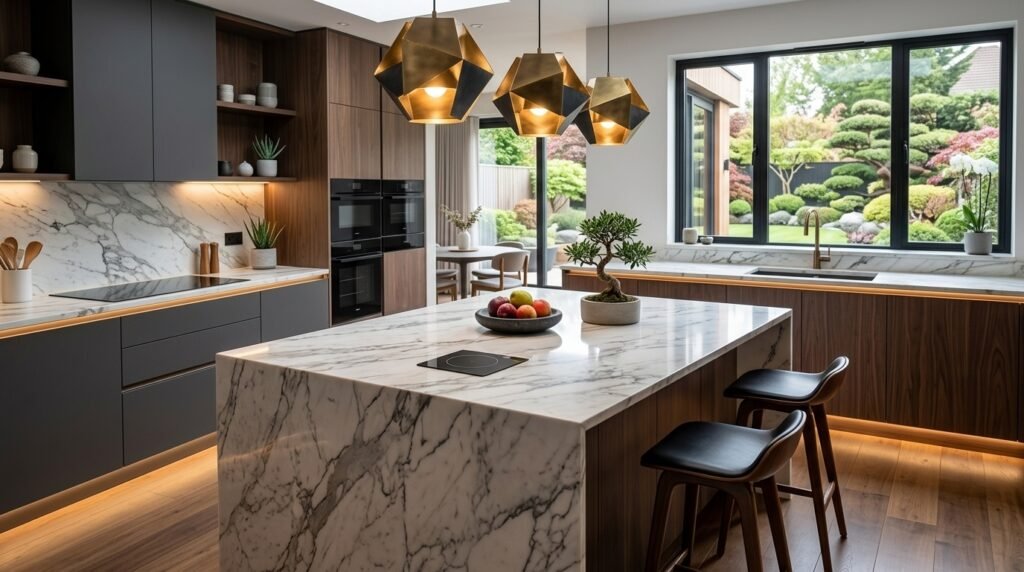
- Large kitchen (200+ sq ft): you have room for an oversized island, waterfall edges, or even a double island setup
If you’re working with a 10×10 or 12×12 kitchen, a compact island in the 40- to 60-inch range, without seating, is often the smarter move than trying to force in a full-sized version. It’s worth pairing this decision with your cabinet layout — our kitchen cabinet sizes calculator can help you figure out how much cabinet space you’ll have left once the island takes its share of the floor.

Functional Islands: Sink, Cooktop, and Storage
Not every island is just a place to sit. Many homeowners want their island doing double duty as a workstation.
- Kitchen island with sink: needs at least 36 inches of depth to fit plumbing and still leave counter space on either side
- Kitchen island with cooktop: needs proper ventilation clearance — <cite index=”8-1″>the countertop should extend a minimum of 9 inches behind the cooking surface</cite> for safety, plus adequate space for a hood or downdraft vent
- Kitchen island with dishwasher or storage: depth of 24 to 26 inches is typically enough, since you’re not fitting knees underneath
If you’re leaning toward a functional island, it’s worth reviewing your full kitchen layout ideas first, since where your sink and cooktop sit affects your entire work triangle, not just the island itself.

Lighting and the Little Details People Forget
Once your island’s footprint is locked in, the next decision is what hangs above it. Pendant lighting placement depends directly on island length — too few fixtures and the space feels dim, too many and it feels cluttered. If you’re finalizing your layout, our kitchen pendant lights calculator makes this part painless.
It’s also worth thinking about what goes inside the island. A well-planned kitchen organizer setup can turn unused cabinet space under your island into real storage for pans, small appliances, or pantry overflow.
And if you’re adding stools, don’t guess on those either — checking a bench and seating size calculator alongside your island plan helps you avoid the classic mistake of buying stools that are too tall or too wide for the overhang you built.

A Kitchen Safety Detail Worth Mentioning
Since we’re talking about where things sit in your kitchen, it’s worth a quick detour into a safety point that gets overlooked during remodels: smoke alarm placement.
Cooking is <cite index=”16-1″>the cause of 37% of fires in one- or two-family homes, and 72% of fires in apartments and other multifamily housing structures</cite> — which makes the kitchen the single most fire-prone room in most homes. Yet <cite index=”11-1″>smoke alarms should not be placed directly in the kitchen</cite>; they belong at least 10 feet from the stove to avoid constant false alarms.
The upside of getting it right is significant: <cite index=”12-1″>working smoke alarms reduce the risk of dying in a home fire by more than half (60 percent)</cite>. On the flip side, <cite index=”16-1″>in 41% of home fire deaths, no smoke detector was present, and in 16% of deaths the detector failed to operate</cite> — usually because of a dead battery or power issue.
If you’re remodeling your kitchen layout anyway, it’s the perfect time to double-check your coverage. Our smoke detector calculator helps you figure out how many alarms your home actually needs and where they should go, based on room count and layout — including the right distance from your new island’s cooktop.
Common Mistakes to Avoid
- Skipping the appliance-door test. Measure clearance with the dishwasher, oven, and fridge doors open, not closed.
- Forgetting the overhang. A gorgeous island with zero knee room under the counter is a wasted opportunity for seating.
- Ignoring the work triangle. Your island shouldn’t block the natural path between the sink, stove, and fridge.
- Going too big for the room. An oversized island in a small kitchen doesn’t feel luxurious — it feels like a hazard course.
- Choosing seating height before choosing stools. Buy your overhang to match your stools, not the other way around.
🏠 Kitchen Island Sizing FAQs
What is the standard kitchen island size?
What is the minimum kitchen island size?
How much clearance do I need around a kitchen island?
What size kitchen island fits 4 stools?
How deep should a kitchen island be?
What size kitchen needs an island?
How much overhang do I need for bar stools?

Final Thoughts
Getting your kitchen island size right isn’t about chasing a trend — it’s about matching the island to how you actually live and cook. Measure your clearance first, decide on seating second, and let the calculator do the heavy lifting on the math. Get those two things right, and everything else — the pendant lights, the stools, the storage — falls into place around a kitchen that finally works the way it looks.