Home Energy Savings Calculator - Calculate Your Energy Savings 2025

Home Energy Savings Calculator

Calculate potential energy savings from home improvements and upgrades

Overview
Insulation
HVAC
Lighting
Appliance
Windows

Total Home Energy Savings

Your Potential Energy Savings

Monthly Savings
-
Annual Savings
-
10-Year Savings
-
CO₂ Reduced (Annual)
-
New Monthly Bill
-
Savings Per Sq Ft
-

Insulation Upgrade Savings

Insulation Savings Results

Annual Savings
-
Installation Cost (Estimate)
-
Payback Period
-

HVAC Upgrade Savings

HVAC Savings Results

Annual Savings
-
Efficiency Improvement
-
Payback Period
-

LED Lighting Savings

Lighting Savings Results

Annual Savings
-
LED Investment
-
Payback Period
-

Appliance Upgrade Savings

Appliance Savings Results

Annual Savings
-
Lifetime Savings (15 years)
-
Payback Period
-

Window Replacement Savings

Window Savings Results

Annual Savings
-
Total Investment
-
Payback Period
-

Quick Tip: The average home can save twenty to thirty percent on energy bills with proper insulation, LED lighting, and HVAC upgrades. Energy Star certified appliances use twenty five to fifty percent less energy than standard models.

Energy Saving Improvements ROI

Improvement Average Cost Annual Savings Payback Period Energy Savings
LED Lighting $150 - $300 $75 - $200 1-2 years 75% on lighting
Smart Thermostat $150 - $300 $100 - $180 1.5-2 years 10-15% HVAC
Attic Insulation $1,500 - $3,500 $200 - $600 3-6 years 15-20% heating
Air Sealing $500 - $2,000 $150 - $400 2-5 years 10-20% total
Energy Star Windows $7,500 - $15,000 $300 - $500 15-25 years 7-15% heating/cooling
High-Efficiency HVAC $5,000 - $10,000 $400 - $800 6-12 years 20-40% HVAC
Heat Pump Water Heater $1,200 - $2,500 $250 - $400 3-6 years 60% water heating
Solar Panels (5kW) $12,000 - $18,000 $800 - $1,500 8-15 years 50-100% electric

Insulation R-Value Guide

Area Recommended R-Value Climate Zone Cost Per Sq Ft
Attic (Cold Climate) R-49 to R-60 Zones 6-8 $1.50 - $3.00
Attic (Moderate) R-38 to R-49 Zones 3-5 $1.25 - $2.50
Attic (Warm) R-30 to R-38 Zones 1-2 $1.00 - $2.00
Walls R-13 to R-21 All zones $0.75 - $1.50
Basement Walls R-10 to R-15 All zones $1.00 - $2.00
Crawl Space R-19 to R-25 All zones $0.75 - $1.50
Floor (above unheated) R-25 to R-30 All zones $1.00 - $2.00

HVAC Efficiency Ratings

System Type Minimum Efficiency Good Efficiency Best Efficiency Annual Savings vs. Old
Central AC (SEER) 14 SEER 16-18 SEER 20+ SEER 20-40%
Heat Pump (HSPF) 8.2 HSPF 9-10 HSPF 10+ HSPF 25-50%
Gas Furnace (AFUE) 80% AFUE 90-95% AFUE 95%+ AFUE 15-30%
Boiler (AFUE) 80% AFUE 85-90% AFUE 90%+ AFUE 15-25%

Energy Star Appliance Savings

Appliance Standard Cost/Year Energy Star Cost/Year Annual Savings Lifespan
Refrigerator $180 $90 $90 12-15 years
Dishwasher $75 $45 $30 10-13 years
Washing Machine $140 $70 $70 10-12 years
Dryer $120 $85 $35 10-13 years
Electric Water Heater $550 $220 $330 10-15 years
Dehumidifier $80 $50 $30 8-10 years

Home Energy Audit Checklist

Area to Check What to Look For Potential Savings DIY or Professional
Air Leaks Gaps around windows, doors, outlets 10-20% DIY
Insulation Attic, walls, basement adequacy 15-25% Professional
HVAC System Age, efficiency rating, maintenance 20-40% Professional
Windows/Doors Single vs double pane, drafts 10-15% Professional
Lighting Incandescent vs LED bulbs 5-10% DIY
Water Heater Age, efficiency, temperature setting 10-20% Professional
Appliances Energy Star ratings, age 5-15% DIY
Ductwork Leaks, insulation, proper sealing 15-20% Professional

Important Disclaimer

This Home Energy Savings Calculator provides estimates based on typical energy usage patterns and industry averages. Actual savings may vary significantly based on climate, home size, insulation quality, energy rates, usage patterns, and local conditions.

Results serve as planning tools only and should not replace professional energy audits or contractor quotes. Always consult with certified energy auditors and licensed contractors for accurate assessments and installation quotes.

We make no guarantees regarding accuracy of calculations or savings projections. Users assume all responsibility for improvement decisions based on calculator results. Energy prices, rebates, and incentives vary by location and change over time.

Many improvements qualify for federal tax credits, state rebates, and utility company incentives. Check with local authorities and utility providers for available programs. ROI calculations do not include potential incentives which can significantly improve payback periods.

Complete Guide to Home Energy Savings: Save Money and Help the Planet

Introduction

Your home uses energy every day. Energy bills climb higher each year. But you can change that.
This guide shows you how to reduce energy consumption. We cover heating, cooling, water, appliances, and lighting. Simple changes save thousands of dollars. You’ll also help protect the environment.
No expensive upgrades required. Many solutions cost nothing. Others cost less than you think.

Understanding Your Home Energy Use

Where Energy Goes in Your Home

Energy consumption happens constantly. Most homes waste significant amounts.
Here’s where your energy dollars go:
Heating and cooling: 40-50% of your energy bills
  • Winter heating bills climb fast.
  • Summer air conditioning runs expensive.
  • Poor insulation wastes energy.
  • Air leaks drain heat in winter.
Water heating: 15-20% of energy bills
  • Hot water usage costs money.
  • Cold water from pipes before heating
  • Gas water heaters use significant energy.
  • Electric water heaters also consume power.
Appliances: 10-15% of energy bills
  • Refrigerators run constantly
  • Washing machines use hot water.
  • Dishwashers heat water
  • Older models waste energy.
Lighting: 5-10% of energy bills
  • Incandescent bulbs waste energy
  • Lights run longer than needed.
  • Unnecessary rooms are lit all day.
Other: 15-20% of energy bills
  • Electronics left plugged in.
  • Entertainment systems
  • Computing devices

Understanding Energy Star

Energy Star is a government program. It identifies products that save energy.
Energy Star certified products:
  • Use less electricity than standard models.
  • Save money on energy bills.
  • Reduce environmental impact
  • Meet strict efficiency standards.
  • Include appliances, windows, doors, and more.
Look for the Energy Star label when buying:
  • Refrigerators
  • Washing machines
  • Dishwashers
  • Air conditioners
  • Furnaces
  • Water heaters
  • Televisions
  • Computers

Heating and Cooling Efficiency

Winter Home Energy Saving

Winter brings high heating bills. Your furnace works overtime. Heat loss through walls and windows costs money.
Reduce heating costs:
  • Lower thermostat by 7-10 degrees
  • Use programmable thermostats
  • Close doors to unused rooms
  • Open curtains during sunny days
  • Keep curtains closed at night.
  • Seal air leaks around windows.
  • Insulate the attic properly.
  • Maintain furnace annually
How much you save:
  • Each degree lower saves 1-3% on heating bills.
  • Lowering the temperature by 10 degrees saves 10-30% annually.
  • One air leak can waste as much as an open window.
  • Proper insulation cuts heat loss dramatically.

Summer Home Energy Saving

Summer cooling costs accumulate fast. Air conditioning runs constantly. Strategic adjustments reduce energy consumption.
Reduce cooling costs:
  • Raise the thermostat temperature slightly.
  • Use ceiling fans (they cool rooms efficiently)
  • Close curtains during hot days
  • Open windows at night
  • Use air conditioning only when necessary.
  • Maintain air conditioner filters.
  • Shade the outdoor air conditioning unit.
  • Plant trees for natural cooling
How much you save:
  • Each degree higher saves 1-3% on cooling costs.
  • Fans use 90% less energy than AC.
  • Window treatments reduce solar heat by 25%
  • Trees reduce cooling needs by 20-35%

Smart Thermostat Installation

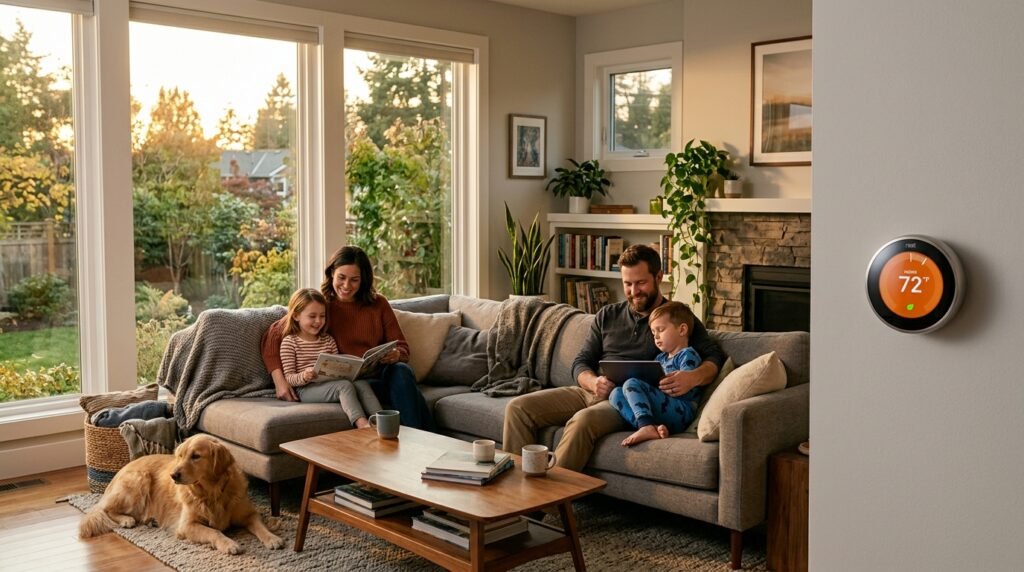
Programmable thermostats adjust temperatures automatically.
Benefits of smart thermostats:
  • Schedule heating and cooling
  • Lower temperatures when away
  • Raise temperatures when sleeping.
  • Save 10-15% on heating and cooling.
  • Remote control via smartphone
  • Track energy usage
  • Learn your preferences
Types available:
  • Basic programmable thermostats ($50-100)
  • Smart connected thermostats ($150-300)
  • Learning thermostats ($200-400)
  • Payback period: 1-3 years

Hot Water and Water Heating

Understanding Water Heating Costs

Hot water consumption adds up. Every shower, bath, and wash uses energy. Water pipes take time to deliver hot water. Cold water runs while waiting.
Sources of hot water waste:
  • Long showers waste gallons of hot water.
  • Water pipes run cold before heating.
  • Leaking faucets waste water and energy
  • Inefficient water heaters
  • No insulation on water pipes

Reducing Hot Water Usage

Simple habits cut water heating bills.
Take shorter showers:
  • A 5-minute shower uses 12-25 gallons.
  • A 10-minute shower uses 25-50 gallons.
  • Reducing 5 minutes saves 2,600 gallons of water per year.
  • Reduces heating costs significantly
Fix leaking faucets:
  • One dripping faucet wastes gallons daily.
  • One leak can waste 3,000 gallons of water per year.
  • Costs $35+ per year per faucet
  • Fix within hours of discovery.
Install low-flow fixtures:
  • Low-flow showerheads reduce water by 25-40%
  • Aerators on faucets reduce water by 25%
  • Low-flow devices save money immediately.
  • Installation takes minutes
Turn off the water while soaping:
  • Running water while brushing teeth wastes 8 gallons
  • Running water while washing dishes wastes more
  • Turn the water off when not rinsing.
  • A simple habit saves gallons daily.

Water Heater Efficiency

Water heaters consume significant energy. Upgrades and maintenance save money.
Maintenance extends life:
  • Flush sediment annually
  • Check temperature setting (120°F is ideal)
  • Inspect for leaks
  • Well-maintained heaters last longer.
Upgrade options:
  • Tankless water heaters (instant hot water)
  • Heat pump water heaters (energy efficient)
  • Solar water heaters (renewable energy)
  • Hybrid water heaters
Insulate water pipes:
  • Wrap pipes with foam insulation
  • Reduces heat loss during transport
  • Saves energy and money
  • Costs under $50 for a typical home
Lower water heater temperature:
  • Reduce from 140°F to 120°F
  • Saves 3-5% on heating costs
  • Prevents scalding
  • Most people don’t notice the difference.

Lighting and Electrical Savings

Understanding Lighting Energy Use

Lighting runs constantly in most homes. Inefficient bulbs waste electricity. Lights in empty rooms waste money.
Switching to efficient lighting:
  • LED bulbs use 75% less energy than incandescent bulbs
  • Incandescent bulbs: 60-watt
  • LED equivalent: 9 watts
  • LEDs last 25,000+ hours
  • One LED saves $50+ over lifetime.
Types of bulbs:
  • Incandescent: very inefficient, being phased out
  • CFL (compact fluorescent): efficient, longer life
  • LED (light emitting diode): most efficient, long life
  • Halogen: inefficient
  • Energy Star-certified LEDs: best choice

Lighting Best Practices

Install efficient lighting:
  • Replace all incandescent bulbs with LEDs
  • Use CFLs in less-used areas.
  • Keep fixtures clean (dirt reduces brightness)
  • Use appropriate bulb wattage.
Control lighting:
  • Turn off lights when leaving rooms.
  • Install motion sensors in rarely-used areas.
  • Use dimmer switches
  • Rely on natural daylight.
  • Use task lighting rather than whole-room lighting.
Outdoor lighting:
  • Use LED outdoor lights.
  • Install motion sensors
  • Set timers for decorative lights.
  • Consider solar outdoor lights.

Reducing Phantom Load

Electronics draw power even when off. This phantom load costs money.
Identify phantom power users:
  • Television sets
  • Cable boxes
  • Computer equipment
  • Phone chargers
  • Coffee makers
  • Game consoles
  • Printers
Reduce phantom load:
  • Unplug devices when not in use.
  • Use power strips (turn them off)
  • Turn off electronic devices completely.
  • Unplug chargers when finished.
  • Phantom load costs 5-10% of electricity.
How much to save:
  • Average phantom load: $100-200 yearly
  • Power strips: one-time cost of $10-30
  • Payback period: 1-3 months

Insulation and Air Sealing

Understanding Heat Loss

Heat escapes from homes through multiple paths. Cold air enters through cracks and gaps. This heat loss drives heating costs.
Where heat escapes:
  • Windows: 25-30% of heat loss
  • Doors: 10-15% of heat loss
  • Walls (poor insulation): 15-20% of heat loss
  • Attic: 15-25% of heat loss
  • Basement/foundation: 10-15% of heat loss

Sealing Air Leaks

Air leaks around windows, doors, and penetrations waste energy.
Common air leak locations:
  • Around windows and doors
  • Electrical outlets and switches
  • Where pipes enter the home
  • Attic hatches
  • Recessed lighting
  • Duct work connections
Sealing air leaks:
  • Caulk around windows ($5-20)
  • Weather strip doors ($10-30)
  • Seal electrical outlets ($1-2)
  • Foam insulation for gaps ($5-50)
  • Cost: minimal
  • Payback period: immediate
How much to save:
  • Sealing air leaks saves 10-20% on heating.
  • One sealed window gap saves $10-20 yearly.
  • Total savings: $100-500 yearly

Insulation Improvements

Proper insulation reduces heating and cooling costs.
Attic insulation:
  • Most homes lack adequate attic insulation.
  • Recommended: R-38 to R-60 depending on climate
  • Attic insulation pays back in 1-3 years.
  • Reduces heating costs by 15-20%
  • Reduces cooling costs 10-15%
Wall insulation:
  • Retrofit is expensive and invasive.
  • Consider during renovation
  • New construction should include proper insulation.
Basement/foundation:
  • Insulate basement walls
  • Reduce basement temperature fluctuation.
  • Reduces heating/cooling costs
Pipe insulation:
  • Wrap hot water pipes with foam.
  • Retains heat during transport
  • Low cost ($0.50-$1 per linear foot)
  • Reduces water heating costs

Window and Door Upgrades

Windows and doors allow significant heat transfer.
Window improvements:
  • Double-pane windows reduce heat loss by 30%
  • Triple-pane windows are even better.
  • Energy Star windows cost more but save money.
  • Weather stripping improves existing windows.
  • Window treatments reduce heat loss 10-25%
Door improvements:
  • Seal gaps around door frames
  • Install door sweeps on the bottom.
  • Replace weatherstripping annually
  • Insulated doors reduce heat transfer.
  • Storm doors provide additional insulation.
Window treatments for energy saving:
  • Cellular shades provide insulation.
  • Heavy curtains reduce heat loss.
  • Thermal drapes keep heat in winter.
  • Reflective film reduces summer heat.
  • Huntington home energy-saving window curtains.
  • Light-colored blinds reflect solar heat in summer.
  • Dark colors absorb heat in winter.

Appliance Efficiency

Refrigerator Energy Use

Refrigerators run 24/7. They consume significant energy.
Refrigerator efficiency tips:
  • Clean condenser coils annually
  • Maintain proper temperature (37-40°F)
  • Keep door seals clean.
  • Don’t open unnecessarily.
  • Keep coils dust-free
  • Allow space around the appliance for air circulation.
When to upgrade:
  • Refrigerators over 10 years old use excessive energy
  • New Energy Star refrigerators use 50% less energy.
  • Payback period: 5-10 years

Washer and Dryer Efficiency

Washing machines and dryers use significant energy, especially hot water.
Washing machine efficiency:
  • Wash in cold water (90% of energy goes to heating)
  • Use high-efficiency washers
  • Wash full loads
  • Modern detergents work in cold water.
  • Front-load washers use less water and energy.
Dryer efficiency:
  • Air dry when possible.
  • Clean the lint trap before every load.
  • Use moisture sensor settings.
  • Heat pump dryers are the most efficient.
  • Dryer runs 2-5 hours per load.

Dishwasher Efficiency

Dishwashers use hot water—efficiency matters.
Dishwasher best practices:
  • Use the air-dry setting.
  • Run only when full
  • Use a lower temperature setting.
  • Energy Star models save water and energy.
  • Scrape plates; don’t pre-rinse

Water Heater Replacement

When replacing water heaters, choose efficient models.
Options available:
  • Traditional tank water heaters (40-60 gallons)
  • Tankless water heaters (instant hot water)
  • Heat pump water heaters (most efficient)
  • Solar water heaters (renewable energy)
  • Hybrid water heaters
Tankless water heater benefits:
  • Instant hot water
  • Save 10-15% on heating costs.
  • Small footprint
  • Higher initial cost
  • Longer lifespan

DIY Home Energy Saving Projects

Low-Cost Projects

Many energy-saving projects cost under $50.
Under $20:
  • LED light bulbs ($5-15 each)
  • Weather stripping ($10-20)
  • Caulk ($5-10)
  • Pipe insulation ($10-20)
$20-50:
  • Programmable outlet timer ($15-30)
  • Thermal window film ($20-30)
  • Weatherstripping kit ($25-40)
  • Pipe wrap ($20-50)
$50-200:
  • Programmable thermostat ($50-150)
  • Power strips with surge protection ($20-40)
  • Door sweep ($20-50)
  • Cellular shades ($100-200)

No-Cost Projects

Free energy saving steps:
  • Turn off the lights in empty rooms.
  • Close doors to unused rooms
  • Open curtains during sunny days
  • Close curtains at night
  • Lower thermostat 7-10 degrees
  • Take shorter showers
  • Turn off the water while soaping.
  • Unplug devices when not in use.
  • Clean air filters
  • Clean refrigerator coils
  • Defrost freezer regularly

Medium-Cost Projects

Projects costing $200-1,000:
Window upgrades:
  • Storm windows ($300-600)
  • New windows with Energy Star rating ($400-1,000+)
  • Cellular shades for multiple windows ($500-1,000)
Door upgrades:
  • New insulated entry door ($400-800)
  • Storm door installation ($200-400)
Insulation:
  • Attic insulation ($400-800)
  • Basement insulation ($500-1,500)
  • Pipe insulation kits ($100-200)

Home Energy Saving Kit Contents

Many organizations offer free or low-cost kits:
Typical kit contents:
  • LED light bulbs
  • Weatherstripping
  • Caulk
  • Pipe insulation
  • Thermometer
  • Information guides
  • Local utility contact info
Where to find kits:
  • Local utility companies (often free)
  • Energy efficiency programs
  • Government grants and programs
  • Community organizations
  • Retailers

Smart Home Energy Saving

Smart Home Devices

Technology helps reduce energy consumption.
Smart thermostats:
  • Learn your schedule
  • Adjust automatically
  • Remote app control
  • Track energy usage
  • Save 10-15% on heating/cooling.
Smart power strips:
  • Eliminate phantom load
  • Schedule device shutdown
  • Remote control
  • Monitor power usage
Smart lighting:
  • Adjust brightness automatically
  • Schedule on/off times
  • Voice control capability
  • Reduce lighting energy by 30-50%
Smart appliances:
  • Energy Star rated
  • Use less water and energy.
  • Communicate with the smart home system.
  • Provide efficiency data

Smart Home Energy Saving System

Complete systems integrate multiple devices:
What integrated systems do:
  • Manage heating, cooling, and lighting together.
  • Optimize based on occupancy.
  • Reduce energy consumption
  • Provide comprehensive monitoring
  • Increase comfort
Popular smart home platforms:
  • Google Home
  • Amazon Alexa
  • Apple HomeKit
  • Samsung SmartThings
  • Various brand-specific systems

Best Smart Home Energy Saving Devices

Top devices for energy savings:
  1. Smart thermostats ($150-400)
    • Highest energy savings
    • Learning capabilities
    • 10-15% reduction in heating/cooling
  2. Smart power strips ($20-80)
    • Eliminate phantom load
    • Easy installation
    • Immediate savings
  3. Smart light bulbs ($10-30 each)
    • Schedule on/off
    • Adjust brightness
    • Integrate with the system.
  4. Smart appliances ($500-3,000)
    • Energy-efficient motors
    • Optimized cycles
    • Remote monitoring

Home Energy Saving Tips by Season

Winter Home Energy Saving Tips

Cold weather increases heating bills. Strategic steps reduce costs.
December through February:
  • Maintain thermostat at 68°F or lower.
  • Use a programmable thermostat.
  • Open curtains during sunny days
  • Close curtains at night
  • Seal air leaks around windows.
  • Maintain furnace annually
  • Replace furnace filters monthly.
  • Use ceiling fans to circulate heat.
  • Avoid opening windows
  • Insulate pipes
  • Lower water heater temperature
  • Take shorter showers with hot water.
  • Use cold water for laundry.
  • Keep the basement door closed.
How much to save:
  • 10% reduction: $200-300 yearly
  • 20% reduction: $400-600 yearly

Summer Home Energy Saving Tips

Hot weather increases cooling costs. Beat the heat efficiently.
June through August:
  • Set thermostat to 78°F
  • Use ceiling fans
  • Close curtains during hot days
  • Open windows at night
  • Keep the air conditioner maintained
  • Replace air filters
  • Avoid using the oven (use the microwave or the grill)
  • Run dishwasher at night.
  • Wash clothes in cold water.
  • Reduce hot water usage.
  • Close basement vents
  • Plant trees for shade
  • Consider window film
How much to save:
  • 10% reduction: $150-250 yearly
  • 20% reduction: $300-500 yearly

Shoulder Season Tips

Spring and fall allow natural temperature control.
April-May and September-October:
  • Use natural ventilation
  • Open windows strategically
  • Minimize heating and cooling.
  • Turn off the thermostat.
  • Use fans instead of air conditioning.
  • Clean air filters
  • Prepare for the upcoming season.

Home Energy Saving Grants and Programs

Government Programs

Many programs help reduce home energy costs.
Federal programs:
  • Energy Star rebates
  • Tax credits for improvements
  • Weatherization assistance
  • Energy audits
  • Information resources
State programs:
  • State-specific rebates
  • Weatherization assistance
  • Energy efficiency programs
  • Low-income assistance
  • Grant programs
Utility company programs:
  • Rebates on efficient appliances
  • Free energy audits
  • Weatherization assistance
  • Education programs
  • Smart thermostat rebates

Finding Programs in Your Area

Where to look:
  • ENERGY.GOV for federal programs
  • Your state’s energy office
  • Local utility company website
  • Community action agencies
  • Non-profit organizations
Available assistance:
  • Rebates on appliances
  • Rebates on windows and doors
  • Insulation assistance
  • Air sealing services
  • Thermostat replacement
  • Audits and assessments

Energy Audits

Professional energy audits identify savings opportunities.
What audits include:
  • Thermal imaging to find heat loss
  • Blower door testing for air leaks
  • Assessment of insulation
  • Appliance evaluation
  • Lighting review
  • Written recommendations
  • Cost estimates
Finding auditors:
  • Local utility companies (often free)
  • Energy auditors (NATE certified)
  • ENERGY.GOV database
  • State energy office
  • Cost: $200-400 for a comprehensive audit

Best Home Energy Saving Products

Top Energy Saving Products

LED light bulbs:
  • Save 75% on lighting energy.
  • Cost: $5-15
  • Lifespan: 25,000+ hours
  • Most cost-effective upgrade
Smart thermostats:
  • Save 10-15% on heating/cooling.
  • Cost: $150-400
  • Payback period: 1-3 years
  • Easy installation
Weatherstripping:
  • Seals air leaks
  • Cost: $10-30
  • Payback period: weeks
  • Most cost-effective
Programmable thermostats:
  • Basic scheduling
  • Cost: $50-150
  • Save 10% on heating/cooling.
  • Good alternative to smart
Insulated window curtains:
  • Huntington home energy-saving window curtains.
  • Reduce heat loss 10-25%
  • Cost: $30-80 per window
  • Easy installation
Power strips:
  • Eliminate phantom load
  • Cost: $15-40
  • Payback period: 3-6 months
  • Convenient control
Low-flow showerheads:
  • Reduce water by 25-40%
  • Cost: $10-30
  • Payback period: 1-3 months
  • Simple installation
Thermal window film:
  • Temporary window insulation
  • Cost: $20-50 per window
  • Reduces heat loss by 10-20%
  • Easy to apply and remove

Home Energy Saving Checklist

Monthly Checklist

Clean refrigerator condenser coils
Replace furnace filter (if needed)
Check thermostat setting
Look for new air leaks.
Check for water leaks.
Review the electric bill.

Seasonal Checklist

Spring:
Have the air conditioner serviced.
Clean air conditioner filters
Open windows for ventilation
Plant shade trees
Clean gutters
Summer:
Set thermostat to 78°F
Close curtains during the day
Maintain the air conditioner.
Keep vents clear
Replace air filters
Fall:
Have the furnace serviced
Seal air leaks
Clean gutters
Check weatherstripping
Prepare for cold weather.
Winter:
Lower thermostat
Close unused rooms
Insulate pipes
Clean furnace filter monthly
Check door seals

Annual Checklist

Get a professional energy audit.
Service heating system
Service cooling system
Check all insulation
Inspect the water heater.
Review energy bills
Check for new air leaks.
Clean or replace air filters
Inspect windows and doors.
Plan upgrades for next year

Best Home Energy Saving Tips Summary

Top 10 Most Effective Tips

  1. Install programmable thermostat (saves 10-15%)
  2. Seal air leaks (saves 10-20%)
  3. Upgrade to LED lighting (saves 75% on lighting)
  4. Insulate attic (saves 15-20%)
  5. Lower water heater temperature (saves 3-5%)
  6. Wash in cold water (saves 10-30%)
  7. Fix water leaks (saves water and energy)
  8. Use window treatments (saves 10-25%)
  9. Maintain HVAC system (saves 5-10%)
  10. Replace weatherstripping (saves 10-15%)

Quick Start: First 7 Days

Day 1:
  • Turn off the lights in empty rooms.
  • Lower the thermostat by 7 degrees.
  • Unplug phantom power devices.
Day 2:
  • Take shorter showers
  • Turn off the water while soaping.
  • Check for water leaks.
Day 3:
  • Clean refrigerator coils
  • Replace high-use light bulbs with LED.
  • Open curtains during sunny days
Day 4:
  • Replace furnace filter
  • Close doors to unused rooms
  • Plug devices into power strips.
Day 5:
  • Caulk drafty windows
  • Install weatherstripping on doors.
  • Lower water heater temperature
Day 6:
  • Clean the air conditioner filter.
  • Wash clothes in cold water.
  • Identify air leaks with the candle test.
Day 7:
  • Schedule an energy audit.
  • Research local rebate programs
  • Plan bigger upgrades

Expected Savings Timeline

First month:
  • Turn off lights and lower the thermostat: 5-10% savings.
  • Cost: $0-50
First three months:
  • Add LED bulbs, fix leaks: 10-15% savings
  • Cost: $50-200
First year:
  • Add weatherstripping and a programmable thermostat: 15-25% savings.
  • Cost: $200-500
Year two and beyond:
  • Add insulation, window upgrades: 25-40% savings
  • Cost: $1,000-5,000
  • Annual savings: $500-1,500

Advanced Home Energy Saving

Renewable Energy Options

Solar panels:
  • Generate your own electricity.
  • Federal tax credits available
  • Cost: $15,000-25,000 after incentives
  • Payback period: 5-10 years
  • 25+ year lifespan
Solar water heaters:
  • Heat water using the sun’s energy
  • Reduce water heating costs by 50-80%
  • Cost: $2,000-4,000
  • Payback period: 5-10 years
Geothermal systems:
  • Most efficient heating/cooling
  • Ground source heat pumps
  • Cost: $15,000-30,000
  • Very high efficiency
  • Long lifespan

Home Energy Audits

Professional audits identify specific savings opportunities.
What auditors measure:
  • Heat loss rate (blower door test)
  • Thermal imaging to find drafts
  • Duct system leakage
  • Insulation levels
  • Equipment efficiency
  • Water usage
Typical recommendations:
  • Specific air sealing locations
  • Insulation upgrades needed
  • Equipment replacement timing
  • Cost/benefit analysis
  • Payback periods

Energy Monitoring Systems

Technology shows real-time energy usage.
Smart meters:
  • Track electricity usage
  • Time-of-use rates
  • Identify peak usage times.
  • Help optimize habits
Home energy management systems:
  • Monitor all energy use.
  • Control devices remotely
  • Provide detailed reports
  • Identify waste
  • Track savings over time

Common Mistakes to Avoid

Energy Saving Mistakes

Closing vents in unused rooms:
  • Reduces efficiency
  • Causes pressure imbalances
  • Doesn’t save money
  • Can damage the HVAC system
Setting the thermostat too low/high temporarily:
  • The system works harder to recover.
  • No net savings
  • Increases energy use
  • Reduces comfort
Poor weatherstripping installation:
  • Ineffective sealing
  • Wastes money
  • Install it the first time correctly.
  • Watch YouTube tutorials
Ignoring water leaks:
  • Waste gallons daily
  • Add up to hundreds yearly.
  • Easy and cheap to fix
  • Fix immediately
Not maintaining equipment:
  • Dirty filters reduce efficiency.
  • Neglected systems use more energy.
  • Poor maintenance shortens lifespan.
  • Maintenance costs less than replacement.
Using space heaters inefficiently:
  • Portable heaters use lots of energy.
  • Better to heat the whole home efficiently
  • Use sparingly and carefully.
Leaving lights on:
  • Costs add up daily
  • Especially with incandescent bulbs
  • Simple habit to break
  • LED bulbs reduce waste

Working From Home Energy Tips

Energy Efficiency for Home Offices

More people work from home. Home office energy use matters.
Reduce home office energy:
  • Use natural lighting when possible.
  • Use task lighting instead of overhead.
  • Close the office door in winter (save heating)
  • Use the computer sleep mode.
  • Unplug when not working.
  • Use an LED desk lamp.
  • Keep the workspace organized.
  • Avoid space heaters
During work:
  • Avoid running excessive equipment.
  • Close doors to reduce the heating/cooling area
  • Use natural light in the morning/afternoon.
  • Turn off equipment during breaks.
  • Unplug at the end of the day.
Savings potential:
  • 5-10% reduction in overall energy use
  • Specific to office usage reduction
  • Varies by equipment

Home Energy Saving FAQs

Understanding Energy Savings and the Environment

Q: How can saving energy at home help the environment?
A: Energy production creates pollution and greenhouse gases. When you save electricity and heating fuel, power plants produce less. Less production means fewer emissions. Your home energy conservation directly reduces climate impact. It’s one of the most effective environmental actions you can take.
Q: How does saving energy at home help climate change?
A: Greenhouse gas emissions drive climate change. Most electricity comes from burning coal, natural gas, or oil. These fuels release carbon dioxide. When you reduce energy consumption, fewer fossil fuels are burned. Fewer burning fuels means less carbon dioxide entering the atmosphere. Your energy savings help prevent global warming.
Q: Why is saving energy at home important?
A: Energy saving matters for three reasons: First, it saves you money immediately. Second, it reduces environmental damage. Third, it decreases dependence on fossil fuels. Energy conservation is the cheapest, cleanest energy source available. Starting at home is practical and impactful.
Q: Why is saving energy in your home important?
A: Homes consume 20-30% of all energy in developed countries. If every household reduced usage by 10%, the impact would be massive. National energy demand would decrease significantly. Coal plants could close. Air pollution would improve. Environmental protection begins with individual homes.
Q: Can energy-saving home improvements help the environment?
A: Yes, absolutely. Insulation improvements, efficient windows, LED lighting, and smart thermostats all reduce energy consumption. Over 20 years, these improvements have prevented tons of carbon emissions. They protect forests from mining and drilling. Environmental benefits accumulate over time.

Tax Credits and Financial Benefits

Q: Are energy-saving home improvements tax-deductible?
A: Yes. The federal government offers tax credits for qualifying energy improvements. You can deduct a percentage of costs from your taxes. Credits vary by improvement type and year. Check current IRS guidelines for specific percentages. Many states offer additional credits.
Q: What can be claimed for energy-saving home improvements?
A: Qualifying improvements include:
  • Insulation and weatherstripping
  • Energy Star windows and doors
  • Heat pumps and efficient furnaces
  • Water heater upgrades
  • Solar panels and solar water heaters
  • Energy storage systems
  • Smart thermostats
Check the IRS requirements for current-year eligibility.
Q: How much can you deduct for energy-saving home improvements?
A: Federal tax credits typically cover 30% of costs for specific improvements. Maximum credit amounts vary by improvement type. Some improvements have no spending limit. Others have caps like $500 or $3,500. State credits vary widely by location. Consult a tax professional for your specific situation.
Q: How to get money for energy-saving home improvements?
A: Several funding sources exist:
  • Federal tax credits (IRS)
  • State rebate programs
  • Utility company rebates
  • Energy efficiency grants
  • Low-interest loans
  • PACE financing (Property Assessed Clean Energy)
  • Local government programs
  • Non-profit assistance
Contact your utility company first. They often have free programs.
Q: Do home energy upgrades increase energy bill savings over time?
A: Yes, dramatically. Initial costs are recovered through monthly savings. A $3,000 insulation upgrade saving $30 monthly pays for itself in 100 months (8.3 years). After payback, 12+ years of savings remain. Over 20 years, savings exceed investment 3-4 times. Energy upgrades are profitable investments.
Q: Is there a home energy saving credit?
A: Yes. The federal government offers renewable energy and energy efficiency credits. Energy efficiency credits apply to windows, insulation, HVAC upgrades, and water heaters. Renewable energy credits apply to solar, wind, and geothermal systems. Credits are non-refundable (reduce taxes owed but don’t create refunds).

Smart Home Technology and Energy Savings

Q: How do smart devices automate energy savings at home?
A: Smart devices learn your patterns and adjust automatically. Smart thermostats lower the temperature when you’re away. Bright lights turn off when rooms are empty. Smart appliances run during off-peak hours. These automations happen without thinking. You get comfort and savings simultaneously.
Q: How does scheduling improve energy savings in smart home devices?
A: Scheduling matches energy use to actual needs. Thermostats heat only when you’re home. Water heaters heat during off-peak hours. Charging happens when electricity is cheapest. Laundry runs when energy demand is low. Scheduling reduces peak demand and costs.
Q: Is home automation a good option for energy saving?
A: Yes, for most homes. Home automation saves 10-15% on heating and cooling. Smart devices eliminate manual mistakes. Automation works 24/7 without effort. Initial costs are reasonable ($500-$2,000). Payback occurs within 2-5 years. Comfort and convenience improve, too.
Q: How to automate home energy storage for maximum savings?
A: Home batteries store energy when it’s cheap. You use stored energy during expensive peak hours. Innovative systems automatically charge and discharge. Some systems integrate with solar panels. Batteries smooth out energy use patterns. Maximum savings require coordinating charging with time-of-use rates.
Q: A smart home networking simulation for energy saving – what is this?
A: Smart home simulations test energy savings before purchase. They model your home’s energy use. Different device configurations are tested virtually. You see projected savings before spending money. Some utilities offer free simulations. This helps make informed decisions.

Practical Energy Saving Strategies

Q: How to balance comfort and energy savings in a home?
A: Comfort and savings aren’t opposites. A properly insulated home feels more comfortable AND uses less energy. Programmable thermostats maintain comfort while saving money. You adjust the temperature for sleeping (cooler), living (comfortable), and away (lower). The key is being intentional, not suffering.
Q: How to save energy at home?
A: Start with free actions: turn off lights, lower thermostat, take shorter showers, fix leaks. Next, add low-cost improvements such as LED bulbs, weatherstripping, and caulk. Then upgrade: insulation, windows, thermostats, and appliances. Finally, consider renewable energy. Progress over time creates maximum savings.
Q: How to draw a home or office that saves energy is better?
A: Energy-efficient design matters from the start. Proper insulation in walls saves more than retrofitting later. Strategic window placement provides natural light and heat. Ceiling fans circulate air efficiently. Shade trees reduce cooling needs. Energy-efficient design is built in, not added later.
Q: What is the best home design for energy savings?
A: Best designs include:
  • Excellent insulation (R-30+ walls, R-60+ attic)
  • Triple-pane windows on the north side
  • Shade trees on the south and west sides
  • Efficient HVAC sizing
  • Strategic natural lighting
  • Thermal mass for temperature regulation
  • Proper air sealing
  • Renewable energy integration
Energy-efficient design costs slightly more initially, but saves forever.
Q: Why don’t the government energy savings apply to new homes?
A: Actually, many government incentives DO apply to new homes. Some require homes to meet efficiency standards to qualify. Others provide credits for new, efficient homes. However, many homeowners don’t know about these programs. New home builders should inform buyers about available credits.
Q: Does a new roof qualify for energy-saving home improvements?
A: Only if the new roof has specific energy-saving features. A standard replacement roof doesn’t qualify. Reflective roofing that reduces heat absorption may qualify. Some metal roofs qualify. Check current IRS guidelines. Many roofs improve overall insulation indirectly.

Environmental and Practical Impact

Q: Did you make energy-saving improvements to your home?
A: This is personal. Many homeowners start small. They replace light bulbs. They fix leaks. They improve insulation. Over time, they invest in bigger upgrades. Most discover savings exceed expectations. Most report satisfaction with improvements.
Q: How can energy saving in homes help the environment?
A: Home energy saving reduces:
  • Greenhouse gas emissions
  • Air pollution
  • Water consumption
  • Fossil fuel extraction
  • Habitat destruction
  • Climate change impacts
The combined impact of individual homes is enormous. Millions of homes saving energy prevents global warming.
Q: What is an energy-saving home?
A: An energy-saving home uses less electricity, natural gas, and water than standard homes. It includes efficient heating and cooling systems. It has proper insulation and sealed air leaks. It uses LED lighting. It has Energy Star appliances. It may include smart controls and renewable energy.
Q: How to make a cookie-cutter home energy saving?
A: Standard homes can be upgraded economically. Start with weatherstripping and caulk. Add insulation where accessible. Install a programmable thermostat. Replace inefficient appliances as needed. Upgrade windows over time. These improvements transform standard homes into energy-efficient ones.

Smart Home Specifics and Implementation

Q: Where to place the eco energy saving device in the home?
A: Device placement matters. Smart thermostats go on the walls of the main living area. Air quality monitors go in bedrooms. Energy meters are attached near the main electrical panel. Smart power strips go in electronics clusters. Smart water sensors attach to the main water lines. Proper placement ensures accurate readings and optimal function.
Q: How does a smart home help with energy savings statistics?
A: Smart homes reduce energy use 10-15% on average. Some homes achieve 20-30% savings with optimization. Peak demand reduction reaches 25-40%. Water savings reach 15-20% with intelligent fixtures. Financial payback occurs within 3-5 years. Smart homes provide continuous savings year after year.
Q: What is a smart home energy saving system?
A: An integrated system manages multiple devices together. The central hub communicates with thermostats, lights, appliances, and meters. The system learns patterns and optimizes automatically. Users control everything via the app. Systems integrate weather forecasts, time-of-use rates, and occupancy sensors. Result: maximum efficiency with minimal effort.
Q: Best smart home energy saving devices 2025?
A: Top devices for 2025 include:
  • AI learning thermostats ($200-400)
  • Smart power strips with load monitoring ($30-60)
  • LED bulbs with scheduling ($10-20)
  • Smart water heater controllers ($300-600)
  • Energy monitoring hubs ($100-300)
  • Smart appliances with efficiency modes ($500-2,000)
  • Battery storage systems ($8,000-15,000)
Payback varies, but all save money.

Advanced Topics

Q: Can Elon Musk’s home energy-saving device help your home?
A: Tesla and other companies develop innovative energy solutions. Powerwall battery storage, solar panels, and smart inverters reduce reliance on the grid. These technologies work for energy-conscious homeowners. Costs are high initially, but savings and independence are significant. Not necessary for basic energy savings.
Q: Why is saving energy in your home important for the planet?
A: Saving energy in homes protects the planet by reducing emissions, conserving resources, and preventing climate change. Every kilowatt saved prevents the burning of fossil fuels. Every gallon of heating oil saved prevents drilling—every home matters. Collective home energy savings change everything.

Common Questions About Implementation

Q: Home energy saving advice – where do I start?
A: Start with an energy audit. Many utilities provide free audits. Audits identify your most significant waste sources. Prioritize improvements by payback period. Start with quick wins: LED bulbs, weatherstripping, thermostat adjustment. Then invest in insulation and upgrades. Track results and celebrate progress.
Q: Home energy saving apps – which work best?
A: Top apps for tracking and saving:
  • Sense (monitors actual energy use)
  • OhmConnect (finds cheap energy times)
  • Wiser (Schneider Electric smart home)
  • Nest app (thermostat control)
  • EnergyHub (comprehensive management)
  • Home/Utilities app (tracks appliances)
Most are free or cost under $5 per month.
Q: Home energy saving checklist – what should I track?
A: Track these monthly:
  • Monthly energy bill
  • Thermostat settings
  • Water heater temperature
  • Equipment maintenance done
  • Leaks found and fixed
  • New devices installed
  • Cost savings calculated
Annual: audit, tax credits claimed, system upgrades planned.
Q: Home energy saving tips 2025 – what’s new?
A: New trends include:
  • AI-powered home optimization
  • Integration with electric vehicle charging
  • Advanced battery storage
  • Resilience planning (backup power)
  • Smart grid participation
  • Decarbonization focus
  • Water heating electrification
  • Heat pump adoption
Technology makes savings easier annually.

Government Resources

Department of Energy
  • Comprehensive energy information
  • Research and technology
  • Efficiency standards
  • Consumer programs

Utility Company Programs

Contact your local electric and gas company:
  • Many offer free energy audits
  • Rebates on efficient appliances
  • Low-income assistance
  • Educational resources
  • Smart meter programs

Efficiency Organizations

ENERGY STAR
American Council for an Energy-Efficient Economy (ACEEE)
  • Research and ratings
  • Product guides
  • Program information

Conclusion: Start Your Energy Saving Journey Today

Home energy saving doesn’t require expensive upgrades. Many changes cost nothing. Others cost under $100.
Start with simple steps:
  • Turn off the lights
  • Lower thermostat
  • Take shorter showers
  • Fix water leaks
  • Unplug phantom loads
These actions save money immediately.
Next, invest in proven upgrades:
  • LED lighting
  • Programmable thermostat
  • Weatherstripping
  • Window treatments
Then, plan for bigger improvements:
  • Insulation upgrades
  • Window replacement
  • Equipment upgrades
  • Renewable energy
Your home energy-saving journey begins today. Every action counts. Every dollar saved matters.
Start with one change. Build from there. Within a year, your energy bills will drop significantly. Within five years, significant improvements pay for themselves through savings.
Energy savings benefit your wallet and the environment. Take action today.

 
This guide is based on energy efficiency best practices, government recommendations, and expert advice. Consult with energy professionals for specific home situations. Energy Star is a registered trademark of the EPA. Always follow manufacturer instructions when installing products.