Grass Square Footage Calculator: How to Measure Your Lawn Accurately
Introduction
Ask most homeowners how big their lawn is, and you’ll get a shrug and a guess. That guess is exactly why so many lawn projects go sideways — too little grass seed, a mismatched fertilizer application, or a sod order that comes up short halfway through the yard.
Grass square footage isn’t just a number for math class. It’s the foundation for almost every lawn decision you’ll make: how much sod to order, how much seed to spread, and how much fertilizer to apply without wasting money or damaging your grass. Get this number wrong, and everything downstream is wrong too.
This guide walks through exactly how to measure lawn square footage, no matter what shape your yard happens to be, and how to use that number for real projects. If you’re planning a full sod installation once your measurements are in hand, our sod area calculator picks up right where this guide leaves off.
- Total Calculated Area: 0 sq ft
- Total Coverage Needed (With 10% Waste Buffer): 0 sq ft
- Estimated Sod Pallets Needed (~450 sq ft each): 0 Pallets
- Estimated Sod Rolls Needed (10 sq ft each): 0 Rolls
- Required Grass Seed Volume: 0.0 lbs
Why Getting Your Lawn Square Footage Right Actually Matters
It’s tempting to eyeball a yard and round to a number that sounds about right. The trouble is, lawn care products are formulated around specific square footage rates, not vibes.
- Sod installation — Order too little sod square footage and you’re stuck mid-project waiting on a second delivery of grass that’s already drying out.
- Grass seed — Too little seed per square foot leaves bare, thin patches; too much wastes money and can smother young grass.
- Fertilizer application — Most fertilizer labels are written per 1,000 square feet. An inaccurate lawn size calculation means you’re either under-feeding your grass or risking burn from over-application.
- Landscaping and turf installation projects — Mulch, topsoil, and compost all get ordered based on total area, so an accurate number saves money across your whole yard, not just the grass.
Getting the square footage of your lawn right the first time saves you money, time, and a lot of frustration later.

Measurement Methods: Pick What Fits Your Yard
There’s more than one way to measure lawn square footage, and the right method depends on your yard’s size and shape.
- Tape measure — Simple, cheap, and accurate for small to medium yards.
- Measuring wheel — Faster than a tape measure for larger properties; you just walk the perimeter.
- Laser distance measurer — Extremely precise, especially useful for long, straight stretches.
- Graph paper — Old-school but effective for sketching your yard to scale before calculating.
- GPS lawn measurement and satellite map tools — Online lawn measurement apps let you trace your property boundary using aerial mapping, which is ideal for large or oddly shaped lots.
- Offset method — Used for tricky, curved, or irregular lawns; you measure a series of parallel lines across the shape at equal intervals, then average and multiply.
For most residential yards, a tape measure paired with basic geometry gets you close enough. Larger or heavily curved properties benefit more from GPS lawn measurement or the offset method.

Lawn Shape Formulas: The Math Behind the Measurement
Every lawn shape has its own formula, and most yards are really just a combination of a few basic shapes.
- Rectangle or square lawn area — Length × width. This is the simplest and most common calculation.
- Triangle lawn area — Multiply the base by the height, then divide by 2. Height means the straight perpendicular distance to the opposite point, not the slanted edge.
- Circle lawn area — This is where π × radius² comes in. Multiply pi (roughly 3.14) by the radius (distance from center to edge) squared. A small measuring mistake on the radius gets squared too, which is exactly why precision matters more for circular beds and lawn islands than for straight-edged sections.
- Oval lawn area — Multiply the two radii (half of each axis) together, then by pi, similar logic to a circle but accounting for two different dimensions.
- Trapezoid lawn area — Add the two parallel sides, divide by 2, then multiply by the height between them.
Irregular and Curved Lawns
Most real yards aren’t clean geometric shapes. For an irregular lawn, the geometric method works best: break the whole space into smaller rectangles, triangles, and circles, calculate each one separately, then add them all together for your total lawn area.
Clemson Cooperative Extension’s HGIC recommends this same approach for irregular shapes, along with the offset method for curved or oddly shaped lawns — measuring a series of equally spaced lines across the area, then averaging those lines and multiplying by the total distance covered. Iowa State University Extension walks through the same rectangle, triangle, and circle formulas for garden beds and lawns, confirming this is standard practice across university turf programs.

Measuring Multiple Lawn Sections
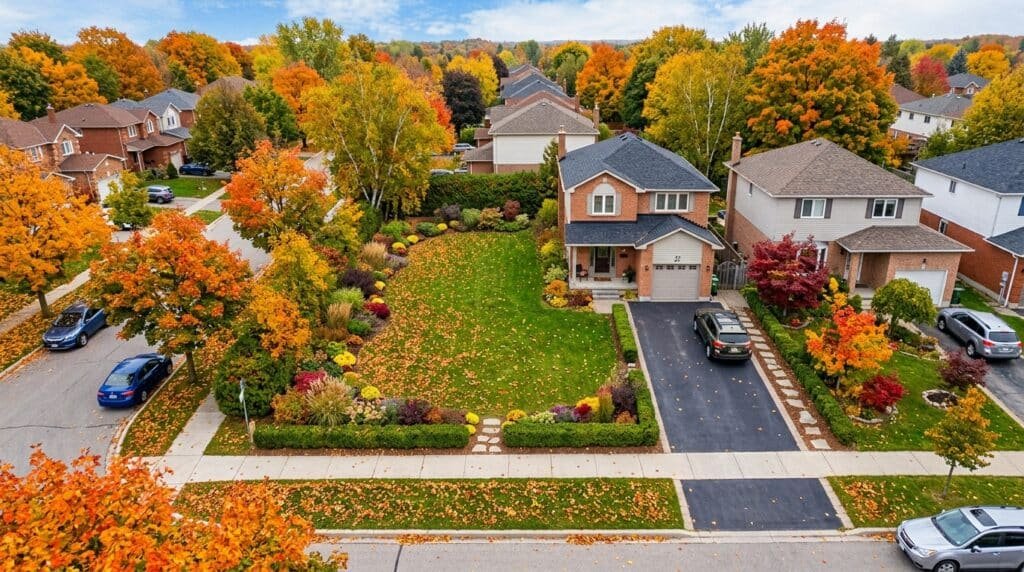
Most properties aren’t just one continuous lawn. A front yard, backyard, and side strip are usually different shapes entirely, and trying to measure them as one combined area almost always leads to errors.
Instead, measure and calculate each section separately, then add the totals together for your combined grass square footage. This is especially important if different sections get different treatment — for example, a shaded side yard that needs a different grass seed blend than a sunny backyard.
Always subtract non-lawn obstacles from your total, including:
- House footprint and foundation beds
- Driveways, patios, and walkways
- Pools, sheds, and playground equipment
- Established garden beds, like ones built around a raised bed or ornamental planting.

Using GPS and Online Tools for Faster Measurement
If manual measuring feels tedious, GPS measuring apps and satellite-based lawn measurement tools let you trace your property boundary directly from your phone or computer. University of Minnesota Turfgrass Science has demonstrated using Google Earth to outline irregular lawn areas and calculate square footage automatically, which works well as a faster alternative to manual tape-measure methods, especially for larger or awkwardly shaped properties.
These online lawn measurement tools also make it easy to save your numbers for future reference, so you’re not remeasuring from scratch every time you plan a new project.

From Square Footage to Real Projects
Once you know your total lawn area, here’s how that number gets used across common lawn projects.
Sod Installation
Sod is sold by square footage, broken into pallets and rolls. Once your total grass square footage is confirmed, our sod area calculator converts that number directly into pallets, cost estimates, and waste factor recommendations.
Grass Seed and Overseeding
Grass seed calculator rates differ depending on whether you’re seeding a brand-new lawn or overseeding an existing one — new lawns typically need a heavier seed rate per square foot since there’s no existing turf to fill in gaps. Multiply your total square footage by the seed rate listed on the product label to get your total seed quantity.
Fertilizer Application
Fertilizer labels are almost always written per 1,000 square feet. Divide your total lawn area by 1,000, then multiply by the recommended rate to get your exact product amount. Pairing this with the right timing matters just as much as the math — our guide on the best time of year to fertilize grass and our organic fertilizer for lawn options both build directly on an accurate square footage number.
Broader Landscaping and Lawn Care
Once you’ve nailed down your total yard size, the same measurements support mulch orders, topsoil calculations, and general lawn care maintenance planning throughout the season. If parts of your lawn need less water overall, our drought-resistant garden calculator can help you plan which zones to convert.

Common Measuring Mistakes to Avoid
- Guessing instead of measuring. Even experienced landscapers rarely get square footage right without actually measuring.
- Forgetting to subtract obstacles. Skipping this step consistently overestimates usable lawn area.
- Using slant measurements for triangle height. Always use the perpendicular height, not the angled side length, or your triangle calculations will be off.
- Treating irregular lawns as one shape. Breaking curved or odd shapes into smaller geometric pieces is far more accurate than estimating the whole area at once.
- Not remeasuring after landscaping changes. A new patio, expanded garden bed, or reshaped lawn edge changes your numbers, so update your measurements when your yard changes.
If patches of your lawn are struggling despite accurate measuring and product application, it’s worth ruling out disease — our guides on lawn spot disease and grass spot disease cover common culprits.
Frequently Asked Questions
Final Thoughts
Measuring your lawn properly isn’t the most exciting part of yard work, but it’s easily one of the most valuable. Once you know your accurate grass square footage, every other decision — sod, seed, fertilizer, mulch — becomes a simple calculation instead of a guess.
Take twenty minutes with a tape measure or a GPS app, break your yard into simple shapes, and write the number down somewhere you’ll remember. That single number will save you money and frustration on every lawn project you tackle from here on out.