Master Rug Sizing: How to Calculate the Perfect Area Rug for Every Room
Introduction
You finally found “the one.” The rug with the perfect pattern, the right color, the texture you’ve been dreaming about. You click buy, it arrives, you roll it out… and something feels off.
Your sofa looks like it’s floating in the middle of nowhere. Or the rug barely peeks out from under your bed like an afterthought. Or it’s so small it looks like a bath mat that wandered into a big living room.
Here’s the truth nobody tells you before you shop: rug size makes or breaks a room, even more than color or pattern. A rug that’s the wrong size can make an expensive, nicely furnished room look cheap and unplanned. Proper rug size, on the other hand, makes even simple furniture look like it was styled by a professional.
This rug size guide walks you through everything: standard rug sizes, a full rug size chart in feet, inches, and cm, rug placement rules for every room, and how to choose rug size with total confidence, no matter your budget or floor plan.

Why Rug Size Actually Matters (More Than You Think)
A rug isn’t just something soft to walk on. It’s a visual anchor. It tells your eye where a “zone” begins and ends: the seating area, the dining area, the reading nook.
When a rug is undersized, furniture legs hang off the edges awkwardly, and the whole room reads as disconnected — a classic case of a rug too big for the moment it was actually asked to fill, or worse, too small to do its job at all. When it’s genuinely oversized, it can swallow the room and make it feel smaller, not bigger.
Getting rug dimensions right is really about proportion, not guesswork. A few core rug placement rules apply almost everywhere in the home:
- Rugs should relate to furniture groupings, not just fill empty floor
- Walkways need breathing room, not rug edges catching toes
- Proper rug size always considers both the room and what sits on it
If you’d rather skip the mental math entirely, our rug size calculator does the room-to-rug math for you in seconds.

All-Room Rug Size Quick Guide
🛋️ Living Room
Front sofa legs on the rug with 6–12" border extension.
Standard: 8' x 10'🛏️ Queen Bedroom
Perpendicular under bed; 30–36" side extensions.
Standard: 8' x 10'👑 King Bedroom
Perpendicular under bed; 36–48" side extensions.
Standard: 9' x 12'🍽️ Dining Room (6 Seats)
Extends 24" beyond table edges on all sides.
Standard: 8' x 10' or 9' x 12'🧸 Kids Room (Twin Bed)
Horizontal under lower 2/3 of bed or centered in play zone.
Standard: 5' x 7' or 6' x 9'🧳 Guest Room (Full/Queen)
Perpendicular under bed; leaves nightstands on bare floor.
Standard: 6' x 9' or 8' x 10'
Standard Rug Sizes Chart (Feet, Inches & CM)
📏 Quick Conversions & Specific Dimensions:
• 8x10 Rug: Measures 96 x 120 inches (approx. 244 x 305 cm)—the most popular pick for standard living rooms.
• 60 x 84 Rug: Equivalent to a 5x7 feet rug, one of the most common small-to-mid room options.
• 3x5 Rug in CM: Approximately 91 x 152 cm.
• 80x120 CM Rug: Translates to roughly 2'8" x 3'11"—a compact European accent size.
• 30 x 40 Inches Rug: A compact accent size ideal for entry mats, nightstands, or placing in front of a kitchen sink.

Rug Sizes for Small Spaces
Not every room needs (or can fit) a sprawling 9×12. Rug size for small spaces is its own category, and getting it right takes a slightly different approach than a big open living room.
For studio apartments, tiny living rooms, or narrow bedrooms, a 5×7 or even a 5×5 rug can anchor a small seating or sleeping area without overwhelming the floor. The trick is choosing a rug that still touches at least the front legs of your main furniture piece — a rug floating in the middle of a small room with no connection to anything looks more like an accident than a design choice.
If you’re weighing whether your room is genuinely tight on space, our furniture spacing guide is a useful next stop before you commit to a size.

How to Choose the Right Rug Size for Every Room
Standard rug sizing guides only go so far because every room in your home has its own layout quirks. Getting the dimensions right creates balance, grounds your furniture, and anchors the space.
Living Room Rug Size Rules
The living room is where sizing mistakes happen most often, usually by selecting a rug that is too small. A rug that sits isolated under a coffee table looks unintentional rather than styled.
General Guidelines for Sofas and Sectionals
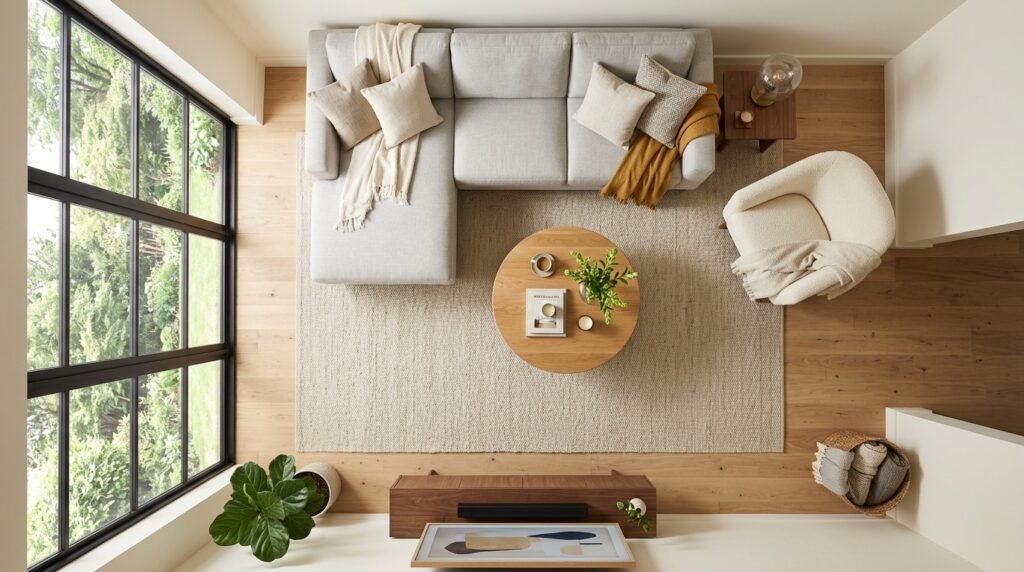
Sofa Overhang: Your rug should extend at least 6 inches beyond both sides of your sofa, though 8 inches is ideal. Standard living room sizes are typically 8’x10′ or 9’x12′.
Proportion and Framing: Leave at least 18 inches of bare floor between the rug edges and the walls to create a border that frames the room’s architecture.
The 5’x7′ Exception: A 5’x7′ rug is almost always too small for a living room, unless the space is a very compact studio or small apartment nook.
Layout Strategies
Designers generally recommend two placement approaches for lounge spaces:
All Four Legs On: Best for larger rooms or open layouts. Placing all legs of your seating on the rug creates a formal, cohesive, and high-end anchored look.
Front Legs Only: Works exceptionally well in mid-sized rooms. Placing just the front feet on the rug holds the seating group together while keeping the room feeling open.
Sizing for Sectionals and Open Floor Plans
If you have a sectional couch, always size up rather than down. An undersized rug beneath a large sectional makes the entire seating area feel top-heavy and unbalanced.
For expansive floor plans, great rooms, or large sectionals, 9’x12′ or 10’x14′ rugs work significantly better than an 8’x10′. Sizing up allows all section elements to sit comfortably on the rug.
Key Takeaway: Measure your active seating footprint rather than the total room dimensions, then select a rug size based on that area. Once placed, walk through your natural traffic pathways to ensure edges do not create tripping hazards or feel awkward underfoot.
Would you like to draft the next sections for the Dining Room and Bedroom rug guides using this same structure?

Bedroom Rug Size (Queen, King, Twin & Full)
Bedroom rug placement depends almost entirely on your bed size.
- Twin bed rug size: a 4×6 or 5×7 rug works well, placed at the foot or along one side — a good fit for a dorm room too.
- Full-size bed rug size: what size rug for a full-size bed usually means a 6×9, positioned so it extends past the sides and foot of the bed.
- Queen bed rug size: an 8×10 rug is the classic choice for rug size to fit a queen bed, extending 18–24 inches past the sides and foot. An 8×10 rug under a queen bed is one of the most reliable combinations in bedroom design.
- King bed rug size: carpet for a king-size bed generally means sizing up to 9×12, especially with a rug size for king bed with nightstands, so the rug extends beyond the nightstands on both sides. A 6×9 rug under a king bed can work in a smaller room, but it needs to be centered carefully so it doesn’t look cramped.
- Dorm rug size: something compact, like a 4×6 or 5×5, works best given limited floor space.
A simple placement trick for what size rug to put under a king bed, or what size rug you need under a king bed in general: the rug should extend far enough that your feet land on it the moment they hit the floor, not just under the center of the mattress.

Dining Room Rug Size
For the dining room, the rule is simple but often ignored: the rug needs to be big enough that chairs stay on it even when pulled out.
The rug should extend beyond the table to accommodate chairs, even when pulled out, protecting floors and adding sophistication — an 8×10 rug or larger typically works, depending on the size of the dining set</cite>. As a baseline, add at least 24 inches of rug space beyond each edge of the table.
So, should you put a rug under a dining table at all? In most cases, yes — it protects flooring from scrapes and adds warmth underfoot, as long as the sizing is right. For round rugs under round tables, use the same math: measure the table’s diameter and add roughly 24–30 inches to it for the rug’s diameter. Among 8 ft round rugs for dining rooms, this size is a common, comfortable choice for round tables seating six.

Kitchen Rug Size
Kitchen rugs work a little differently since they’re mostly about comfort and durability rather than anchoring furniture. Common kitchen rug sizes are 2×3, 3×5, and 4×6, often placed in front of the sink or stove, or as an L-shaped kitchen rug arrangement that wraps an island or peninsula layout.
Washable kitchen rug runners are especially popular for galley-style kitchens where a full area rug doesn’t make sense, and the best kitchen rugs for hardwood floors are usually low-pile and non-slip so they don’t shift or trap moisture against the wood. Unique kitchen rugs and woven kitchen rug styles both hold up well in busy kitchens, and color is largely personal preference — black kitchen rugs and red kitchen rugs tend to hide stains well, while blue kitchen rugs and beige kitchen rugs lean toward a lighter, airier look.
If you’re planning your kitchen layout from scratch, check our kitchen organizer ideas for how rug placement fits into the bigger workflow.

Bathroom Rug Size
Bathrooms are one of the few rooms where a smaller footprint is almost always correct. A 4×6 bathroom rug is a common, comfortable choice for larger bathrooms with separate tub and shower areas, while a 2×3 or 3×5 works well in front of a single sink or shower stall.
Stick to washable, quick-drying materials here, since bathroom rugs deal with more moisture than almost any other room in the house.

Entryway And Hallway Rug Size Guide
Entryways and hallways endure the highest foot traffic in any home, making proper sizing, placement, and durability critical considerations for these spaces.
Entryway Rugs & Doormats
When selecting rugs for foyers and front doors, balancing floor space with clearance is key:
Standard Entryway Sizes: 2×3 feet or 3×5 feet rugs are the standard for smaller entries, with a compact entry rug often being the better choice when floor space is tight.
Standard Doormat Sizing: Most standard doormats measure 18 x 30 inches, whereas a doormat designed for a double door typically runs 30 x 48 inches.
Material & Maintenance: For high-traffic entryway rugs, choose washable low-pile materials paired with non-slip backing. Darker tones, such as a black entry rug, help conceal daily scuffs and dirt near the front door.
Hallway & Custom Runners
Runners elongate transition spaces and protect high-traffic flooring paths:
Standard Hallway Runner Dimensions: Typically 2–3 feet wide and 6–14 feet long, sized according to the overall length of the hallway minus a few inches on each end.
Placement Rule (e.g., 10 ft Runner): Measure your hallway length beforehand and ensure you leave roughly 6–10 inches of bare floor exposed at both ends so the runner looks intentional rather than cramped.
Custom Runner Options: Useful when standard sizes do not accommodate odd-shaped entryways, unusual hallway lengths, or staircase landings.
Would you like to continue with another room section, or need this formatted into a specific layout or code snippet?

Home Office Rug Size
Office rugs need to account for a rolling chair. A rug that’s too small will let your chair roll off the edge constantly, which is both annoying and a tripping hazard.
Measure the full “chair swing” area, meaning desk plus how far the chair rolls back, and size your office rug layout so the chair stays on the rug at all times. A 5×8 or 6×9 rug comfortably covers most single-desk setups and doubles as the best rug for an office chair, since it gives enough room for natural movement.
If your floor is carpeted, an office chair rug alone often isn’t enough protection, and you’ll want a dedicated office chair mat for thick carpet or a desk chair mat for carpet on top of or instead of a decorative rug. The right mat thickness depends on your carpet and pad: thinner mats work for hard floors and commercial carpet, while thicker options are recommended for plush residential carpet, which is why brands like Anji Mountain chair mats offer multiple thickness options depending on your flooring. A computer chair on carpet without any mat at all will wear grooves into the fibers over time, so even a simple large floor mat is worth adding under a rolling chair.
Pair your rug or mat with the right layout using our office organizer guide.

Nursery Rug Size Guide
Choosing a nursery rug is all about balancing comfort for floor play, fitting the crib layout, and leaving room for nursing chairs and changing stations.
Standard Nursery Sizes & Layouts
5′ x 7′ or 6′ x 9′ (Most Popular): Fits well in average-sized nurseries. Place the rug partially under the crib (front legs resting on the rug) to anchor the room while leaving soft surface space in the center for tummy time and play.
8′ x 10′ (Large Nurseries): Ideal for spacious nurseries or open rooms. All major furniture—crib, rocking chair, and dresser—can rest fully or mostly on the rug to create a unified, cozy environment.
4′ x 6′ or Accent Rugs: Best for compact nurseries or targeting specific zones, such as placing a small rug directly under a nursing glider or alongside the crib.
5′ to 6′ Round Rugs: Round rugs are a favorite in nursery design. Placing a round rug in the center of the room or under a rocking chair softens sharp furniture lines and draws the eye to the middle of the space.
Placement Tips & Essentials
Crib Anchor Rule: Avoid pulling the rug completely out from under the crib if it leaves a awkward small gap. Either place the front legs of the crib on the rug or keep the crib entirely on top of a larger rug.
Glider / Rocker Zone: Ensure your nursing chair or glider fits fully on the rug (or fully off) so it doesn’t wobble on an uneven edge during night feedings.
Safety & Material: Choose low-to-medium pile, soft, non-toxic materials (like organic cotton or wool) and always use a non-slip rug pad underneath to prevent slipping during late-night visits.

Oriental Rug Sizes & Outdoor Rug Sizes
Two categories deserve a quick mention, as they don’t always follow the exact same rules as everyday machine-made area rugs.
Oriental & Persian Rug Sizes
Oriental rug sizes generally align with standard rug size charts, but they come with unique crafting characteristics:
Handcrafted Variations: Persian and Oriental rugs are handcrafted, so slight variations in shape and dimensions are common, and metric-to-imperial conversions can add small differences too.
Verify Exact Dimensions: When shopping for a hand-knotted or authentic piece, always double-check the precise listed measurements rather than assuming it matches a standard machine-cut size exactly.
Outdoor Rug Sizes
Outdoor rug sizes follow the same furniture-first logic as indoor spaces:
Outdoor Dining Setups: For an outdoor dining setup, add at least two feet to all sides of the table’s dimensions, so a typical six-chair table often calls for an 8×10-foot rug.
Patio & Balcony Spaces: For smaller patios or balconies, a 3×5 rug fits nicely under a small bistro table and two chairs.
Proportion Rule: It is generally safer to size up than down for outdoor spaces, as a too-small rug reads as an afterthought outside just as much as it does indoors.

Rug Size Calculator: A Simple Formula You Can Use
If you don’t want to eyeball it, here’s a fast formula that works for figuring out the area of a rug you actually need in almost any room:
- Measure your seating or furniture zone (not the whole room) — width and length in feet
- Add 16–24 inches to each side for a standard “framed” look, or extend to all furniture legs for a fuller look
- Round up to the nearest standard rug size from the chart above
For example, a sofa and two chairs arranged in an 8-foot by 9-foot zone would comfortably call for a 9×12 rug once you add the buffer space.
Want to skip the math altogether? Our rug size calculator works as a rug size calculator by room dimensions, letting you plug in your space and furniture layout for an instant recommendation, including comparisons with our carpet size calculator if you’re deciding between wall-to-wall carpet and an area rug.
Wondering what size rug for a 10×10 room? An 8×10 rug is usually the sweet spot, leaving a clean, even border on all sides. Similarly, for what size rug for a 12×12 room, the same 8×10 works well, though a 9×12 can work if the room has minimal furniture crowding the edges.

Common Rug Sizing Mistakes to Avoid
Even seasoned decorators fall into these traps:
- Going too small to save money. A too-small rug almost always looks worse than no rug at all.
- Ignoring walkways. Leave at least 18–24 inches of clear floor for main walking paths.
- Matching the rug to the room instead of the furniture. Size to your furniture zone first, then check it fits the room.
- Forgetting the rug pad. Should rug pads be the same size as a rug? Not quite — a rug pad is usually cut about 1 inch smaller on all sides so it stays hidden under the rug’s edge.
- Cutting a rug incorrectly. If you’re wondering how to cut a rug to size for an odd space, always mark the cut line with tape first, cut from the backing side, and seal raw edges to prevent fraying.
- Not accounting for pattern scale. Large-pattern rugs can visually shrink a room if sized too small.

Rug Materials, Features And Style Options
Size isn’t the only decision, but it does interact with material and style choice.
For materials and features, large area rugs and small area rugs both have their place, but rectangular area rugs remain the most versatile shape for anchoring furniture. A fluffy rug, especially white fluffy rugs for bedroom use, adds softness underfoot in low-traffic rooms, while large wool rugs and a high pile rug 8×10 size tend to look best somewhere people aren’t constantly spilling things. For busier households, a washable rug or stain-proof rug is the smarter call, since non-washable area rugs can be difficult to keep looking fresh over time.
On the style side, cool carpets and rugs come in nearly every color and pattern combination: a crisp white rug 8×10 works as a bright, versatile base layer, a black pink rug or brown and white carpet can anchor a bolder color scheme, and clearance sections often turn up deals on blue 9×12 area rugs for larger rooms. Irregular rug shapes and layered rugs and mats can also add personality to a space once the base sizing is sorted out.
If your space also deals with humidity or moisture concerns near flooring, it’s worth checking your flooring calculator alongside your rug choice, especially during a broader home renovation project.
And don’t forget the finishing layer: coordinating your rug size with other soft furnishings, like properly sized cushion covers or well-measured curtains, pulls the whole room together.
FAQs: Rug Size Area
Answers to common questions regarding rug proportions, room clearances, and furniture layouts

Conclusion
Rug sizing isn’t guesswork once you know the rules. Measure your furniture zone first, add the right buffer space, round up to a standard size, and check the room-specific tips above for your exact situation.
Get the size right, and your rug stops being “just a rug.” It becomes the piece that makes the whole room finally click into place.